What is the 50-30-20 rule and how can you apply it?
The simple rule that helps organise your finances and build financial stability
6 September 2025 · 16 min read

The philosophy behind the 50-30-20 rule
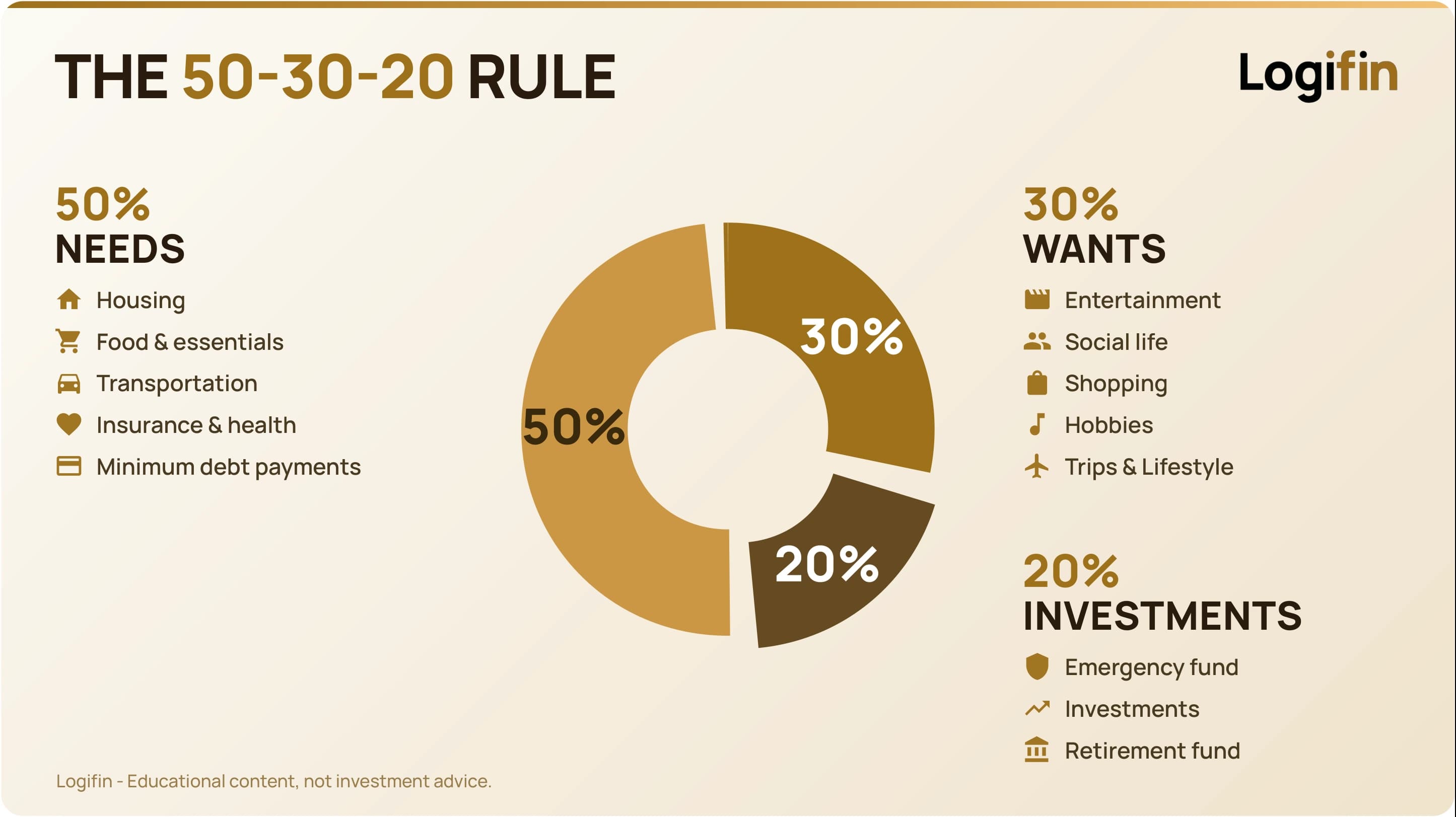
The 50-30-20 strategy (50-30-20 rule) is a budgeting rule that splits your net monthly income into three categories: 50% for needs, 30% for wants and 20% for savings and investments.
It is one of the most well known and easiest budgeting rules in the world.
It was created to simplify the management of personal finances and to give a clear framework to anyone who wants to organise their expenses without complex accounting tools.
In more detail:
- 50% for needs such as rent or a mortgage instalment, bills, groceries, transport and basic living costs.
- 30% for wants such as entertainment, travel, going out and purchases that improve quality of life but are not strictly necessary.
- 20% for savings and investments
The rule was proposed and became widely known through the book All Your Worth: The Ultimate Lifetime Money Plan by Elizabeth Warren and her daughter, Amelia Warren Tyagi, before she even took on a political role.
Since then it has been adopted by millions of people internationally, precisely because it is realistic and human.
🔶 Why is it so popular?
- It is simple and easy to apply. You do not need to categorise every euro. You only need to keep the proportions.
- It does not require complex spreadsheets or apps. It can be applied with a sheet of paper, an Excel file or even in your head.
- It creates a balance between the present and the future. It does not push you to deprive yourself today, but it also does not leave your future to chance.
In short, the 50-30-20 is neither perfect nor absolute.
But it is an excellent first rule for anyone who wants to bring order to their finances without stress and without losing control of their daily life.
What does the 50% include: Essential needs
The first and largest part of the 50-30-20 strategy concerns needs.
These are the expenses that are absolutely necessary to maintain a decent standard of living.
50% of your net income should cover these expenses.
🔶 Housing
Housing is almost always the largest category among the essential needs of a budget.
It includes all the costs related to your accommodation and the basic running of the home.
A general rule is that, if housing exceeds 30-35% of net income, it becomes very difficult for the other categories to stay in balance. In that case both wants and savings or investments are squeezed, creating constant financial strain.
This category usually includes:
- Rent or a mortgage instalment. The main and heaviest expense, which ties up a large part of monthly income.
- Utility bills. Electricity, water, heating, internet and other fixed costs that are necessary for running the home.
Managing housing well does not necessarily mean living on the bare minimum.
It means choosing a level of housing that fits your income, so that it leaves room for savings, investments and quality of life.
🔶 Groceries and essentials
The Groceries and essentials category concerns the daily purchases that are necessary for living and cannot be avoided.
It is part of the needs in the 50-30-20 rule and differs substantially from purchases related to comfort or lifestyle.
This includes everything you need to keep your household running smoothly, without excess and without elements of luxury.
Specifically, this category includes:
- Supermarket: Food, basic necessities, cleaning products and basic consumables for the home.
- Pharmacy: Basic pharmaceutical products, vitamins, hygiene items and first aid.
- Basic supplies: Anything that is necessary for daily life but is not related to consumption for pleasure or a social outing.
The fine line here is the distinction between a need and a choice. Food from the supermarket belongs to the essentials, while frequent delivery or a gourmet product usually moves into the wants category.
The better you control this category, the easier it becomes to keep your budget balanced without depriving yourself of the essentials.
It is one of the most important areas where small changes can have a large monthly impact.
🔶 Transport
Transport is considered an essential need when it concerns how you get to work or cover essential daily obligations.
It is part of the needs because without it daily life cannot function.
However, there is an important distinction here: If you keep a second car, a luxury vehicle or choose options that significantly increase the cost without being necessary, then this extra cost does not belong to needs but to wants. The category stays the same, but the assessment changes.
The basic monthly transport costs include:
- Fuel: The cost required for necessary journeys and not for optional trips or leisure travel.
- Car insurance and maintenance: Compulsory insurance, servicing, technical inspection and basic repairs that ensure functionality and safety.
- Public transport costs: Cards, tickets or passes used for daily commuting.
The right approach to transport is not to cut it to zero, but to keep it at a functional level.
The more efficiently this category is organised, the more room is created in the budget for savings, investments and choices that genuinely improve your quality of life.
🔶 Insurance and health
Health is the most fundamental need in any budget. Even so, it is one of the categories that are often underestimated or dealt with piecemeal, until something unexpected comes up.
In reality, anything that concerns basic medical coverage should clearly be part of needs, even if it does not appear every month as an expense.
Planning for this category properly concerns not only your health but also your financial security. An unplanned medical cost can easily destabilise an entire budget if you are not prepared.
The Insurance and health category usually includes:
- Private health insurance: Supplementary or basic coverage that reduces the financial risk in the event of illness or accident.
- Pension funds and insurance contributions: Compulsory or voluntary contributions that secure future coverage and stability.
- Medicines and medical expenses: Doctor visits, tests, medication and basic health costs.
The logic here is simple:
Health is not a luxury. It is investment and protection at the same time.
When this category is planned for properly, stress decreases, the resilience of the budget increases and panic decisions in difficult moments are avoided.
🔶 Minimum loan payments
Loans and credit cards are obligations that must be serviced regardless of your other priorities.
That is why minimum payments clearly belong to the needs category. They are not a choice, they are a commitment.
Failing to service them on time can lead to:
- surcharges and extra interest
- a deteriorating credit profile
- fewer future financing options
This category includes:
- Minimum loan instalments: Mortgages, consumer loans or other forms of borrowing that require a monthly payment.
- Minimum credit card payments: The minimum amount required to keep the account in good standing and to avoid penalties.
An important distinction:
- Anything extra you pay in order to reduce the debt faster is not a need but a strategic choice.
- These extra payments can be recorded in the 20% savings/investments category, since they essentially work like an investment with a guaranteed return through saved interest
🔶 Why the limit matters
If needs exceed 50% of income, then they eat into the room left for investments and savings.
The 50-30-20 strategy works like an alarm bell for balance: it warns you that something is wrong if the largest part of your income is consumed by needs.
What does the 30% include: Wants
The second category of the 50-30-20 rule concerns wants, that is all the things that are not necessary for survival but make life more comfortable and pleasant.
The 30% of income can be directed here, as long as it does not get out of hand and does not eat into savings.
🔶 Entertainment and social life
Entertainment is a key part of a balanced life. It gives us joy, rest and social connection.
Even so, it does not belong to the needs but to the wants category in the 50-30-20 rule.
This category includes:
- Outings to restaurants, cafes or bars: Social activities that improve quality of life but can be reduced or adjusted.
- Cinema, concerts and theatre: Cultural experiences that add value to daily life without being necessary for survival.
- Travel and short getaways: Important for mental wellbeing, but they need planning so that they do not disrupt the overall budget.
The point here is not deprivation. It is conscious choice.
When entertainment has a specific space in the budget, it is enjoyed without guilt and without financial stress.
🔶 Technology and lifestyle
Technology purchases and lifestyle subscriptions make life more comfortable and more fun, but they are not vital. That is why they clearly belong to the wants category.
This usually includes:
- New gadgets: Phones, tablets, laptops or accessories that upgrade the user experience but are not always necessary.
- Streaming subscriptions and digital services: Netflix, Spotify, Disney+ and similar platforms that offer entertainment at a small monthly cost.
- Lifestyle upgrades: Such as switching to a more expensive or luxury car without a real need.
Tip: Subscriptions are sneaky. They do not look expensive on their own, but they steadily eat a piece of the budget every month. Check regularly which ones you actually use and which you simply forgot you are paying for.
When you control this category, you free up room for savings, investments or experiences that have greater value for you.
Balance here is not a restriction. It is a choice.
🔶 Shopping and personal care
Shopping beyond the absolute basics and personal care fall into the wants category, since they relate more to comfort, image and lifestyle than to functional needs.
This category includes:
- Clothes and accessories beyond the essentials: Purchases that improve style and confidence but are not necessary for daily living.
- Personal care: Hairdressers, cosmetics, treatments and wellness products that offer comfort and a better feeling, without being a basic obligation.
- Gym or personal training: Although for some it may be considered a need for health or medical reasons, in the general budgeting rule it is classified as a want, especially when lower cost alternatives exist.
Managing this category well does not mean limiting how you care for yourself.
It means conscious choices that do not undermine your long term financial goals.
🔶 Experiences and travel
Travel and experiences are not necessary for survival, but they are often among the most valuable parts of life.
They clearly belong to wants, yet they carry particular weight because they are linked to personal growth and memories.
This category includes:
- Trips abroad: Experiences that broaden horizons but require proper planning so that they do not disrupt the budget.
- Holidays and weekend getaways: Small escapes that offer rest and recharging.
- Special experiences: Activities that are not necessary but enrich life and create unique moments.
Balance here is the key: live your life today without sacrificing the stability of tomorrow
When experiences have a planned space in the budget, they are enjoyed more and without guilt
🔶 The importance of balance
Wants are not bad. On the contrary, they make financial discipline more sustainable and help you not feel deprived.
But if they exceed 30%, they start to reduce the amount left for savings and investments.
What does the 20% include: Savings and investments
The last, but perhaps most important, part of the 50-30-20 rule is the 20% of your income.
This is where the decisions are made that determine your financial security in the present and your financial freedom in the future.
This is not money for consumption; it is money that works for you.
🔶 Saving for security
The first priority of any investment plan is not stocks or ETFs, but building a safety net that protects you from the unexpected.
Without it, even the best investment strategy can collapse in the face of a crisis.
- Emergency fund: Your first money should cover at least 3-6 months of basic expenses. This ensures that, if you lose your job or a serious emergency arises, you have the time and calm to react.
- Short term goals: Beyond the emergency fund, it is good to save for specific goals such as a deposit for a home, buying a car or studies. These amounts should not be exposed to investment risk.
Example: If your monthly expenses are 1,000 €, then an emergency fund of about 6,000 € gives you the peace of mind that you can withstand a crisis without having to borrow or sell investments at the wrong time.
🔶 Investing for growth
Once you have secured your emergency fund, the rest of the money can and should be directed to investments that build wealth over the long term.
That is where compound interest really starts to work and your financial future is built.
- ETFs and stocks: The most common choice for growth. ETFs give you instant diversification at low cost, while stocks offer potentially high returns, although with greater volatility.
- Bonds: They add stability and reduce overall risk. Even if stocks go through periods of decline, bonds act as a counterweight.
- Pension plans: They provide additional security for the future and often come with tax incentives that strengthen their returns.
🔶 High interest debt
Before you start investing seriously, you need to deal with high interest debt.
Paying it off is essentially one of the safest investments you can make.
With every euro you repay, you secure a return equal to the interest you no longer pay.
- Credit cards: They are among the most expensive forms of borrowing, a multiple of the average rate on consumer loans in the euro area (~7.5%, ECB 2026), while they often reach or exceed 15%.
- Consumer loans: They may look smaller, but their interest rates often eat a large part of your income.
Example: If your card has an interest rate of 18%, paying it off is like earning an 18% return with no risk. No investment can guarantee you such a return with such certainty.
The advantages of the 50-30-20 rule
The 50-30-20 strategy has become so popular because it combines simplicity with effectiveness.
It does not require complex budgets; you only need to remember three numbers. Below are its main advantages:
🔶 Simplicity and clarity
The rule is easy to remember and to apply. It does not require complex spreadsheets or specialised apps.
- You split your net income into three categories: 50% needs, 30% wants, 20% savings/investments.
- The categorisation is clear and applies to any income, small or large.
Example: From a net income of 1,500 € you direct 750 € to needs, 450 € to wants and 300 € to savings/investments. A split you can remember at a glance.
🔶 Balance between present and future
The strategy creates a balance between daily life and your financial security.
- It gives room for basic expenses.
- It sets aside a budget so you can enjoy life without guilt.
- It ensures that you invest for your future.
Its great advantage is that it stops you from feeling guilty when you spend for pleasure: you know that the savings part has already been covered.
🔶 It builds habit and discipline
It turns saving and investing into a steady routine.
- Every month you know exactly what amount goes to investments.
- Over time, consistency builds financial stability and grows your wealth through compound interest.
Consistency is more important than the size of the amount. Even 100 € a month, if it becomes a habit, can make a huge difference over decades.
🔶 Flexibility in application
Although the rule is simple, it is not rigid. It can be adapted to your stage of life and your needs.
For example:
- 60-20-20: for those with higher fixed expenses.
- 50-25-25: for those who want to give more weight to investments.
- 40-30-30: for higher incomes where needs take up a smaller share.
This flexibility makes it a timeless rule that can stay with you from your first income all the way to retirement.
The disadvantages of the 50-30-20 rule
Despite its benefits, the 50-30-20 strategy is not perfect and has limits that you need to know.
The rule is a simple guide, not a recipe that applies with the same success in every case.
🔶 It does not always fit every income
- In areas with a high cost of living, the needs category can get out of hand very easily.
- In large cities, rent alone can exceed 40-50% of income.
- This upsets the balance and leaves very little room for savings or investments.
🔶 It is a general rule, not personalisation
- The strategy works as a general direction, but it does not automatically adapt to individual goals.
- If you are aiming for early financial independence (FIRE), the 20% savings may not be enough.
- In such cases, you need to aim for savings rates of 30-40% or even more.
🔶 It may leave too much room for wants
- The 30% for wants can be large if you have more ambitious investment goals.
- If you want to build wealth faster, it may be wiser to limit wants to 20% and increase the investment share to 30%.
- This, however, requires greater discipline and changes in lifestyle.
Conclusion and practical takeaways
The 50-30-20 strategy is one of the most practical and proven budgeting tools.
It gives you a clear picture of how to allocate your income, without getting tangled in complex details.
- The 50% helps you cover your needs with confidence.
- The 30% lets you enjoy life without guilt.
- The 20% builds your financial future and brings you closer to financial independence.
Theory is useful, but the real value of the strategy becomes clear only when you put it into practice. Adopting it does not require complicated methods. It requires consistency, self-awareness and small, steady steps.
Practical steps to apply it
1. Calculate your net income
- Work with the real money that comes into your account each month.
- Not with the gross amounts shown on the contract or the tax statement, but with what actually lands in your account each month.
- This means after taxes, insurance contributions and any compulsory deductions
2. Split it into three buckets
- 50% → Needs
- 30% → Wants
- 20% → Savings and Investments
3. Use automation
- Set up a standing order so that the 20% is transferred straight to a savings account or an investment platform.
- This way you protect your future before you are even tempted to spend.
4. Review periodically
- Conditions change: a new salary, different expenses, new goals.
- Readjust the rule if needed (for example 60-20-20 or 40-30-30), but always keep the spirit of balance.

The content of this article is provided exclusively for informational and educational purposes and does not constitute investment advice or a recommendation to buy or sell financial products. The information is based on publicly available sources considered reliable, without any guarantee of accuracy or completeness. Before making any financial or investment decision, it is recommended that you consult a certified professional advisor or accountant, taking into account your own financial situation and risk profile. The Logifin team bears no responsibility for any direct or indirect damages arising from the application of the information presented.
Related articles

How to create a budget that works in practice
A practical guide to taking control of your finances, step by step and without guilt.
12 min read

How much you should save and invest each month
What the data says, what the well-known rules suggest and how to find the number that fits your own life.
11 min read

Minimalism and investing: Can they coexist?
How the idea of less but better organises your spending and leads to a simple portfolio you can hold for years without second guessing it.
14 min read

What is a recession and how it affects investors?
How a recession is defined, what causes one, how the markets usually behave during it and what an investor can do to prepare in advance.
24 min read
EXPLORE LOGIFIN
Everything you need in order to learn, plan and track your investments.
Logifin Blog
Learn everything you need to get your finances in order and invest with confidence.
Logifin Insights
What moves the markets and what it means for a long term investor. Short and without the noise.
Logifin Tools
Free, inside the site, no signup. Everything you calculate stays on your device.
Logifin ETF Hub
Find the ETF that fits you: 550+ UCITS ETFs, smart filters and in-depth comparisons.
Logifin Guides
A series of guides that builds your investment plan step by step. The first guide is free for everyone.
Logifin Circle
The tools and the Hub are free for everyone. You become a member for the intelligence that never stops.