How to create a budget that works in practice
A practical guide to taking control of your finances, step by step and without guilt.
3 August 2025 · 12 min read

What creating a budget means (and why most people give up)
A budget is the process by which you decide where your money will go before it leaves your account, instead of discovering at the end of the month where it went.
It is the most fundamental tool of personal finance, because every next step, from the emergency fund to investing, is built on top of it.
The difference between the two scenarios is substantial. Without a budget, you play a passive role: expenses happen and you simply react to whatever is left. With a budget, you take an active role: you set the priorities yourself and the money follows your plan, not the other way around.
If it is that simple, why do most people give up? Almost always for one of the three reasons below:
- They expect perfection from day one: a single forgotten expense is enough to make them feel they have failed and quit.
- They build an overly strict plan: a budget that leaves no room for any enjoyment is a crash diet that does not last.
- They ignore the need for flexibility: life brings surprises, while a rigid plan breaks at the first one.

It is also worth clarifying what a budget is NOT. Budgeting does not mean counting every cent with guilt, nor is it an exercise you do once and put in a drawer. It is a living system: you set it up once, you adjust it a little every month and gradually it runs almost on its own.
Keep the basic conclusion in mind from now: an effective budget is not the one that looks ideal on paper, but the one that is realistic and adaptable to your own life.
Track where your money really goes
The first step is not to cut expenses. It is to see where your money really goes, because almost nobody knows this precisely.
Tracking creates awareness, while the first shock you feel when you see the real numbers is perhaps the most useful tool of the whole process.
Example: on a 1,300 € salary, you estimate that you spend about 200 € per month on wants. You track for one month and the real number comes out at 280 €: coffee and snacks 90 €, delivery 60 €, subscriptions 35 €, clothes 45 €, small miscellaneous 50 €. The 80 € difference per month means almost 1,000 € per year that vanish without you noticing.
As you track, separate expenses into two big groups.
- Fixed expenses repeat every month at roughly the same amount: rent or mortgage payment, bills, subscriptions, transport.
- Variable expenses change depending on your choices: groceries, outings, purchases, gifts.
The distinction matters, because your room for manoeuvre lies almost entirely in the variable ones, while fixed costs change only with bigger decisions, such as moving house or switching provider.
⚠️ Notice something important though: the tracking shock does not automatically mean cutting everything. Out of the 280 € in the example, you may decide that coffee with your friends is worth every euro, while the 60 € of delivery can drop by half without you even feeling it.
Tracking does not tell you what to cut. It gives you the data so that you decide what deserves your money and what does not.
For the tracking itself you do not need anything complicated.
A notebook does the job if you like paper, a spreadsheet if you want a bit more order, or an app if you prefer it to happen almost automatically.
Electronic payments make it much easier, since your bank statement has already done half the work; only cash needs a note of your own. Thirty days of consistent tracking are enough to get a clear picture.
Zero-based budgeting or 50/30/20? Which method suits you?
Once you have a picture of your expenses, you need a method to organise them. The two most popular ones are zero-based budgeting and the 50/30/20 rule.
Zero-based budgeting: every euro has a mission
In zero-based budgeting you allocate all of your income to categories until the remainder is zero: Income minus Expenses equals 0.
It does not mean you spend everything, since saving is also an expense with its own line.

Example: on a net income of 1,500 €, one allocation can be housing 600 €, food 250 €, bills 100 €, transport 100 €, entertainment 150 € and savings 300 €. Total 1,500 €, remainder zero. It suits those who have clear goals and want maximum control over every euro.
The 50/30/20 rule: simplicity above all
The 50/30/20 rule, made widely known by Elizabeth Warren, splits net income into just three buckets: 50% needs (housing, bills, food, transport), 30% wants (outings, travel, subscriptions) and 20% future (savings, investments, debt repayment).
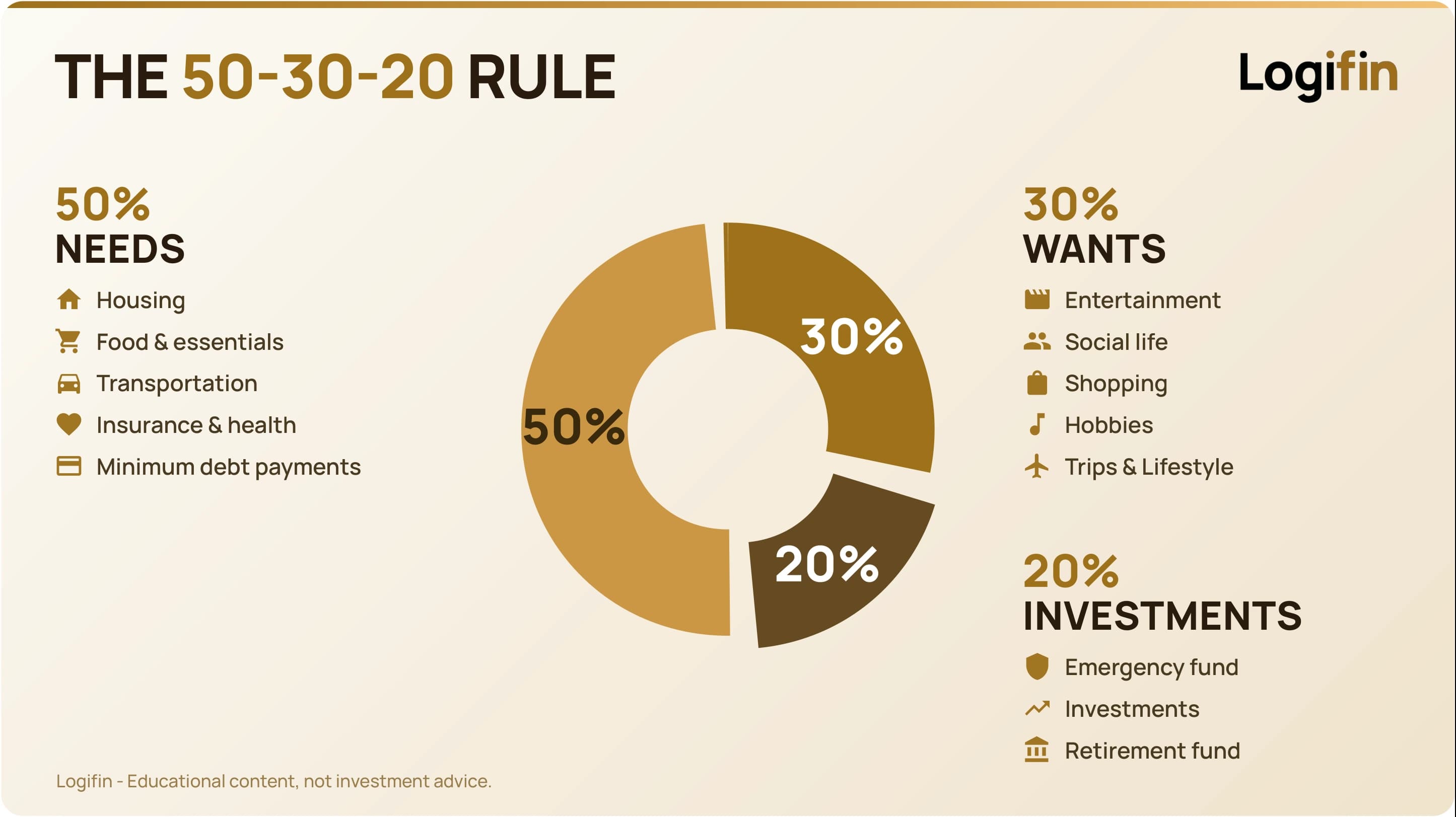
Example: on the same 1,500 € income, the rule gives 750 € for needs, 450 € for wants and 300 € for your future. You do not need to track dozens of categories, only three totals. Ideal for beginners who want structure without accounting.
Which one to choose?
- If you are starting now, 50/30/20 gives you a quick sense of control with minimal effort.
- When tracking becomes a habit and you want more precision, you can move to zero-based.
- The two methods are not rivals, but stages of the same journey.
It is worth knowing that other variations exist as well.
- In pay yourself first, savings leave first of all through an automatic transfer and you live on what remains.
- In the envelope method, each category has its own wallet with a predefined amount; once it is empty, the category waits for next month.
- All methods arrive at the same principle: your income gets a plan before it starts being spent.

Psychology and money: Why you feel pressure before the end of the month
A budget looks like an arithmetic exercise, but in practice it is mostly a psychology exercise.
Money is tied to emotions such as security, freedom and self-esteem, while each of us carries subconscious beliefs about it, often shaped in childhood: “money is there to be enjoyed”, “it is never enough”, “saving is a duty”.
These scripts are not innocent, because they shape behaviour. Someone who grew up with financial scarcity may save excessively and feel guilty even about necessary expenses. Someone else spends to feel freedom or success, even when their income does not allow it.
Neither pattern is fixed by a spreadsheet if you do not first recognise it.
Before you change the numbers, it is worth observing your own patterns.
When do you spend more? Many people consume as a reaction to stress or as a small reward after a hard week.
A second useful test: describe your relationship with money in one word. If the word that comes to you is stress or fear, a budget will help you more than you imagine.
💡 Think also of the familiar monthly cycle: in the first days after payday there is comfort and ease, in the middle comes the first squeeze and in the final days you count how far away the next salary is.
A budget breaks exactly this cycle, because it spreads awareness across the whole month instead of piling it up, together with the stress, at its end.
👉 The goal is not to feel guilty about every coffee or drink.
A budget exists so that you consciously choose what deserves funding in your life, so that you can enjoy your spending without the weight of uncertainty.
The biggest personal budgeting traps
Four traps appear again and again for those who are starting out. If you know them in advance, you get past them easily:
- Perfectionism: a plan with 25 categories and accounting precision collapses within two weeks. Start with 4-5 categories (housing, food, transport, wants, savings) and refine later, only if you need to.
- Ignoring small expenses: the 2 € coffee and the 9.90 € subscription look insignificant, but cumulatively they erode the plan. Track them for 30 days. If a category of small items exceeds 10% of your income, give it its own line in the budget.
- Zero flexibility: if every deviation counts as failure, frustration will make you quit. Add an Unexpected category with 5-10% of your income and give your plan room to breathe.
- Quitting after one bad month: a month off-plan does not cancel the system, just as one bad meal does not cancel your diet. Keep what the deviations taught you and start the next month normally.

The common denominator in all four traps: the budget that survives is the one designed for a human, not for a robot.
Paper, Excel or an app? What actually helps?
The tool matters less than we think, but it is worth knowing the pros and cons of each option.
- Pen and paper offers simplicity and puts you in direct contact with the numbers, but makes month-to-month comparison difficult.
- A spreadsheet (Excel or Google Sheets) is for many people the sweet spot: flexibility, charts and a view of trends, while with a ready-made template the setup becomes a matter of minutes.
- Apps automate most of the work. Popular examples in Europe are Wallet by BudgetBakers, Spendee and YNAB for those who want strict zero-based budgeting, while digital banks such as Revolut and N26 now have built-in tools with categories, limits and alerts.
💡 The Logifin Personal Budget Tracker is exactly such a ready-made template: built on the category logic we describe here, so that you can start today without setting anything up from scratch.

Whatever you choose, pair it with a small steady routine: 10 minutes a week, for example every Sunday evening, to go through the expenses and see where you stand against the plan. This small weekly appointment with your finances makes a bigger difference than any feature of an app or template.
Whichever tool you choose, there is one rule: the best tool is the one you will use consistently. A notebook updated every day beats the most impressive app you opened once.
Connect your budget to specific goals
A budget without a goal ends up feeling like deprivation: you cut things without knowing why.
With a goal, the same process turns into measurable progress. Every month that closes brings you measurably closer to something you really want.
For a goal to work, it needs three characteristics:
- it must be specific (not putting something aside, but an amount),
- measurable (you can see the progress every month) and
- it must have a date (a when that makes it real).
Example: see how four common goals translate into monthly numbers:
- A 1,000 € emergency fund in 5 months: you set aside 200 € per month and build your first safety net.
- Investing 150 € per month with a DCA strategy: the future part of your budget takes concrete shape.
- Repaying 3,000 € of debt in 12 months: 250 € per month and you watch the balance shrink steadily.
- A 1,500 € trip in one year: 125 € per month in a separate envelope, so that the trip does not end up on a card.

In practice, give each goal its own line in the budget, set up an automatic transfer at the start of the month before you get the chance to spend the money, track the progress and reassess your goals every quarter.
Automation is your quietest ally: whatever leaves on its own requires no discipline.
Conclusion and practical takeaways
A budget is not a punishment, nor an accounting exercise. It is the way for you to decide where your money goes, so that you fund the things that hold real value in your life.
The biggest obstacle is not the numbers, but the expectation of perfection. Your first budget only needs to get started, even roughly, because it will improve with every month you use it.
🔑 What to keep in mind:
- A budget is a decision made in advance: you decide where the money goes before it leaves, instead of doing a post-mortem after it is gone.
- Thirty days of tracking is the most revealing step: the distance between what you think you spend and what you actually spend often hides hundreds of euros per year.
- The 50/30/20 rule is the best starting point: three buckets, zero accounting. Zero-based budgeting comes later, when you want maximum control.
- Flexibility keeps the plan alive: an unexpected category of 5-10% and a quarterly reassessment make the difference between a plan that lasts years and one that collapses in a month.
Practical Tips — your first budget in 4 steps:
-
Choose a tool today.
Notebook, spreadsheet or app, it does not matter which. What matters is opening it today, not starting on Monday.
-
Start with 4 basic categories.
Housing and fixed costs, everyday expenses, wants, saving and investing. Anything more is added only when you need it.
-
Apply the 50/30/20 rule to your net income.
Split the income into the three buckets and compare with your real numbers. Where the deviation is large, that is where your first room for improvement lies.
-
Set a small, measurable goal.
A 50 € surplus at the end of the month or 30 days of continuous tracking is enough. The first small win builds the habit, while the habit builds everything else.

The content of this article is provided exclusively for informational and educational purposes and does not constitute investment advice or a recommendation to buy or sell financial products. The information is based on publicly available sources considered reliable, without any guarantee of accuracy or completeness. Before making any financial or investment decision, it is recommended that you consult a certified professional advisor or accountant, taking into account your own financial situation and risk profile. The Logifin team bears no responsibility for any direct or indirect damages arising from the application of the information presented.
Related articles

What is the 50-30-20 rule and how can you apply it?
The simple rule that helps organise your finances and build financial stability
16 min read

How much you should save and invest each month
What the data says, what the well-known rules suggest and how to find the number that fits your own life.
11 min read

Minimalism and investing: Can they coexist?
How the idea of less but better organises your spending and leads to a simple portfolio you can hold for years without second guessing it.
14 min read

What is a recession and how it affects investors?
How a recession is defined, what causes one, how the markets usually behave during it and what an investor can do to prepare in advance.
24 min read
EXPLORE LOGIFIN
Everything you need in order to learn, plan and track your investments.
Logifin Blog
Learn everything you need to get your finances in order and invest with confidence.
Logifin Insights
What moves the markets and what it means for a long term investor. Short and without the noise.
Logifin Tools
Free, inside the site, no signup. Everything you calculate stays on your device.
Logifin ETF Hub
Find the ETF that fits you: 550+ UCITS ETFs, smart filters and in-depth comparisons.
Logifin Guides
A series of guides that builds your investment plan step by step. The first guide is free for everyone.
Logifin Circle
The tools and the Hub are free for everyone. You become a member for the intelligence that never stops.