FIRE: The road to financial independence
What the FIRE movement is, how to calculate your own number and what you can keep from its philosophy, even if you are not aiming to exit at 40.
22 July 2025 · 12 min read

What the FIRE movement is and why it is gaining ground
FIRE (Financial Independence, Retire Early) is a personal finance philosophy with a simple core: you build an investment capital large enough for its returns to cover your expenses, so that work becomes a choice rather than a necessity, long before the conventional retirement age.
Financial independence does not necessarily mean never working again. It means being able to choose.
The movement’s roots go back to the book Your Money or Your Life by Vicki Robin (1992), while its big spread came in the 2010s through blogs and communities such as Mr. Money Mustache. From the United States, the idea expanded worldwide, with active communities today from Germany and the Netherlands to Japan and India.
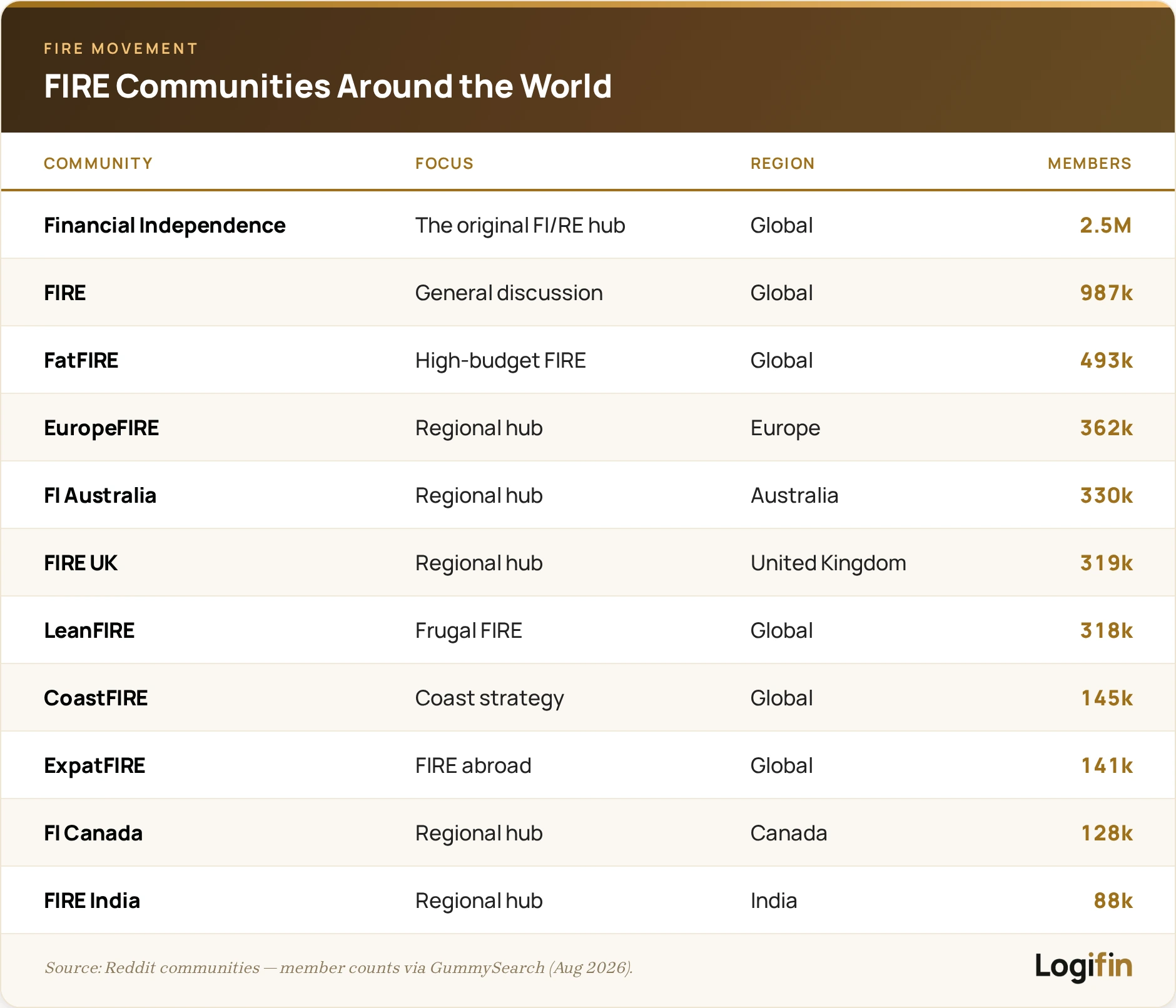
Why is it gaining ground? Because at its centre lies not money, but time.
FIRE treats time as the most valuable asset and money as the tool that buys it back.
Every euro invested is, in this logic, a piece of future freedom purchased today.
In this guide we will look at the numbers behind the idea, its variants, the myths that surround it and, above all, what you can keep from it even if you do not plan to retire at 40.
The basic numbers: the rule of 25 and the 4% rule
How much capital does financial independence require? FIRE answers with two connected rules of thumb.
The rule of 25 says you need roughly 25 times your annual cost of living in invested capital.
The 4% rule is the other side of the same coin: from that capital you withdraw about 4% each year for your expenses.
Example: if you live on 24,000 € per year, that is 2,000 € per month, the rule of 25 gives a target of 600,000 €. Four percent of 600,000 € is exactly the 24,000 € you need annually. If your cost of living is 18,000 € per year, the target drops to 450,000 €.
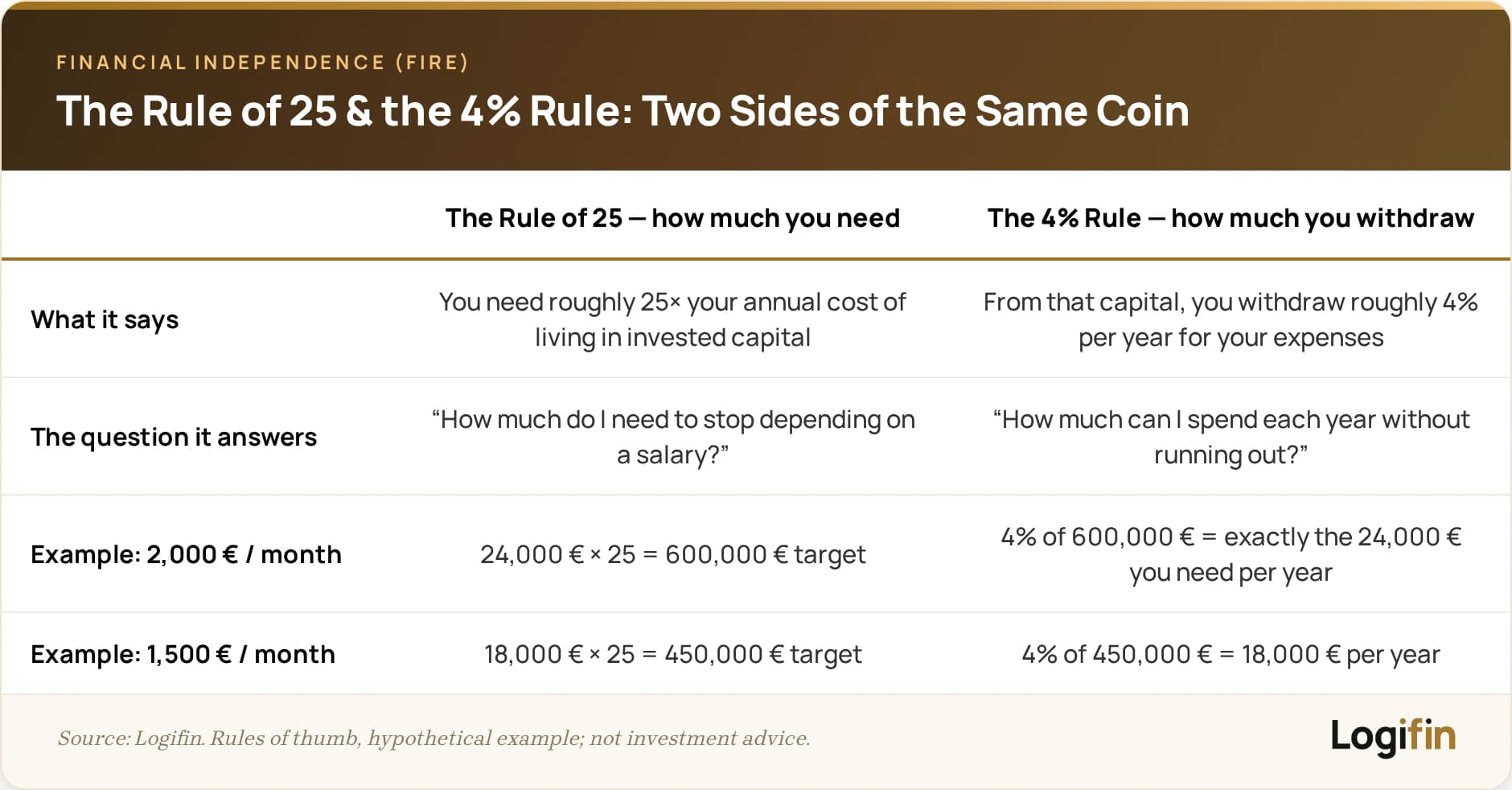
The size of your number depends more on your expenses than on your income, which is why FIRE insists so much on conscious spending.
Where does the 4% come from? From the so-called Trinity study (Trinity University, 1998), which examined historical US market data and found that, for portfolios with a significant share of stocks, an annual withdrawal of 4% had success rates above 95% over 30-year periods.
With long-term returns higher than the withdrawal rate, the capital historically not only endured but often kept growing.
🔶 Two honest caveats before we continue:
- First, the study is based on historical US data; the past does not guarantee the future and European conditions (taxation, healthcare costs, inflation) differ.
- Second, the 4% was designed for a 30-year horizon; those aiming for a very early exit, with a 40 or 50-year horizon, often work with more conservative rates, such as 3.5% or even lower.
Use the rules as a compass, not as a contract.
The FIRE variants: Lean, Fat, Coast and Barista
FIRE is not a monolithic plan. Over the years, variants have developed that cover very different profiles and levels of ambition:
▸ Lean FIRE: the fast and frugal version
In Lean FIRE you aim for independence on a low cost of living, usually well below your country’s average. Because your number is calculated on small annual expenses, the capital target is smaller and is reached earlier.
- Target example: with a cost of living of 15,000 € per year, the rule of 25 gives a target of 375,000 €.
- The gain: the shortest route to the exit, with the smallest capital requirement.
- The trade-off: a frugal lifestyle and small margins for surprises, since the budget carries no fat.
Ideal for: those who already live frugally by choice and value freedom more than comfort.
▸ Fat FIRE: the comfortable version
Fat FIRE sits at the other end: independence without any compromise in living standards, with comfortable travel, spacious housing and a large safety cushion.
- Target example: with a desired cost of living of 48,000 € per year, the target rises to 1,200,000 €.
- The gain: comfort, flexibility and room for more conservative withdrawal rates.
- The trade-off: it requires a high income during the accumulation phase and usually more years of work.
Ideal for: high earners who want freedom without any change to their lifestyle.
▸ Coast FIRE: the autopilot
In Coast FIRE you have already invested enough so that, without a single euro of new contributions, compounding alone will carry you to the target by the conventional retirement age.
- How it works: you keep working, but only for your current expenses; your retirement now builds itself.
- The gain: the pressure of saving disappears decades before full independence.
- The trade-off: the full exit arrives at the conventional age, not earlier.
Ideal for: those who started early and want a lighter daily life already in their 40s or 50s.
▸ Barista FIRE: the hybrid version
In Barista FIRE you combine part-time work with income from your investments, so the capital you need is noticeably smaller than for full FIRE.
- How it works: investments cover part of the cost of living and a few days of work per week cover the rest, together with insurance in countries where it is tied to employment.
- The gain: more free time years earlier, without needing the full number.
- The trade-off: a dependence on work remains, even if a much looser one.
Ideal for: those who want a gentler daily life soon and do not mind a flexible part-time job.
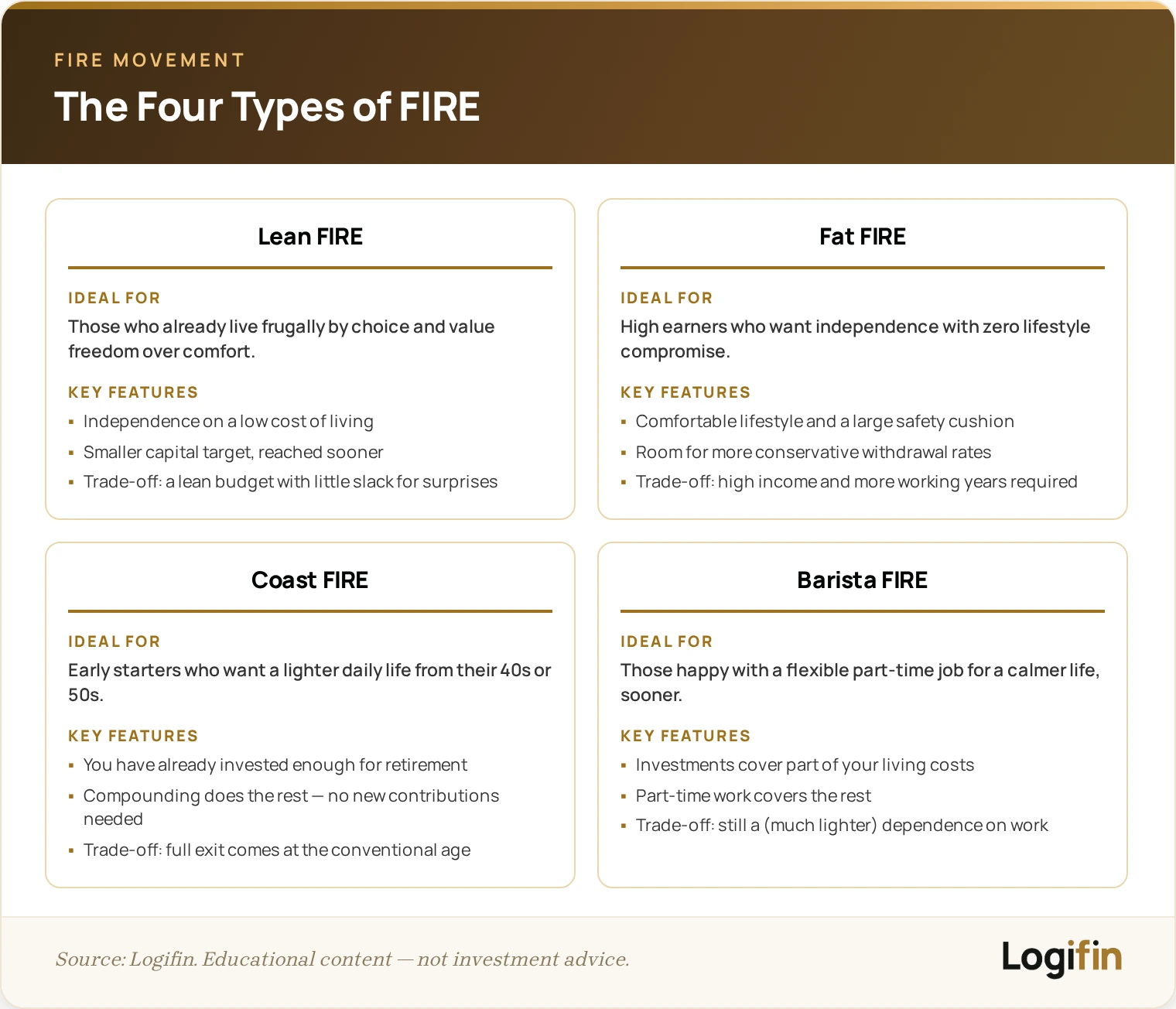
The most useful reading of this list is not to pick a camp, but that financial independence is a scale rather than a switch.
Between working because I must and not working at all there are many intermediate steps, each offering more freedom than the previous one.
What FIRE requires in practice (and who it suits)
The classic version of FIRE is demanding; it is more honest to say so plainly.
Its most dedicated followers save 40% or more of their net income, which presupposes either a high income or a very disciplined cost of living, usually both.
Contrary to the prevailing image, though, the movement does not consist only of high-earning tech workers; a large part of it is middle-income people making conscious choices.
In daily life, the strategy rests on three habits:
- postponing non-essential purchases,
- systematically investing the difference and, above all,
- avoiding lifestyle inflation, that is the tendency for expenses to rise automatically with every income increase. Whoever keeps their cost of living steady while their income grows turns every raise into fuel for their goal.
Is it feasible in Europe?
Conditions differ from country to country: salaries, investment taxation, healthcare costs and inflation significantly change the equation compared with the United States.
On the other hand, Europe offers advantages such as public healthcare systems and easy access to low-cost UCITS ETFs.
Some also make use of so-called geoarbitrage: building income and capital in a high-pay environment while living, or planning to live, somewhere with a lower cost of living.
💡 The most important point, however, is different: you do not need to adopt the whole package to benefit.
Even if 40% savings sounds unrealistic for your circumstances, the mechanisms of FIRE, from the rule of 25 to avoiding lifestyle inflation, work just as well at a moderate 15%.
Myths and misconceptions around FIRE
As the movement spreads, so do the misconceptions.
The four most common:
- You need a huge income. Income helps, but the decisive variable is the savings rate. Someone saving 30% of a modest income moves towards independence faster than someone saving 5% of a large one.
- It means a life of deprivation. FIRE does not ask for self-denial, it asks for awareness: spending fearlessly on what offers you real value and cutting mercilessly what does not. For many, this proves more liberating than the opposite.
- It is too late for me. The rules of FIRE have no age limit. Someone starting at 40 may not retire at 45, but can very well reach a Coast or Barista level at 55, with all the difference that makes to quality of life.
- It cannot be done with a family. Harder, not impossible. Thousands of families internationally follow versions of FIRE, usually more moderate ones, with the same mechanisms and more realistic timelines.
⚠️ The common core of all the myths is the idea that FIRE is all or nothing.
In practice, it is a set of tools that each person applies at the intensity that suits them.
If there is one thing worth keeping from this chapter, it is that the right question is not “can I do FIRE?”, but “which type of FIRE fits my own life?”.
The engine of FIRE: DCA and compounding
Behind every FIRE plan, the same combination of two mechanisms we have analysed in detail on the blog is at work: the DCA strategy, meaning a fixed amount invested every month regardless of the market’s mood, together with compounding, which turns time into return.
Example: you start with 1,000 € initial capital and invest 250 € per month for 25 years, with an indicative annual return of 8%. At the end of the journey, the portfolio reaches approximately 245,000 €. Of this, your own contributions are 76,000 €; the remaining 169,000 €, meaning more than two thirds of the total, is the work of the market and time.
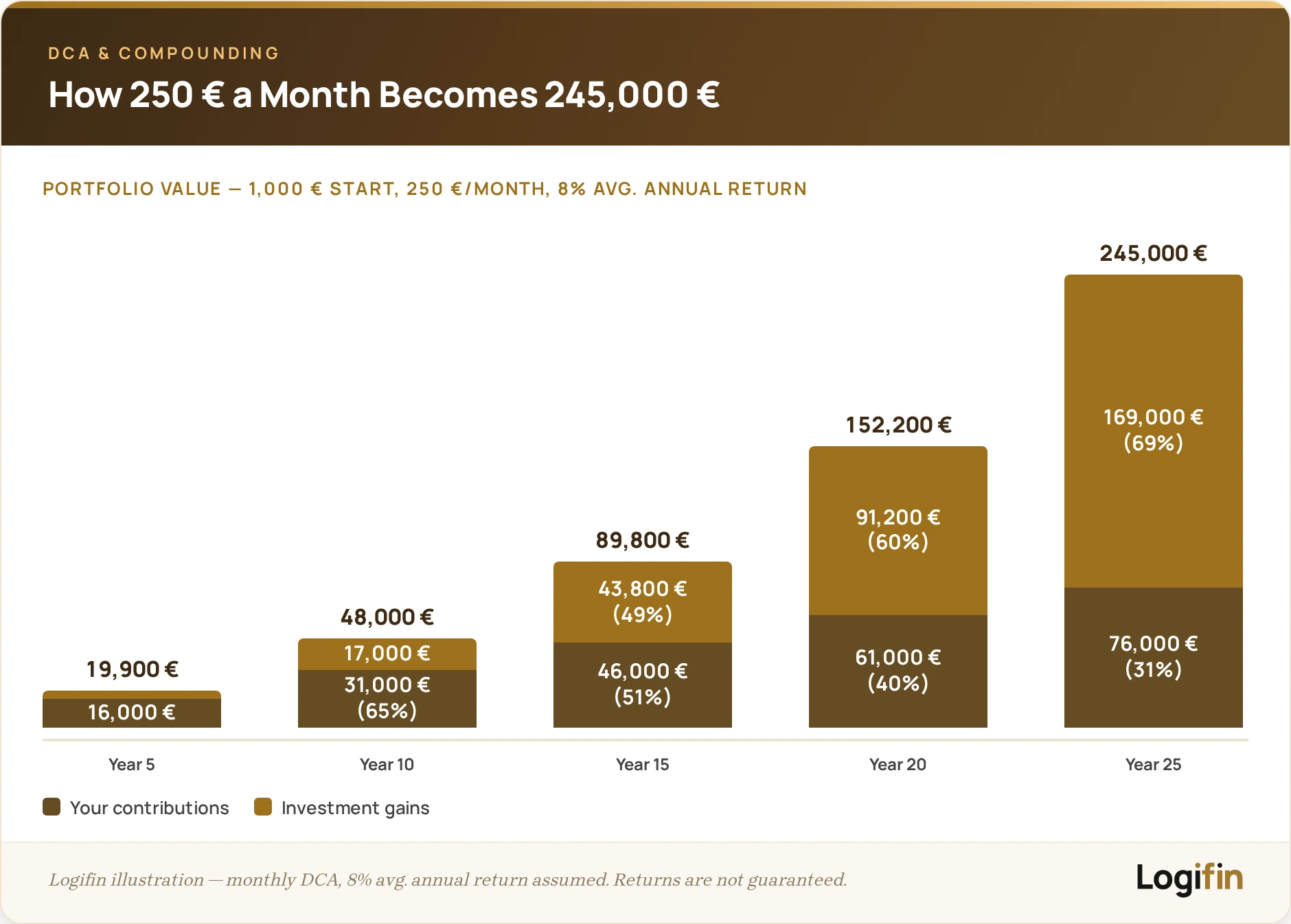
The vehicle that makes this combination work quietly is, for most European investors, broadly diversified low cost accumulating ETFs, which automatically reinvest dividends, as we explained in the article on Accumulating vs Distributing ETFs.
⚠️ One reminder that leaves no room for exception: the 8% is an indicative assumption based on long-term historical averages of major indices, not a promise.
The real journey will have years of gains and years of losses, while the only way to capture the long-term average is to stay invested through both.
How to start and how to measure your progress
The first step is not investment related, it is diagnostic: record your income and expenses for one month, as we described in the article on how to create a budget.
Without knowing your real cost of living, you cannot calculate either your “number” using the Rule of 25 or the percentage you can save.
Then, set a realistic savings target. Do not start with the 40% of the most hardcore cases; 15% to 20% is ambitious and sustainable at the same time, as we saw in the article on how much you should save and invest.
Set up the system with automatic transfers on payday, so that consistency does not depend on willpower every month.
From there, progress is measured through simple signs:
- you consistently save a meaningful percentage of your income,
- you follow an investment plan without abandoning it during market fluctuations,
- your net worth (assets minus debt) improves year after year and your spending decisions have become more conscious.
💡 If you recognise yourself in these sentences, you are already on the path, regardless of whether you use the word FIRE.
Conclusion and practical takeaways
FIRE, at its core, is not a number, nor an exit age.
It is a philosophy that reverses the usual order: instead of adapting your life to your expenses, you adapt your expenses to the life you want to build.
Even if early retirement does not interest you at all, its mechanisms, from the rule of 25 to a high savings rate, make any financial future safer. Freedom can be built; it does not need to be inherited.
🔑 What to keep in mind:
- Your number is 25 times your annual cost of living: with expenses of 24,000 € per year, the target is 600,000 €. Expenses determine the target more than income does.
- The 4% is a compass, not a contract: it rests on historical US data for a 30-year horizon. For a very early exit, more conservative assumptions are your friend.
- Independence is a scale, not a switch: Coast and Barista FIRE are valuable intermediate steps, achievable for far more people than the full package.
- The savings rate beats the size of the salary: it is the variable you control the most and the one that accelerates or brakes the whole journey.
Practical Tips — FIRE in practice in 4 steps:
-
Calculate your own number.
Annual cost of living times 25. This exercise alone changes how you see your expenses: every 100 € of permanent monthly spending adds 30,000 € to your target.
-
Raise your savings rate to your own limit.
Start from a sustainable 15-20% and escalate gradually. Every extra percentage point brings your independence measurably earlier.
-
Put the engine on automatic.
A standing order, a DCA strategy and diversified low-cost accumulating ETFs. The system must keep working even in the months when you have no appetite to deal with it.
-
Protect the journey from lifestyle inflation.
With every income increase, keep your cost of living steady and direct the difference to investments. It is the most painless way to accelerate without any sacrifice today.
The content of this article is provided exclusively for informational and educational purposes and does not constitute investment advice or a recommendation to buy or sell financial products. The information is based on publicly available sources considered reliable, without any guarantee of accuracy or completeness. Before making any financial or investment decision, it is recommended that you consult a certified professional advisor or accountant, taking into account your own financial situation and risk profile. The Logifin team bears no responsibility for any direct or indirect damages arising from the application of the information presented.
Related articles

How much you should save and invest each month
What the data says, what the well-known rules suggest and how to find the number that fits your own life.
11 min read

How to create a budget that works in practice
A practical guide to taking control of your finances, step by step and without guilt.
12 min read

Minimalism and investing: Can they coexist?
How the idea of less but better organises your spending and leads to a simple portfolio you can hold for years without second guessing it.
14 min read

What is a recession and how it affects investors?
How a recession is defined, what causes one, how the markets usually behave during it and what an investor can do to prepare in advance.
24 min read
EXPLORE LOGIFIN
Everything you need in order to learn, plan and track your investments.
Logifin Blog
Learn everything you need to get your finances in order and invest with confidence.
Logifin Insights
What moves the markets and what it means for a long term investor. Short and without the noise.
Logifin Tools
Free, inside the site, no signup. Everything you calculate stays on your device.
Logifin ETF Hub
Find the ETF that fits you: 550+ UCITS ETFs, smart filters and in-depth comparisons.
Logifin Guides
A series of guides that builds your investment plan step by step. The first guide is free for everyone.
Logifin Circle
The tools and the Hub are free for everyone. You become a member for the intelligence that never stops.