What is an ETF? The complete beginner's guide
Learn how ETFs work, why they have become so popular and how you can use them to invest with strategy.
2 August 2025 · 22 min read

What does ETF mean — The concept in simple terms
An ETF (Exchange-Traded Fund) is an investment product that gives you, in a single transaction, exposure to dozens or thousands of stocks and bonds simultaneously, trading on a stock exchange just like an ordinary share.
It is an investment instrument that provides easy and immediate exposure to entire markets or sectors without requiring you to purchase stocks one by one. Real-time trading gives you full execution flexibility and complete price transparency.
ETFs have become particularly popular because they offer broad diversification, low costs and simplicity: three characteristics that are especially valuable for newer investors building stable, resilient portfolios.
Example
- If you buy an ETF that tracks the S&P 500 you gain in a single move exposure to the 500 largest companies in the United States such as Apple, Microsoft, Amazon, Nvidia, Coca Cola and many more.
- It is like owning a small share of the entire American economy without having to pick the companies yourself.
- In this way an ETF makes investing simple, accessible and well suited for anyone who wants to start in an organised way without unnecessary decisions.
How an ETF works in practice
Every ETF has a very specific objective: to track the performance of an index or an investment strategy.
This means it attempts to replicate, as faithfully as possible, the trajectory of the underlying index or basket, whether that covers a geographic region (e.g. the US), a thematic sector (e.g. technology), or a composite investment rule.
The ETF manager purchases (either directly or through swaps) the securities included in the index or strategy the ETF follows.
For example, if the ETF tracks the Nasdaq 100, it will hold appropriately weighted positions in the top 100 US technology companies, such as Apple, Microsoft, Meta, Nvidia and others.

🔶 How does an ETF work?
There are two main ways an ETF can operate, depending on how it “replicates” the performance of the index it tracks.
Physical replication
- The ETF purchases the actual securities of the index.
- If the index consists of stocks, the ETF holds those stocks in the corresponding weighting.
- This approach is considered more transparent because investors know exactly which assets are held in the portfolio.
- It is also the most common approach in the European ETF market.
Synthetic replication
- The ETF does not purchase all index securities; instead, it uses derivatives (typically swap agreements) to achieve the same return.
- This method allows the ETF to track more complex or specialised indices with precision, without needing to buy every underlying asset.
- While synthetic replication can be more efficient in certain cases, it carries a small degree of counterparty risk, since it relies on agreements with third parties.
Understanding this distinction helps investors select products that align with their own philosophy, their desired level of transparency and their risk tolerance.

🔶 How is the ETF Price Determined?
- The price is determined by supply and demand and moves in real time throughout the trading day, exactly like a stock.
- This means you can buy or sell at any point during market hours, unlike traditional mutual funds which are priced once at the end of each day.
- You retain full control over both the timing and the price of your transaction.
🔶 Are ETFs safe?
UCITS ETFs (the dominant category in Europe) operate under a strict EU regulatory framework that sets specific rules on transparency, diversification and investor protection.
A critical principle is asset segregation: the securities held by the ETF are kept separately from the provider’s own assets, through an independent custodian. This means that even if the provider goes bankrupt, your portfolio does not vanish: the securities remain yours and can be transferred or liquidated.
Like any investment product, ETFs are not free from market risk. Their price moves up and down based on the performance of the securities they hold. However, their regulatory framework and structure make them one of the most transparent and protected investment vehicles available to retail investors in Europe.
👉 Most ETFs are passively managed:
- ETFs do not aim to "beat" the market: they aim to reproduce it as faithfully as possible.
- There is no active manager making investment calls; the ETF composition follows the index rules mechanically.
- This is precisely why ETFs carry much lower management costs, greater transparency and fewer surprises than traditional actively managed funds.
The main advantages of ETFs
The success of ETFs is no accident. They combine characteristics that make them ideal for long-term investors and for those who want to start with small amounts and limited risk.
Compared to other investment options, ETFs offer a unique balance of simplicity, performance and flexibility.
Here are the main advantages:
🔶 Diversification in a single move
- Instead of investing in individual stocks and taking on the full risk of each company, a single ETF purchase gives you exposure to dozens or thousands of securities simultaneously. Even if one company in the index underperforms, others can offset it.
- Diversification is one of the most important factors for reducing risk over the long term.
🔶 Low management cost
- Because most ETFs are passively managed and do not require active management by highly paid analysts, they carry an exceptionally low TER (Total Expense Ratio).
- Many ETFs cost less than 0.10% per year, a fraction of traditional mutual fund fees.
🔶 Liquidity and flexibility
- ETFs trade in real time, like stocks.
- This means you can buy or sell immediately, at any point during the trading session, unlike mutual funds priced only at the end of the day.
🔶 Transparency
- Major ETF providers (iShares, Vanguard, Amundi) publish their ETF holdings, top positions and characteristics daily.
- You can always know exactly what you are investing in, with complete transparency.
🔶 Ease and accessibility
- ETFs can be purchased with very small amounts, starting from 20–50 € per month via DCA.
- No large capital or specialist knowledge is required. They are ideal for gradual investing, even if your budget is limited.
🔶 Historical data
According to ETFGI (January 2026), global ETF assets under management reached $19.85 trillion at the end of 2025, growing 33.7% year-over-year from $14.85 trillion at end-2024. Net inflows for 2025 reached $2.37 trillion, a record high, surpassing the previous record of $1.88 trillion in 2024.
The share of passive/ETF products in the total fund universe continues to grow year on year, making ETFs one of the fastest-growing investment product categories worldwide.

What types of ETFs are available in the market?
The ETF market has evolved dramatically over the past decade, covering nearly every possible investment need.
Today you can find ETFs tracking broad indices such as the S&P 500 or MSCI World, giving you instant access to thousands of companies in a single move.
Alongside these, thematic ETFs focus on sectors such as artificial intelligence, renewable energy or emerging markets, allowing you to invest in specific investment themes with high growth potential.

💡 If you are just starting out, choose large, broadly diversified ETFs tracking established indices.
- Indices like the S&P 500, MSCI World and FTSE All World offer exposure to hundreds or thousands of companies worldwide, giving you a balanced foundation in a single move.
- This way you avoid the complexity of picking individual stocks and build a solid base on which you can later add more targeted choices.
- Choosing a broadly diversified ETF acts as the foundation for your long-term investment strategy and allows you to start with confidence and a clear plan.
ETF vs stocks – What are the differences?
Many new investors start with the same question: "Should I invest in ETFs or pick individual stocks?"
The honest answer depends on what you need and how actively you want to engage with your investments.
ETFs offer simplicity, diversification and low cost; individual stock selection demands more active involvement but can provide greater control and, potentially, higher volatility.
Below you will find the key differences so you can decide what best fits your profile and the time you want to dedicate to your investments.

🔶 Historical data: SPIVA Scorecard
According to the SPIVA U.S. Year-End 2024 Scorecard (S&P Dow Jones Indices), over the 15-year period ending December 2024, nearly 90% of US large-cap active equity funds failed to beat their benchmark.
Even at the 1-year horizon, 65% of active large-cap managers underperformed the S&P 500 in 2024.
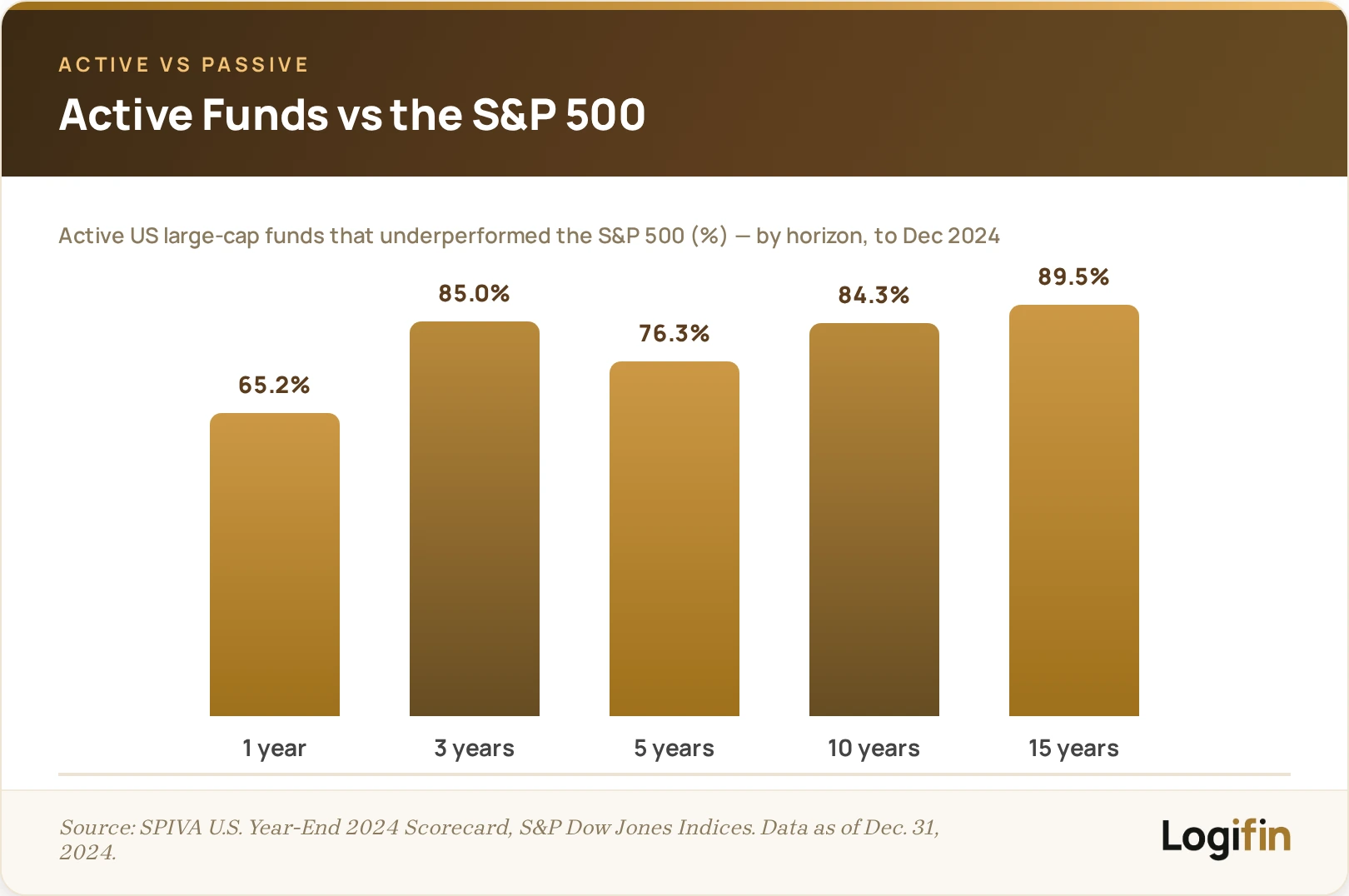
If professional managers with all available resources struggle to beat the index, individual investors face even greater odds, compounded by timing errors, trading costs and behavioural biases.
Conclusion
- ETFs are the ideal starting point for investors who want a stable, predictable strategy with low costs and full transparency. They do not require deep company analysis. You do not need to predict which company will perform best.
- Individual stocks can have a place in more active or advanced portfolios, particularly for those who enjoy research and want greater control.
- If you are starting now, an ETF-based portfolio gives you the stability and balance you need to develop healthy habits and build solid foundations for the years ahead.
Costs and fees: What to check before investing in an ETF
One of the greatest advantages of ETFs is their low cost, especially compared to traditional mutual funds burdened with higher management fees.
Low cost, however, does not mean no cost at all.
It is important to know which costs affect your final return, so you can make conscious choices and build the most efficient portfolio possible.
🔶 TER (Total Expense Ratio)
- The TER is the most fundamental and transparent cost you will encounter.
- It represents the annual percentage retained by the ETF provider to cover operating expenses: management, custody and regulatory costs.
- You are not charged separately. It is simply embedded in the ETF’s net asset value.
Example: if you hold 10,000 € in an ETF with a TER of 0.10%, approximately 10 € per year covers the product’s expenses.
The most popular ETFs tracking major indices such as the S&P 500 or MSCI World carry a TER between 0.05% and 0.25%. Thematic ETFs or those tracking less liquid markets may reach up to 0.50%.
🔶 Bid-Ask Spread
- The spread is the difference between the buying and selling price.
- It is an often underestimated cost that mostly affects those making frequent trades or moving larger amounts.
- ETFs with high liquidity typically show a very low spread of 0.02% to 0.08%.
- Thematic or smaller ETFs may show spreads approaching 0.5%.
🔶 Platform costs
The broker you choose can significantly affect your total cost. Depending on the platform, you may encounter:
- per-transaction fees
- monthly or annual subscription fees
- currency conversion fees when the ETF is denominated in USD
Many new investors favour platforms such as Trade Republic, DEGIRO or Scalable Capital because they offer zero or very low costs, especially for those practising DCA.
🔶 Currency risk and conversion cost
- If an ETF trades in US dollars, every purchase involves a small currency conversion fee.
- In addition to that cost, there is exposure to EUR/USD exchange rate fluctuations.
- This is not necessarily negative, but it is important to be aware of it as it can increase or decrease your final return.
🔶 Hidden costs and common misconceptions
- Many investors confuse the TER with the trading commission.
- The TER is an annual operating cost, not a transaction cost. The trading commission is solely a broker charge.
- For a clear picture, always read the KID (Key Information Document). It is short, mandatory and contains everything you need to know about the ETF: cost, risk, strategy and classification.
- This way you avoid misunderstandings and build a portfolio with full awareness of your actual expenses.
💡 Conclusion:
- ETFs are low-cost, but not "free". Learn to examine TER, spread, platform fees and currency before you invest.
- The right combination of ETF and broker can save you thousands of euros over 10–20 years.
How to buy an ETF: A practical guide
Choosing the right platform is one of the most important steps, as it affects both your costs and the ease of managing your portfolio.
Europe now offers a wide range of online brokers providing access to ETFs with low costs, DCA automation and user-friendly interfaces, so you can invest consistently with a clear plan.

1. Choose the right platform
The first and most important step is choosing a broker that fits your needs.
Most investors prefer online platforms that offer low costs, an easy-to-use interface and access to a wide range of international ETFs.
In Europe, popular options include:
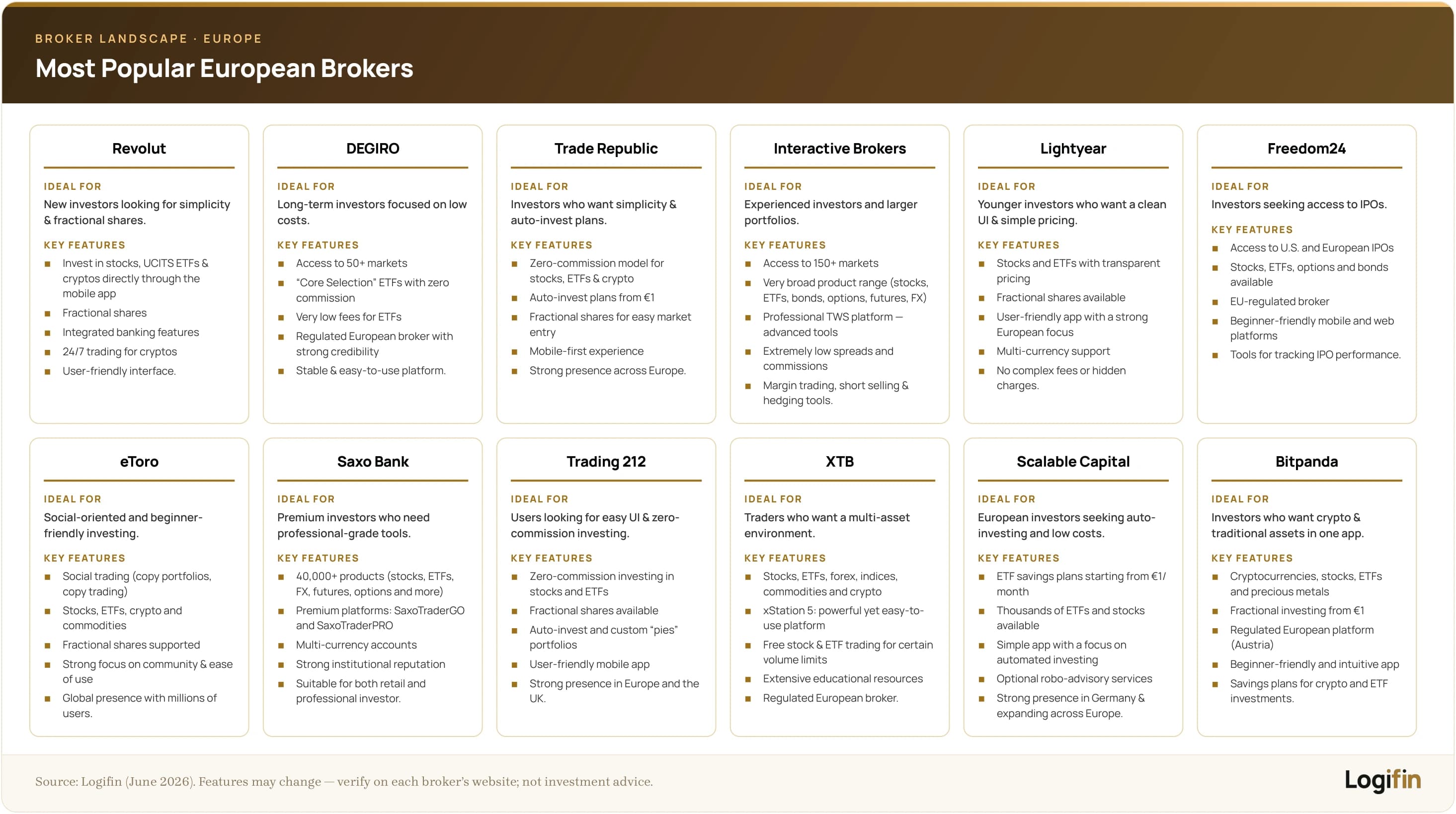
These platforms typically allow small starting amounts, support monthly DCA and provide access to ETFs traded on European and international exchanges.
2. Open an account and complete KYC
After choosing your platform, the next step is to create an account and complete the KYC process (Know Your Customer).
This is a standard, mandatory procedure applied by all licensed financial providers in Europe to ensure the user is a real person and that their account is protected.
The process is simple and can be completed via mobile or computer. You will typically need:
- a photo or scan of your ID or passport
- proof of address, such as a utility bill or recent bank statement
- a brief selfie or video verification
Each platform uses automated systems and security checks to verify your details.
In most cases the check completes within 24 to 72 hours, although often much faster.
3. Make your first deposit
Once your account is activated, the next step is to transfer funds to the platform so you can make your first investment.
The most common method is a SEPA bank transfer, which is secure, reliable and low-cost.
Many platforms also support deposits via debit or credit card, as well as instant payments for even faster account funding.
Regardless of the method, it is important that the funds originate from a bank account in your own name.
Most brokers do not accept deposits from third parties or joint accounts for security and compliance reasons. This ensures transactions are lawful and your investment profile remains protected.
Once the deposit is complete, you can proceed to select your first ETF and start building your portfolio with a clear, organised plan.
4. Search for the ETF you want
With funds available in your account, the next step is to identify the ETF you wish to purchase.
Most platforms have a user-friendly search engine that lets you find the right product within seconds, provided you know one of the basic identifiers.
You can find it easily if you know:
- the ticker symbol, such as VWCE, CSPX or IWDA
- the ISIN, such as IE00B3RBWM25
- the provider name, such as iShares, Vanguard or Amundi
Even if you do not remember the full code, platforms recognise keywords and display relevant results, making your search easier.
💡 Most platforms immediately display the detailed ETF profile.
There you can see the cost (TER), liquidity, portfolio composition, whether dividends are distributed or reinvested and the currency in which it trades.
This information helps you confirm that you are choosing the right product for your investment plan.
5. Execute your purchase
After identifying the ETF you want, the next step is to make your first purchase.
Modern platforms have made the process exceptionally simple and offer many ways to invest, depending on what suits you and how frequently you want to do it.
You can:
- buy ETFs based on the number of units, deciding exactly how many shares you want to acquire
- invest a specific amount, for example 50 € per month, via automated DCA executed on a fixed date
- set an order type, such as a market order for immediate execution or a limit order for purchase at a specific price
Most brokers also support scheduled DCA plans that run automatically without you needing to remember to execute each month’s purchase.
Additionally, several platforms offer zero fees for specific ETFs or for automated monthly purchases, making the cost even lower and the process friendlier for new investors.
With this step you have already made your first investment and begun building your portfolio with a clear, organised long-term strategy.
🔶 What to watch: currency and exchange
Before completing your purchase, it is important to check the currency and exchange on which the ETF trades.
Many ETFs trade in US dollars. This is not necessarily bad, but it creates currency risk, since your returns can be affected by EUR/USD exchange rate fluctuations.
For many investors, especially those who want stability or a clear picture of their returns, it is often more convenient to prefer ETFs that trade in euros or pounds, avoiding major currency swings.
If you want to limit this risk, you can choose ETFs that trade on European exchanges, such as:
- Xetra in Germany
- Euronext Paris
- Borsa Italiana in Italy
Platforms clearly display the currency, market and liquidity of each product.
Choosing a European version of an ETF can make your portfolio cleaner and easier to manage, especially if you practise DCA and do not want extra volatility from exchange rate changes.
Examples of popular ETFs and how to evaluate them
The global ETF market holds thousands of products, but certain ETFs stand out for their stability, size and wide acceptance among investors worldwide.
Below you will find some of the most well-known ETFs, presented not as buy recommendations but as an evaluation guide.
🔶 Global Diversification
Global diversification ETFs form the foundation of a stable, balanced portfolio, offering exposure to the entire global market in a single move.
Instead of trying to identify which country or sector will perform best, you invest in hundreds or thousands of companies across different economies and currencies, significantly reducing concentration risk.
The logic is simple. With a global ETF you can participate in the growth of the world’s largest markets while staying protected when one region or sector goes through a downturn.
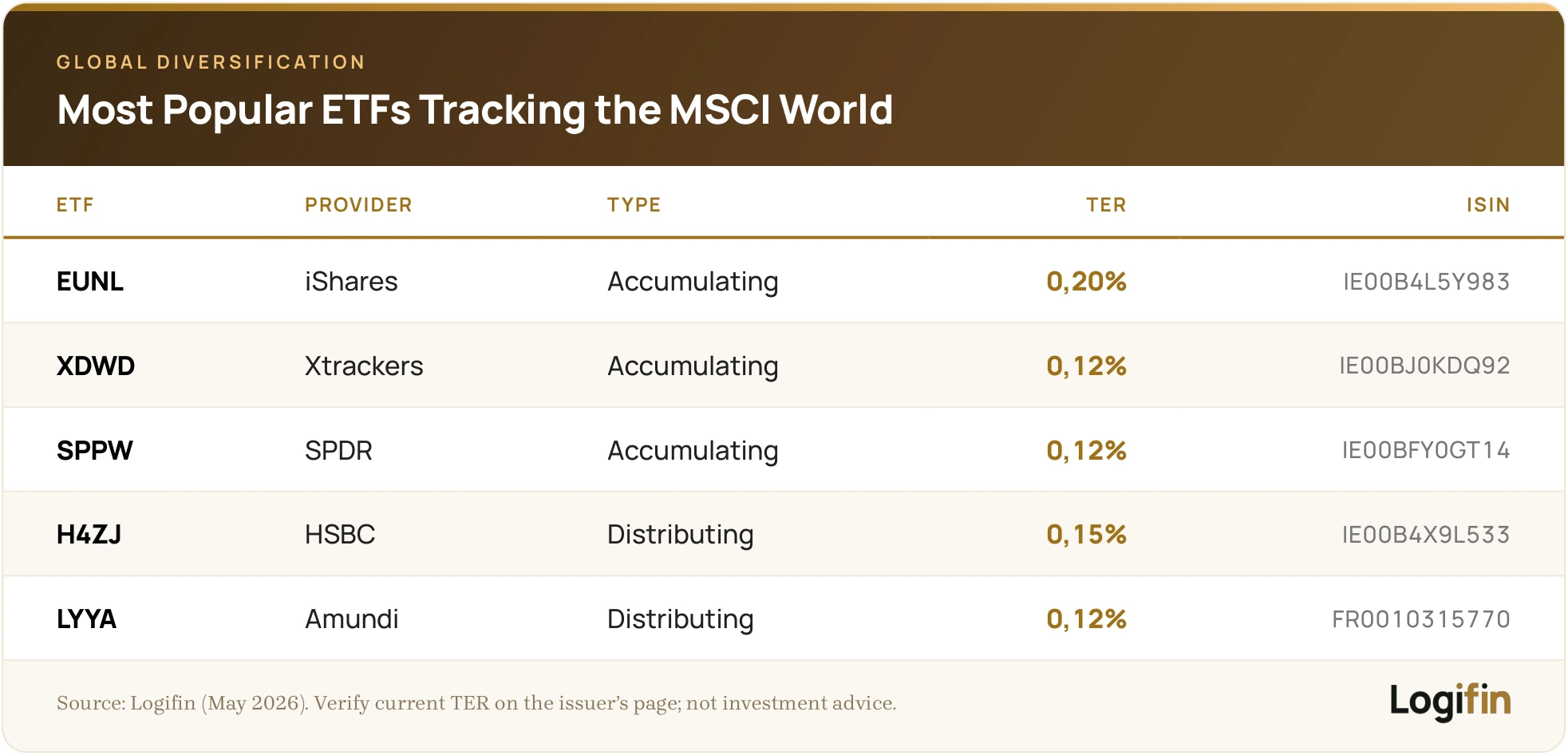
This broad diversification is one of the reasons global ETFs are considered ideal for new investors and form the core of many long-term strategies.
They also reduce the need for frequent changes and help you follow a clear, disciplined approach, without chasing trends or short-term opportunities.
🔶 US Market
The US market is the largest and most developed stock market in the world, serving as a reference point for millions of investors.
Thanks to its size, liquidity and innovation, it hosts many of the most powerful and recognisable companies globally, making it a fundamental pillar in many portfolios.
ETFs tracking the S&P 500 are among the most popular and traded products worldwide.
With a single move you gain exposure to 500 leading US companies, covering sectors such as technology, healthcare, energy and consumer goods.
This combination of stability and growth is why most investors use S&P 500 ETFs as the core component of their portfolio.

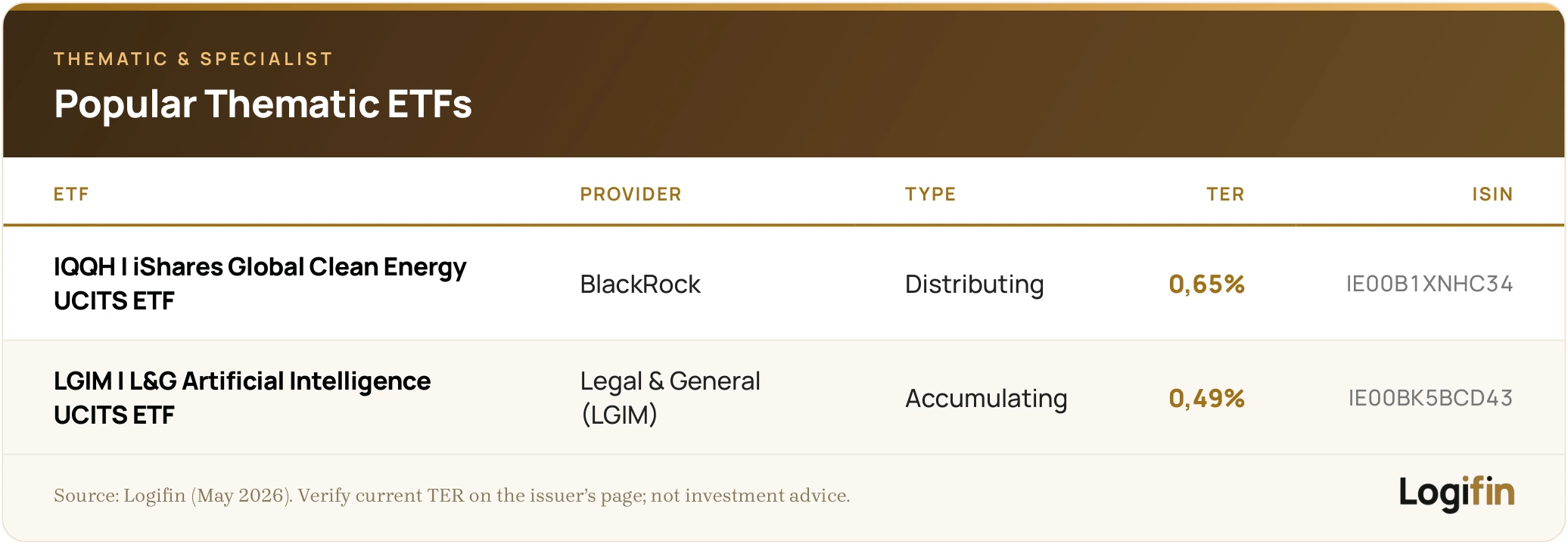
🔶 Thematic and Specialised ETFs
Thematic and specialised ETFs allow you to invest in specific megatrends or sectors with high growth potential.
They can focus on sectors such as artificial intelligence, renewable energy, cybersecurity or healthcare technology.
However, this specialisation typically comes with higher risk. Because exposure is more limited and concentrated, returns can show sharp fluctuations.
Additionally, thematic ETFs often have higher costs, as they track more complex indices or markets with lower liquidity.
For this reason, they work best as satellite additions to an otherwise stable portfolio. They can boost growth when a trend is favourable, but should not replace the core that provides diversification and stability.
🔶 What to check before investing in an ETF
Before purchasing any ETF, it is important to know exactly what you are buying.
A quick but proper check can protect you from mistakes, reduce costs and help you choose products that truly fit your investment plan.
- Index tracked (S&P 500, MSCI World, Nasdaq 100, etc.)
- Total Expense Ratio (TER) — prefer <0.30% for core ETFs
- Income treatment: Accumulating (acc) or Distributing (dist)
- Currency — EUR or USD
- Provider and ETF size — prefer large, liquid products
💡 Use tools such as justetf.com to compare ETFs and evaluate key metrics.
Common mistakes beginner ETF investors should avoid
ETFs are considered simple products, but their simplicity hides a few traps, especially for investors starting without guidance or a strategy.
Below are the most common mistakes to avoid.
🔶 Switching ETFs every few months
- Frequent switching based on "the trend of the moment" leads to inconsistency, unnecessary costs and typically lower returns.
- Each switch means new research, new adjustment and possible commissions.
- The biggest mistake for a new investor is constantly chasing the next "best" product.
Choose one or two stable core ETFs and follow a long-term strategy that is not swayed by short-term fluctuations.
🔶 Overexposure to thematic ETFs
- Thematic ETFs are attractive because they track trends such as AI, biotech or clean energy, but this focused approach significantly increases risk.
- Their returns can be exceptional during growth periods, but the decline arrives faster and more severely.
- It is not uncommon for a thematic ETF to fall 30–50% in difficult years, especially when the market rotates towards value sectors or investors avoid risk.
Thematic ETFs should function as small satellite positions, not as the foundation of the portfolio.
🔶 False sense of diversification
- Many investors believe that an ETF with thousands of holdings always offers high diversification.
- However, the reality depends on the structure of the index.
- If most companies belong to the same sector or region, then actual diversification is limited.
For the real picture, check the sectoral and geographic exposure of the ETF, not just the number of holdings.
This is the only way to understand whether the ETF truly protects your portfolio from concentration risk.
🔶 Focusing on recent performance
- Recent performance is the most misleading indicator.
- An ETF that performed exceptionally last year may not repeat that trajectory next year.
- Very often markets work through mean reversion, where outperformance is followed by a period of underperformance.
ETF selection should be based on structure, diversification, cost and strategy, not on short-term returns that cannot be predicted.
🔶 Selling under pressure when markets fall
- Declines are part of the investment cycle and will happen many times over the coming decades.
- Panic leads to wrong moves, the most common being hurried selling at low prices.
- DCA exists precisely to help you take advantage of lower prices and reduce your average purchase cost.
Patience and consistency are far more powerful than the impulse to "protect" the portfolio at the wrong moment.
Conclusion and practical takeaways
If you are looking for a way to invest consistently, affordably and without complex decisions, ETFs are perhaps the best choice to start with.
They require no specialist knowledge, no daily monitoring and offer something few investment products combine: diversification, simplicity and low cost.
🔑 With a single ETF you can access:
- Exposure to the world’s largest companies
- Global geographic diversification
- Access to thematic sectors that interest you
- Efficient management without hidden fees
🔶 Why start with ETFs?
ETFs are the most stable and friendly starting point for a new investor, because they remove complexity and help you focus on what truly matters: consistency and long-term strategy.
🔶 You do not need to predict the markets
ETFs track entire markets or indices, so you do not need to guess when a stock will rise or fall.
You simply participate in the overall trajectory of the market.
🔶 You are not dependent on a single company’s luck
With an ETF you gain exposure to dozens or hundreds of companies, reducing the risk created by individual stock selection.
🔶 You are not burdened by high fees
Unlike traditional mutual funds, ETFs carry low costs, which enhances your long-term returns.
🔶 No continuous rebalancing required
Management is handled automatically by the provider.
You simply follow your plan, without endless adjustments or extra stress.
👉 At the end of the day, ETFs allow you to focus on what truly builds investment results: discipline, consistent contributions and a long-term perspective.
This is precisely why they form the foundation of most successful portfolios.

The content of this article is provided exclusively for informational and educational purposes and does not constitute investment advice or a recommendation to buy or sell financial products. The information is based on publicly available sources considered reliable, without any guarantee of accuracy or completeness. Before making any financial or investment decision, it is recommended that you consult a certified professional advisor or accountant, taking into account your own financial situation and risk profile. The Logifin team bears no responsibility for any direct or indirect damages arising from the application of the information presented.
Related articles

ETF or stocks: Which strategy is right for you?
A guide for investors weighing single stocks against ETFs, covering diversification, cost, taxes and the time each approach really demands.
15 min read

Accumulating vs distributing ETFs: Which one suits you and why
How to choose between accumulating and distributing ETFs based on taxation, your tax residence and what you plan to do with the dividends.
13 min read

How to choose between ETFs that track the same index
VUAA, SXR8, D500 – all track the S&P 500. Which one is actually worth it?
26 min read

What is a recession and how it affects investors?
How a recession is defined, what causes one, how the markets usually behave during it and what an investor can do to prepare in advance.
24 min read
EXPLORE LOGIFIN
Everything you need in order to learn, plan and track your investments.
Logifin Blog
Learn everything you need to get your finances in order and invest with confidence.
Logifin Insights
What moves the markets and what it means for a long term investor. Short and without the noise.
Logifin Tools
Free, inside the site, no signup. Everything you calculate stays on your device.
Logifin ETF Hub
Find the ETF that fits you: 550+ UCITS ETFs, smart filters and in-depth comparisons.
Logifin Guides
A series of guides that builds your investment plan step by step. The first guide is free for everyone.
Logifin Circle
The tools and the Hub are free for everyone. You become a member for the intelligence that never stops.