Compound interest: Why it is called the "eighth wonder of the world"
The phenomenon that turns time into the strongest ally of your investments. And how not to cancel it.
3 August 2025 · 11 min read

What is compounding and why does it matter to you?
Compound interest is the mechanism through which your capital grows not only from your initial investment, but also from the gains that are reinvested and in turn produce new gains.
In simple terms, you earn interest on interest. This small detail is what makes the difference between an investment that crawls and one that takes off over the years.
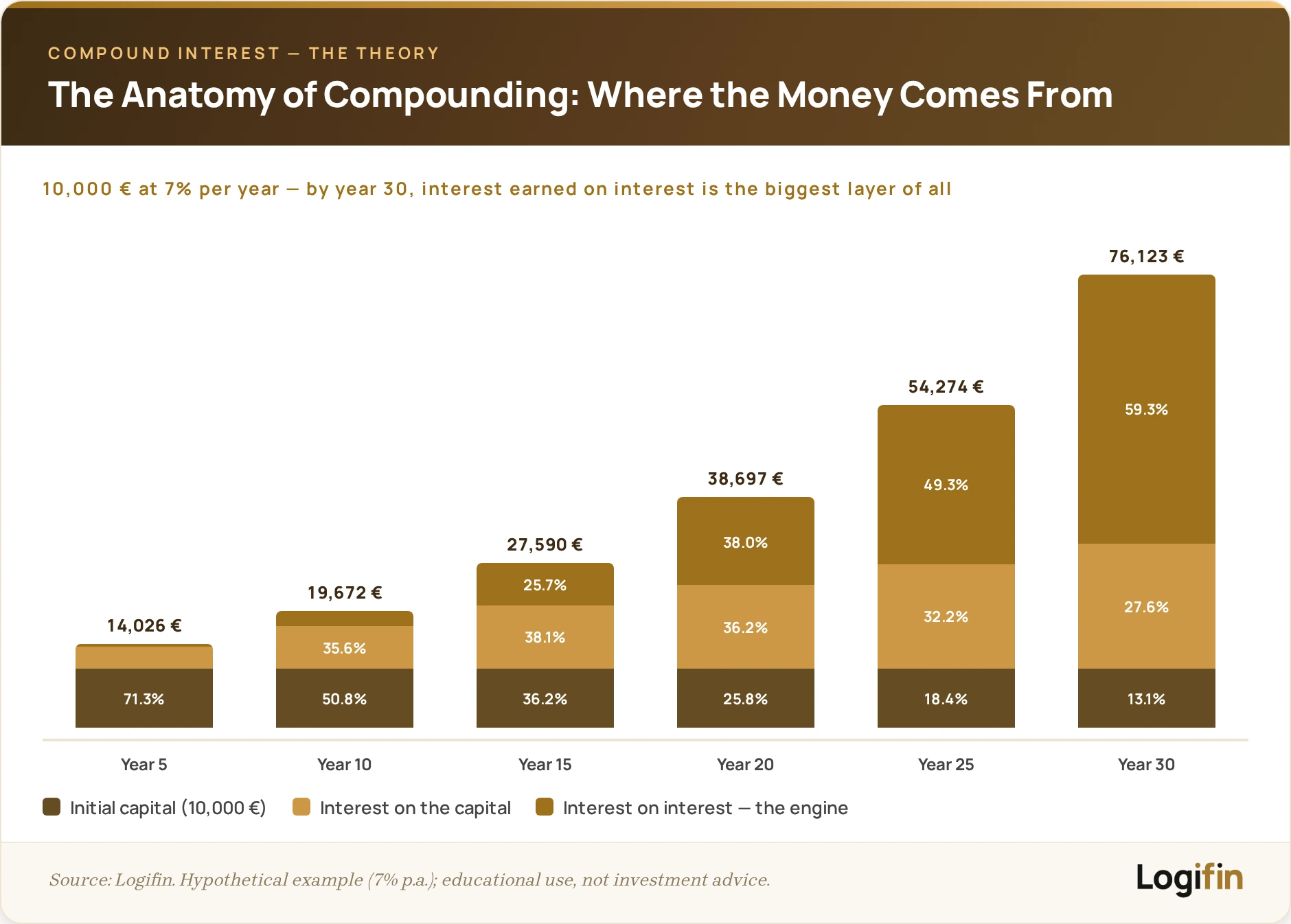
The mechanism works like self-acceleration. At the start the effect is almost invisible, because the first gains are small.
As the years pass, however, gains generate gains on an ever larger base, while the curve turns from a straight line into something resembling a snowball.
You already encounter it in your everyday life, even if you have not noticed.
- In savings accounts, the interest credited quarterly or annually is added to the capital and subsequently earns interest itself.
- In investments, accumulating ETFs automatically reinvest dividends.
- Even outside finance, daily learning and practice compound in exactly the same way.
⚠️ There is, however, a dark side too: the exact same mechanism also works against you when you owe money.
A credit card balance with a high interest rate compounds in the same relentless way, only there the snow piles up on your debt.
How does compounding differ from simple return?
To understand the power of compounding, it is enough to compare it with simple return, that is the scenario where gains are never reinvested.
Example: you invest 10,000 € at an indicative annual return of 8%.
- With simple return, you earn 800 € per year, you take it in cash and the capital stays fixed at 10,000 €. In 10 years you will have collected 8,000 € and your total value will be 18,000 €.
- With compounding, the 800 € of the first year stay inside the investment. In the second year the return is calculated on 10,800 €, so you end it at 11,664 €. At the end of the third year you stand at 12,597 €, while every year the step grows a little more than the previous one.
- At the ten-year mark, the capital has reached about 21,600 €: almost 3,600 € more than simple return, without you having done anything different except not touching the gains.
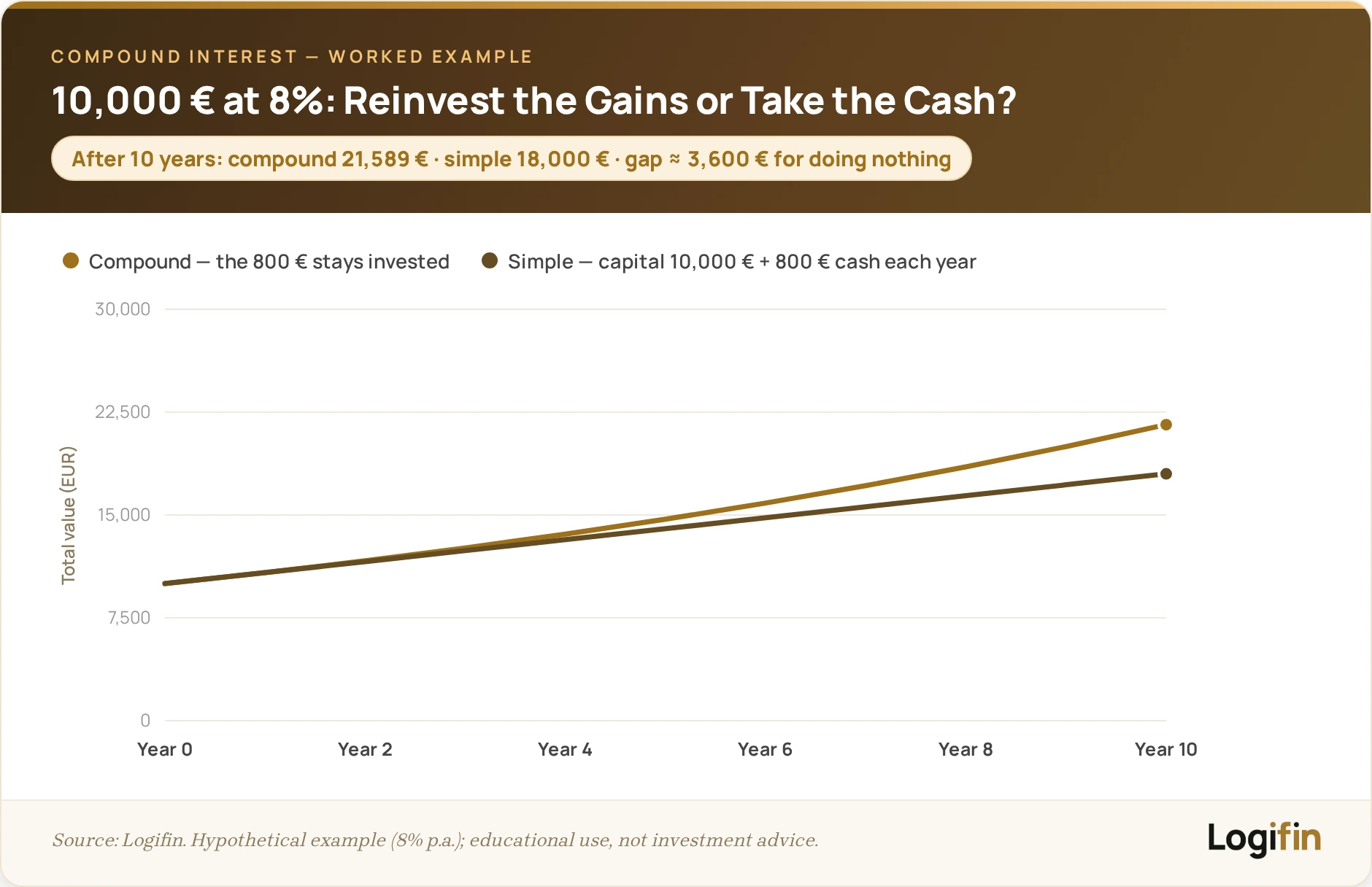
Notice, though, the psychological paradox hiding here. In the first years the difference between the two scenarios is almost negligible, a few tens or hundreds of euros.
Many investors look at this early picture, conclude that nothing is happening and give up, precisely before the phenomenon starts working in earnest.
In the first years compounding tests your patience; in the final years it rewards it.
Time is the greatest multiplier
If compounding is the engine, time is its fuel.
No other parameter, not even the return, affects the final result as dramatically as when you start.
Example:
- Nick and George both invest 300 € per month at an indicative return of 8% per year.
- Nick starts at 25 and continues until 65, that is for 40 years.
- George starts at 35 and also continues until 65, for 30 years.
- Their only difference is one decade at the starting line.
- Nick contributed a total of 144,000 € and George 108,000 €, that is only 36,000 € less.
The final result, however, has nothing to do with this small difference in contributions:
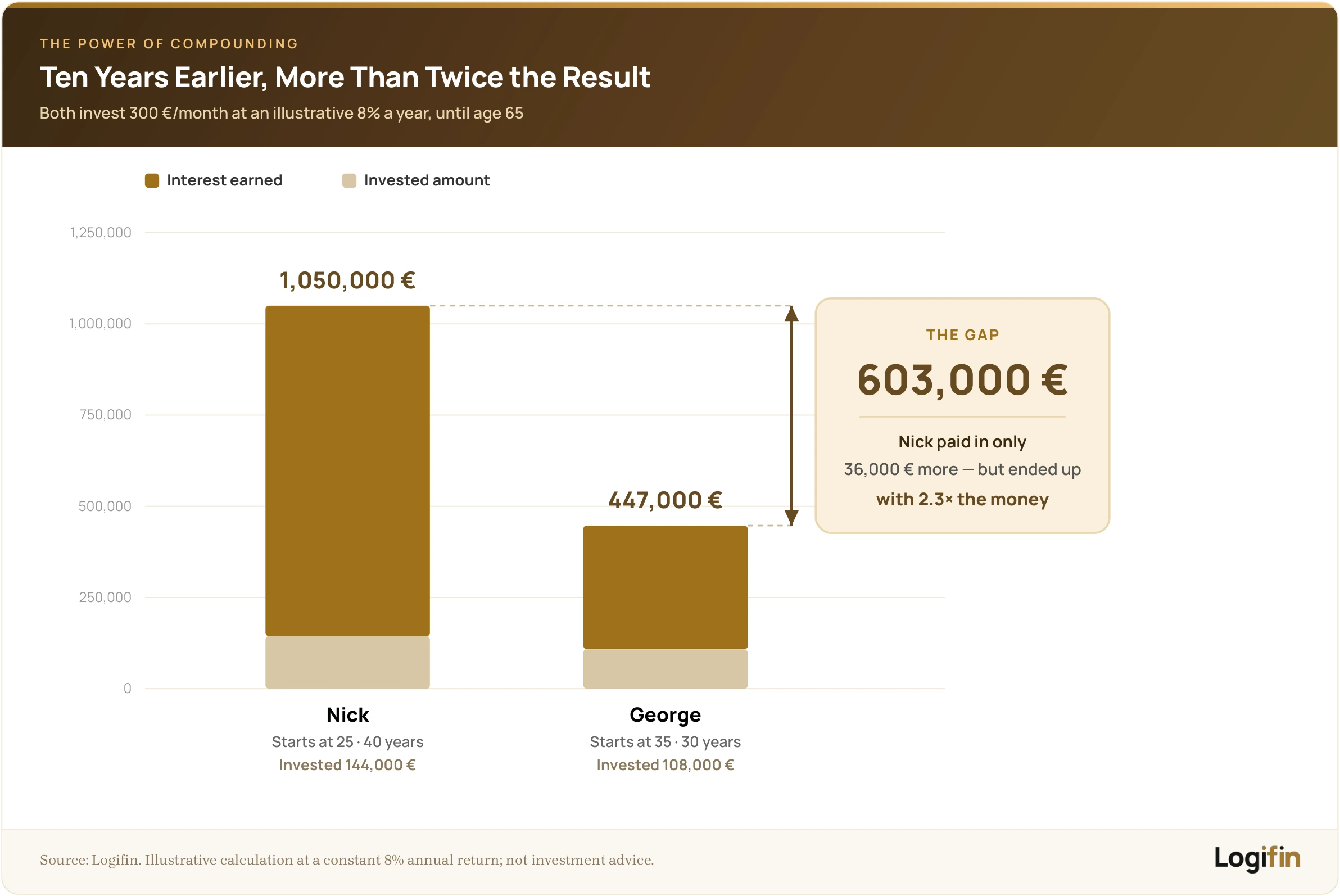
- Nick reaches about 1,050,000 €, while George stops at about 447,000 €.
- The one extra decade did not add a third, as common sense would expect. It more than doubled the final capital.
The conclusion is simple but disruptive: the question of how much to invest comes second.
The first question is “when do I start?”. The best start was ten years ago; the second best is today.
💡 Even small amounts that start early usually beat larger amounts that start late.
The Einstein quote and its real meaning
“Compound interest is the eighth wonder of the world. He who understands it, earns it. He who does not, pays it.”
The phrase is attributed to Albert Einstein, although, to be precise, there is no documentation that he actually said it.
Its value, however, does not depend on who said it, because it captures in one sentence the most important truth of this chapter: compounding works always, either for you or against you.
Example (the negative side):
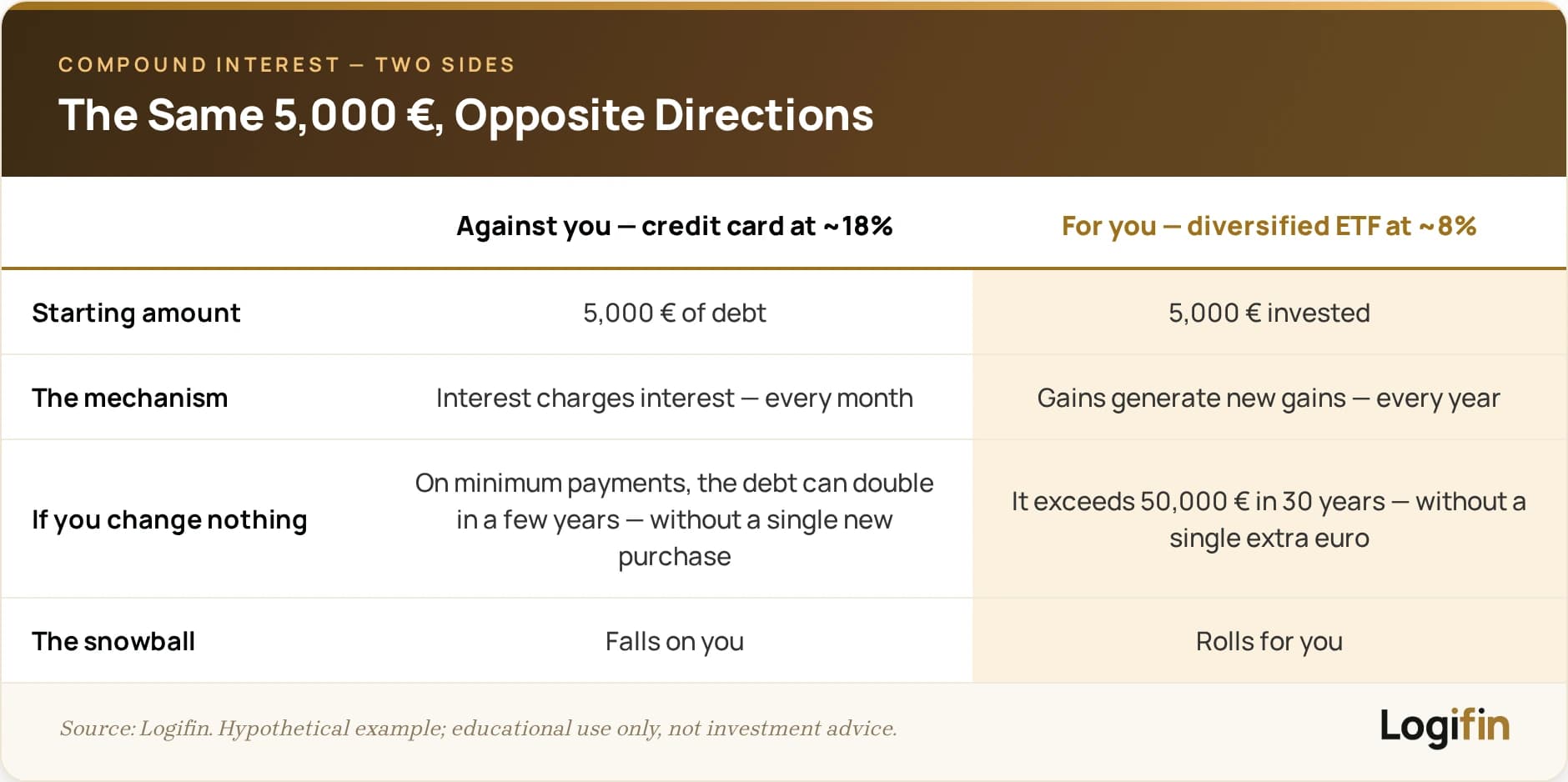
- A credit card balance of 5,000 € with an interest rate near 18% compounds against you every month.
- If you pay only the minimum instalment, the debt can double within a few years without you making a single new purchase.
- Interest breeds interest here too, only now the snow is falling on you.
Example (the positive side):
- The same 5,000 €, placed in a diversified ETF at an indicative return of 8% per year, exceed 50,000 € in 30 years without a single additional euro contributed.
- Same amount, same mechanism, opposite direction: the only difference is which side of the equation you sit on.
This is why the order of priority in personal finance is almost always the same:
- first you pay off expensive debts to stop the compounding that works against you;
- then you invest, so that you put it to work for you.
⚠️ Investing at 8% while owing at 18% is like walking up an escalator that is going down.
Why compounding only works with patience
The human brain thinks linearly: if something grows, we expect it to grow at a steady pace.
Compounding, however, is exponential, that is slow at the start and explosive at the end. This mismatch between how the phenomenon works and how we perceive it is the reason so many investors quit midway.
Example:
- You invest 200 € per month at an indicative return of 8% per year.
- At five years you have about 14,700 €, barely above what you deposited.
- At ten years you reach about 36,600 € and the effect starts to show.
- At twenty years you stand at about 117,800 €, while at thirty years you exceed 298,000 €, having deposited a total of 72,000 €.
Now look at the most revealing number of this series: out of the ~298,000 € at thirty years, about 180,000 €, that is 60% of the final value, are created within the last decade.
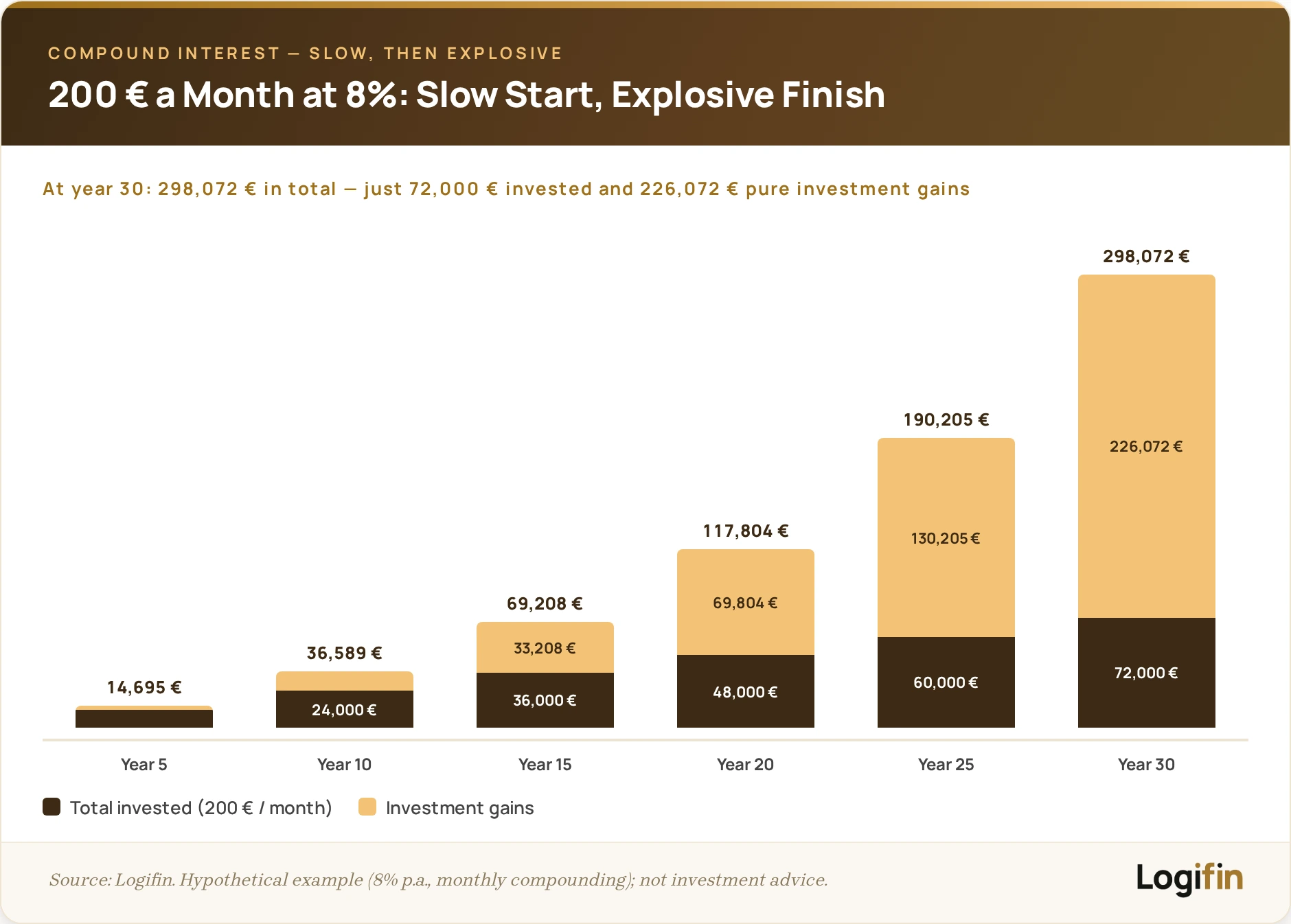
Whoever stops at 15 or 20 years does not miss a little extra. They miss the biggest part of the whole journey.
⚠️ There is also a practical consequence for your daily life: constant monitoring of the portfolio works against patience.
The more often you look, the more dips you see, the more stress you accumulate and the more likely you are to make an impulsive decision that interrupts the phenomenon.
The most common mistakes that cancel compounding
Compounding does not need talent to work. It only needs you not to sabotage it.
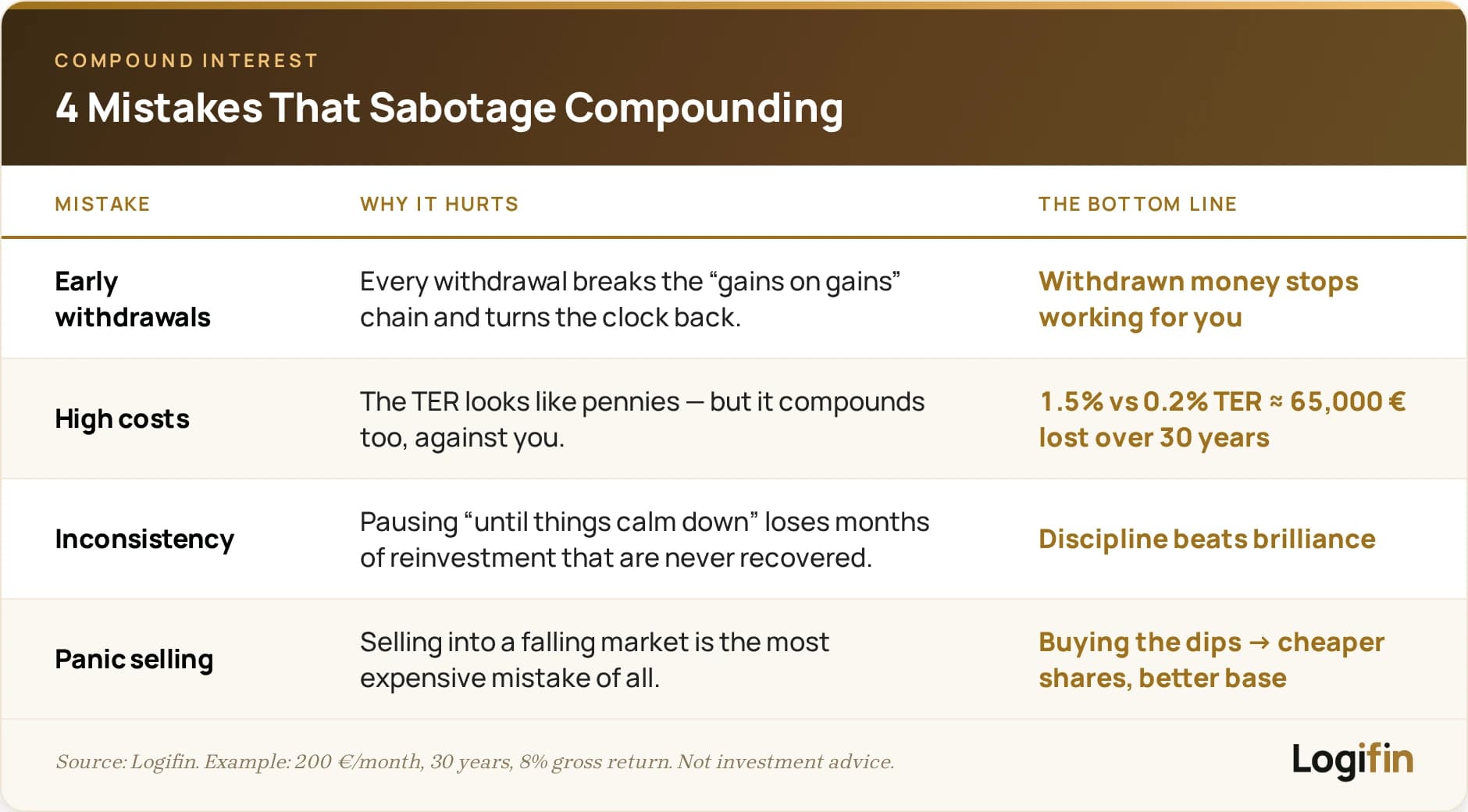
Four mistakes appear again and again:
- Early withdrawals: every withdrawal breaks the gains-on-gains chain and turns the clock back. The capital that leaves the investment stops working for you from that moment on.
- High costs: the total expense ratio (TER) looks like small change, but it compounds too, only it compounds against you. With 200 € per month for 30 years and a gross return of 8%, a product with a 0.2% TER brings you to about 286,000 €, while one with a 1.5% TER to about 221,000 €. The small cost difference cost about 65,000 €.
- Inconsistency: pauses until things calm down cost more than they seem, because months of reinvestment are lost and never recovered. Over the long journey, discipline beats brilliance.
- Panic in downturns: selling when the market falls is the most expensive mistake of all. If you keep buying through the dips, you buy the same shares cheaper, so the compounding of the following years starts from a better base.
💡 The protection against all four is the same:
- automate your monthly contributions with a standing order, so that no new decision is needed every month,
- set a horizon of a decade or more and
- limit portfolio check-ins to a short appointment once a quarter.
Whatever happens automatically cannot be ruined by one bad day.
How to make compounding work for you
Everything we have seen comes down to a strategy of three ingredients. You need nothing more complicated, but you do need all three together:
- Time: start early, even with small amounts. As the example of Nick and George showed, a decade at the starting line is worth more than thousands of euros in extra contributions later. If you can start with only 50 € per month, start with 50 €. The mechanism is the same, only the scale changes.
- Consistency: the most proven way to achieve it is a DCA strategy, that is a fixed amount every month through a standing order, regardless of where the market stands. This way investing becomes a habit like the electricity bill and not a decision you make again and again under the weight of the news.
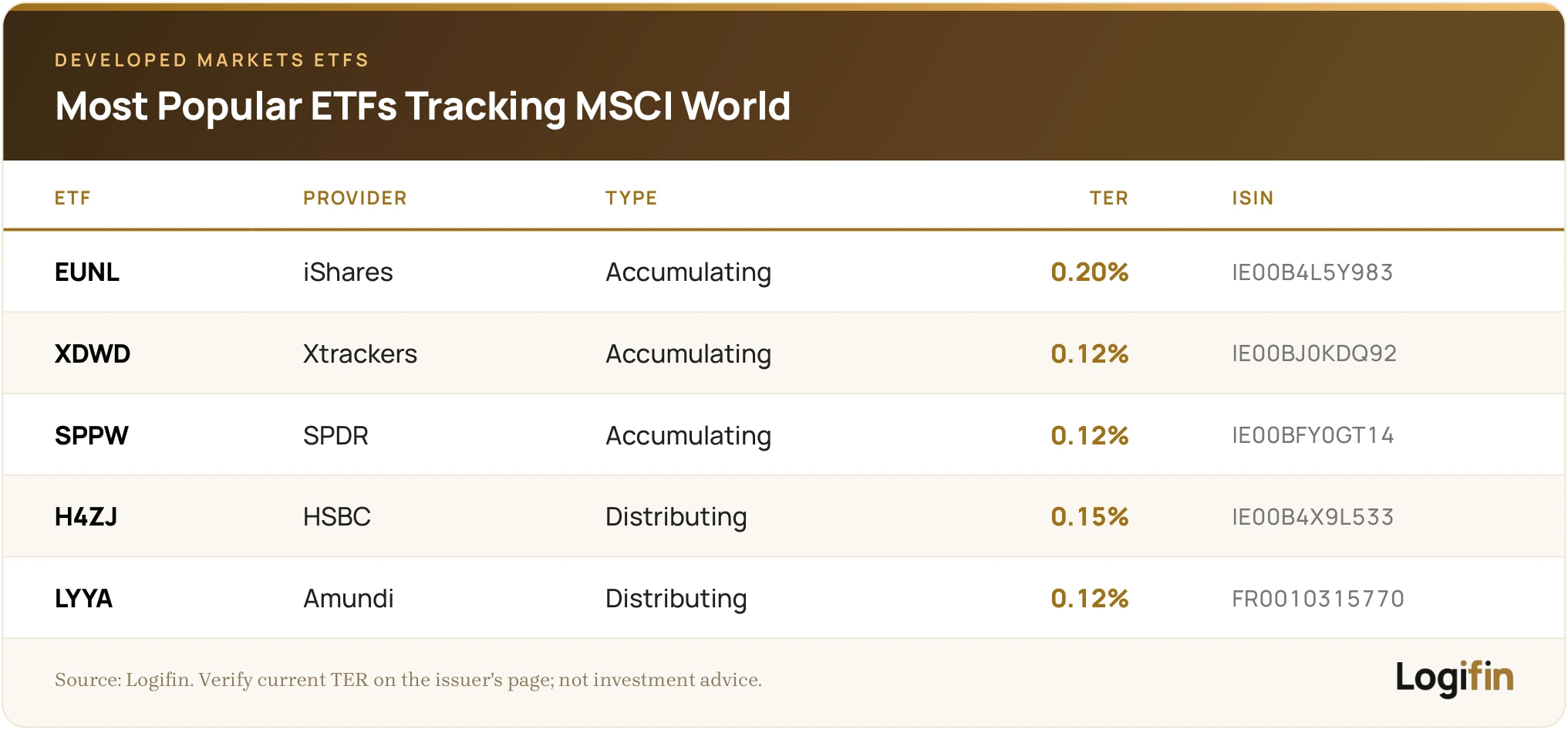
- Low cost: for most long-term investors, the right vehicle is broadly diversified accumulating ETFs with low total cost, on major indices such as the S&P 500 or the MSCI World, which handle reinvestment automatically and quietly. Complicated products with high fees, as we saw in the previous chapter, eat exactly the part of the return that would have compounded.
And one final, equally important point: once the system is set up, do not tinker with it.
Every strategy change midway resets the compounding clock for the part you changed. Your role after the setup is mostly not to stop what is already working.
Conclusion and practical takeaways
Compounding is not a trick, nor secret knowledge. It is a mathematical mechanism that works for anyone who gives it the two things it asks for: time and consistency.
The real challenge is not to understand it, but to serve it patiently through the years when the result is not yet visible. Whoever manages that collects the miracle in the years that follow.
🔑 What to keep in mind:
- Gains on gains: reinvestment is the whole magic. On the same 10,000 € capital at 8%, compounding gives ~21,600 € at ten years versus 18,000 € for simple return.
- Time beats amount: starting one decade earlier more than doubled the final capital in our example, with only 36,000 € of extra contributions.
- The big gain comes at the end: in the 200 € per month scenario, 60% of the final value is created in the last decade of the thirty years. Whoever stops early misses the best part.
- It also works against you: on expensive debts the same mechanism charges you in reverse. First you pay off, then you invest.
Practical Tips — put compounding to work starting today:
-
Start now, with what you have.
Even 50 € per month set the mechanism in motion. The time you gain by starting today cannot be made up by any larger amount later.
-
Automate with a standing order.
A fixed amount every month, on the same day, with no new decision. The DCA strategy turns discipline from a daily struggle into a five-minute setup.
-
Keep costs low and reinvestment automatic.
Diversified accumulating ETFs with a low TER do both without any action on your part. In our example, the cost difference between 0.2% and 1.5% cost about 65,000 € over 30 years.
-
Do not interrupt it.
Set a horizon of a decade or more, check the portfolio quarterly and let the downturns work for you through cheaper purchases. Interruption is the one mistake that cannot be fixed.
The content of this article is provided exclusively for informational and educational purposes and does not constitute investment advice or a recommendation to buy or sell financial products. The information is based on publicly available sources considered reliable, without any guarantee of accuracy or completeness. Before making any financial or investment decision, it is recommended that you consult a certified professional advisor or accountant, taking into account your own financial situation and risk profile. The Logifin team bears no responsibility for any direct or indirect damages arising from the application of the information presented.
Related articles

DCA: The most stable investment strategy
What dollar cost averaging is, how it lowers risk and when it beats lump sum investing.
15 min read

5+1 reasons to start investing today
Six reasons to start investing now instead of waiting for the right moment, from compounding and small amounts to the discipline it builds.
9 min read

How to start investing: A beginner's guide
The complete guide to start investing: strategy, products, choosing a platform and the traps you need to avoid.
15 min read

What is a recession and how it affects investors?
How a recession is defined, what causes one, how the markets usually behave during it and what an investor can do to prepare in advance.
24 min read
EXPLORE LOGIFIN
Everything you need in order to learn, plan and track your investments.
Logifin Blog
Learn everything you need to get your finances in order and invest with confidence.
Logifin Insights
What moves the markets and what it means for a long term investor. Short and without the noise.
Logifin Tools
Free, inside the site, no signup. Everything you calculate stays on your device.
Logifin ETF Hub
Find the ETF that fits you: 550+ UCITS ETFs, smart filters and in-depth comparisons.
Logifin Guides
A series of guides that builds your investment plan step by step. The first guide is free for everyone.
Logifin Circle
The tools and the Hub are free for everyone. You become a member for the intelligence that never stops.