5+1 reasons to start investing today
Six reasons to start investing now instead of waiting for the right moment, from compounding and small amounts to the discipline it builds.
5 September 2025 · 9 min read

Introduction
The best time to start investing is as soon as possible: what determines the outcome is not perfect timing, but the time you let your money compound. Even so, many people postpone investing in the hope of finding "the ideal moment" to enter the market.
Some wait to earn a higher income, others to wrap up a professional obligation and many want to feel "financially comfortable" first.
The truth, however, is that the perfect moment never comes.
Markets always carry uncertainty: inflation, interest rates, wars, crises. If you wait for all of these to disappear, you will most likely stay on the sidelines for years.
In the world of investing, the real secret is not to catch the market "low" or avoid the market "high".
What matters is the time you let your money work for you. Compounding needs patience and consistency, not perfect timing.
That is why the answer to the question "When should I start?" is always the same: as soon as possible.
Below are 5+1 strong reasons that explain why it is worth taking the first step this very day – even if it is with small amounts.
Reason 1 – Time is your greatest ally
The earlier you start, the more you will harness the power of compounding.
The money you invest does not only work for you; over time, your gains themselves begin to produce new gains.
This creates an exponential growth cycle that seems slow at first, but over the decades becomes impressive, like a snowball that starts small but gains enormous force as it rolls.
🔶 Example:
- If you invest 250 € per month from age 25 to 65, at a 7% average annual return, you will accumulate roughly 650,000 €, of which your contributions are 120,000 € and the gains around 530,000 €.
- If you start the same strategy at age 35, by 65 you will have roughly 300,000 €
- If you wait until 45, by 65 you will have only about 130,000 €.
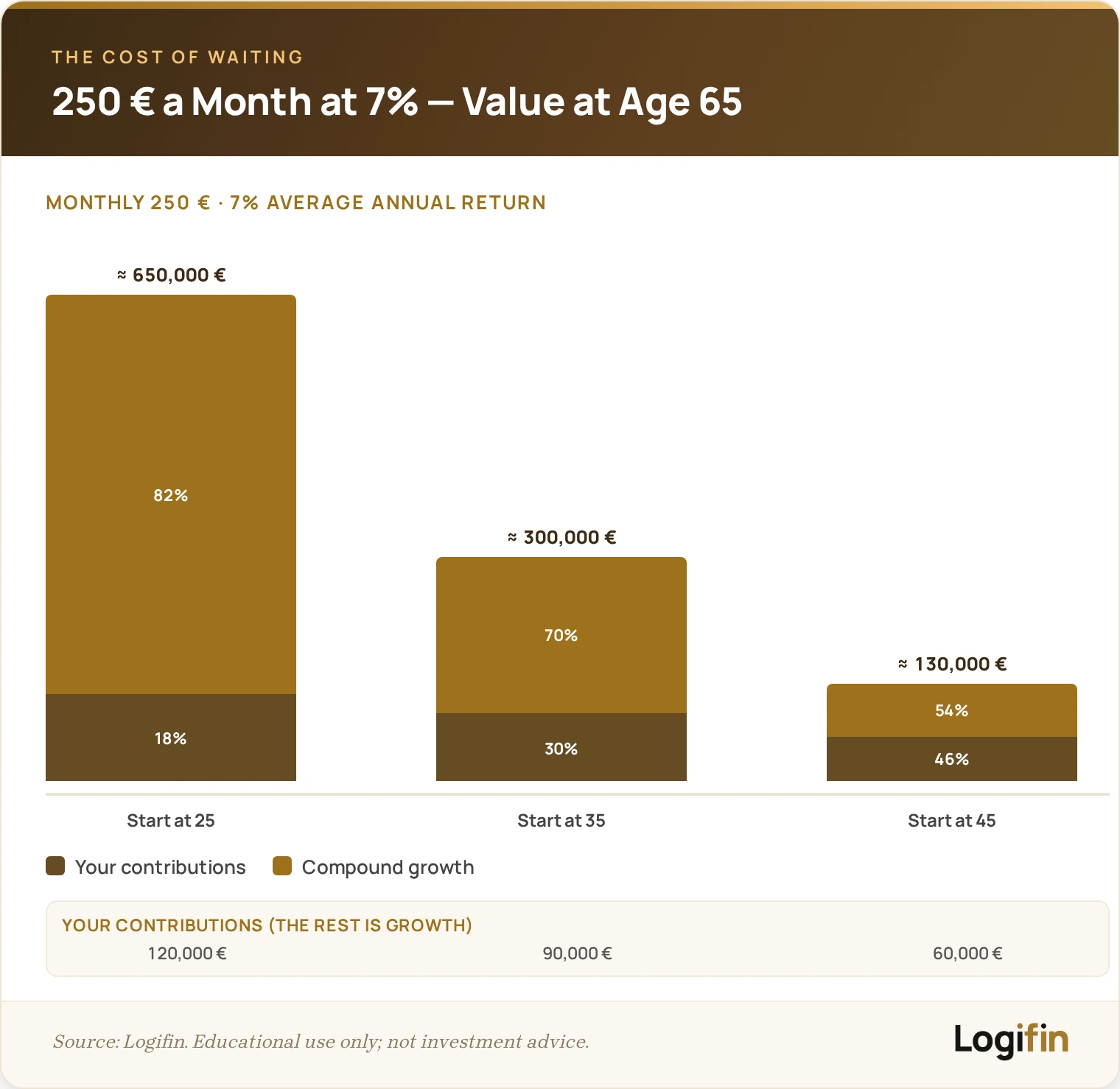
In other words, each decade of delay roughly halves the final result, even though the monthly amount stays exactly the same. It is not about how much you put in; it is about how long you let compounding work.
Reason 2 – You do not need a large amount of capital to get started
Many people believe that investing is a privilege of those who already have large amounts set aside.
In reality, thanks to modern investment platforms and fractional shares (that is, the ability to buy a fraction of a stock or ETF), you can start with as little as 20–50 € per month.
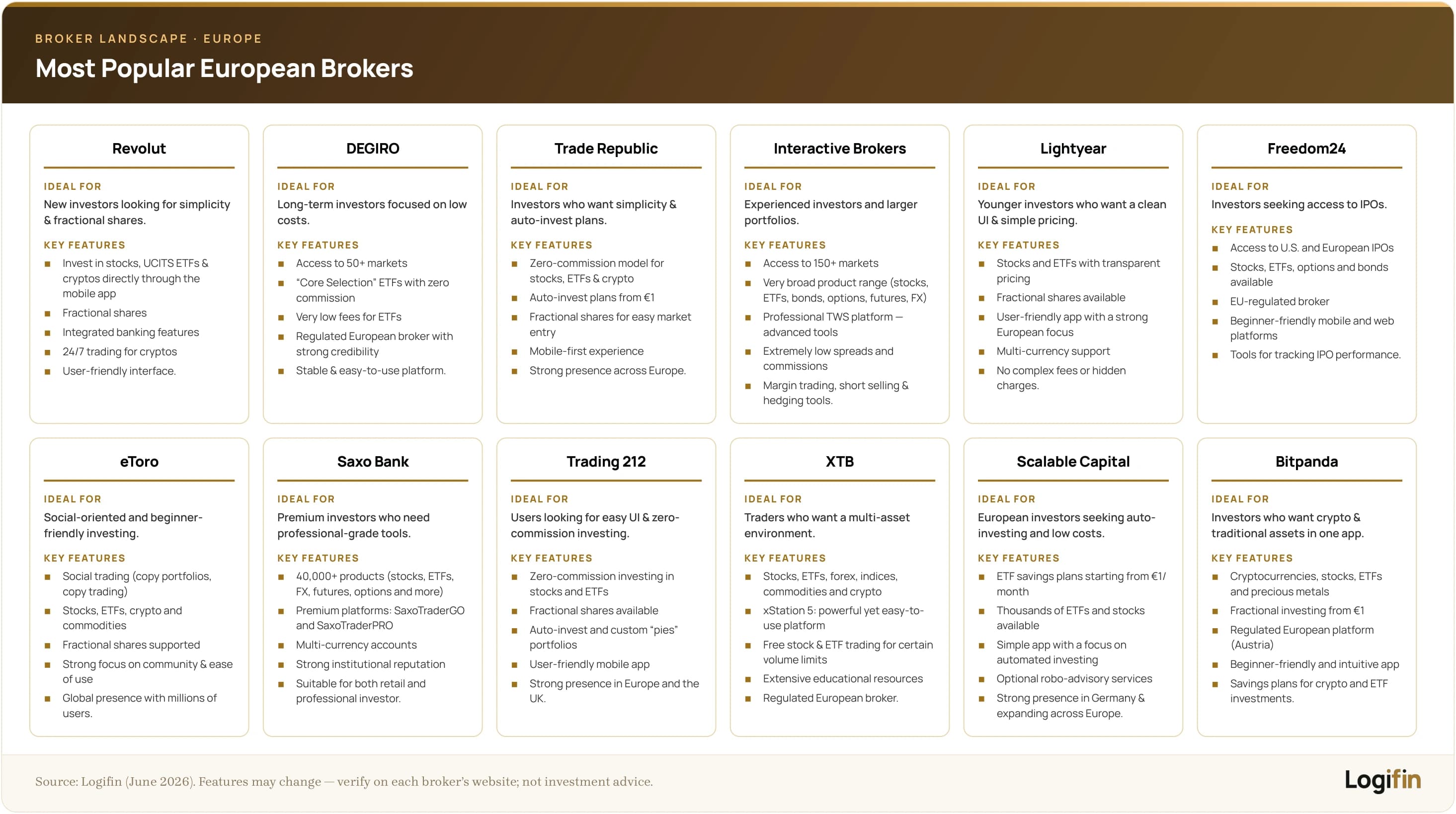
This way, you gain access to top companies and indices such as the S&P 500 or Apple, without having to pay the full price of a single share.
🔶 Example of a 10,000 € investment at a 7% average annual return
The amount grows exponentially the longer the period you stay invested:
- After 10 years → ~19,700 €
- After 20 years → ~38,700 €
- After 30 years → ~76,100 €
- After 40 years → ~149,700 €

In investing, time and discipline are the real multipliers of wealth – not whether you started with little or a lot.
Reason 3 – DCA protects you from poor timing
The biggest fear of beginner investors is: "What if I enter when the market is expensive?"
This is where the Dollar Cost Averaging (DCA) strategy offers a solution.
With DCA you invest a fixed amount every month, regardless of how the market moves. You do not try to predict whether tomorrow will be better or worse; you follow a disciplined plan.

In practice this means:
- When the market is expensive, the same amount buys fewer units.
- When the market is cheap, the same amount buys more units.
- Over time, these purchases at different price levels create an average purchase cost that tends to smooth out.
You do not always buy "cheap", nor always "expensive". You buy systematically.
🔶 Example:
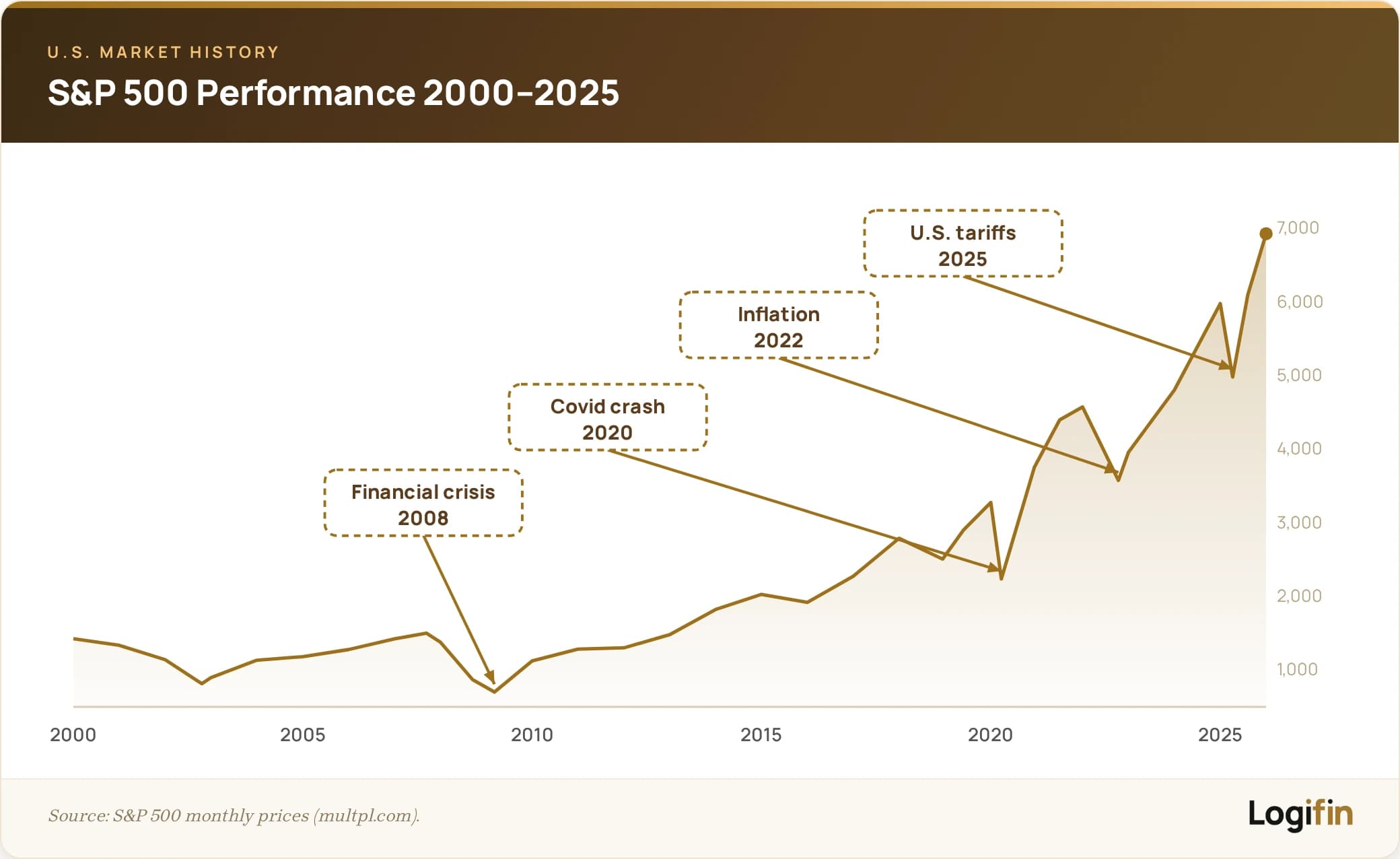
- Those who applied DCA to the S&P 500 during 2007–2009 (the global financial crisis) saw their portfolio recover much faster than those who waited for the market to "turn".
- The former kept buying cheap units every month, while the latter stayed on the sidelines, missing most of the subsequent rally.
Reason 4 – Markets always reward patient investors
Short-term fluctuations are inevitable. No market moves in a straight line.
There will be corrections, sharp drops, but also periods of stagnation that test investors’ psychology. These phases are part of the "cost of participation" in the markets.
The crucial point is that volatility is normal, not a sign that your strategy has failed.
Markets react to news, interest-rate cycles, geopolitical events and fear. All of this creates noise in the short term, but rarely changes the long-term direction.
Over the long run, markets tend to rise. This is not random. They reflect:
- the growth of economies
- technological progress
- the continuous rise in productivity
- the creation of new value by businesses
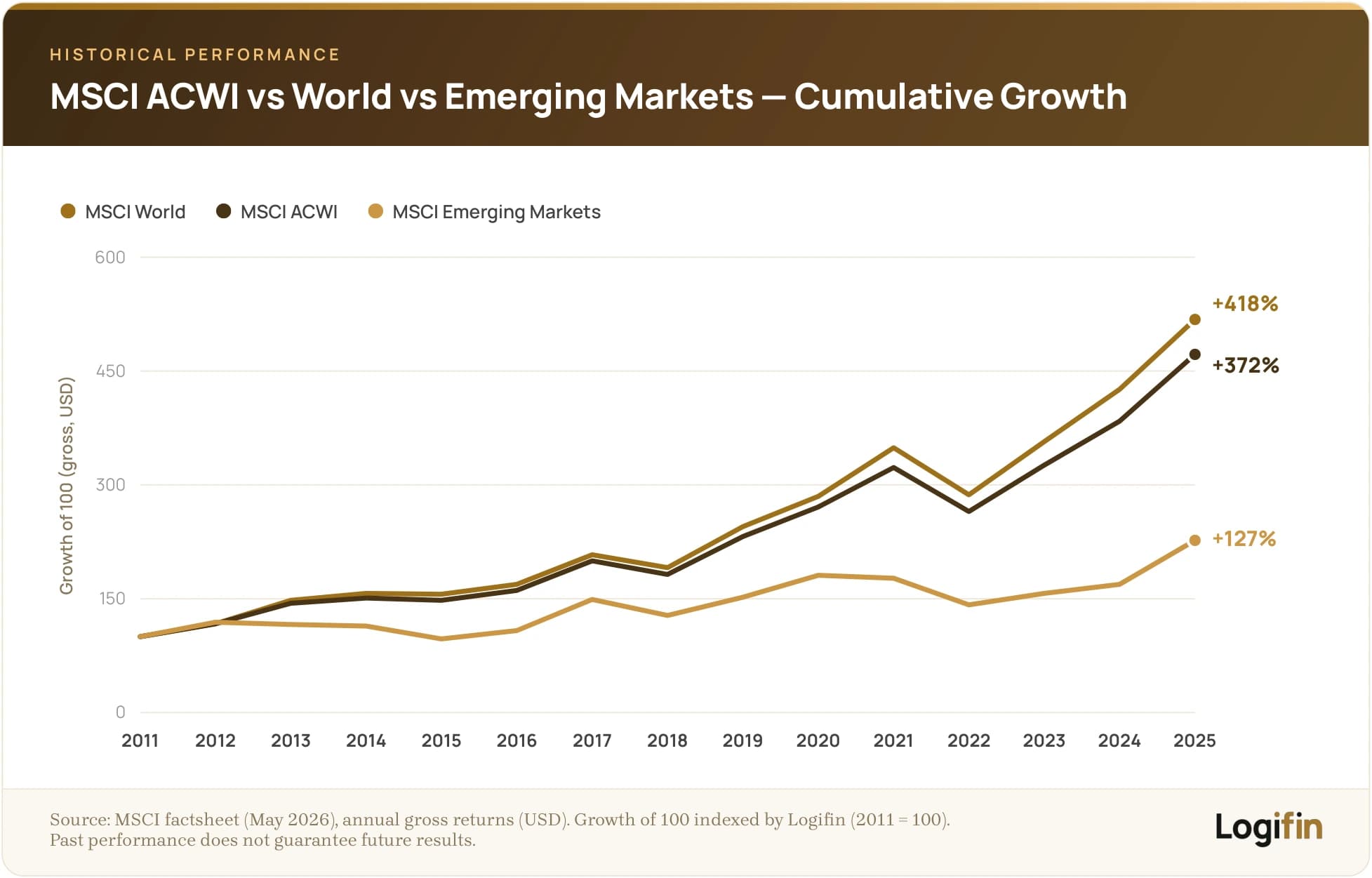
The investors who get rewarded are not those who predict every move, but those who stay in the market long enough to let time work in their favour.
Put simply, patience is not a passive stance. It is an active strategy!
And historically, it is one of the most reliable allies of anyone who invests with discipline and a long-term view.
Reason 5 – Investing builds discipline
Regular investing is not merely a financial tool.
It is a daily exercise in discipline and self-improvement that affects the way you think, organise and evaluate your choices.
When you invest systematically, you do not only build capital. You build habits. Through this process:
🔶 You learn to save consistently:
- Investing becomes a fixed priority and not something you "do if anything is left at the end of the month".
- This consistency is the foundation on which all long-term financial progress is built.
🔶 You organise your budget better:
- By adopting the pay yourself first logic, the way you see your money changes.
- First you invest for your future and then you allocate the rest to everyday needs.
- This creates order, control and transparency in your budget, reducing stress and unpleasant surprises at the end of the month.
🔶 You set priorities and reduce impulsive spending:
- When you have a clear goal and a specific plan, you start thinking differently before you spend.
- Every decision passes through a filter: does it bring me closer to or further from my goal?
- This way, your choices become more conscious and less emotional, reducing the impulsive spending that often undermines progress.
Over time, this discipline is not limited to money. It extends to the way you manage your time, your goals and your choices.
And this is perhaps one of the most underrated yet powerful benefits of investing: it helps you operate with a long-term mindset, in a world that rewards the immediate.
Bonus (reason 6) – The cost of delay is enormous
The biggest trap for any investor is neither market fluctuations nor choosing the "perfect" product. It is the phrase: "I will start later".
Postponing seems harmless, but in reality it is extremely costly.
Every year that passes without investing dramatically reduces the final outcome, because you deprive your money of its most powerful weapon: compounding.
The earlier you start, the more time your investment has to multiply. Even if the amounts are small at first, the effect of time is enormous.
Delay does not simply mean you lose a few years of saving; it means you lose entire decades of accumulated growth.
🔶 Example:
- Two people invest 200 €/month at a 7% average return.
- The first starts at 25 and invests until 35, contributing 24,000 € in total. After that they add no new capital, but let the amount compound until 65.
- The second starts at 35 and invests continuously until 65, contributing 72,000 € in total.

Even though the second invests three times the capital, the first ends up with a larger sum at 65, because their money had three decades to work with the power of time and compounding.
Conclusion and practical takeaways
There is no "perfect moment" to start; there is only now.
Waiting, however reasonable it seems, hides the greatest cost: it deprives you of time, the investor’s most powerful weapon.
Investing rewards time, consistency and discipline. The earlier you begin, the more power compounding gains and the calmer you feel about your future.
Practical tips to get started
1. Start even with small amounts, but start now
- Even 50 €/month is better than nothing.
- The habit is more important than the amount at the start.
2. Automate your investments
- Set up a standing order so you do not rely on momentary willpower.
- Automation protects you from impulsive decisions.
3. Think of it as a "future account"
- Every investment is a commitment to yourself that you are preparing for better days.
- It is not about today but about where you want to be in 10, 20 or 30 years.
4. Prioritise consistency, not timing
- Whether you enter the market at the "perfect price" matters far less than entering and staying consistent.
- Most investors do not fail because they bought expensive but because they stopped investing when the market got tough.
5. Trust time and compounding
- Do not get discouraged by short-term fluctuations.
- History shows that markets reward those who stay long-term, not those who try to predict them.
- Time is an ally when you let it work.

The content of this article is provided exclusively for informational and educational purposes and does not constitute investment advice or a recommendation to buy or sell financial products. The information is based on publicly available sources considered reliable, without any guarantee of accuracy or completeness. Before making any financial or investment decision, it is recommended that you consult a certified professional advisor or accountant, taking into account your own financial situation and risk profile. The Logifin team bears no responsibility for any direct or indirect damages arising from the application of the information presented.
Related articles

When should you start investing?
Why time in the market matters more than perfect timing, how much delay actually costs you and how to begin with small amounts and DCA.
15 min read

Compound interest: Why it is called the "eighth wonder of the world"
The phenomenon that turns time into the strongest ally of your investments. And how not to cancel it.
11 min read

DCA: The most stable investment strategy
What dollar cost averaging is, how it lowers risk and when it beats lump sum investing.
15 min read

What is a recession and how it affects investors?
How a recession is defined, what causes one, how the markets usually behave during it and what an investor can do to prepare in advance.
24 min read
EXPLORE LOGIFIN
Everything you need in order to learn, plan and track your investments.
Logifin Blog
Learn everything you need to get your finances in order and invest with confidence.
Logifin Insights
What moves the markets and what it means for a long term investor. Short and without the noise.
Logifin Tools
Free, inside the site, no signup. Everything you calculate stays on your device.
Logifin ETF Hub
Find the ETF that fits you: 550+ UCITS ETFs, smart filters and in-depth comparisons.
Logifin Guides
A series of guides that builds your investment plan step by step. The first guide is free for everyone.
Logifin Circle
The tools and the Hub are free for everyone. You become a member for the intelligence that never stops.