What is a recession and how it affects investors?
How a recession is defined, what causes one, how the markets usually behave during it and what an investor can do to prepare in advance.
13 September 2025 · 24 min read

What a recession is and how it is defined
A recession is a period during which economic activity declines significantly and broadly across the whole economy, affecting incomes, jobs, industrial production and consumption.
The most widely used technical definition is that a recession occurs when a country’s GDP (Gross Domestic Product) falls for two consecutive quarters.
The word often causes anxiety among investors and the general public, because it is associated with rising unemployment, falling output, lower consumption and declining markets. Yet a recession is not an accident; it is part of the normal economic cycle that repeats every few decades.
Beyond the technical definition, many economists prefer a broader view: they focus on how significantly and how broadly activity declines across the entire economy and not only on GDP.
🔶 When do we consider the U.S. to be in a recession?
In the United States, the official designation of a recession is not given by the government or the Fed, but by the National Bureau of Economic Research (NBER).
The NBER’s Business Cycle Dating Committee examines a set of macroeconomic indicators (not only GDP) such as:
- real personal income,
- employment and hours worked,
- industrial production,
- and retail sales.
Only when a widespread, significant and prolonged decline is observed across these indicators does the NBER officially announce that the economy has entered a recession.
🔶 Why does the definition matter?
For the investor, knowing exactly what a recession means is not mere theory.
It shapes how you will react:
- You will expect stocks to come under downward pressure.
- You will know that bonds can act as a safe haven.
- You will understand that consumption and corporate earnings will be squeezed.
What causes a recession
Recessions can start from different triggers, but they almost always stem from a combination of factors that press on the economy at the same time.
🔶 Monetary policy and interest rates
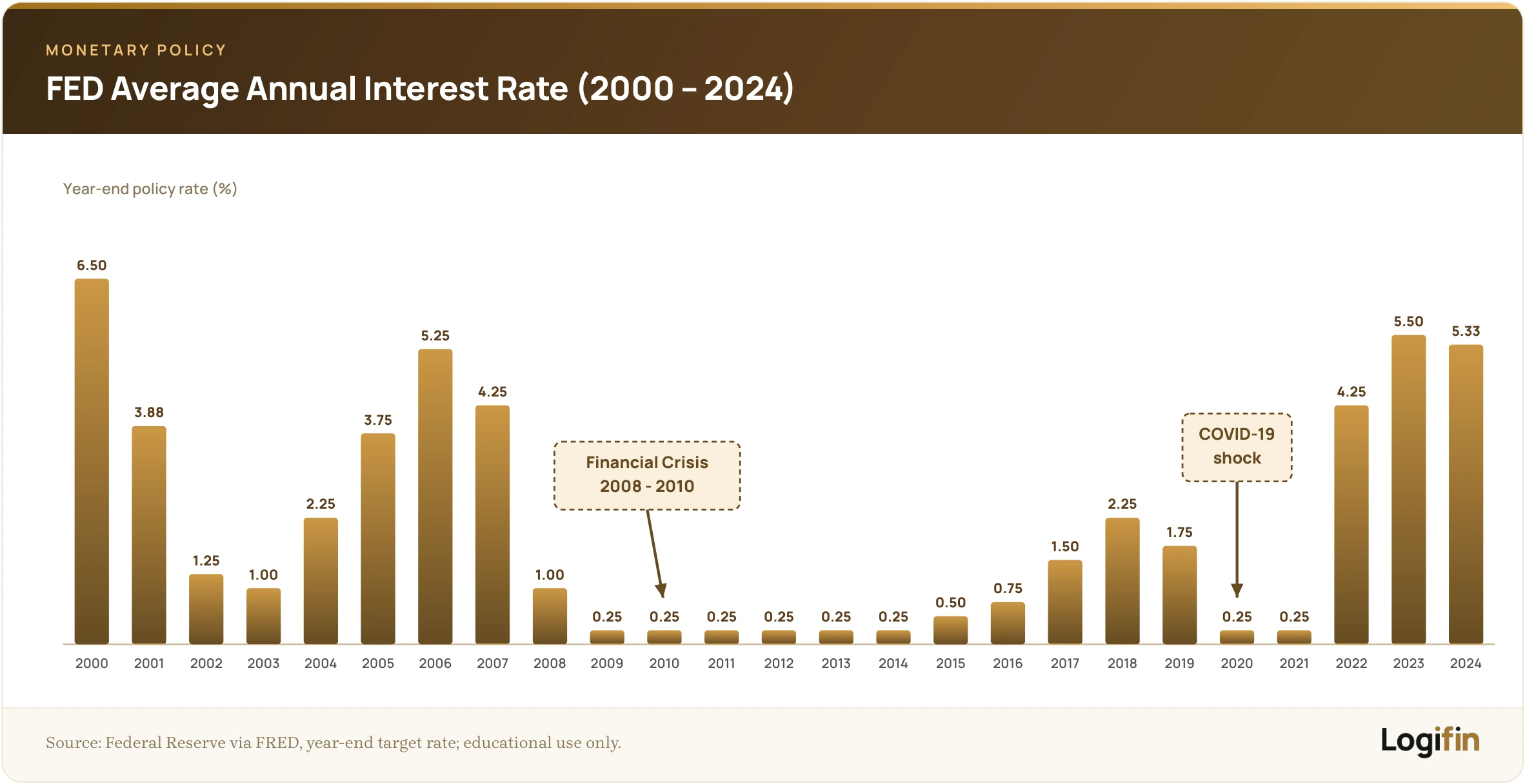
When central banks (for example the Fed and the ECB) raise interest rates to curb inflation, the cost of borrowing for businesses and households goes up.
This leads to:
- lower consumption,
- fewer investments,
- a slowdown in growth.
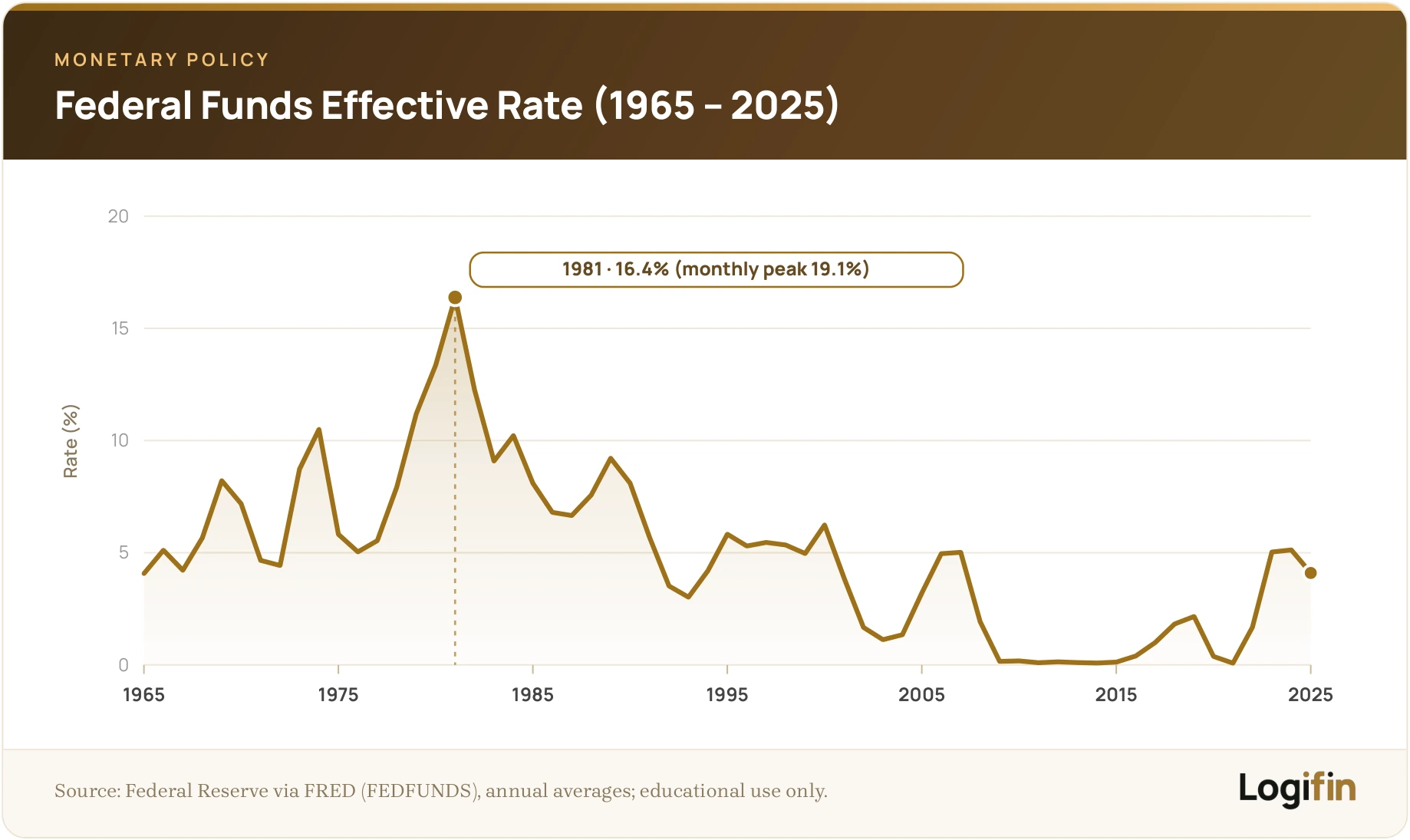
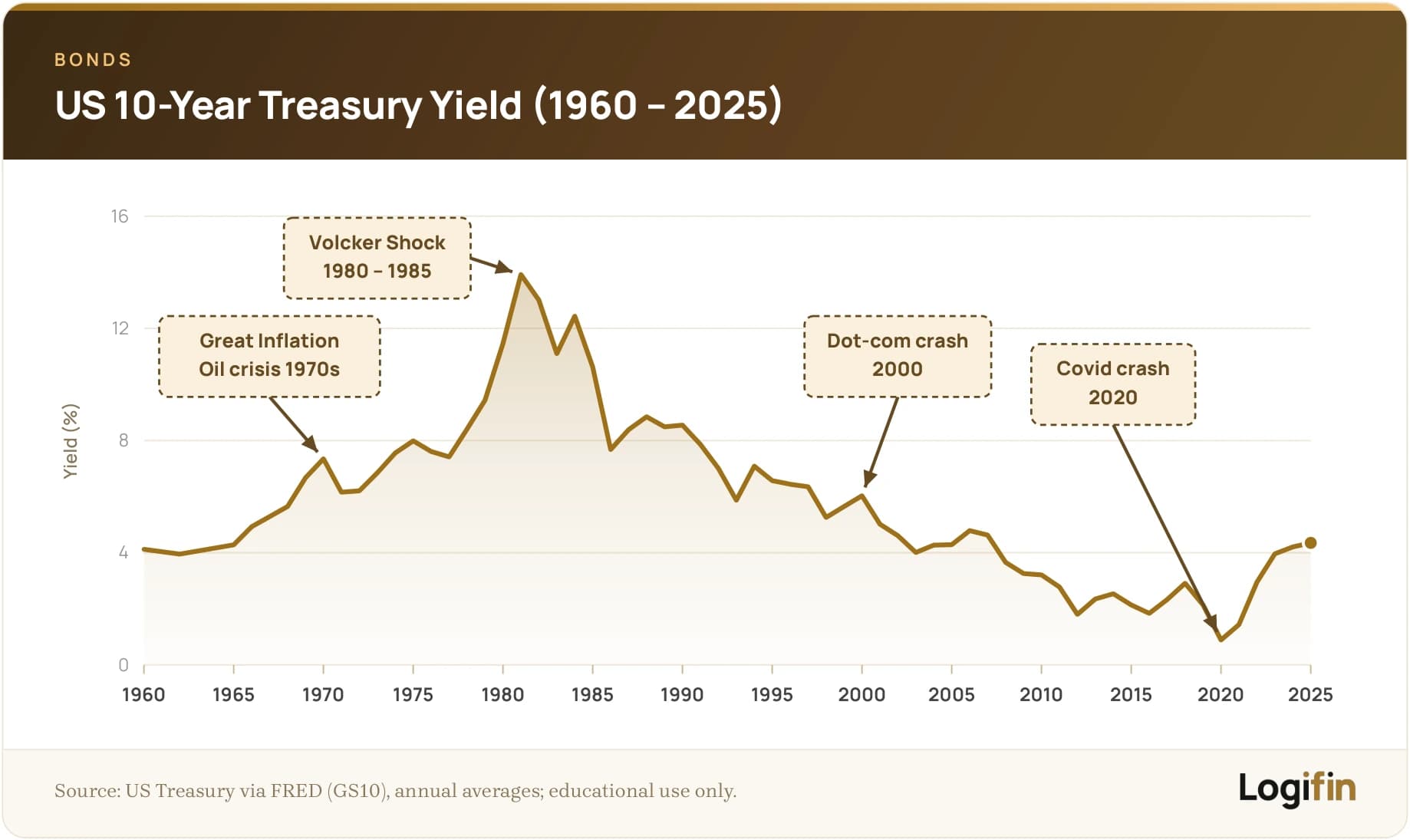
Example: In the early 1980s, Paul Volcker led the Fed into one of the most aggressive rate-hiking cycles in history, reaching almost 20% (Federal Reserve History). This policy pushed the U.S. into a double-dip recession, but it eventually crushed double-digit inflation and restored monetary stability.
🔶 A drop in consumer demand
Consumption is the heart of the economy, since in many developed countries it accounts for more than 60–70% of GDP.
When consumers cut back on spending (out of fear for the future, rising unemployment or falling incomes), the blow to the economy is immediate.
- Businesses sell less.
- To adjust, they cut production.
- This leads to layoffs and rising unemployment.
- Lower employment reduces incomes and consumption even further.
This creates a vicious cycle that feeds the recession and can last months or even years if governments or central banks do not step in.
🔶 Disruptions to production
The economy is affected not only by monetary and financial factors, but also by external shocks.
Wars, pandemics, natural disasters or energy crises can cause a serious drop in production and freeze supply chains.
- Raw materials become scarcer or more expensive.
- Factories are forced to cut back or halt operations.
- Businesses delay deliveries and cannot meet demand.
- Costs rise while productivity falls, creating recessionary conditions.
Example: In 2020, the Covid-19 pandemic caused an unprecedented shutdown of factories, disruptions at ports and in supply chains, leading to a simultaneous recession in almost every economy on the planet.
🔶 Financial crises
The financial system is the backbone of the economy.
When banks or money markets freeze, the flow of capital to businesses and households is cut off.
Without financing, businesses cannot invest or pay suppliers and employees, so the recession becomes inevitable.
- Banks restrict lending.
- Consumers and businesses cannot finance basic needs.
- Confidence in the system collapses, intensifying the vicious cycle.
Example:
- The 2008 crisis began with high-risk mortgage loans (subprime mortgages) in the U.S.
- Banks had bundled these loans into complex financial products, which collapsed when borrowers started to default.
- The collapse of major banks and financial institutions triggered the most severe global crisis since the Great Depression of 1929.
🔶 Excesses and bubbles
Often, recessions do not start from an external crisis, but from the excesses that precede them.
When a market rises quickly and reaches levels that are not justified by fundamentals, a bubble forms.
- It may involve technology stocks, real estate, equity markets or even a new investment fad (for example crypto).
- As the price keeps rising, investors become overly optimistic and pour in more and more money, feeding the vicious cycle.
- But when reality returns, the sharp correction does not stay confined to the markets; it drags down the real economy too: reduced wealth, lower consumption, layoffs.
Example: The dot-com bubble of 2000, where technology companies with no real profits were valued at dizzying heights, led to a market collapse and a slowdown in the global economy.
How do you recognise that the economy is entering a recession?
A recession is not announced overnight; it is a process that unfolds over time.
Even so, there are specific indicators that send early signals that the economy is starting to turn downward.
🔶 GDP (Gross Domestic Product)
The most classic and widely used way to measure a recession is Gross Domestic Product (GDP).
According to the simple rule, when an economy posts two consecutive quarters of negative growth, it is considered to be in a technical recession.
- GDP measures the value of all goods and services produced in a country.
- Its decline reflects lower consumption, lower investment and often problems with exports.
- Although simple, this definition does not always capture the full picture (for example the labour market, incomes and industrial production).
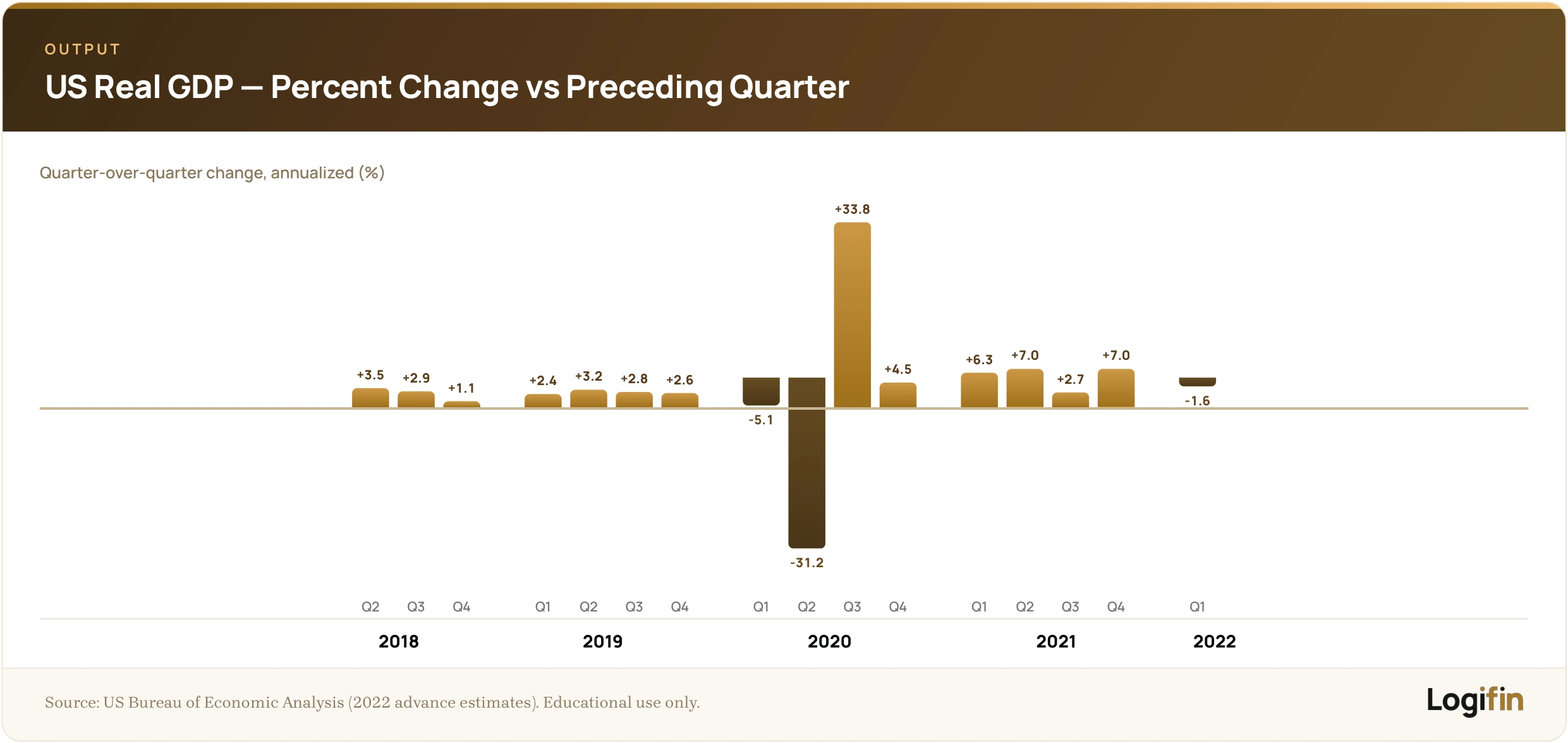
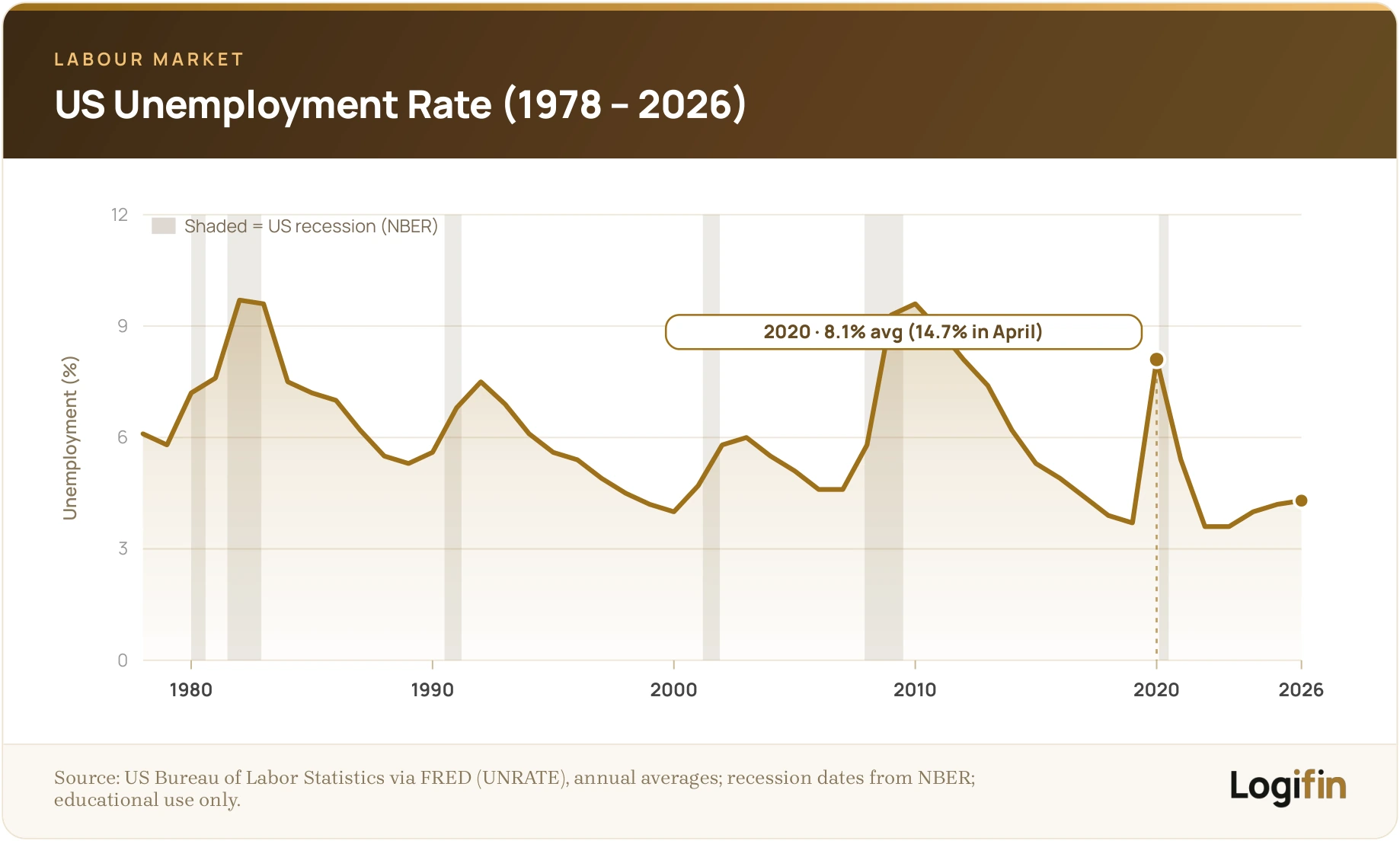
Example: In 2020, the U.S. economy collapsed abruptly because of the COVID-19 pandemic: GDP plunged by 31% at an annualised rate in the second quarter and unemployment spiked to 14.7% (BEA; BLS).
The NBER designated the March–April period as a recession, the shortest in history, since unprecedented monetary and fiscal support led to a rapid recovery and a return to growth as early as the third quarter.
🔶 Production and industrial activity indicators
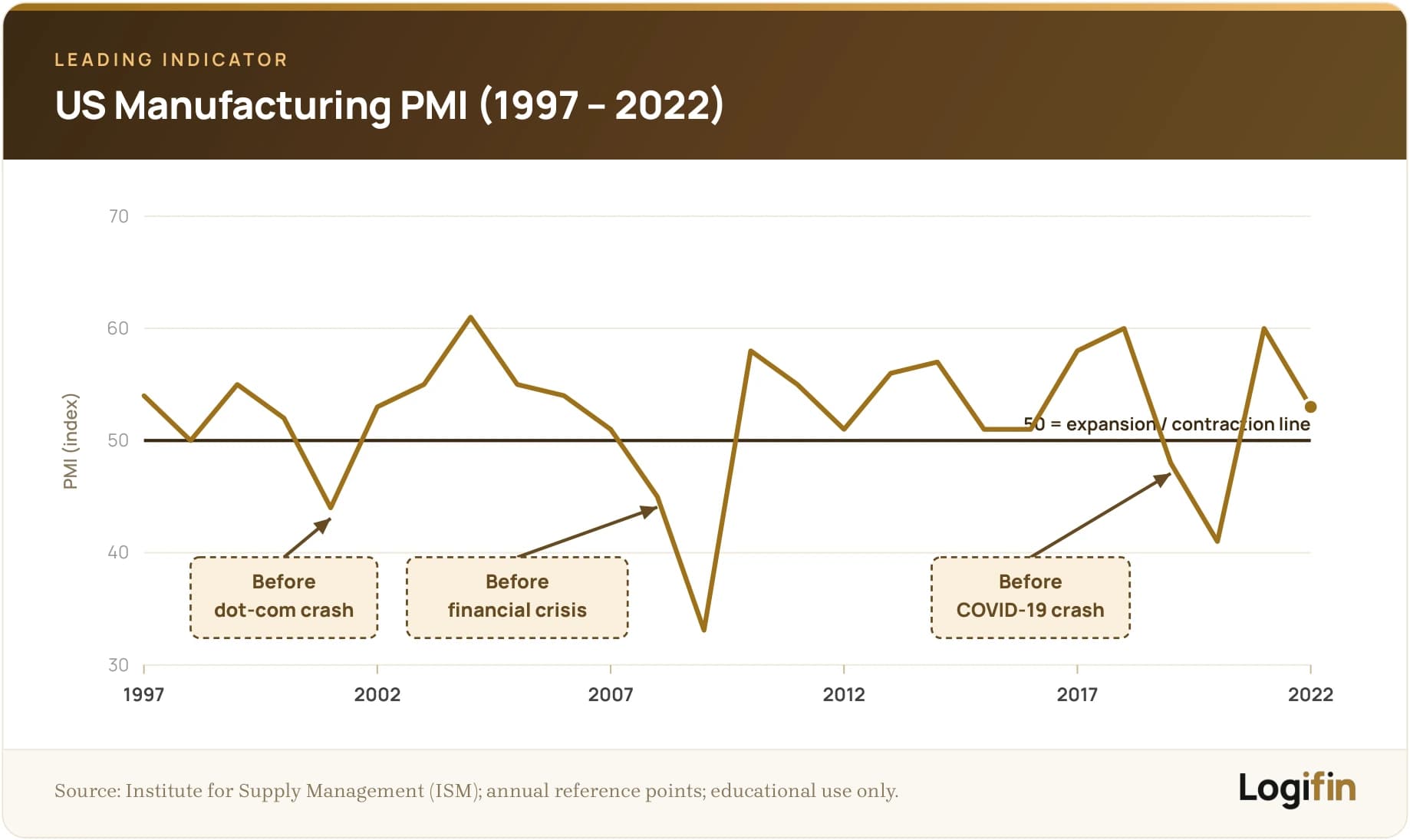
One of the most useful leading indicators of the economy is the PMI (Purchasing Managers’ Index).
It is based on surveys of purchasing and production managers, who have a direct view of orders, inventories and employment.
- Values above 50 point to growth and an expansion of economic activity.
- Values below 50 signal contraction and a tendency towards recession.
The PMI is considered a leading indicator, because it often shows the direction of the economy months before it appears in the more lagging indicators, such as unemployment.
Example: During the 2020 pandemic, the global PMI plunged below 40, capturing the sharp drop in production and demand before it fully showed up in GDP.
🔶 Unemployment and the labour market
The labour market is one of the most reliable lagging indicators of the economy.
When unemployment is at very low levels, it usually means the economy is in a growth phase.
But when it starts to rise, even from a low base, it is a sign that growth has reached saturation and the slowdown has begun.
- Businesses reduce hiring and begin layoffs.
- Falling incomes hit consumption.
- Lower demand leads to a new cycle of contraction.
🔶 Consumer confidence
Consumption is the main lever of the economy and is directly affected by the psychology of citizens.
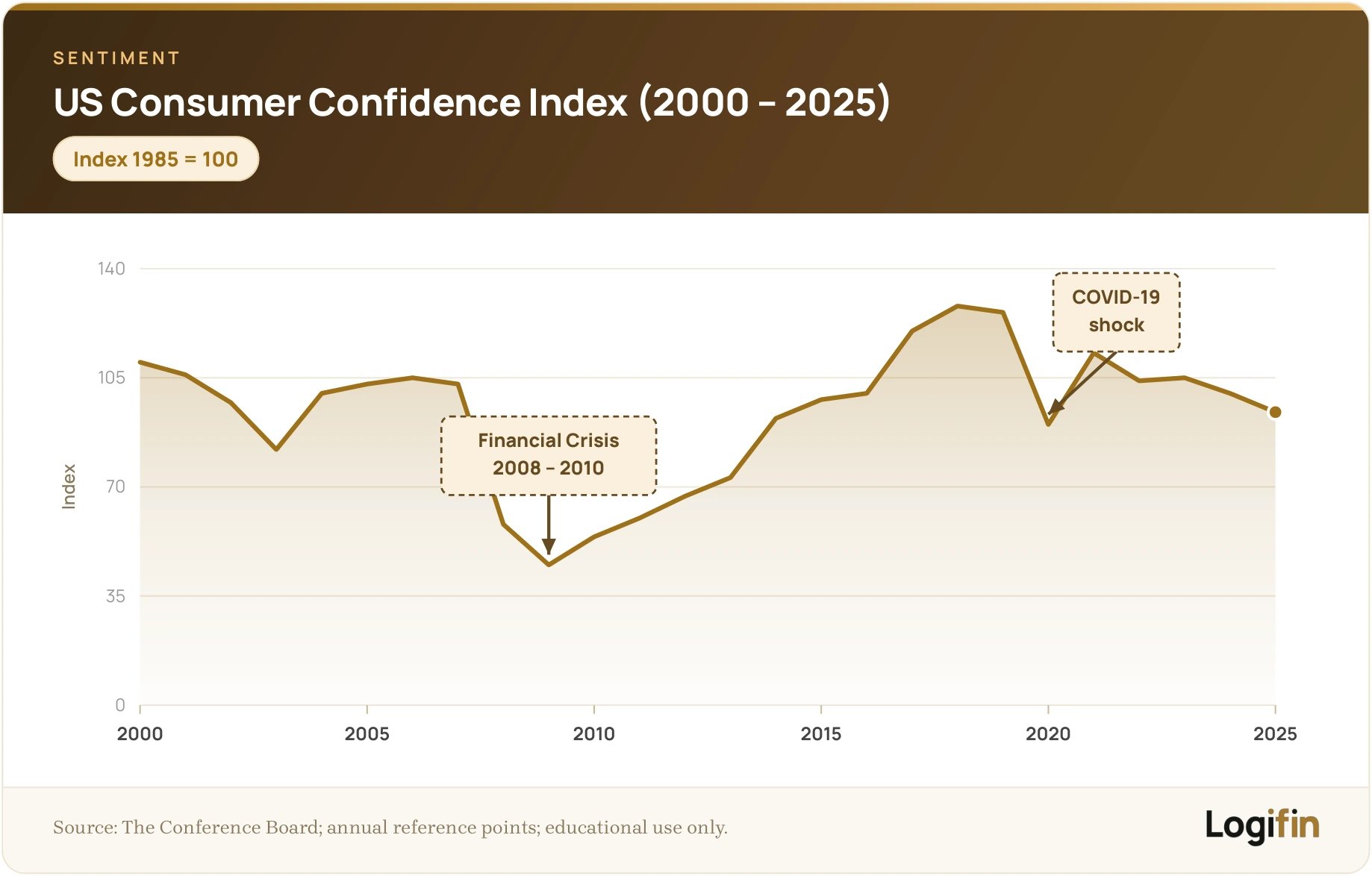
Indicators such as the Consumer Confidence Index (CCI) or the University of Michigan Sentiment Index measure how consumers feel about their finances and about the future.
- When confidence is high, consumers spend more, supporting growth.
- When confidence falls, they cut spending, increase saving and postpone large purchases.
- This drop in demand can trigger a vicious cycle that leads to recession.
Example: During the Covid-19 pandemic in 2020, the U.S. consumer confidence index collapsed to multi-year lows, reflecting fear of income loss and unemployment. This drop preceded the large contraction in GDP.
🔶 Capital markets and financial stability
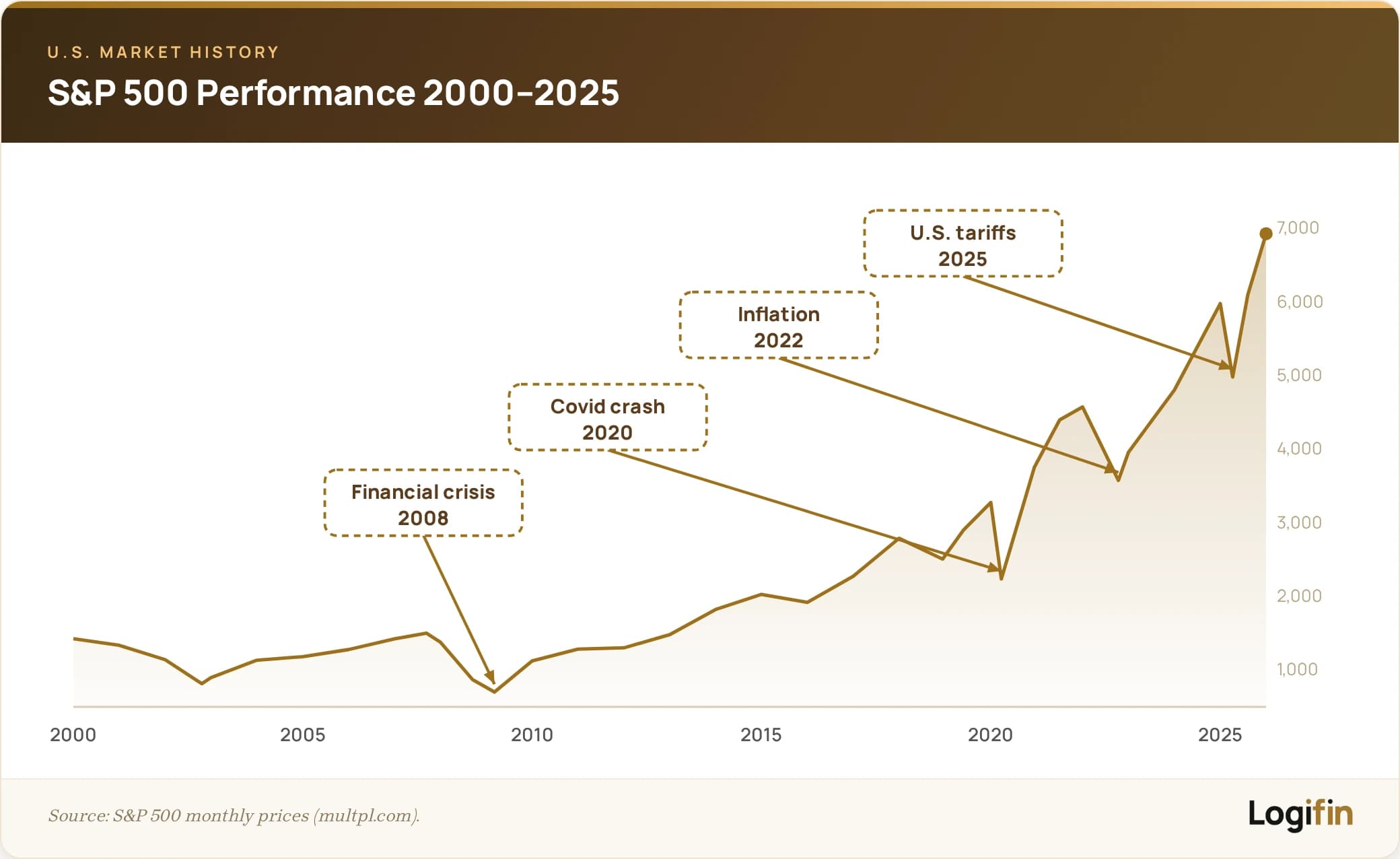
Financial markets often act as a barometer of the economy.
When investors fear a recession, that worry shows up almost immediately in stocks, bonds and credit markets.
- Falling stocks: investors price in lower earnings and reduced growth.
- Widening bond spreads: the extra cost of borrowing for countries and companies (relative to safe government bonds, for example those of the U.S. or Germany) rises, signaling increased risk.
- Tighter lending: banks tighten their lending criteria, making access to capital harder for households and businesses.
Example: In 2008, shortly before the crisis peaked, spreads on corporate bonds spiked, stocks collapsed and banks drastically restricted lending, signaling the onset of a recession.
How does a recession affect the markets?
A recession does not hit only the real economy (jobs, consumption, production); it also has a direct impact on the financial markets.
For the investor, understanding these effects is decisive, because it determines whether you will stay calm or panic.
🔶 Stocks
Stocks are the asset that is affected the most.
Companies see their revenue and profits shrink, as consumers cut back on spending and investments freeze.
- The sectors that depend on consumption (retail, automobiles, technology) usually take the hardest hit.
- By contrast, the so-called defensive sectors (healthcare, food, utilities) tend to hold up better, since their products are considered essential.
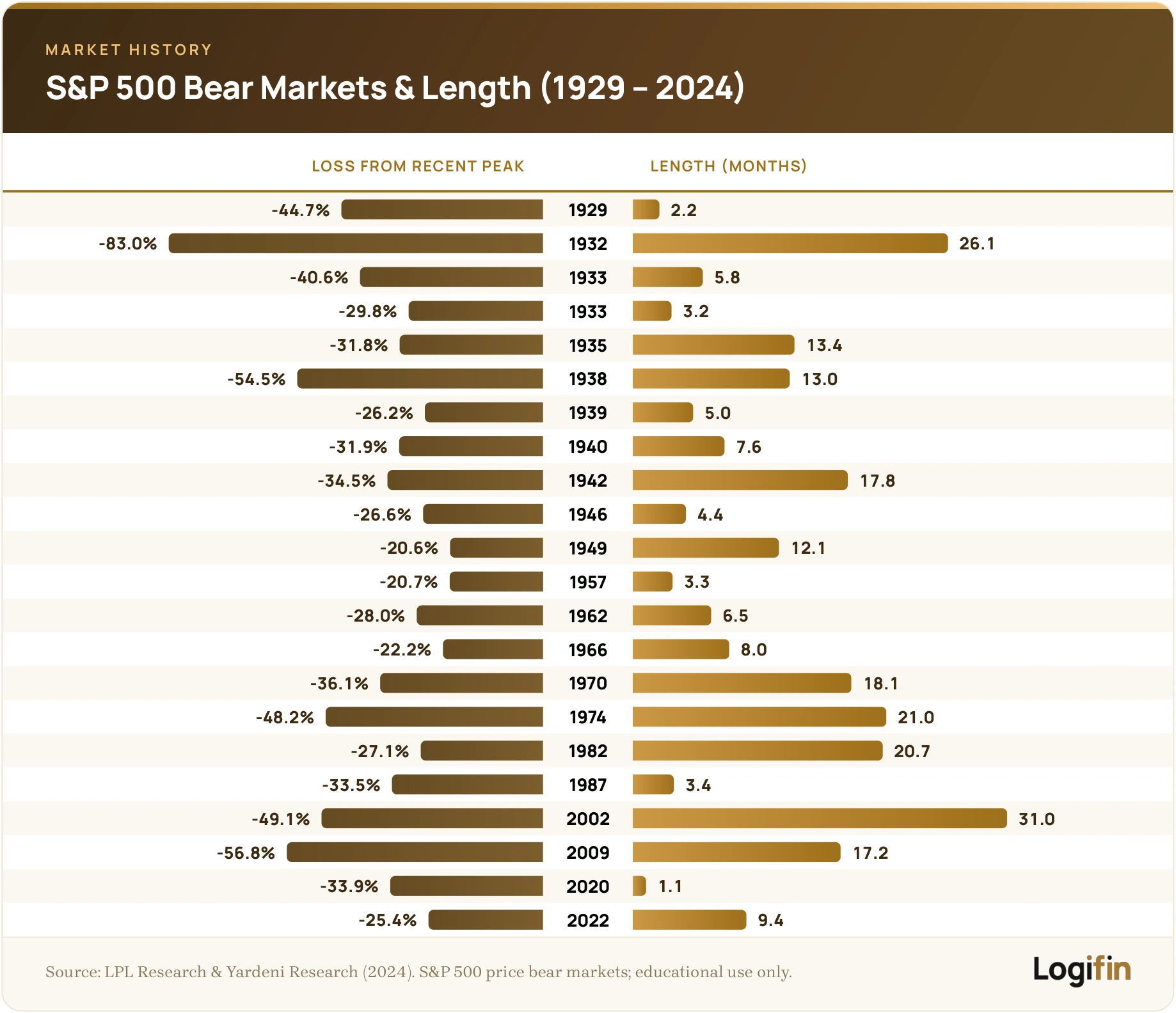
Example: In the 2008–2009 crisis, the S&P 500 fell by ~57% (Federal Reserve History), with banks and real estate collapsing. Over the same period, however, food and consumer-staples companies recorded smaller losses.
🔶 Bonds
Government bonds are often seen as a safe haven during recessions.
- Demand for bonds rises as investors seek safety.
- This leads to lower yields and higher prices.
- Corporate bonds, especially those with lower credit ratings, can come under pressure on default fears.
In the 2020 recession (the Covid crash), U.S. government bonds (10-year Treasuries) saw their yields fall to historic lows, while corporate spreads spiked.
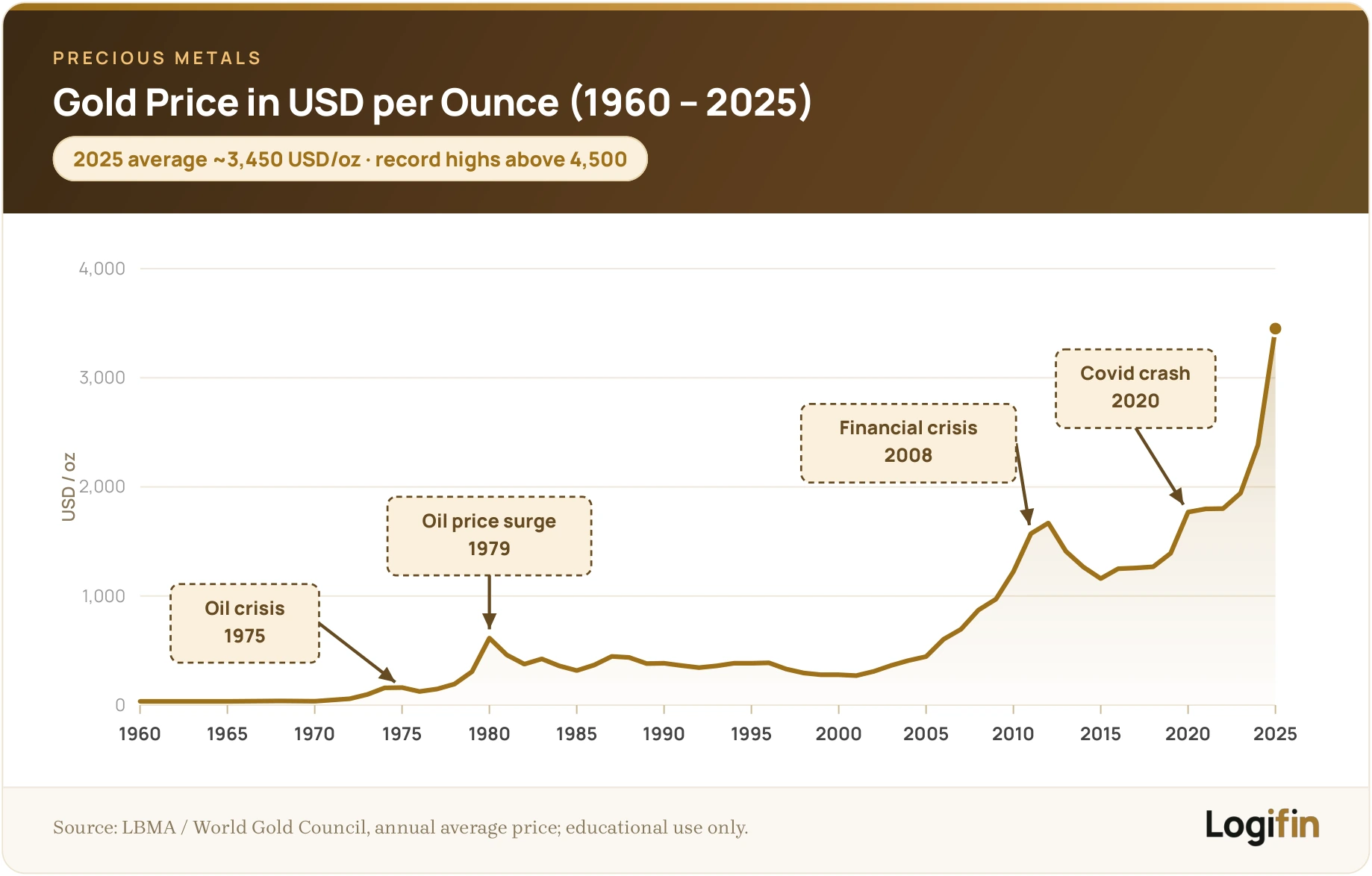
🔶 Precious metals
Gold and silver traditionally act as a hedge during crises.
They often hold their value or even rise when stocks fall.
At the same time, they attract investors who fear inflation or the stability of the monetary system.
Example: In the 2008 crisis, gold soared from about $800/oz to more than $1,800 within a few years.
🔶 Currencies
Currency markets often act as a mirror of global anxiety.
In recessions, investors tend to seek out the so-called safe havens.
So currencies such as the U.S. dollar (USD), the Swiss franc (CHF) and the Japanese yen (JPY) strengthen, since they are considered more stable and reliable in times of crisis.
By contrast, the currencies of countries with:
- high public or private debt,
- heavy dependence on commodities,
- lower confidence in the markets,
often weaken, since investors view them as riskier.
Example: During the 2008 financial crisis, the U.S. dollar strengthened significantly against the euro and other currencies, as investors liquidated positions and sought safety in the world’s strongest reserve currency.
🔶 Real estate markets
Recessions often leave a strong mark on the real estate market too.
The decline in household purchasing power, combined with higher interest rates, makes access to mortgage credit harder and reduces demand for new homes.
- Borrowers struggle to secure new loans or to service existing ones.
- Real estate investors see lower valuations and higher financing costs.
- The drop in transactions creates a vicious cycle that pushes prices down even further.
Example: In the 2008 crisis, the collapse of the U.S. real estate market was the main cause of the financial crisis. Home prices fell dramatically, leading to mass foreclosures and the destabilisation of the banking system.
Historical examples of recessions and their impact
History is a valuable guide for the investor.
Recessions repeat with different causes and intensities, but they leave behind lessons that can prepare you better for the future.
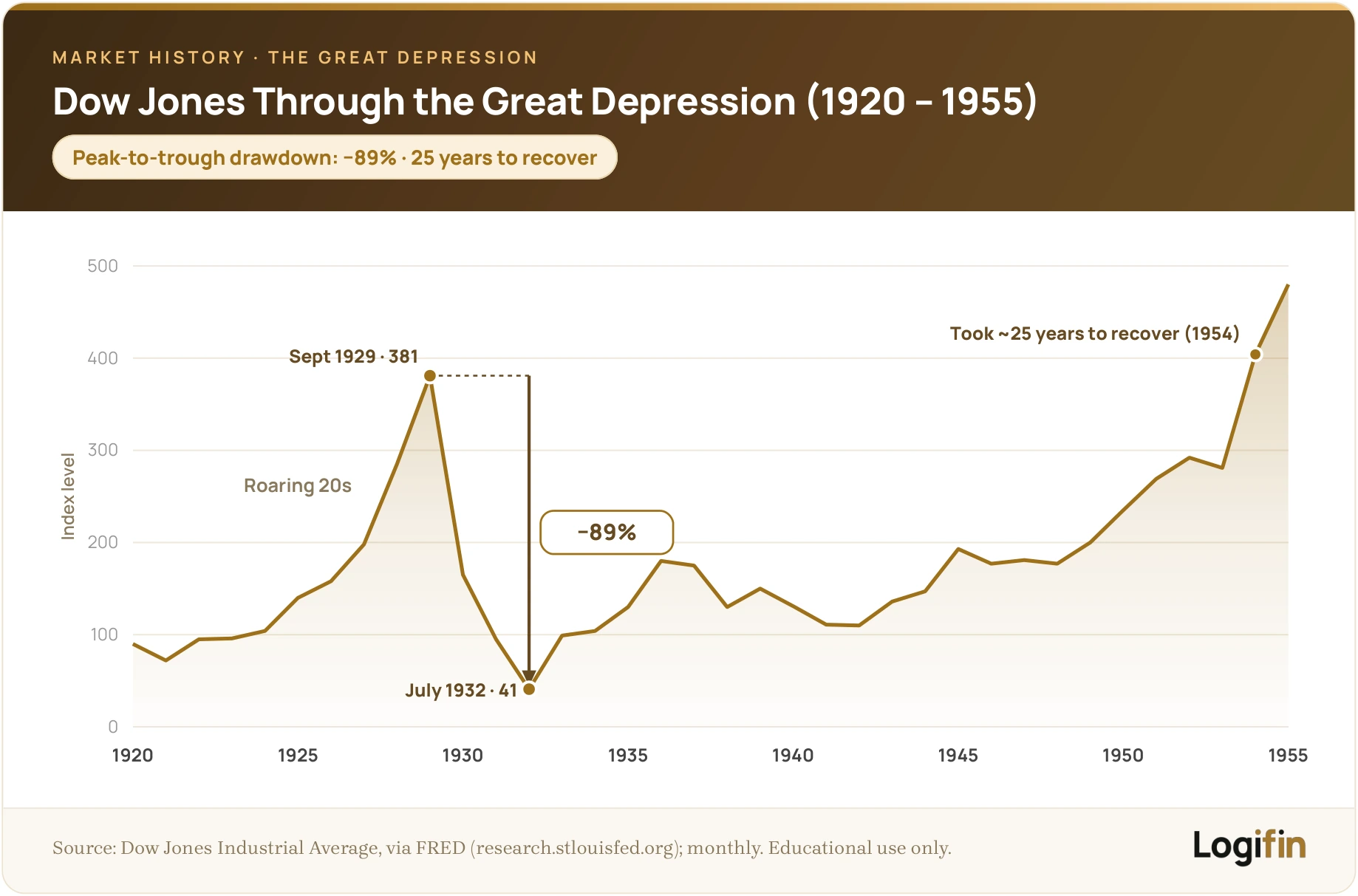
🔶 The Great Depression (1929–1939)
The Great Depression is the most extreme example of an economic crisis in modern history and a reference point for how markets can collapse when excessive leverage, banking instability and a lack of institutional protection combine.
It started with the stock market crash of 1929 and developed into the deepest and longest-lasting recession of the 20th century.
The crisis was not confined to the markets; it ran through the entire real economy.
- U.S. GDP fell by almost 30%, a magnitude unthinkable by today’s standards.
- Unemployment spiked to 25%, leaving millions of people without income or social security.
- The banking system largely collapsed, with mass bank failures and loss of deposits.
- Stocks needed more than 20 years to return to their pre-crash levels in nominal terms.
The Great Depression does not just show how badly things can go. It shows why today we have:
- central banks with an active role
- deposit guarantee systems
- regulatory frameworks and market-support mechanisms
For the modern investor, the lesson is not fear.
It is the need for diversification, institutional safety and a long-term strategy.
The markets evolved precisely because they learned from this period.
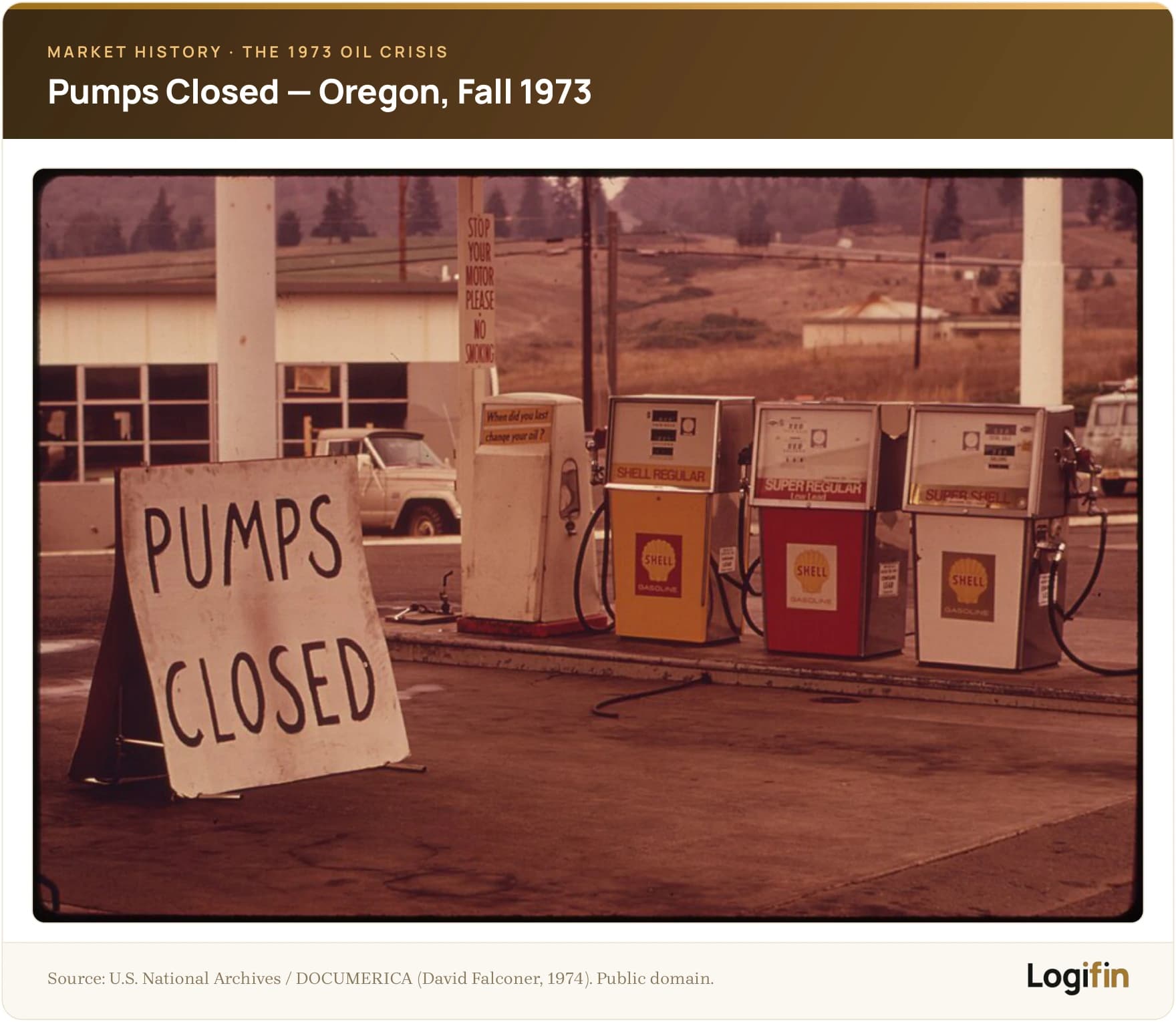
🔶 The oil crisis (1973–1975)
The oil crisis of the 1970s is one of the most characteristic examples of how geopolitical developments can violently disrupt the global economy.
The sharp rise in oil prices, after the OPEC embargo of 1973, caused a phenomenon that until then was considered almost theoretically impossible: stagflation.
That is:
- high inflation, due to surging energy costs
- low or negative growth, as economies slowed down
- rising unemployment, with reduced investment and consumption
Unlike the classic recessions, central banks were then caught in a deadlock.
Raising rates to fight inflation worsened the recession, while easing to support growth fed further price increases.
From an investment standpoint, this period was particularly difficult:
- Stocks collapsed, as corporate earnings were squeezed and valuations declined.
- Bonds suffered large losses, because high inflation eroded real returns.
- By contrast, the prices of oil and gold soared, acting as a hedge against inflation and uncertainty.
The oil crisis of 1973–1975 remains a key case study to this day. It shows that:
- inflation can be just as dangerous as a recession
- traditional stock-and-bond portfolios are not always sufficient
- real assets play a critical role during energy and geopolitical shocks
For the modern investor, the message is clear: diversification is not a luxury but a necessity, especially when crises do not follow textbook economic scenarios.
🔶 The Dot-com recession (2001)
In the late 1990s, investors had bet heavily on technology and internet companies, many of which had no profits, no steady cash flows and no viable business model.
Optimism about the new internet created excessive valuations and a classic bubble of expectations.
The bubble peaked in 2000 and then burst violently.
The Nasdaq Composite recorded a drop of almost 78% within two years, as investors abruptly revised their expectations.
The consequences for the economy were clear:
- The U.S. economy entered a recession.
- Unemployment rose to roughly 6%, mainly in sectors linked to technology.
- Thousands of startups collapsed or were absorbed.
- Investors lost trillions of dollars in market capitalisation.
From an investment standpoint, this period was especially painful, particularly for those who had over-concentrated in hot technology stocks without diversification or quality criteria.
Despite the severity of the decline, the recession proved relatively short.
The main reason was the decisive intervention of the Federal Reserve, which eased monetary policy, lowering rates and supporting liquidity.
At the same time, technology did not disappear. On the contrary:
- the weak business models were weeded out
- the strong companies survived and evolved
- the ground was laid for the later rise of the giants we know today
The dot-com bubble shows that:
- innovation does not guarantee investment success
- valuations matter, even in new eras
- diversification and quality protect you in extreme phases
Markets can overshoot both on the way up and on the way down.
The investor who survives is the one who does not equate technological progress with certain profits and keeps discipline when enthusiasm prevails.
🔶 The Financial Crisis (2007–2009)
The financial crisis of 2008 began with the bubble in the U.S. real estate market and the mass issuance of high-risk mortgage loans (subprime mortgages).
For years, easy access to borrowing and low interest rates created the illusion that property prices would rise forever.
But when borrowers started to default, the chain broke. These loans had been bundled into complex financial products and scattered across banks, insurers and investment funds around the world.
The losses were not confined to the housing sector, but spread across the entire financial system.
The crisis peaked in 2008 with the bankruptcy of Lehman Brothers, an event that acted as a catalyst for panic. Confidence vanished almost overnight and the global banking system was on the brink of collapse.
The effects on the markets and the real economy were dramatic:
- The S&P 500 fell about 57% in less than a year and a half (Federal Reserve History).
- U.S. unemployment exceeded 10%, as businesses collapsed or proceeded with mass layoffs.
- Millions of people lost their homes to foreclosures and their jobs to the recession.
- The crisis spread rapidly worldwide, leading to a deep global recession.
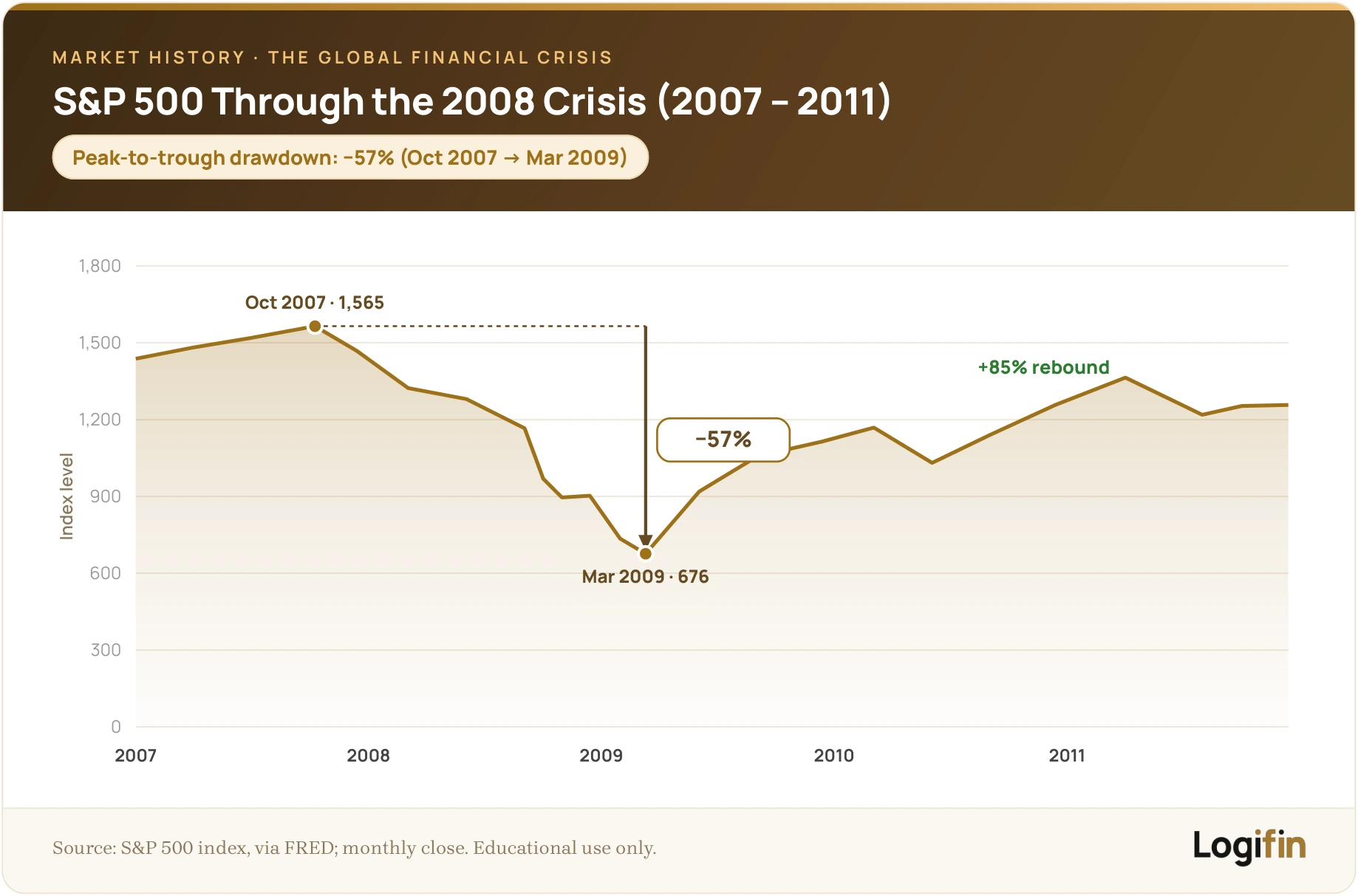
This crisis was not just a market decline. It was a systemic failure that exposed:
- the danger of excessive leverage
- the importance of transparency in financial products
- how quickly confidence in the system can be lost
At the same time, it was a turning point.
It led to stricter regulatory frameworks, stronger bank supervision and a more active role for central banks in handling crises.
🔶 The Covid-19 Pandemic recession (2020)
The Covid-19 pandemic caused an unprecedented global recession.
Governments imposed lockdowns and strict travel restrictions, which froze most of the world’s economies almost simultaneously.
The shock was immediate and violent.
- The GDP of many countries collapsed within a single quarter, recording the largest postwar decline.
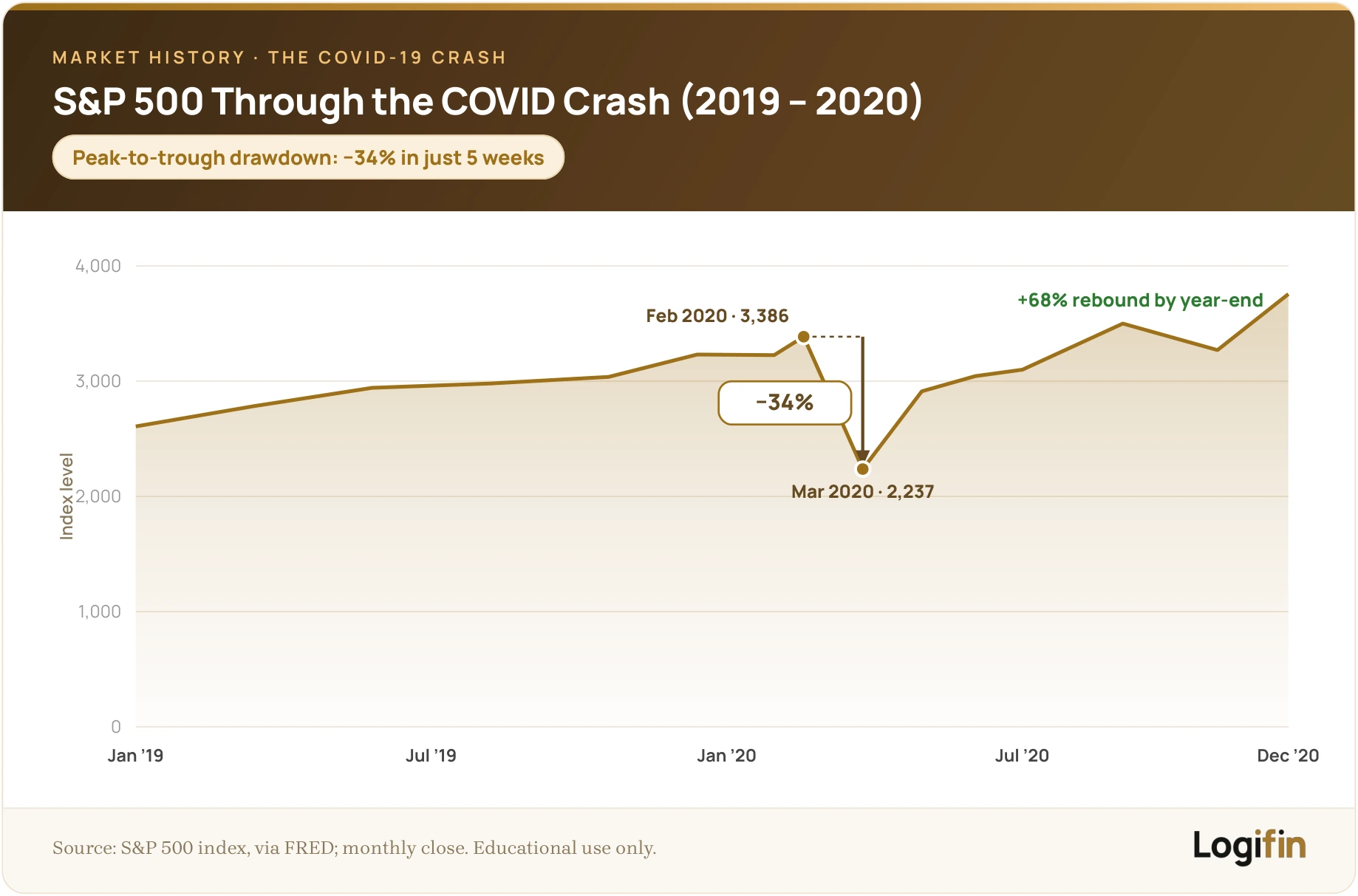
- Stock markets plunged by up to 35% within a few weeks, peaking in March 2020.
- Uncertainty was total, as no one knew the duration or the intensity of the health crisis.
Yet the recovery was one of the fastest in history!
The following were activated immediately:
- zero or near-zero interest rates
- quantitative easing (QE) programmes on a massive scale
- direct subsidies to businesses and workers
- government guarantee and liquidity-support programmes
This combination of policies quickly stabilised the markets and restored confidence, driving stocks to new all-time highs within a relatively short time.
The 2020 recession offers a crucial lesson:
- External shocks such as pandemics or natural disasters can cause sharp and violent declines, regardless of the economy’s fundamentals.
- But, unlike in the past, governments and central banks now have tools for immediate and large-scale intervention.
- The speed of response now plays a role as important as the crisis itself.
The 2020 pandemic did not cancel the long-term logic of the markets. It confirmed it, in the sharpest way.
🔶 Common lessons from all recessions
Although every recession has its own characteristics, history shows that there are recurring patterns worth knowing for every investor.
These patterns are far more useful than trying to predict the next crisis.
- Recessions arise either from internal excesses (bubbles, leverage) or from external shocks (oil, pandemics).
- All recessions are accompanied by falling confidence, high unemployment and shrinking consumption.
- Despite the severity, the markets always recover in the long run, creating new all-time highs.
The crucial lesson is not to avoid recessions; that is impossible. It is to never let a recession push you out of the market for good.
How can you prepare as an investor for a recession?
A recession is certain to happen again; the only thing we do not know is when.
Proper preparation does not mean you can avoid it, but that you will withstand it and, if you are strategic, come out stronger.
🔶 Build an emergency fund
The first step is not an investing one but a defensive one.
Before you start building a portfolio, you need an emergency fund that covers 3–6 months of basic expenses.
This is placed in a simple, safe savings or term-deposit account, not in the market.
- It protects you when the market falls or when an unexpected need arises (for example job loss or health expenses).
- It prevents the worst mistake an investor can make: selling investments at the bottom just to cover daily expenses.
- It gives you psychological calm so you can let your long-term investments work without stress.
Example: If your fixed expenses are 1,800 €/month, then you need roughly 5,400–10,800 € in easily accessible cash to cover basic needs for 3–6 months.
🔶 Portfolio diversification
A recession does not hit all assets in the same way.
A well-diversified portfolio reduces losses during crises and offers you greater stability and resilience over time.
In practice, this means combining different asset classes:
- Stocks. They are the main engine of growth over time. They offer higher returns, but also greater volatility.
- Bonds. They act as a stabilizer of the portfolio. They offer lower volatility and often more predictable income.
- Gold or other real assets. They can act as a hedge in periods of inflation, geopolitical tension or crises of confidence in the financial system.
- Cash. It provides liquidity and flexibility. It lets you take advantage of buying opportunities when markets are falling, without being forced to sell other assets.
Diversification does not protect you from every decline. But it protects you from the big loss that can push you out of the game for good.
And that is the most important element for an investor who thinks long term.
🔶 Consistency with DCA
The Dollar Cost Averaging (DCA) strategy is probably the most effective tool during a bear market.
Instead of trying to time the market, you invest the same fixed amount every month, regardless of whether prices go up or down.
- When prices fall, you buy more units with the same amount.
- When prices rise, you buy fewer, but you have already built up positions at lower levels.
- So your average acquisition cost falls and when the recovery comes, your gains are larger.
🔶 Prepare your psychology
- Bear markets are not only economic events; they are also psychological tests.
- A 30–40% drop in your portfolio can make you feel that everything is being lost and lead you to the biggest mistake: selling at the bottom.
- Psychological pressure makes you see losses as permanent, when in reality they are temporary.
- History has shown that markets always recover, but only those who stay invested enjoy the recovery. Composure is often more valuable than any technical strategy.
Remember that bear markets are phases of the cycle and not the end of the market. If you have built a sound plan and an emergency fund, composure is your strongest weapon.
Example: In the 2020 crisis, those who sold at the market bottom needed months or years to recover their losses. But those who held their positions saw their portfolios return to new highs in less than a year.
🔶 Re-examine your risk and your portfolio allocation
Bear markets are the best stress test for your portfolio.
That is where you see whether the allocation you have chosen truly matches the level of risk you can bear.
- If you panic at a 20% decline, you probably have too much exposure to stocks or other risky assets.
- If you stay calm and follow your plan, then your strategy is properly aligned with your psychology and your goals.
Re-examining does not mean changing everything in the middle of a bear market; it means drawing conclusions about how you should shape your allocation in the future.
Example: If a portfolio of 80% stocks / 20% bonds frightens you at the first correction, it may be better to move to a more conservative ratio (for example 60% stocks / 40% bonds).
🔶 Keep flexibility
Preparing for a recession does not mean rigidity.
Markets do not move only downward; significant opportunities also appear during periods of decline.
Quality companies, with healthy balance sheets and steady earnings, often trade at bargain prices when fear dominates the market.
- Keep a portion of liquidity in your portfolio, so you have the ability to take advantage of such opportunities.
- Do not get trapped in inaction; the strategy must adapt to conditions.
- Flexibility gives you an advantage over investors who are forced to stay idle due to a lack of cash.
Bear markets are often like sale periods for patient investors.
As with big sales, the key is to buy quality products (strong companies) and not whatever is cheap.
Conclusion and practical takeaways
A recession is a difficult but entirely normal phase of the economic cycle.
Its effects on the markets, on businesses and on daily life can be intense, but for the investor proper preparation and composure make the difference between disaster and opportunity.
🔑 What to keep in mind
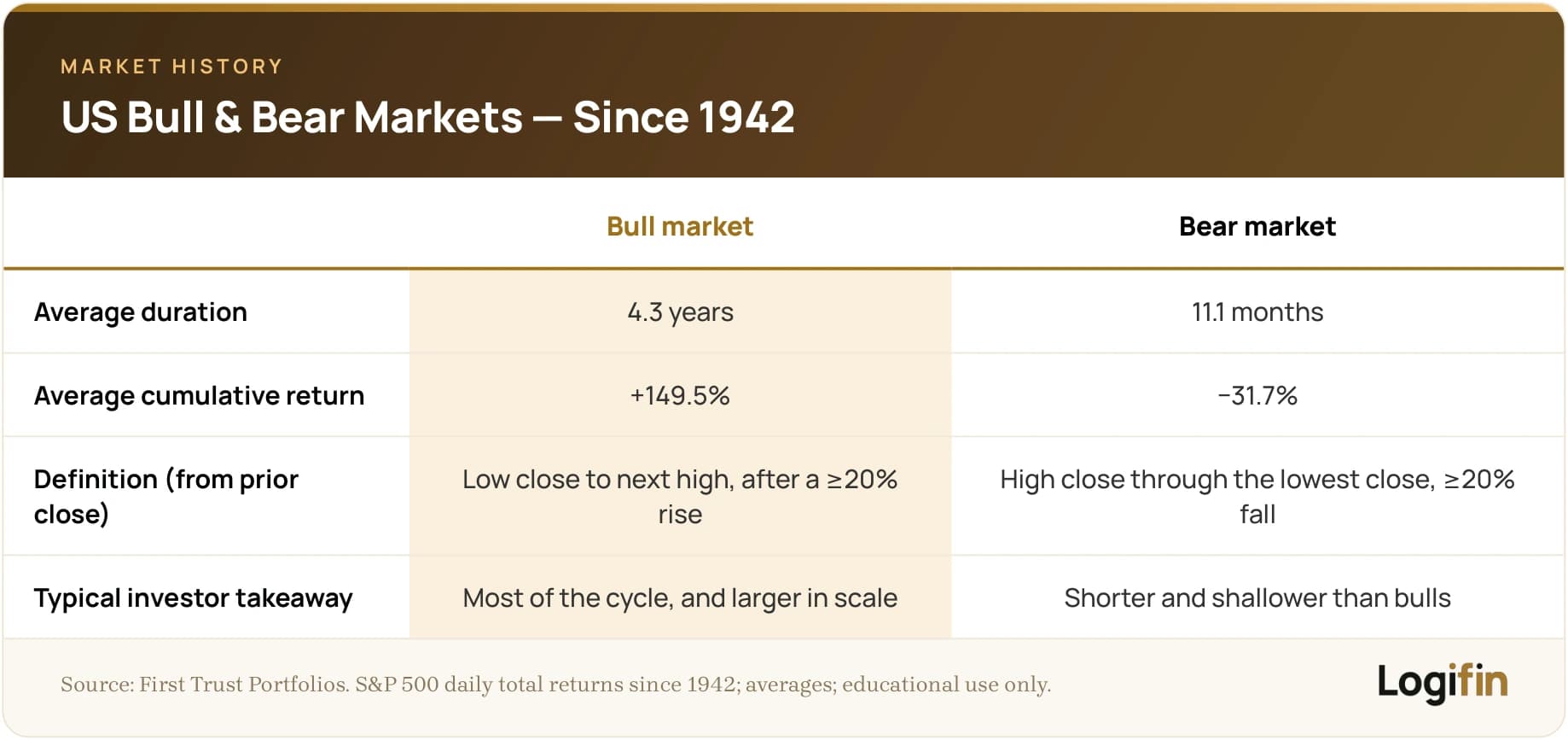
- Recessions are inevitable but temporary.
- They negatively affect consumption, employment and corporate earnings.
- They do not hit all assets the same way: stocks fall, while bonds and gold often act as a safe haven.
- Diversification, the emergency fund and DCA are powerful tools of protection.
- History shows that after every recession comes new growth.
Practical tips for new investors:
1️⃣ Always keep liquidity so you do not liquidate investments at the bottom.
2️⃣ Diversify your portfolio so you can withstand any scenario.
3️⃣ Stay consistent with DCA: declines are an opportunity to buy cheaply.
4️⃣ Do not panic: recessions are psychologically hard, but statistically the market always recovers.
A recession is not the end; it is a stage of the cycle.
For those who have a plan, discipline and patience, it can turn into an opportunity. The market will find its upward path again; the question is whether you will be there to follow it.
The content of this article is provided exclusively for informational and educational purposes and does not constitute investment advice or a recommendation to buy or sell financial products. The information is based on publicly available sources considered reliable, without any guarantee of accuracy or completeness. Before making any financial or investment decision, it is recommended that you consult a certified professional advisor or accountant, taking into account your own financial situation and risk profile. The Logifin team bears no responsibility for any direct or indirect damages arising from the application of the information presented.
Related articles

What are the signs before a bear market?
How to read the macroeconomic indicators, the market behaviour and the investor psychology that often appear before a fall of more than 20%.
19 min read

What is inflation and how does it affect your investments?
The “invisible tax” that reduces purchasing power and changes the rules of the game for investors
16 min read

What is the Fed and what is its role?
The world’s most powerful central bank and why its decisions affect every investor
15 min read

Minimalism and investing: Can they coexist?
How the idea of less but better organises your spending and leads to a simple portfolio you can hold for years without second guessing it.
14 min read
EXPLORE LOGIFIN
Everything you need in order to learn, plan and track your investments.
Logifin Blog
Learn everything you need to get your finances in order and invest with confidence.
Logifin Insights
What moves the markets and what it means for a long term investor. Short and without the noise.
Logifin Tools
Free, inside the site, no signup. Everything you calculate stays on your device.
Logifin ETF Hub
Find the ETF that fits you: 550+ UCITS ETFs, smart filters and in-depth comparisons.
Logifin Guides
A series of guides that builds your investment plan step by step. The first guide is free for everyone.
Logifin Circle
The tools and the Hub are free for everyone. You become a member for the intelligence that never stops.