How much you should save and invest each month
What the data says, what the well-known rules suggest and how to find the number that fits your own life.
24 July 2025 · 11 min read

Why saving and investing are worth it (even starting small)
Your savings rate is the part of your net income that you set aside every month, either as savings or as investments, instead of spending it.
It is perhaps the most decisive number in your personal finances, because it shapes your future even more than the size of your salary itself.
Saving and investing are the two pillars of a stable financial life, with distinct roles: the first protects you from surprises, the second grows your capital over time.
Neither requires a big salary or complicated products. They require something simpler and at the same time harder: habit and consistency.
If you are wondering whether your own amounts are too small to be worth it, remember what we saw in our article on compound interest: even small monthly contributions, when they start early and are not interrupted, build capital that is hard to believe at the start of the journey.
The question, therefore, is not whether it is worth it, but how much makes sense for you to set aside, with your own income and at your own stage of life.
There is no single magic number for everyone here. There are, however, data, rules and a practical way to arrive at your own target.
Let us take them in order.
How much do others save? What the data says
Before you set your own target, it helps to know where the average stands. According to Eurostat, the household saving rate in the euro area hovered around 14-15% of disposable income in 2025. In other words, the average European household sets aside roughly one euro out of every seven it earns.

The average, however, hides enormous differences. Behind the 14% there are households that save more than a quarter of their income and households that cannot set aside a single euro, living paycheck to paycheck. The rate depends on income, the country’s cost of living, the stage of life and, not least, on habits.
What does this mean for you?
That a rate in the region of 10-15% is a realistic target for the average European with a steady income: close to the average, achievable without extreme sacrifices and enough to build meaningful capital over a decade. If you are below that today, do not be discouraged. As we will see below, the starting point matters far less than the direction.
The three best-known income allocation rules
There is no single right “recipe” for how to allocate your income, but there are simple rules that have helped millions of people gain stability and start building their capital.
Allocation rules are not laws, they are scaffolding: they give you a ready-made structure to get started, until you build your own.
The three most widely used are the following:
- The 50/30/20 Rule: the best-known
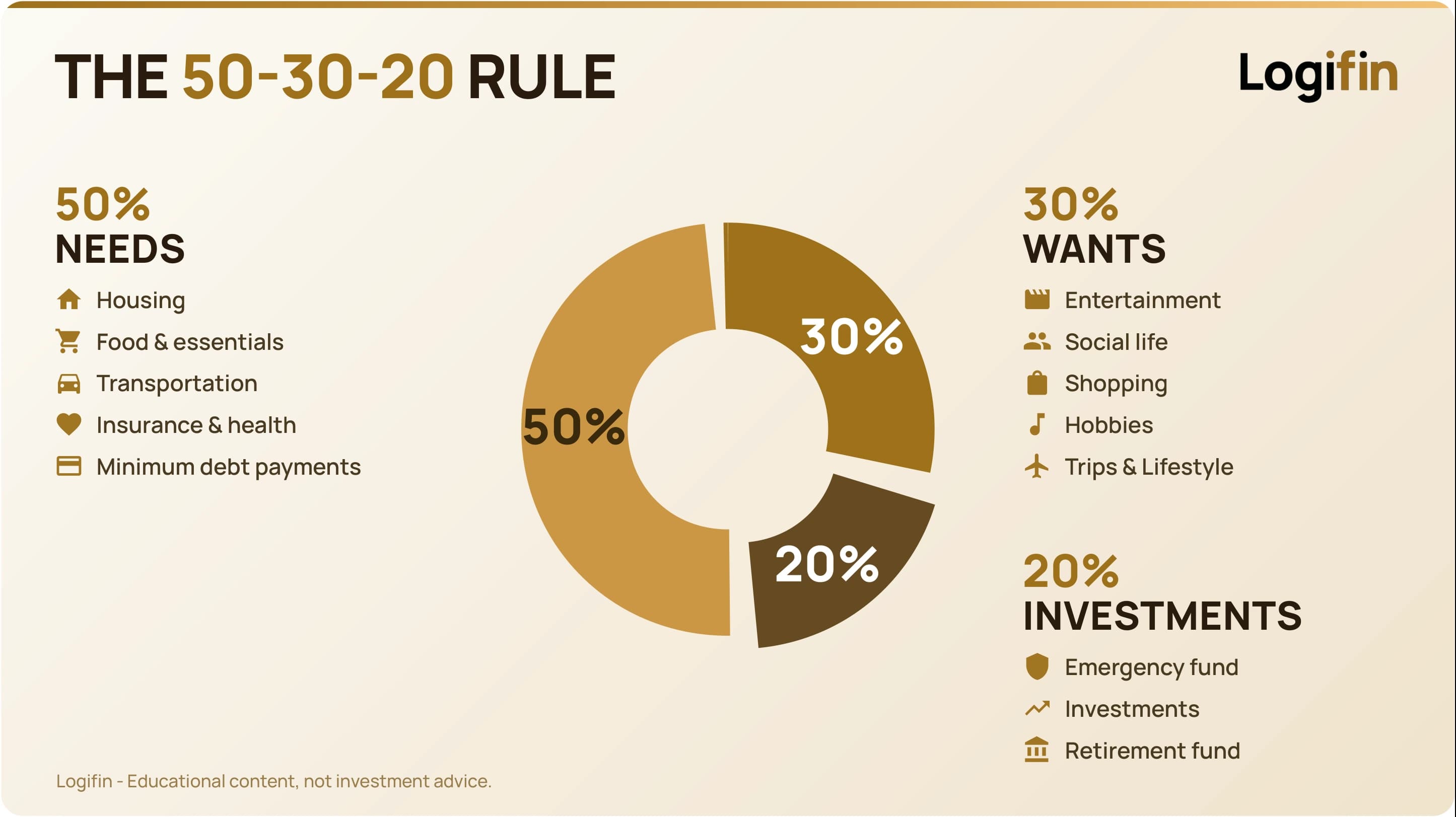
The 50/30/20 rule is perhaps the most recognizable budgeting system in the world, precisely because it is simple, clear and applicable by anyone, regardless of income.
It divides your net income into three distinct categories that help you understand where your money goes and develop healthy financial habits.
- 50% for basic needs: rent or mortgage, groceries, bills, transportation, insurance.
- 30% for wants: entertainment, travel, shopping, nights out, anything that makes life more enjoyable.
- 20% for savings and investments: emergency fund, debt repayment, ETFs, pension contributions.
Ideal for: beginners who want balance without deprivation.
It organises your spending in a way that does not restrict your everyday life, while at the same time putting you on a path of saving and investing. We have analysed it step by step in our article on how to create a budget.
In other words, it is the most accessible rule for making your finances clearer, without dramatically changing your lifestyle.
- The 70/20/10 rule: the easiest to apply
Here, you do not need to separate needs from wants, which in practice is the hardest part of the 50/30/20. All expenses, essential and non-essential, go into one single “bucket”, so tracking becomes a matter of just one number.
- 70% for all expenses: housing, bills, food, transportation, entertainment, subscriptions, everything you spend during the month.
- 20% for savings and investments: emergency fund, ETFs, long-term goals.
- 10% for debt or donations: extra payments beyond the minimums, or giving to causes that matter to you.
Ideal for: those who want structure without categorising every expense. It only requires one point of attention: total expenses should not go above 70%.
- The 60/30/10 rule: the most realistic for tight budgets
The milder version, designed for cases where the cost of living absorbs a large part of income and 20% for the future simply does not work.
- 60% for needs: housing, bills, groceries, transportation, with more room than the 50/30/20 for expensive housing.
- 30% for wants: the same role as in the 50/30/20, so everyday life does not feel deprived.
- 10% for the future: savings, investments or debt repayment. Less than ideal, but enough to build the habit.
Ideal for: lower incomes or countries with high housing costs. An honest 10% that is followed beats a theoretical 20% that is abandoned.

Which rule is the “right” one?
The one you can stick to. A rule that fits you 90% is infinitely more useful than an “ideal” one that you will abandon in two months.
Use the percentages as a starting point and adjust them to your own reality, not the other way around.
Your savings target by life stage
The how much is not fixed for life. It changes along with the priorities of each decade.
The following are indicative targets commonly found in financial planning, not rules that should stress you:
- In your 20s: priority goes to the first emergency fund of 3-6 months of expenses and to paying off any expensive debts. An automatic 5% of your salary is enough to build the habit, because at this stage the habit is worth more than the amount.
- In your 30s: the emergency fund grows to 6+ months, while the savings target climbs gradually towards 15-20% of net income. This is also where the first big named goals come in: home, family, education.
- In your 40s: if income allows, the bar rises above 20%, with a separate pot for retirement and attention to income protection (insurance, health).
- In your 50s and beyond: the weight shifts from accumulation to planning: you calculate the real cost of living you want to fund, while savings gradually start turning into future income, as we saw in our article on Accumulating vs Distributing ETFs.

If you are reading the list and find yourself behind your decade, keep this in mind**: these targets describe an ideal path, not the only one**.
Starting today at 5% at age 38 is infinitely better than not starting at all because you should have been at 15%.
How much you can save based on your income
Percentages become more tangible when you turn them into euros.
Example:
- On a net monthly income of 1,500 €, the 50/30/20 rule translates into 750 € for needs, 450 € for wants and 300 € for saving and investing.
- On a 1,000 € income, the same 20% means 200 €, while on 2,500 € it means 500 €.
In practice, however, the rate one can sustain is not the same across incomes.
The lower the income, the larger the share absorbed by essentials: the rent does not shrink because the salary shrinks.
This is why at lower incomes an honest 5-10% is often more realistic than a theoretical 20%, while at higher incomes 20% can comfortably become 25% or 30% without a sense of deprivation.

The most useful advice here fits in one sentence: start from the rate that does not hurt and increase it gradually.
A 5% that starts today and rises by one percentage point every quarter reaches 13% within two years, without you ever feeling an abrupt change in your daily life.
Gradual escalation beats grand declarations almost every time.
How to start if you feel you cannot afford it
The "nothing is left over" objection is the most common one, which usually hides an ordering mistake: we wait for money to be left over at the end of the month, but at the end of the month almost nothing is ever left.
The solution is to reverse the order with five practical steps:
- Pay yourself first: transfer 20-50 € to a separate account on the day your salary arrives, before any other expense. What leaves first is never spent by accident.
- Separate safety from growth: one account for the emergency fund and a separate one for investments. When everything goes into the same bucket, everything gets spent with the same ease.
- Raise the bar little by little: add 5 € to the monthly transfer every two to three months. The increase is invisible in daily life, but visible in the account balance.
- Find the hidden money: unused subscriptions, duplicate insurance, forgotten charges. A typical 30-day tracking exercise, like the one we described in the budgeting article, usually uncovers 15-30 € per month that disappear with nothing in return.
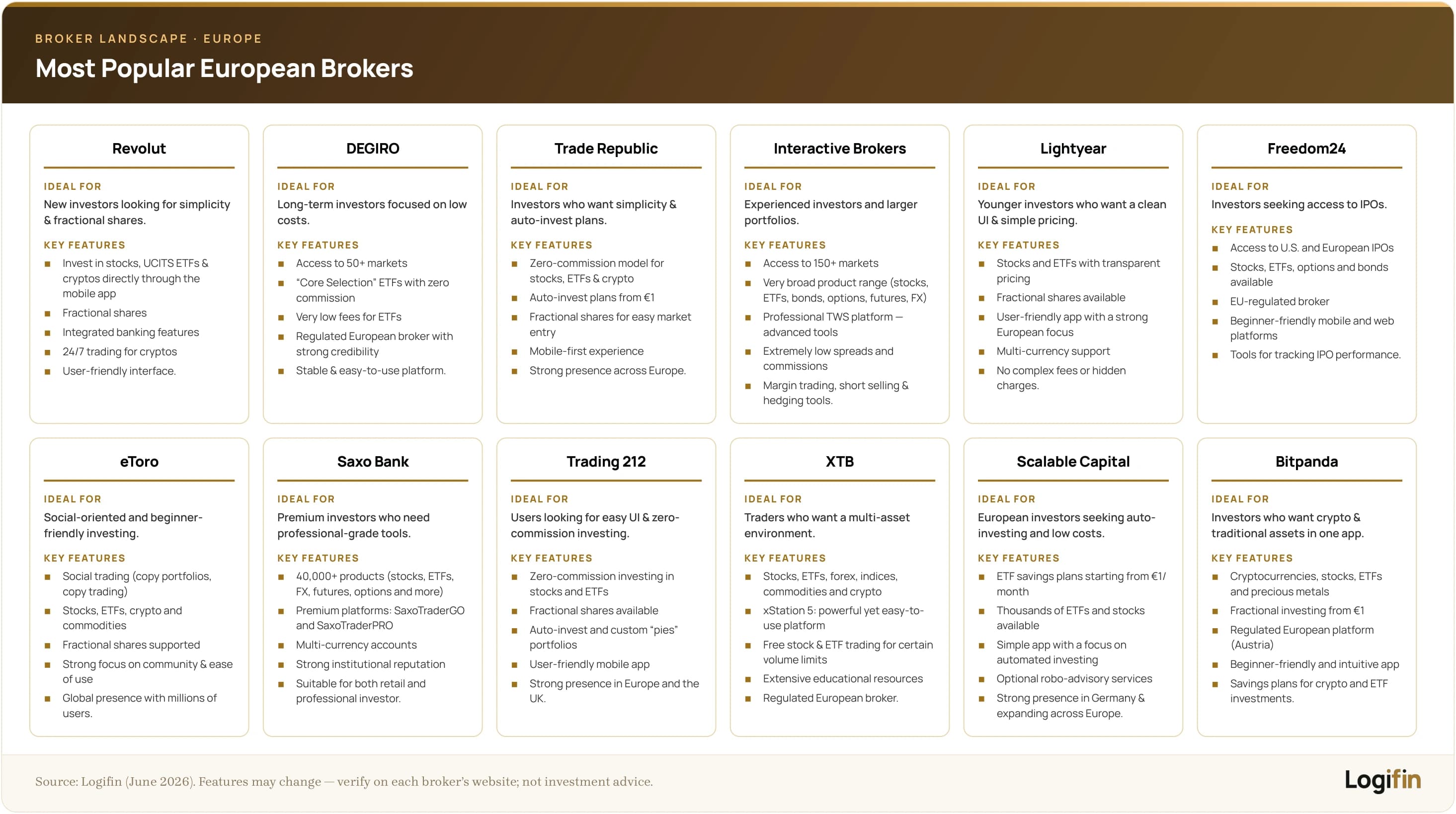
- Start investing with small amounts: many platforms today allow fractional ETF purchases from a few euros, so even 20-30 € per month into a diversified, low-cost ETF sets compounding in motion.
- And a sixth, less technical one: give your goal a name. Saving is vague. Building a 3,000 € emergency fund by next year is a motive that survives even the difficult months.
How to keep the habit alive
The hard part is not starting. It is continuing when the initial enthusiasm fades, an expensive month arrives or you simply get bored.
A few principles make the difference between a habit that lasts years and a three-month plan.
- The first is automation. The standing order that runs on payday removes the need for a monthly decision; whatever requires no decision requires no willpower either.
- The second is a review every quarter or six months: half an hour to see whether the amount still fits you, whether something changed in your income and whether you can raise the bar a little.
- The third principle concerns surprises: one bad month does not cancel the system. If you had to skip a transfer, the plan did not fail. You continue the next month normally, without guilt and without the "it broke, so I quit" trap.
- Small intermediate milestones also help: the first 100 €, the first 500 €, the first six months of consistency. Each milestone you hit fuels the next one.
Finally, keep the division of roles clear: saving protects, investing grows. The emergency fund is not dead money because it earns nothing, it is what allows you to never touch your investments at a difficult moment.
The two together, each in its role, are what make a system resilient in any circumstances.
Conclusion and practical takeaways
How much should you ultimately save and invest each month? As much as you can keep setting aside consistently, heading towards 10-20% of your net income as your capacity grows.
The number you choose today matters less than you think. What matters is that there is a number, that it leaves automatically and that it grows over time.
🔑 What to keep in mind:
- The average European household saved around 14-15% of its disposable income in 2025 (Eurostat). A 10-15% rate is a realistic target for most people.
- Rules are scaffolding, not laws: 50/30/20 for balance, 70/20/10 for simplicity, 60/30/10 for tighter incomes. Choose the one you will stick to.
- Order beats amount: pay yourself first on payday. Whatever waits for the end of the month rarely survives.
- Saving protects, investing grows: first the emergency fund, then compounding. The two together make a system, not one without the other.
Practical Tips — find your own number in 4 steps:
-
Calculate 20% of your net income.
This is the 50/30/20 reference target. If it feels comfortable, start there. If not, move to the next step.
-
Start from the rate that does not hurt.
Even 5%, that is 60 € on a 1,200 € salary, is enough to establish the habit. Consistency at a small amount is worth more than ambition at a large one.
-
Automate the transfer on payday.
One standing order to a separate account for safety and one to your investments. Five minutes of setup, years of effortless discipline.
-
Raise the bar every quarter.
One percentage point or 5-10 € at a time.

The content of this article is provided exclusively for informational and educational purposes and does not constitute investment advice or a recommendation to buy or sell financial products. The information is based on publicly available sources considered reliable, without any guarantee of accuracy or completeness. Before making any financial or investment decision, it is recommended that you consult a certified professional advisor or accountant, taking into account your own financial situation and risk profile. The Logifin team bears no responsibility for any direct or indirect damages arising from the application of the information presented.
Related articles

What is the 50-30-20 rule and how can you apply it?
The simple rule that helps organise your finances and build financial stability
16 min read

How to create a budget that works in practice
A practical guide to taking control of your finances, step by step and without guilt.
12 min read

FIRE: The road to financial independence
What the FIRE movement is, how to calculate your own number and what you can keep from its philosophy, even if you are not aiming to exit at 40.
12 min read

What is a recession and how it affects investors?
How a recession is defined, what causes one, how the markets usually behave during it and what an investor can do to prepare in advance.
24 min read
EXPLORE LOGIFIN
Everything you need in order to learn, plan and track your investments.
Logifin Blog
Learn everything you need to get your finances in order and invest with confidence.
Logifin Insights
What moves the markets and what it means for a long term investor. Short and without the noise.
Logifin Tools
Free, inside the site, no signup. Everything you calculate stays on your device.
Logifin ETF Hub
Find the ETF that fits you: 550+ UCITS ETFs, smart filters and in-depth comparisons.
Logifin Guides
A series of guides that builds your investment plan step by step. The first guide is free for everyone.
Logifin Circle
The tools and the Hub are free for everyone. You become a member for the intelligence that never stops.