What are bonds and why do professionals invest in them?
What a debt security is, which types of bonds exist, what risks come with them and the role they play inside a portfolio.
20 August 2025 · 13 min read

What is a bond in simple terms?
A bond is a debt security.
In plain terms, when you buy a bond, you lend your money to a government, a bank, or a company, in exchange for the promise that it will be paid back to you in the future together with interest.
In essence, you act as a creditor and the bond is the contract that sets the terms of this “loan”.
Unlike a share (which means ownership in a company), a bond represents a lender–borrower relationship.
This entails specific characteristics that make it more predictable:
- you receive a fixed income (coupon/interest) at regular intervals,
- you know in advance when you will get your capital back (the bond’s maturity),
- in the event of bankruptcy, you have priority in repayment over shareholders, meaning lower risk compared with shares.
Example:
- If you buy a 10-year government bond worth 1,000 € with a 3% interest rate, you will receive 30 € per year for 10 years, while at the end you will get back the original capital of 1,000 €.
- If you hold it to maturity, you know your final return in advance, something that offers certainty compared with the volatility of shares.

👉 Bonds are traditionally considered a “safe haven”, especially when issued by reliable states such as the US or Germany.
But not all bonds are the same: government bonds are considered safer, while corporate bonds may offer higher returns but also greater risk.
That is why investors use them for balance in a portfolio, combining them with shares so as to reduce losses in difficult periods.
What are the main types of bonds?
Bonds are not all the same; they vary according to the issuer, the maturity, the currency and the degree of risk.
Understanding the main categories is essential, because each type plays a different role in a portfolio.
🔶 Government Bonds
They are issued by governments to finance their needs: from public investment to covering deficits.
Those considered safest are from countries with a strong economy and credit rating (e.g. US Treasuries, German Bunds).
Investors often choose them in times of crisis, because they are seen as a “safe haven” (flight to safety).
There are also so-called “high-risk” issues from countries with a weak economy or fiscal problems, which offer higher interest rates to attract buyers.
🔶 Corporate Bonds
They are issued by companies that need funding for growth, acquisitions or refinancing debt.
They usually offer a higher return than government bonds, but with greater default risk. They fall into:
- Investment Grade (from large, strong companies with good creditworthiness).
- High Yield / Junk Bonds (with greater risk, hence higher returns).
Their credit ratings from agencies such as Moody’s, S&P and Fitch are decisive in whether institutional investors will choose them.
Professionals often include them to raise a portfolio’s return, but offset them with safer assets for risk balance.
🔶 Municipal / Local Bonds
They are issued by municipalities or regions for infrastructure projects, schools and hospitals.
- In the US they are especially popular due to tax incentives (e.g. exemption from federal income tax).
- In Europe they are less widespread, but the rise of “green projects” has given them momentum.
Example: A municipality may issue a bond to finance the construction of a new metro or hospital, in exchange for a steady stream of payments to investors.
🔶 Green & Sustainable Bonds (Green / ESG Bonds)
This is a more recent category, linked to the sustainability trend.
The funds are used exclusively for projects with an environmental or social footprint.
- They include financing for renewable energy, energy-saving projects and “smart cities”.
- They attract institutional investors who want to incorporate ESG criteria into their portfolios.
- Although they are a small share of the overall market, their growth rate is rapid.
Example: The European Commission has established the NextGenerationEU Green Bonds framework, with the capacity to raise up to about 250 billion € by 2026, as part of financing the European recovery plan.

🔶 Fixed-rate vs floating-rate bonds
Bonds are not all the same. The way their interest rate is calculated directly affects both the income you receive and the risk you take in different economic environments.
- Fixed-rate bonds
With fixed-rate bonds, the investor knows from the start exactly the coupon amount they will receive each year until maturity.
This predictability makes them particularly attractive to those who want steady income and low uncertainty.
They work best when:
- interest rates are stable or on a downward path
- inflation is under control
- the priority is predictability rather than adaptability
However, in a rising-rate environment their value can come under pressure, as new bonds are issued with higher coupons.
- Floating-rate bonds
Floating-rate bonds have a coupon that adjusts periodically based on a reference rate, such as Euribor or a government rate.
This means the income changes according to market conditions.
They offer:
- greater resilience in periods of rising rates
- better protection from inflation than fixed-rate bonds
- lower sensitivity to central-bank rate hikes
In a high-inflation, rising-rate environment, floating-rate bonds usually become more attractive, as their coupon “follows” the market rather than staying static.

Why do professionals invest in bonds?
Although retail investors’ attention often turns to shares because of their high return, professional investors (insurance funds, pension funds, banks, asset managers) base a significant part of their portfolios on bonds.
The reason is no accident: bonds offer stability, predictability and capital protection, elements that are essential when you manage billions or have a responsibility towards pensioners and the insured.
🔶 Steady income
Bonds pay regular coupons (interest), securing a continuous flow of income regardless of market fluctuations.
- For pension funds, this predictability is critical, as they must pay pensions to millions of beneficiaries every month.
- For insurance companies, bonds act as a “cushion”, as they provide steady inflows against unpredictable claims.
🔶 Reducing portfolio risk
Bond prices often move inversely to shares in times of crisis.
Thus, they act as a hedge, reducing overall volatility.
When equity markets collapse, investors turn to bonds, raising their value.
This is also why the traditional “60/40” model (60% shares, 40% bonds) has remained popular for decades as a balancing strategy.
🔶 Priority in the event of bankruptcy
If a company goes bankrupt, bondholders are repaid before shareholders.
This makes bonds clearly less risky than shares, especially for investors who want to limit the risk of capital loss.
Example: In the 2008 Lehman Brothers bankruptcy, shareholders lost everything, while bondholders managed to recover part of their money through the liquidation.
🔶 Stability over a long-term horizon
Professionals do not chase only high returns, but also capital stability.
Investment-grade bonds offer this predictability, making them an ideal choice for institutions that manage huge sums and have long-term obligations.
🔶 ESG and strategic diversification
The rise of “green” and “social” bonds has attracted investors who want to combine return with responsible investing.
For institutional organisations, choosing these securities has not only financial value but also brand positioning, strengthening their image as socially responsible investors.
Risks of investing in bonds
Despite their advantages, bonds are not “bulletproof”.
They carry risks that may not be so obvious but directly affect their real return.
The main risks of investing in bonds relate to:
🔶 Lower returns
Over the long run, bonds cannot compete with shares in terms of total net return.
Their role is not explosive growth, but stability.
According to the UBS Global Investment Returns Yearbook 2026, over 1900–2025 (126 years) US equities returned 6.6% a year in real terms (after inflation), versus 1.6% for government bonds and just 0.5% for Treasury bills.

Such a return difference, when it works through compounding over decades, leads to enormous divergences in the final size of wealth.
🔶 Inflation risk
Inflation is perhaps the most insidious enemy of bonds.
When the rate of price increases exceeds a bond’s return, the investor loses real purchasing power, even if the coupon keeps being paid normally.
Example: A bond with a 3% coupon in a 6% inflation environment leads to a net negative return of -3%, eroding the value of the capital.
🔶 Interest-rate risk
Bond prices move inversely to interest rates.
When rates rise, existing bonds with a lower coupon become less attractive, so their value falls.
This creates book losses for anyone who needs to sell before maturity.
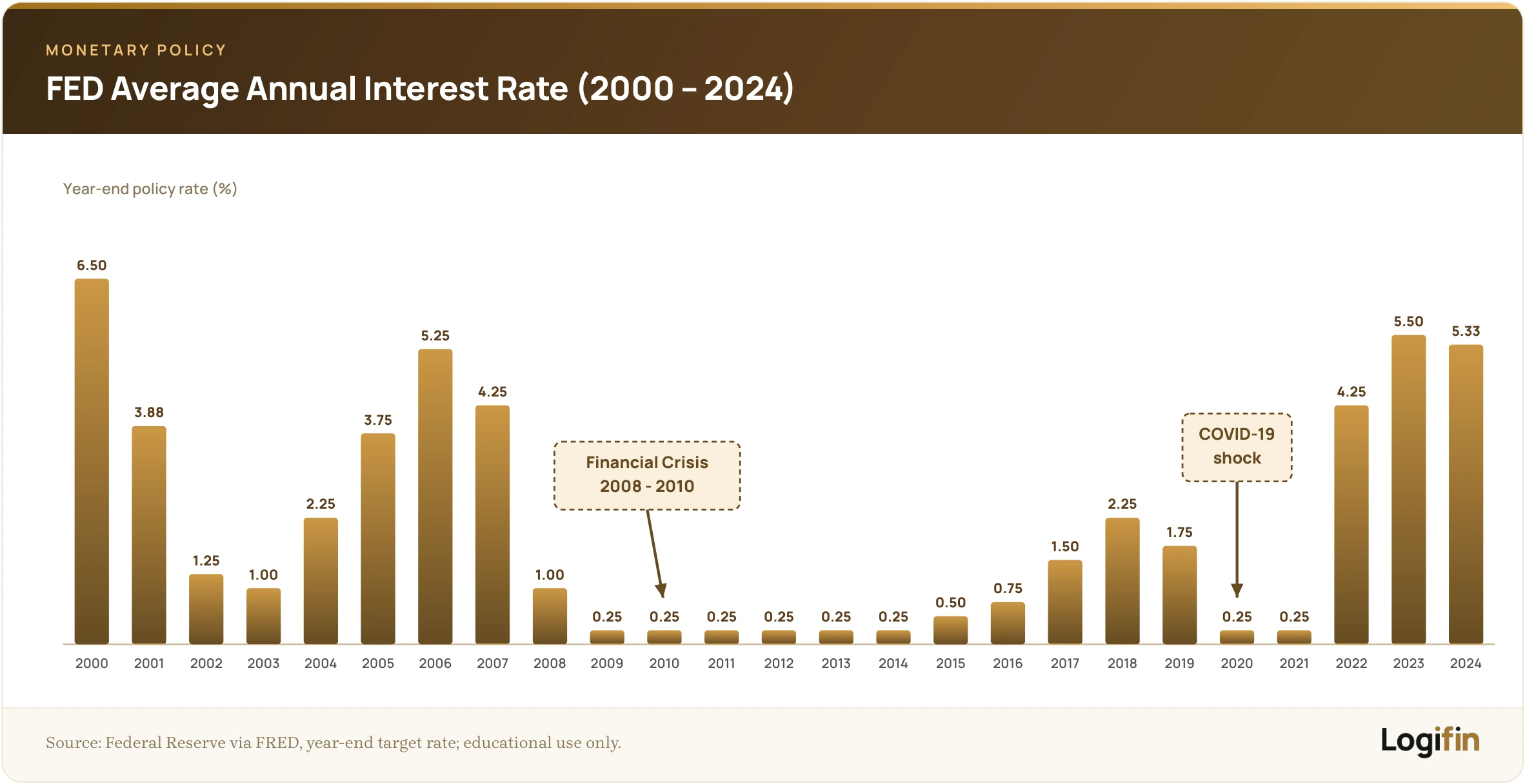
A bond’s duration shows how sensitive it is to interest-rate changes. The longer the duration, the stronger the price reaction to rate moves.
Thus, long-term bonds carry greater interest-rate risk than short-term ones.
🔶 Default risk
Especially with low-credit-quality corporate or government bonds, there is a risk of non-repayment.
The issuer’s solvency is a decisive factor.
Example:
- Argentina has gone through repeated defaults over recent decades, leaving bondholders with significant losses.
- By contrast, countries or companies with a high rating (investment grade) offer greater certainty, even if the return is lower.
🔶 Limited participation in growth
Shares have theoretically unlimited upside when a company thrives.
Bonds, by contrast, have a predetermined return ceiling: the coupon and the repayment at maturity.
This means that even if a company “takes off”, bondholders do not benefit from its full upside.
How are bonds used in a portfolio?
Bonds are a core component of any serious investment strategy.
Their role is not to “excite” with explosive returns, but to offer stability, balance and protection.
If the portfolio is a ship sailing through uncertain markets, bonds are the keel that keeps it upright when strong winds blow.
🔶 Diversification and risk reduction
History shows that equity markets can collapse suddenly, while bonds often act as a “counterweight”.
- When shares fall, investors seek safety in government bonds, raising their demand and their price.
- This mechanism reduces a portfolio’s overall losses and smooths its path over time.
🔶 Steady income flow
Bonds offer regular coupon payments, creating a predictable cash flow.
- For insurance funds, this stability is a foundation for paying future pensions.
- For individual investors, the predictability of income is just as important as capital protection, especially as they approach retirement.
Example: An investor with 100,000 € in a 10-year government bond with a 3% coupon knows they will receive 3,000 € per year until maturity, regardless of market fluctuations.
This makes bonds an “income tool” that does not depend on stock-market psychology.
🔶 Risk hedging
Bonds act like a “safety cushion” in difficult periods.
In a recession, central banks often cut interest rates → the prices of already-issued bonds rise.
So, while shares may decline, bonds offset part of the loss and contain the portfolio’s overall loss.
Short-term government bonds are considered the “closest thing to cash” (cash equivalent). They are ideal for those who want liquidity with minimal risk, acting as a safe “parking space” for capital.
🔶 Allocation strategies: the classic 60/40
The traditional 60/40 rule (60% shares, 40% bonds) was for decades the investors’ “golden recipe”.
The goal was to combine the growth of shares with the stability of bonds.
- In bull markets, the portfolio benefits from the rise in shares.
- In bear markets, bonds reduce the loss.
However, recent studies (AQR, 2022) show that the correlation between shares and bonds is not stable and can rise in periods of high inflation and intense monetary tightening, such as 2022.

In such phases, the benefits of diversification diminish temporarily, which highlights the need for greater flexibility in allocation strategies.
🔶 Special uses: ESG and Green Bonds
“Green” bonds give investors the ability to combine return with social and environmental goals.
Institutions use them to align their strategy with ESG standards.
At the same time, they also serve as a tool for strategic positioning, strengthening investors’ image as responsible and long-term.
Thus, bonds are not only a tool of stability, but also a vehicle of evolution that can adapt to the new needs of the markets.
🔶 How large a share of bonds should I hold in my portfolio?
There is no single number that fits everyone. It depends on your time horizon, your risk tolerance and your goal.
A classic rule of thumb says “hold a share of bonds close to your age”, while the 60/40 model remains a reference point; neither is absolute.
The general rule: the closer you are to your goal (e.g. retirement) or the lower your tolerance for fluctuations, the larger the share of bonds.
🔶 How do I buy bonds as a retail investor in Europe?
Most individuals do not buy single bonds, but gain exposure through bond ETFs in a UCITS structure, via an international broker.
This offers diversification across hundreds of issues with a small amount of capital, rather than tying up a large sum in a single bond.
🔶 Bonds or bond ETFs: which should I choose?
A single bond held to maturity gives you a known return and the return of your capital, but requires more capital and research per issue.
A bond ETF offers instant diversification and liquidity, but without a “maturity date”. Its value fluctuates with interest rates, which suits those who want simplicity and gradual investing.
Conclusion and practical takeaways
Bonds may seem “boring” compared with shares, but their power lies precisely in their stability and predictability.
They are the tool that institutions and professionals use to build resilient portfolios, protect capital and secure income over time.
🔑 What to remember:
- A bond is a loan you give to a state or company, in exchange for interest and the return of your capital.
- They provide lower risk and volatility than shares.
- They are not without drawbacks: they are exposed to inflation, rate hikes and, in some cases, payment defaults.
- Their role is not to replace shares, but to complement them.
Practical tips for new investors:
1. Think about the right allocation
The classic 60/40 strategy may not always be ideal, but it shows the importance of balance.
The closer you are to retirement, the larger the share of bonds in your portfolio can be.
2. Prefer quality in times of crisis
In times of uncertainty, government bonds of highly rated countries (US, Germany) act as a safe haven.
3. Diversify
Do not invest in only one type of bond.
Combine government, corporate and, if it fits your profile, green bonds, so as to reduce risk and have more sources of return.
4. Learn to read the “duration”
Duration shows how sensitive a bond is to interest-rate changes. The longer it is, the more vulnerable the bond is to rising rates.
The content of this article is provided exclusively for informational and educational purposes and does not constitute investment advice or a recommendation to buy or sell financial products. The information is based on publicly available sources considered reliable, without any guarantee of accuracy or completeness. Before making any financial or investment decision, it is recommended that you consult a certified professional advisor or accountant, taking into account your own financial situation and risk profile. The Logifin team bears no responsibility for any direct or indirect damages arising from the application of the information presented.
Related articles

What is a money market fund and how does it work?
How a fund that holds short dated, high quality debt securities works, what it returns, what risks it carries and when it belongs in a portfolio.
10 min read

What is hedging and when do we need it?
What hedging is, which tools investors use for it, what it costs in giving up return and when a private investor genuinely needs it.
17 min read

How to build a resilient portfolio
A guide for investors who want to build something stable, simple and rewarding over the long term.
19 min read

What is a recession and how it affects investors?
How a recession is defined, what causes one, how the markets usually behave during it and what an investor can do to prepare in advance.
24 min read
EXPLORE LOGIFIN
Everything you need in order to learn, plan and track your investments.
Logifin Blog
Learn everything you need to get your finances in order and invest with confidence.
Logifin Insights
What moves the markets and what it means for a long term investor. Short and without the noise.
Logifin Tools
Free, inside the site, no signup. Everything you calculate stays on your device.
Logifin ETF Hub
Find the ETF that fits you: 550+ UCITS ETFs, smart filters and in-depth comparisons.
Logifin Guides
A series of guides that builds your investment plan step by step. The first guide is free for everyone.
Logifin Circle
The tools and the Hub are free for everyone. You become a member for the intelligence that never stops.