What is inflation and how does it affect your investments?
The “invisible tax” that reduces purchasing power and changes the rules of the game for investors
26 August 2025 · 16 min read

What is inflation?
Inflation is the general rise in the prices of goods and services in an economy over a period of time.
In simple terms, when the same amount of money buys you less than it did last year, you are experiencing inflation.
It is a phenomenon that directly affects living standards, since it reduces the so-called purchasing power of money.
It is not about individual products (e.g. if only olive oil gets more expensive), but about the overall upward trend in prices across the whole economy. To count as “inflation”, the rise must be sustained and broad, not just a temporary increase in a few categories.
Example:
- If inflation is 5% per year, then something that cost 100 € last year will cost 105 € this year, even if its quality or quantity has not changed.
- If the same trend continues for 10 years, the price will have risen to about 163 €, that is, almost 63% more expensive, due to inflation alone.

🔶 How is it measured?
The most common index is the Consumer Price Index (CPI), which tracks the evolution of prices in a “basket” of basic goods and services (e.g. food, fuel, rents, transport).
The CPI often differs from country to country, depending on which goods and services the average household’s “basket” includes.
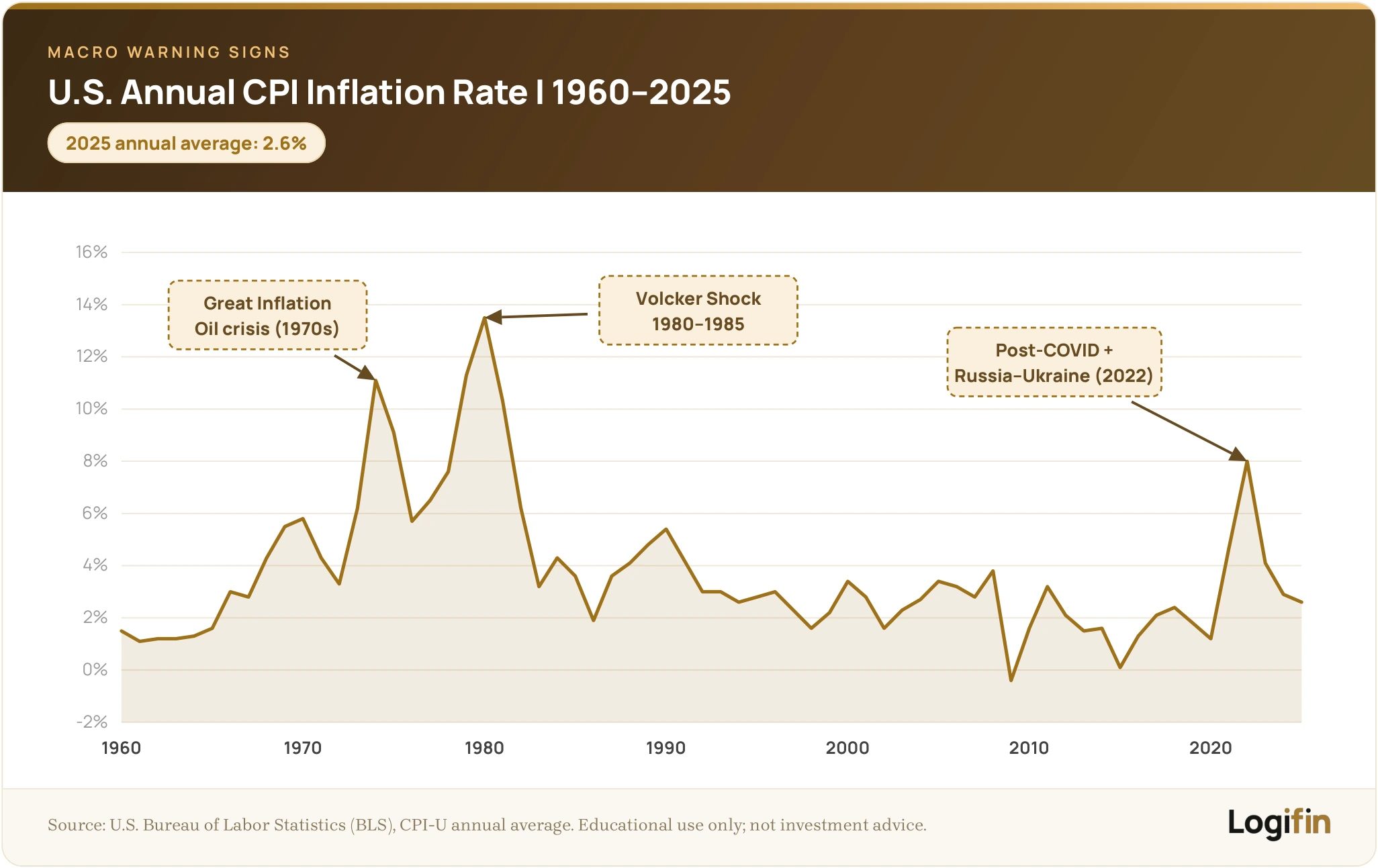
For example, in a country with a high share of renters, housing carries more weight than in a country where most people own their home.
Another important index is the Producer Price Index (PPI), which shows price changes at the production level, i.e. before products reach the consumer. It often acts as a “leading indicator” of where inflation may head in the future.

Why does inflation occur?
Inflation does not arise by chance.
It is the result of a combination of factors that affect demand, supply and monetary policy.
To understand why prices rise, you need to look at the main causes behind it:
1. Demand that “runs” faster than supply (Demand-Pull Inflation)
When the economy grows strongly and consumers spend more, demand for goods and services outpaces production.
In such periods, businesses raise prices because they know customers will keep buying.
Example:
- After the COVID-19 pandemic, consumers returned strongly to spending (travel, electronics, dining out).
- Supply, however, was still limited due to supply-chain problems. This caused a price “explosion” in many goods.
2. Rising production costs (Cost-Push Inflation)
If raw materials, energy or wages rise, businesses usually pass the cost on to the end consumer.
This leads to a generalised rise in prices, even if demand has not increased much.
Example:
- The 2021–2022 energy crisis in Europe sent the cost of electricity and natural gas soaring.
- The higher energy cost passed to industries and then to consumers, raising prices on almost all goods and services.
3. Monetary and fiscal factors
The policy of central banks and governments also plays a decisive role.
- When interest rates are low, consumers and businesses borrow more easily and spend more.
- When governments channel large amounts of support into the economy (e.g. benefits, tax cuts), consumption and demand increase.
If these measures are not accompanied by a corresponding rise in production, inflation can be created.
Excessive “money printing” without corresponding real production almost always leads to higher prices.
4. External factors & supply shocks
Inflation can also be triggered by events beyond an economy’s control:
- Geopolitical tensions (e.g. the war in Ukraine → higher energy prices).
- Natural disasters that destroy infrastructure and supply chains.
- International crises (e.g. pandemics) that create shortages of basic goods.
Example: According to the OECD (2022), a large part of inflation in the G7 countries in 2021–22 was due to the rise in energy and food prices, which was linked mainly to external factors such as the energy shock and disruptions in global supply.

How does inflation affect everyday life?
Inflation is not just a number announced every month by statistical agencies.
It has a direct, daily impact on people’s lives, as it shapes the cost of living, savings and investment decisions.
In a high-inflation environment, money “loses value” faster, which affects both households and businesses.
🔶 Higher prices on essential goods
When prices rise, consumers are forced to spend a larger share of their income on food, energy and transport.
This reduces purchasing power and leaves less available for saving or for spending on other goods and services.
Example: If a salary rises by 2% but inflation is 5%, in practice the consumer “gets poorer” by 3% in real terms.
The rise in prices of essential goods hits lower-income groups disproportionately, since a larger share of their budget goes to food and energy.
🔶 Savings & Deposits
Inflation “nibbles away” at the value of savings.
Example: A savings account with a 1% interest rate in a 6% inflation environment gives a negative real return of −5%.
As a result, cash and low-interest deposits lose their appeal and force savers to look for alternative investments with higher returns.
🔶 Loans & Financing
Inflation affects borrowers differently:
- For those with a fixed interest rate, inflation can be an “ally”: the real value of the debt decreases over time, as the future money to be repaid is worth less.
- By contrast, with variable rates, banks raise interest rates to offset inflation, making instalments more expensive.
This mechanism explains why, in periods of high inflation, mortgages and consumer loans become harder to get and more expensive.
🔶 Wages & Work
High inflation puts strong pressure on employees to ask for pay rises.
When wages do not keep up with rising prices, a “wage gap” is created that erodes purchasing power and lowers quality of life.
However, if wage increases follow inflation too closely, there is a risk of a “wage–price spiral”, where pay rises fuel new price increases, creating a vicious cycle of inflationary pressure.
🔶 Consumer psychology
Inflation affects not only the wallet but also psychology.
When people see prices rising:
- They cut back on spending pre-emptively, even if their income has not yet fallen.
- They become more cautious about investments or big purchases.
This “freeze” can lead to a slowdown in economic activity and, in extreme cases, to stagflation (a combination of low growth and high inflation).
How does inflation affect investments?
Inflation is perhaps the investor’s most important “opponent”.
Even if a portfolio’s returns look satisfactory in nominal terms, their real value can be negative if inflation is high.
For this reason it is often called an “invisible tax” that reduces the value of wealth without you even realising it directly.
🔶 Erosion of real returns
If an investment yields 4% and inflation is 6%, the real return is −2%.
This means that, although you see your money growing numerically, its purchasing power is shrinking.
The Credit Suisse Global Investment Returns Yearbook 2023 notes that in periods of high inflation, such as 2022, bonds recorded some of the worst real returns observed in several developed markets.

Over the same period, equities too suffered significant losses in real terms, confirming that high-inflation environments are particularly unfavourable for both bond and equity returns.
🔶 Effects on different types of investments
- Cash & Deposits: Almost always lose value in a high-inflation environment, since interest does not cover the loss of purchasing power.
- Bonds: Fixed-rate ones are particularly vulnerable. When central banks raise interest rates to contain inflation, the prices of older bonds fall, causing losses for their holders.
- Stocks: Hold up better, but not all of them. Companies with pricing power (the ability to pass costs on to consumers, e.g. energy, consumer goods) can protect their profit margins. Companies without such power, by contrast, come under pressure.
- Real Assets (Real estate, Gold, Commodities): Often act as a hedge against inflation. Gold and raw materials are seen as “safe havens”, while real estate retains its value due to scarcity and real-world use.

Example:
- In the 1970s, with inflation exceeding 10% in several years, the real returns of government bonds were negative.
- Gold, by contrast, soared (from about 35 dollars an ounce in 1971 to over 800 dollars in 1980), multiplying its value and acting as a strong hedge against inflation.
🔶 The role of diversification
- A portfolio that relies exclusively on bonds can be devastated in periods of inflation.
- By contrast, a balanced mix of stocks, real assets and short-term securities can limit losses and offer resilience.
- Diversification does not eliminate inflation risk, but spreads it, so that no single category can “drag down” the entire portfolio.
🔶 The psychological dimension
- Inflation affects not only returns but also investor behaviour.
- The feeling that “money is losing its value” makes investors more impatient and more prone to risky or hasty decisions.
For example, many rush into risky assets (crypto, speculative stocks) without a strategy, simply out of fear that “if they stay in cash, they will lose”.
Historical examples of inflation and how markets reacted
Inflation is not a theoretical phenomenon; it has left a deep mark on global economic history.
Three characteristic cases are taught internationally as examples of how societies, markets and central banks reacted to rising prices.
🔶 Weimar (Germany, 1922–1923): the “handbook” of a hyperinflation crisis
In 1923 inflation spiralled to the point where the currency ceased to function as a means of exchange and a store of value.
Daily life fell apart, with wages paid twice a day and citizens rushing to the shops before prices changed.
- Monetary reform: The solution came with the introduction of the Rentenmark in November 1923, which restored confidence in the currency (Bundesbank).
- Destruction of savings: Savings held in nominal financial assets were practically wiped out, leaving a generation without capital.
Indicative scale: at the peak of the crisis, a loaf of bread was priced in tens of billions of marks, an image of the complete collapse of purchasing power.
Lesson: in extreme cases of monetary destabilisation, nominal financial assets are “wiped out”. Stabilisation comes only with a credible monetary anchor and drastic reform (Bundesbank).
🔶 The “Great Inflation” (USA, 1970s–early ’80s)
The 1970s were marked by successive oil shocks and loose monetary policy, which drove inflation out of control.
Annual CPI reached 13.5% in 1980, the highest of the post-war era.
The Fed under Paul Volcker reacted aggressively: the effective fed funds rate shot up to near 20% in late 1980–early 1981.
Markets:
- The S&P 500 fell about −48% from its highs to the bottom of the 1973–1974 bear market.
- Real bond returns collapsed, as high interest rates weighed on prices.
- Gold, by contrast, had a historically strong decade, often cited as a hedge during the inflationary storms of the ’70s (World Gold Council).
Lesson: When inflation expectations “get loose”, restoring credibility requires very strict policy. This entails a short-term cost (recession, bear market), but leads to long-term price stabilisation.
🔶 The global surge of 2021–2022 (USA & Eurozone)
After the pandemic and the war in Ukraine, inflation surged again in developed economies that had grown used to decades of low prices.
- USA: Annual CPI peaked at 9.1% in June 2022, the highest since the early 1980s.
- Eurozone: The harmonised HICP index reached 10.6% in October 2022, an all-time high.

Markets in 2022:
- The Bloomberg EURO Aggregate Bonds index returned −17.2%, one of the worst years in the history of bonds.
- The S&P 500 closed 2022 down −19.4%, its worst performance since 2008.

Lesson: even without “lost decades”, a sharp rise in prices combined with aggressive rate hikes can hit stocks and bonds at the same time.
This underscores the need for genuine diversification and proper duration management in fixed-income assets.
Portfolio strategies in a high-inflation environment
Inflation is one of the investor’s biggest “enemies”, because it reduces the real value of money.
But it does not mean that capital is doomed to erode; with the right strategy you can protect yourself and, in some cases, come out ahead.
🔶 Staying consistent through DCA
The Dollar Cost Averaging (DCA) strategy works even in periods of high inflation.
By investing the same amount steadily every month, you buy more on dips and less on rallies.
- Over a long horizon, you smooth out the impact of volatility and avoid wrong timing.
Example: An investor who put $500 a month into the S&P 500 during the 1970s (with inflation >10%) came out ahead over a 10-year horizon, despite the huge swings of that period.
Consistency is the antidote to uncertainty; even in difficult conditions, DCA keeps you “in the game”.
🔶 Adjusting your portfolio allocation
Asset allocation is one of the most decisive factors in how a portfolio performs in a higher-inflation environment.
When prices rise, not all assets are affected in the same way.
Some categories hold up better and can act as a natural counterweight to the loss of purchasing power.
- Stocks with pricing power
- Companies that can raise prices without losing customers have an advantage in an inflationary environment.
- These are usually businesses in consumer staples, energy and healthcare.
- Their steady revenues and strong market position let them pass the higher cost on to consumers.
- Real assets
- Real estate, commodities and infrastructure tend to perform better when prices rise.
- Rents, tolls and raw-material prices often adjust upward together with inflation, preserving the real value of the investment.
- Inflation-linked bonds
- Inflation-linked bonds, such as TIPS in the US or European ILBs, adjust their nominal value and coupons based on the inflation index.
- In this way they protect the investor’s purchasing power during periods of prolonged inflationary pressure.
According to Morningstar (2022), commodities were among the few categories with positive returns in 2022, when stocks and bonds posted negative results due to inflationary pressure.
🔶 Managing bond duration
In periods of high inflation, interest rates usually rise → bond prices fall.
- Prefer short-term bonds, which are less vulnerable to rate increases.
- Avoid long-term fixed-rate bonds, unless there is a strategic expectation that inflation and rates will ease.
“Duration” is like a measure of a bond’s sensitivity to interest-rate moves. The longer it is, the riskier in an inflationary period.
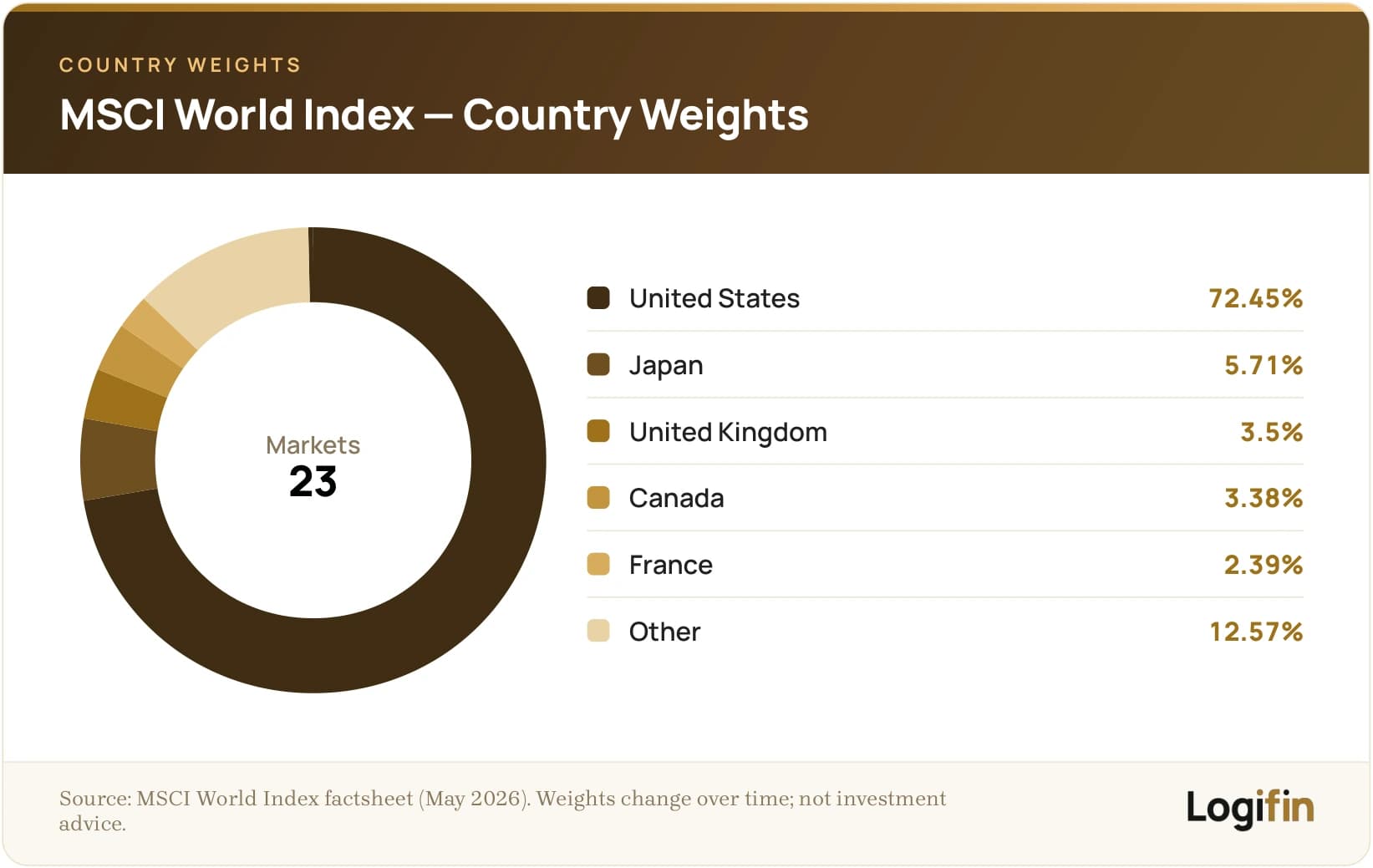
🔶 International diversification
Inflation does not hit all economies in the same way.
- If the Eurozone has 10% inflation but the US has 3%, then diversifying into US stocks or bonds can act protectively.
- The same applies to emerging markets that follow different interest-rate cycles or have exposure to raw materials.
Geographic diversification is not just a “fashion”, but one of the most effective tools for protection against inflationary shocks.
🔶 Discipline and realistic expectations
Inflation works like an “invisible tax” that gradually erodes purchasing power.
Managing it requires time, consistency and the right mindset. To move correctly you need:
Realistic return targets
- Markets do not deliver consistently high returns every year.
- In periods of higher inflation, even preserving the real value of your capital is a success.
- Excessive expectations increase the risk of disappointment and poor decisions.
Patience and time horizon
- Tackling inflation is a marathon, not a sprint.
- Results come gradually, through proper asset allocation and a disciplined strategy.
Avoiding the “quick-gains” trap
- In periods of inflationary pressure, many investors are drawn into hasty moves, chasing trends or overvalued assets.
- This behaviour often leads to mistakes that cost more than inflation itself.
In short, real protection from inflation does not come from spectacular moves, but from discipline, realism and consistency over time.
Conclusion and practical takeaways
Inflation is one of the most insidious phenomena in the economy.
It does not always appear with the same intensity, but it affects every investor, whether you hold stocks, bonds or simply money in the bank.
It is the “invisible tax” that reduces purchasing power, but you can deal with it through the right strategy and discipline.
🔑 Key takeaways
- Inflation is measured mainly through CPI/HICP and directly affects everyday life, from the supermarket basket to loan interest rates.
- Its causes vary: increased demand, rising costs, monetary policies and external shocks.
- In high inflation, savings and fixed-rate bonds lose value in real terms.
- The bigger winners are companies with pricing power and real assets (real estate, commodities, gold), which often act as a hedge.
Practical tips for new investors:
1. Do not leave large amounts in cash
- In a high-inflation environment, cash “melts” day by day.
- Keep liquidity only for short-term needs and emergencies.
2. Apply a DCA (Dollar Cost Averaging) strategy
- Consistency in investing through Dollar Cost Averaging protects you from wrong timing and lets you take advantage of market swings.
- It is a strategy that has proven its worth even in decades of high inflation (e.g. the 1970s).
3. Diversify your portfolio
- Do not limit yourself to one market. Other countries may have lower inflation or more favourable monetary policies.
- Geographic spread reduces the risk of being trapped in a single environment.
4. Watch your bond duration
- In inflationary periods, short-term bonds are less vulnerable, while long-term fixed-rate bonds risk losing significant value.
- By contrast, inflation-linked bonds adjust automatically to price increases.

The content of this article is provided exclusively for informational and educational purposes and does not constitute investment advice or a recommendation to buy or sell financial products. The information is based on publicly available sources considered reliable, without any guarantee of accuracy or completeness. Before making any financial or investment decision, it is recommended that you consult a certified professional advisor or accountant, taking into account your own financial situation and risk profile. The Logifin team bears no responsibility for any direct or indirect damages arising from the application of the information presented.
Related articles

What is the Fed and what is its role?
The world’s most powerful central bank and why its decisions affect every investor
15 min read

What is the ECB and how does it affect the economy and the markets?
The role of the European Central Bank in our everyday lives and investments
15 min read

What is a recession and how it affects investors?
How a recession is defined, what causes one, how the markets usually behave during it and what an investor can do to prepare in advance.
24 min read

What are the signs before a bear market?
How to read the macroeconomic indicators, the market behaviour and the investor psychology that often appear before a fall of more than 20%.
19 min read
EXPLORE LOGIFIN
Everything you need in order to learn, plan and track your investments.
Logifin Blog
Learn everything you need to get your finances in order and invest with confidence.
Logifin Insights
What moves the markets and what it means for a long term investor. Short and without the noise.
Logifin Tools
Free, inside the site, no signup. Everything you calculate stays on your device.
Logifin ETF Hub
Find the ETF that fits you: 550+ UCITS ETFs, smart filters and in-depth comparisons.
Logifin Guides
A series of guides that builds your investment plan step by step. The first guide is free for everyone.
Logifin Circle
The tools and the Hub are free for everyone. You become a member for the intelligence that never stops.