How to build a resilient portfolio
A guide for investors who want to build something stable, simple and rewarding over the long term.
2 August 2025 · 19 min read

Why you need a portfolio that endures
A resilient portfolio is a portfolio designed to withstand rises, falls and long periods of uncertainty without forcing you to abandon your strategy at the worst possible moment.
When you start investing, it is natural to focus on questions such as which ETF has the best performance, or when the right time is to enter the market.
Yet the real essence of a successful investor is not found in the search for perfect timing, but in building a portfolio that endures over time.
Markets move in cycles: rise, fall, uncertainty and euphoria. What sets apart the investors who succeed over the long term is their ability to keep a steady strategy, rather than to predict the future.
And to be able to stay steady, you need a resilient portfolio, designed to work both in good and in difficult times.
Example:
- In 2020, many investors panicked and sold at a loss. The same happened in 2000, in 2008, in 2022 and even in 2025.
- The few who had built their portfolio on resilience rather than prediction were the ones who not only avoided losses, but came out ahead over time.

What a resilient portfolio means in practice
The term resilience is not just a buzzword. In the world of investing it describes the ability of a portfolio to withstand fluctuations, crises and long periods of uncertainty without throwing the investor off balance or leading to large, irreversible losses.
A resilient portfolio does not mean the absence of risk. It means that the risk is controlled, predictable and distributed in such a way that:
- you do not depend on a single market or asset,
- your whole strategy does not collapse if the short-term trend changes,
- and, perhaps most importantly, it lets you sleep calmly even when the markets are shaking.
Example:
- Two investors may choose portfolios that achieved exactly the same average return, around 7% over the decade.
- On the surface it looks as if they are in the same place, yet the reality is completely different.
- One had to endure sharp swings that reached as much as 45%, while the other never saw the portfolio fall more than 20%.
Although the return figures are the same, the emotional experience is completely different.
In the first scenario, the temptation to sell at the wrong time is enormous. In the second, it is much easier to stay consistent with your strategy.
The rule of diversification
If there is one principle that all serious investors accept, from professional fund managers to ordinary individuals, it is diversification.
The idea is simple: do not put all your eggs in one basket. In practice, though, many investors ignore it, become overexposed to a single sector or ETF and discover it only when it is too late.
🔶 The absence of diversification makes a portfolio vulnerable.
- If, for example, you have invested 100% of your capital in a technology ETF, then you depend entirely on the course of that sector.
- In a period of growth you may see excellent returns. But when technology retreats, as happened in 2022, the blow can be devastating.
🔶 By contrast, a well diversified portfolio:
- Spreads across different geographic regions, such as the United States, Europe, Emerging Markets and Asia,
- Includes both large and smaller capitalisations, such as Large, Mid and Small Caps,
- Combines sectors, such as technology, industry, health and energy,
- and, in some cases, incorporates non-equity components such as bonds or cash.
👉 You can achieve a high level of diversification even with one to three ETFs, as long as they are broad based and do not overlap heavily.
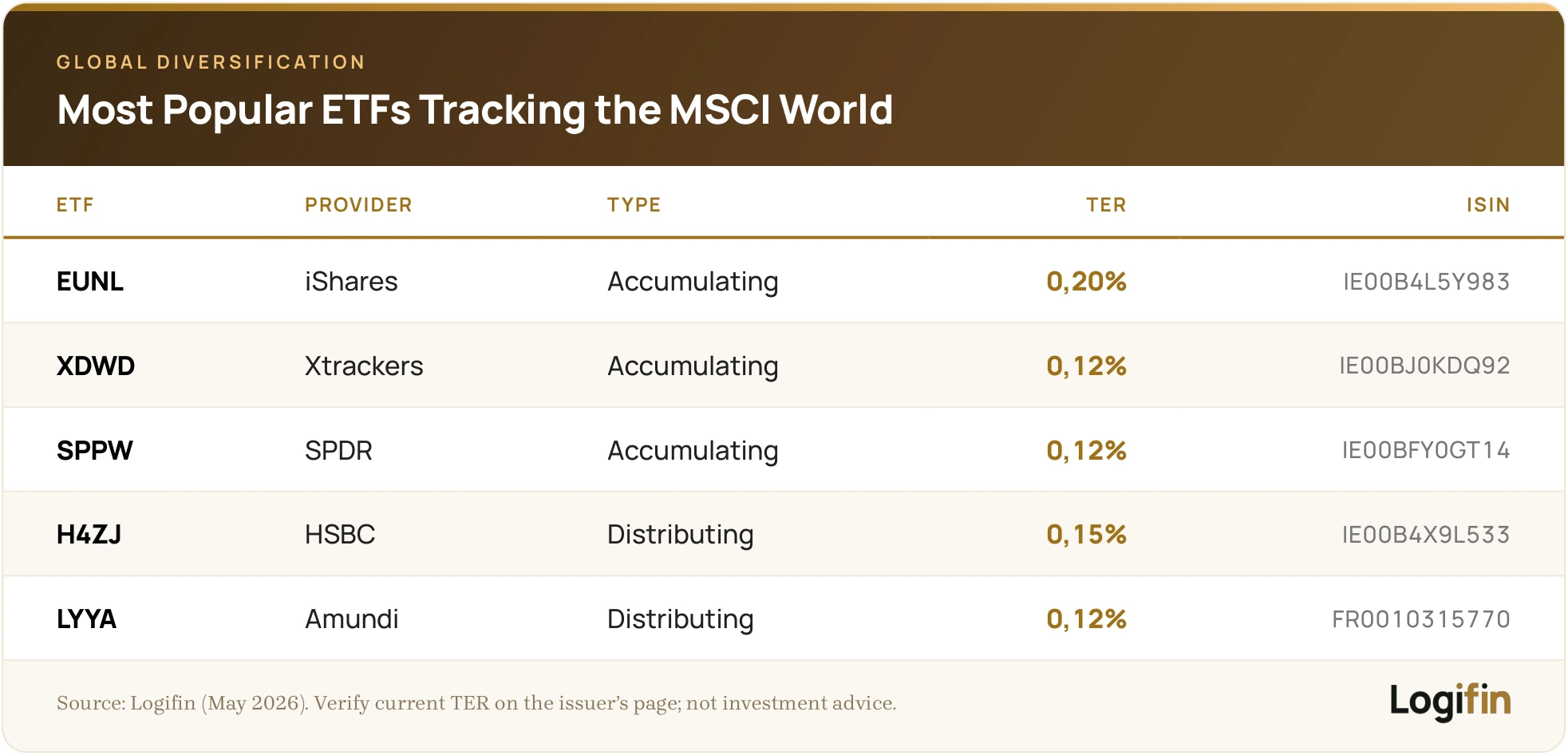
Examples such as VWCE or combinations such as S&P 500 plus Emerging Markets plus Europe can bring you fairly close to global coverage with minimal cost and complexity.
Surviving market cycles and crises
Markets do not move in a straight line.
Every investor, sooner or later, will live through periods of strong growth, deep corrections and also years of stagnation.
What sets apart a portfolio with staying power is its ability to survive every cycle, without the investor's psychological mechanism breaking down.
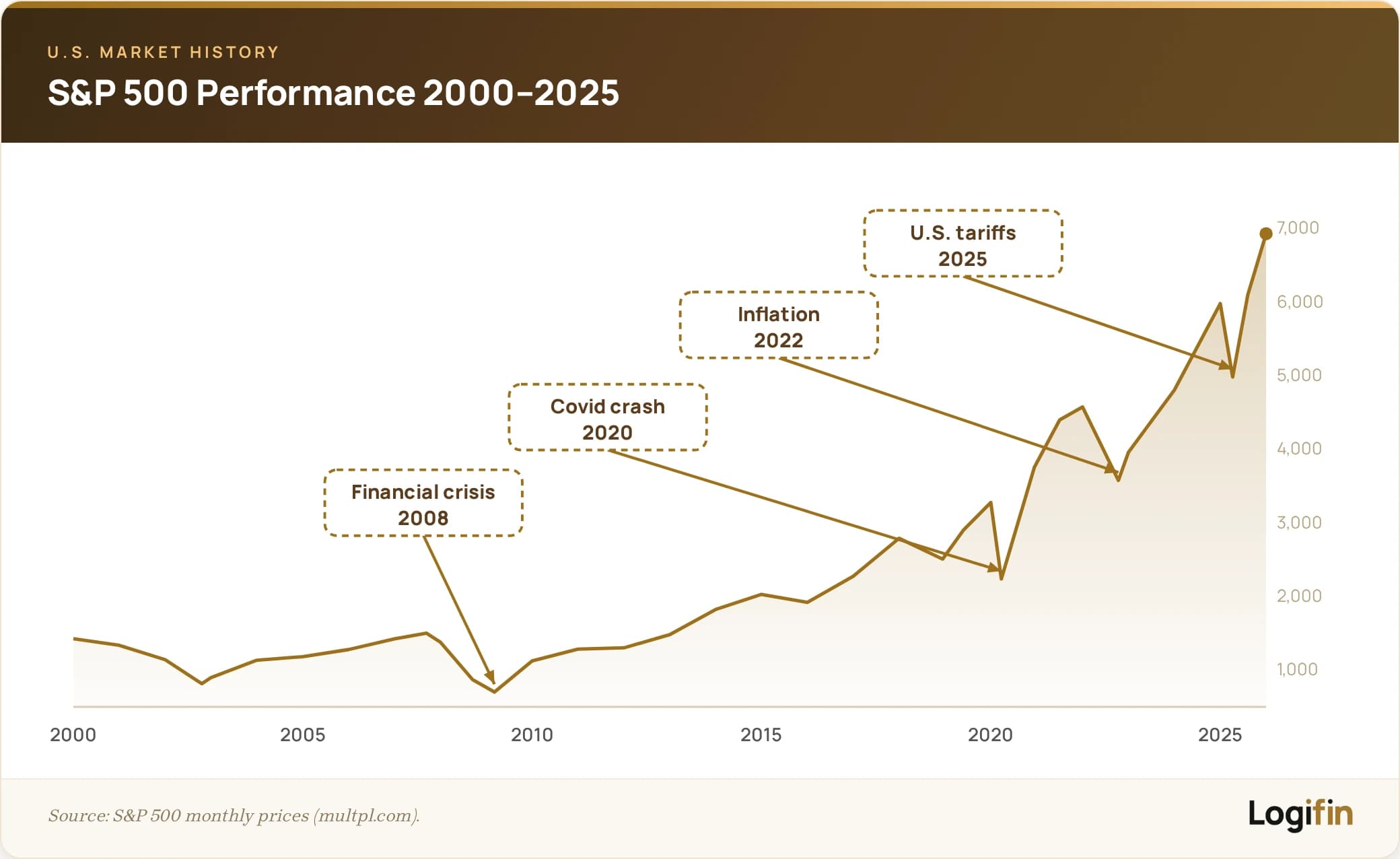
Recent crises that marked investors:
- 2000 to 2002: the dot-com bubble
- 2008: the global financial crisis
- 2020: the COVID-19 pandemic
- 2022: the return of inflation and aggressive interest rate hikes
- 2025: the imposition of tariffs by the U.S. administration on dozens of countries.
In every case the market recovered, but not every investor did. Many sold at the bottom, froze or simply had not built a plan able to withstand such shocks.

Example:
- During the great crisis of 2007 to 2009, the S&P 500 index fell about 57% from its highs (Federal Reserve History).
- Many panicked and sold near the bottom, locking in large losses.
- By contrast, those who held a balanced allocation and kept investing consistently, for example through a DCA strategy, saw their portfolio recover fully within five years and move into positive territory.
The difference was not only in returns, but in composure and discipline.
Why geographic diversification matters
One of the most common (and dangerous) mistakes new investors make is to focus too much on their home market or on a single highly popular region, such as the United States.
Although the US remains the largest and most dynamic stock market pillar, geographic diversification is critical for a portfolio that wants to endure over time.
🔶 What does geographic diversification mean?
Having exposure to markets with different:
- macroeconomic characteristics, such as the US versus the Eurozone,
- demographic profiles, such as India versus Japan,
- and growth trajectories, such as Emerging versus Developed markets.
For a more detailed look, see our guide to the right geographic allocation for a European investor.
🔶 How it is achieved:
- Through a global ETF such as VWCE or VWRL, which invest in stocks from across the world,
- or with a Core-Satellite combination, for example S&P 500 as the core and India, Japan and Emerging Markets as satellites,
- or with simple and cost effective combinations such as S&P 500 plus Europe plus Emerging Markets.

How to choose the right ETFs for your core
If your portfolio is a building, then the core is the foundation. It is the basic part that supports the overall return and stability of your investment strategy. (If you want the basics first, see our guide: what an ETF is.)
Choosing the right ETFs for this core is critical, but it does not need to be complex.
🔶 What characteristics should a core ETF have?
When choosing the ETF that will form the core of your portfolio, you want something stable, predictable and easy to hold for many years.
The core of a portfolio does not need complexity. It needs consistency, transparency and a strong investment foundation that can help you stay committed to your plan, even when the market tests your discipline.
🔶 Broad diversification
- A core ETF should cover a large number of companies, ideally hundreds or even thousands.
- The broader the diversification, the lower the risk that your portfolio will be heavily affected by one specific company or sector.
- Broad market exposure is one of the foundations of long-term portfolio stability.
🔶 Low cost (TER)
- Cost acts like a leak in your returns.
- Ideally, the TER should be below 0.25%, so that it does not gradually consume a meaningful part of your long-term performance.
- Core ETFs are usually designed to keep expenses low and this is one of the reasons why they have become so popular among long-term investors globally.
🔶 High liquidity
- You want to be able to buy and sell without difficulty and without significantly affecting the price.
- Liquidity provides flexibility, especially for investors who follow a DCA strategy or make regular monthly investments.
🔶 Simplicity and transparency
- A core ETF should be easy to understand. You should know exactly what you are buying and which index it tracks.
- Simplicity protects you from unnecessary decisions and helps you stay committed to your strategy, even when market noise increases.
🔶 Long-term reliability
- The core of a portfolio should be based on an index with history and consistency.
- Indexes such as the FTSE All-World, MSCI World and S&P 500 have demonstrated resilience across many economic cycles.
- This long-term track record is an important advantage when you are building something you want to hold for decades.
🔶 What are popular core ETF options for European investors?
When building the core of your portfolio, you want ETFs that offer broad diversification, stability and predictable long-term behaviour.
These are some of the most reliable options for European investors who want a clean, simple and effective core portfolio:
VWCE: Vanguard FTSE All-World UCITS ETF Acc
- VWCE offers global diversification with exposure to approximately 3,700 stocks from developed and emerging markets.
- It is one of the most popular “one-stop” solutions for investors who want a complete core portfolio without needing to combine several different ETFs.

VWRL: Vanguard FTSE All-World UCITS ETF Dist
- VWRL is the distributing version of the FTSE All-World ETF. It tracks the same index, but distributes dividends to investors.
- It is often chosen by investors who prefer income or want more active control over their cash flows.
VUAA and SXR8: S&P 500 ETFs
- VUAA and SXR8 provide exposure to 500 of the largest companies in the United States, one of the strongest equity markets historically.
- They are popular core ETF options with high liquidity and very low costs, making them suitable as the main U.S. equity component of a portfolio.

IWDA: iShares Core MSCI World UCITS ETF Acc
- IWDA invests in approximately 1,500 stocks from developed markets.
- It can be an excellent solution for investors who do not want emerging markets in the core of their portfolio and prefer cleaner exposure to the developed world.
SSAC: iShares MSCI ACWI UCITS ETF
- The MSCI All Country World Index includes both developed and emerging markets, offering balanced global equity exposure.
- In practice, SSAC is one of the most direct alternatives to the FTSE All-World approach for investors who prefer the MSCI methodology.
No ETF is “the best” for everyone. What matters is choosing a broad, reliable ETF that fits your investment horizon, risk tolerance and DCA strategy.
⚠️ Do not let complex thematic ETFs or short-term market trends become the core of your portfolio.
Those may have a place as satellite positions, but not as the foundation. Your core should be resilient, predictable and as stable as possible.
The role of satellites in the overall portfolio
After building the “foundation” of your portfolio with one or two strong core ETFs, there comes a point where you may want to add a little more colour.
This is where satellites come in. Satellite investments complement the main core of your portfolio by offering targeted exposure, additional growth potential or thematic diversification.
🔶 What is a satellite ETF or satellite investment?
A satellite ETF or satellite investment is a product you use to add extra growth potential, diversification or exposure to specific market trends within your portfolio.
It is not the foundation of your investment plan. Instead, it complements your core portfolio and allows you to strengthen areas that you believe may have strong long-term potential.
Usually, a satellite ETF focuses on a more specialised area, such as:
- a specific sector, such as technology, clean energy or healthcare
- a specific region or country, such as India, China or Japan
- an investment style, such as growth or small caps
- a targeted strategy, such as value investing or dividend focus
Its role is to give your portfolio a little more “character” and potentially improve long-term returns.
That is why the right balance between the core and satellite parts of your portfolio is so important. This structure allows you to combine stability and growth, which is a key element of a resilient long-term investment plan.

Example:
- A portfolio with 80% VWCE, the Vanguard FTSE All-World UCITS ETF, as the core and 20% in a specialised thematic or geographic ETF as a satellite may offer a strong combination.
- On the one hand, the core ETF gives you global diversification and stability. On the other hand, the satellite ETF adds targeted exposure to a region, sector or theme with higher potential for long-term growth.
- This way, you keep your portfolio simple and easy to manage, while also strengthening it strategically with an investment choice that may offer greater long-term upside.
💡 The philosophy behind this approach is simple
- You do not need to fill your portfolio with many ETFs in order to achieve diversification.
- You can build a strong core and add one or two satellite positions that adjust the direction of your portfolio without reducing its simplicity or stability.
- This allows you to maintain a clear foundation that can work across different market cycles, while the satellite allocation adds identity and strategy without increasing risk beyond what you can realistically manage.
🔶 Historical perspective
Historical data and analysis from organisations such as Morningstar and Vanguard suggest that the core and satellite approach can support diversification and help investors remain disciplined.
- The core, usually built with low-cost passive ETFs, provides stability and long-term structure to the portfolio.
- Satellite allocations allow investors to express personal views in a controlled way, such as specific sectors, countries or themes, without putting the entire portfolio at risk.
As a result, investors can manage risk more effectively and avoid excessive concentration in individual positions.
🔶 Satellites should remain satellites
- If your portfolio ends up with 50% in thematic ETFs, then you have moved away from the original purpose of the strategy.
- A more balanced approach is usually to keep around 70% to 90% of the portfolio in core ETFs and 10% to 30% in satellite investments, depending on your experience, risk tolerance and investment goals.
The psychology of the long-term investor
Even the most well-designed portfolio can fail if the investor does not stay calm. Markets test psychology more than knowledge.
The investor’s biggest enemy is not the market decline itself, but their reaction to that decline.
🔶 Common psychological mistakes:
- Panic selling during a market correction,
- Buying because of FOMO near market highs,
- Constantly checking the portfolio and monitoring performance anxiously,
- Abandoning the strategy at the worst possible moment.
🔶 Historical data:
According to DALBAR’s annual QAIB report (2022), the average American mutual fund investor has historically underperformed the benchmark by approximately 4–6% per year over the long term.

This gap is not caused by the funds themselves, but by investor behaviour. Investors often buy and sell at the wrong times, dramatically reducing their overall returns.
🔶 How do you stay disciplined?
The more stable and clear your process is, the easier it becomes to stay consistent, even when the market tests your nerves.
Through simplicity
- The fewer ETFs you hold, the fewer decisions you need to make every month.
- A clean and minimal plan reduces pressure, protects you from impulsive moves and helps you focus on the bigger picture without getting distracted by noise and unnecessary choices.
Through habit
- The consistent application of DCA works like a bill you pay every month. It does not require constant thinking, it does not create stress and it builds discipline.
- Over time, this habit becomes one of your strongest advantages because it keeps you in the market when others are struggling with uncertainty.
Through distance
- You do not need to check your portfolio performance every week. Small short-term fluctuations do not matter for an investor with a long-term horizon.
- Distance reduces stress and protects you from poor decisions based on emotion.
Through remembering your goal
- Your portfolio is not for 2028. It is for 2035, 2040 or 2045.
- When you view time this way, your behaviour changes as well.
- You stop focusing on the next week and start focusing on the next decade. That perspective is what helps you remain steady, calm and consistent with your plan.
Portfolios that passed the crash test
The most reliable way to judge an investment plan is not theory. It is testing it under extreme conditions.
Just like a car goes through crash tests to prove that it can protect the driver, a portfolio shows its true value when everything around it is collapsing.
🔶 Example 1 (2008): Global financial crisis
- During the 2008 crisis, an investor with a core ETF such as MSCI World or the S&P 500 saw their portfolio decline by as much as 45%.
- The drop was sharp and panic dominated the market.
- However, those who continued applying DCA and did not sell in a moment of fear managed to fully recover by 2012 and then moved into a new upward cycle.
- Those who liquidated their positions at the lowest point locked in their losses permanently and missed the recovery.
🔶 Example 2 (2020): COVID-19
- Within just a few weeks, the market fell by 30% to 35%.
- Thematic ETFs with single-theme exposure, such as travel or financials, were disproportionately affected.
- By contrast, core ETFs with global exposure, such as VWCE, the Vanguard FTSE All-World UCITS ETF and CSPX, the iShares Core S&P 500 UCITS ETF, needed less than six months to return to all-time highs.
- Broad diversification acted as a shield during a period of unprecedented uncertainty.
🔶 Example 3 (2022): Inflation and rising interest rates
- In 2022, markets came under pressure due to high inflation and aggressive interest rate hikes.
- Emerging markets and technology stocks recorded significant losses.
- Investors who had focused exclusively on growth ETFs or thematic choices such as clean tech experienced intense volatility.
- By contrast, portfolios with a better balance between developed and emerging markets and exposure to value-oriented sectors experienced a noticeably milder decline.
💡 What the examples show:
- Simplicity, global exposure and consistency are far more powerful than any investment “trick” driven by short-term market news.
- Portfolios built around 3 to 4 ETFs with a core-satellite approach proved more resilient than those trying to “catch” the latest trend.
- DCA and patience outperformed the seemingly “smarter” tactics of constant rebalancing or market timing.
Conclusion and practical takeaways
Building a portfolio that can stand the test of time is not rocket science. But it does require discipline, strategy and self-awareness.
The goal is not to predict when the next crisis will come. The goal is to be ready for it, without having to change your entire plan halfway through the journey.
🔑 What to remember:
- Resilience is built through proper structure, not through market timing.
- Diversification across sectors, geography and investment styles works as a shock absorber.
- A strong core with 1 to 2 broad-based ETFs is more effective than a chaotic mix of 8 to 10 different products.
- Satellite additions should be targeted and controlled.
- Psychology and consistency matter more than knowledge.
- Investors who use DCA and patience tend to capture the market average over the long term.
Practical tips for new investors
1. Start simple
- You do not need five or six different ETFs to make a good start.
- One or two core ETFs with global diversification can be enough to build a solid foundation without unnecessary decisions.
- Simplicity reduces stress and helps you stay focused on your goal.
2. Set up your DCA strategy with a standing order
- Make the process automatic.
- A standing order removes emotion from the equation and keeps you consistent, even during periods of market turbulence.
- DCA is one of the strongest habits a new investor can build.
3. Do not check performance every month
- Monthly volatility says nothing about the success of your plan.
- What matters is your timeline and your ten or twenty-year investment horizon.
- Focus on the overall journey, not the small short-term fluctuations.
4. Avoid investment trends
- An ETF that is “hot” today may be on the opposite side of the market a few months later.
- Trends change, but a well-built core portfolio remains reliable across different market environments.
5. Review your plan every twelve months
- Changing strategy too often creates confusion and increases the risk of poor decisions.
- Once a year is enough to check whether your plan remains aligned with your goals and your financial reality.

The content of this article is provided exclusively for informational and educational purposes and does not constitute investment advice or a recommendation to buy or sell financial products. The information is based on publicly available sources considered reliable, without any guarantee of accuracy or completeness. Before making any financial or investment decision, it is recommended that you consult a certified professional advisor or accountant, taking into account your own financial situation and risk profile. The Logifin team bears no responsibility for any direct or indirect damages arising from the application of the information presented.
Related articles

What is the right geographical allocation for a European investor?
Europe, USA or global? How to build a balanced portfolio based on geography
18 min read

What is hedging and when do we need it?
What hedging is, which tools investors use for it, what it costs in giving up return and when a private investor genuinely needs it.
17 min read

What are bonds and why do professionals invest in them?
What a debt security is, which types of bonds exist, what risks come with them and the role they play inside a portfolio.
13 min read

What is a recession and how it affects investors?
How a recession is defined, what causes one, how the markets usually behave during it and what an investor can do to prepare in advance.
24 min read
EXPLORE LOGIFIN
Everything you need in order to learn, plan and track your investments.
Logifin Blog
Learn everything you need to get your finances in order and invest with confidence.
Logifin Insights
What moves the markets and what it means for a long term investor. Short and without the noise.
Logifin Tools
Free, inside the site, no signup. Everything you calculate stays on your device.
Logifin ETF Hub
Find the ETF that fits you: 550+ UCITS ETFs, smart filters and in-depth comparisons.
Logifin Guides
A series of guides that builds your investment plan step by step. The first guide is free for everyone.
Logifin Circle
The tools and the Hub are free for everyone. You become a member for the intelligence that never stops.