What is the ECB and how does it affect the economy and the markets?
The role of the European Central Bank in our everyday lives and investments
29 August 2025 · 15 min read

What is the European Central Bank (ECB)?
The European Central Bank (ECB) is the core monetary institution of the Eurozone.
It was founded in 1998 and is headquartered in Frankfurt. Its main task is to manage the euro, the common currency now used by 21 member states of the European Union.

The ECB’s mission is not limited to simply managing the currency. It is the institution that sets:
- the overall monetary policy for the entire Eurozone,
- the official interest rates at which banks borrow,
- the control of inflation, with the primary goal of price stability (around 2% over a medium-term horizon),
- the supervision of major banks through the Single Supervisory Mechanism (SSM), ensuring they remain sound and reliable.
In simple terms: the ECB is the "heart" of the Eurozone; it draws in and channels the "blood" (liquidity) that keeps the economy alive.
When it decides to raise or lower interest rates, it directly affects the cost of borrowing for businesses and households, as well as the path of inflation.
🔑 Composition and bodies
The Governing Council is the ECB’s highest body and its main decision-making organ.

It sets monetary policy and interest rates for the whole Eurozone.
- It consists of the six members of the Executive Board, who handle the ECB’s day-to-day operations,
- as well as the governors of the national central banks of the Eurozone member states.
At the top is the President of the ECB, who is also the most recognizable "voice" of monetary policy in Europe.
Every statement can affect markets, currencies and government decisions.
Objectives and responsibilities of the ECB
The European Central Bank is not merely a "guardian" of the euro.
It is the institution that shapes the environment within which the Eurozone economy grows.
Its objectives and responsibilities are defined by the Treaty on the Functioning of the European Union and serve as a guide for every decision it makes.
🔶 The primary objective: Price stability
The absolute and non-negotiable goal of the ECB is to maintain price stability.
In practice, this means keeping inflation at 2% over the medium term, a symmetric target it formally adopted in 2021 (negative and positive deviations from the target are equally undesirable).

Why is this so important?
- High inflation erodes the purchasing power of households.
- Very low or negative inflation (deflation) holds back consumption and investment.
- A stable price level creates predictability and confidence in the economy.
With tools such as interest rates and bond-purchase programmes, the ECB intervenes to achieve this goal.
🔶 Secondary objectives
Although price stability is the priority, the ECB has other objectives that serve the overall development of the European Union:
- Supporting economic growth and employment.
Through monetary policy, interest rates and liquidity programmes, the ECB seeks to create conditions that encourage investment activity and job creation, without undermining price stability.
- Safeguarding the stability of the financial system
The ECB supervises the Eurozone’s major banks and intervenes preventively so that crises do not turn systemic.
This reduces the risk of problems spreading from one country or banking group to the entire Union.
- Smooth functioning of payment systems
From everyday card transactions to interbank transfers and the TARGET systems, the ECB guarantees the security, speed and reliability of payments.
It is an infrastructure we take for granted, but it is critical to how the economy works.
- Promoting financial integration
The ECB helps create a single framework where citizens and businesses can invest and borrow within the Eurozone without institutional or monetary barriers.
This strengthens liquidity, competition and the overall efficiency of the markets.
Example:
- In 2012, at the peak of the Eurozone debt crisis, the ECB under Mario Draghi sent the historic message "whatever it takes" to support the euro.
- In doing so, it showed determination to protect the common currency, boosting market confidence and averting a deeper crisis.
The ECB’s main tools
To achieve its goal (price stability around 2%), the ECB has a "toolkit" that directly affects the cost of borrowing, liquidity and investment in the Eurozone.
Its decisions do not stay on paper; they touch everything from citizens’ mortgages to states’ ability to finance their deficits.
1. Policy interest rates
Interest rates are every central bank’s main weapon. At the ECB, they fall into three basic pillars:
- Main Refinancing Operations (MRO): the key rate at which banks borrow from the ECB for short-term funding. It is the most closely "watched" rate.
- Deposit Facility Rate: the rate at which banks "park" their excess reserves at the ECB. When it is low or negative, it encourages banks to channel liquidity into the economy.
- Marginal Lending Facility: the rate for immediate, short-term lending when banks urgently need liquidity.
Example:
- When the ECB sharply raised rates in 2022–2023 to curb inflation, mortgage rates across the Eurozone shot up.
- This reduced demand for housing and cut consumption, acting like a "brake" on the economy.

2. Bond-purchase programmes (Quantitative Easing, QE)
The ECB buys government and corporate bonds on a massive scale, channeling liquidity into the system.
In this way it:
- lowers bond yields,
- makes borrowing cheaper for states and businesses,
- boosts asset prices (stocks, real estate), increasing the "wealth effect."
QE does not only increase liquidity; it also works psychologically, as it sends the markets the message that "the central bank is backing" the economy, reducing panic in times of crisis.
3. Targeted loans to banks (TLTROs)
Through Targeted Longer-Term Refinancing Operations (TLTROs), the ECB provides cheap loans to commercial banks, on the condition that they channel the liquidity to businesses and households.
It is a tool that directly links the central bank to the real economy.
The ECB’s TLTRO III programme (2019–2021) provided European banks with over €2.2 trillion in cheap loans.

Through this massive injection of liquidity, a credit crunch during the pandemic was avoided, ensuring that businesses and households continued to have access to financing.
4. Forward Guidance (communication strategy)
The ECB influences markets not only through actions, but also through words.
Through statements, press conferences and announcements, it "steers" expectations about its future moves on rates or monetary policy.
In other words, it uses communication as a policy tool.
This instrument gained enormous importance after the 2008 crisis, when rates had already been cut to nearly zero and the ECB needed new ways to influence the markets.
How do the ECB’s decisions affect the Eurozone economy?
The European Central Bank’s (ECB) decisions are not theoretical; they have direct consequences for the daily lives of citizens, businesses and governments.
From the rate on a mortgage to a state’s ability to finance its debt, everything is affected by monetary policy.
🔶 Borrowing rates and consumption
The ECB’s most basic "adjustment screw" is interest rates.
When the ECB lowers rates:
- Banks offer cheaper loans.
- Households borrow more easily (mortgages, consumer loans).
- Businesses invest more, supporting growth.
When the ECB raises rates:
- Loans become more expensive.
- Consumption and investment shrink.
- Inflation falls, but at the cost of lower growth.

Example:
- In 2022, the ECB raised rates to record levels to curb Eurozone inflation of >8%.
- This increased mortgage costs and slowed the property market, especially in countries with already high housing prices.
🔶 Investment and corporate financing
Interest rates do not only affect investors and markets. They directly affect how businesses themselves are financed and, by extension, the pace of economic growth.
Low interest rates
When the cost of borrowing is low, businesses can raise capital more easily and cheaply. This favours:
- the growth of start-ups
- investment in innovation and research
- higher-risk projects with a long-term horizon
In such an environment, entrepreneurship is encouraged and the economy gains momentum, which is often reflected in stock valuations as well.
High interest rates
When rates rise, access to capital becomes harder and more expensive. This disproportionately affects:
- small and medium-sized enterprises (SMEs)
- highly leveraged companies
- sectors that rely heavily on bank financing
Investment shrinks, growth plans "freeze," and economic activity slows down.
In the Eurozone, unlike the US which relies more on capital markets, bank financing is the main source of capital.
🔶 Public debt and government budgets
The ECB’s policy drastically affects states’ ability to service their debt:
- Low rates → states borrow more cheaply and can support the economy more easily.
- QE programmes (Quantitative Easing, 2015–2021): the ECB bought government bonds, narrowing the spreads of countries such as Italy and Greece.
- High rates: raise debt-servicing costs, pressuring government budgets and often leading to austerity measures.
Example:
In 2023, the Italy–Germany 10-year bond spread moved to elevated levels and at times approached or exceeded 200 basis points, amid tighter ECB monetary policy and heightened concerns about fiscal risks.
🔶 Exchange rates
The ECB’s decisions also affect the value of the euro.
- Rate hikes → the euro tends to strengthen, as it becomes more attractive to international investors.
- Rate cuts → the euro weakens, improving the competitiveness of exports but making imports (e.g. energy) more expensive.
Example:
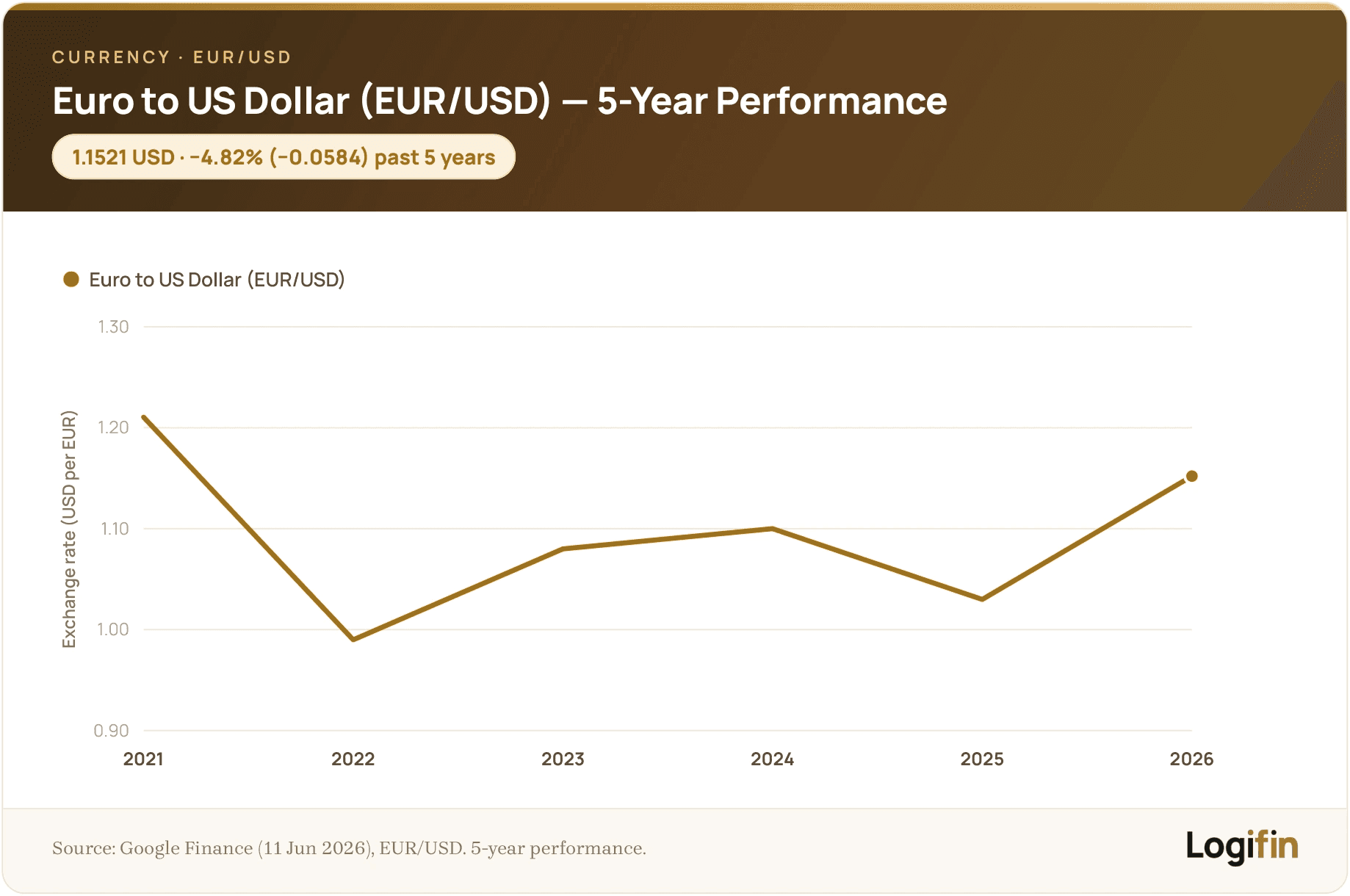
In 2022, the euro fell below 1:1 parity with the dollar for the first time in 20 years, as the Fed raised rates more aggressively than the ECB.
How does the ECB affect the markets: stocks, bonds and ETFs?
The European Central Bank’s (ECB) decisions have a direct and indirect impact on the capital markets.
Every rate change, every bond-purchase programme and every statement by the President can shift investor behaviour in stocks, bonds and ETFs.
🔶 Stocks
Monetary policy directly affects both corporate profitability and the relative attractiveness of stocks compared with other investment assets.
When the ECB lowers rates
- The cost of borrowing for businesses falls.
- Companies can more easily finance investments, expansions and acquisitions, which boosts their earnings over time.
- At the same time, future cash flows are discounted at a lower rate, which theoretically increases stock valuations.
- In such an environment, stock markets tend to be favoured.
When the ECB raises rates
- The picture changes. The cost of borrowing rises, squeezing profit margins, especially at highly indebted companies.
- At the same time, investors begin to compare the returns of stocks with those of bonds.
- If bonds now offer a safer and attractive yield, stocks lose part of their relative appeal.
Example:
The 2015–2021 period, with zero or negative rates and quantitative easing (QE), contributed significantly to the rise of European indices such as the EuroStoxx 50, as companies borrowed cheaply and investors turned to stocks in search of returns.

🔶 Bonds
The ECB is one of the largest and most decisive players in the bond market.
- Through its quantitative easing (QE) programme it bought government bonds en masse, driving their yields to unprecedented lows.
- In some countries, such as Germany, 10-year bonds even reached negative yields, meaning investors paid to hold them.
- When the ECB turns to tightening (raising rates, reducing purchases), yields rise and bond prices fall.
Example:
In 2022, after the ECB’s first rate hike in more than a decade and amid a rapid monetary-tightening cycle, the Bloomberg Euro Aggregate Bond Index recorded its worst annual performance in its history, with losses of around –17%.

🔶 ETFs
- Equity ETFs (e.g. MSCI Europe, EuroStoxx 50) move in line with the ECB’s stance on growth and consumption.
- Bond ETFs (e.g. Bunds, sovereign debt ETFs) react strongly to rate changes and to government-bond yields.
- Cross-country ETFs that invest across the entire Eurozone show increased volatility when the ECB announces policies that affect member states differently.
For an investor buying an ETF of European bonds, understanding ECB policy is just as important as choosing the product itself.
🔶 Indirect effects
The ECB’s decisions are not confined to Europe alone.
The euro is the second most important reserve currency in the world after the dollar.
Its strengthening or weakening affects:
- The competitiveness of European exports.
- The price of commodities (which are priced mainly in dollars).
- International capital flows, as large institutional investors rebalance portfolios according to monetary policy.
ECB vs Fed: The key differences
The European Central Bank (ECB) and the US Federal Reserve (Fed) are the two most powerful central banks in the world.
Although they share the common goal of stabilising their economies, they differ significantly in philosophy, tools and priorities.
1. Policy objectives
ECB: Single mandate
- The ECB’s main and almost exclusive goal is price stability, with inflation close to 2%.
- All monetary-policy decisions are judged primarily on whether they serve this goal.
Fed: Dual mandate
- The Fed operates under a dual mandate: price stability and maximum employment.
- This gives it a greater degree of freedom in its decisions.
This means the Fed can tolerate higher inflation if unemployment is elevated, whereas the ECB focuses exclusively on price stability.
This institutional framework explains why the Fed often shows greater "flexibility," while the ECB is seen as more "strict" and inflation-oriented.
2. Structure and governance
- ECB: Decisions are taken by the Governing Council, with the participation of the governors of the member states’ national central banks.
- Fed: Decisions are taken by the FOMC (Federal Open Market Committee), made up of the Fed’s Board of Governors and the presidents of the regional Federal Reserve Banks.
The difference in structure makes the ECB more "political," since each national central bank brings with it different interests and needs.
3. Eurozone vs US
- The Fed manages a single state with a central budget and a federal government.
- The ECB manages 21 different economies with different fiscal frameworks, debt levels and policy priorities.
This is why the ECB often has a harder time making decisions.
It must balance countries with different needs: e.g. Germany with low debt and an emphasis on price stability, versus Italy with high debt and a need for cheaper financing.
4. Tools
Both banks use the same basic tools: interest rates, QE/QT (Quantitative Easing/Tightening) and forward guidance.
However:
- The Fed has greater flexibility and more direct market intervention, reflecting the centralised nature of the US.
- The ECB moves more slowly and cautiously, due to the political complexity of the Eurozone.
Example:
- In 2020, the Fed reacted immediately to the pandemic by cutting rates to nearly zero and launching massive QE.
- The ECB needed more time and used special programmes, such as the PEPP (Pandemic Emergency Purchase Programme), to support the markets.
5. International influence
Dollar:
- The world’s main reserve currency, with around 58% of global foreign-exchange reserves.
- The Fed’s decisions have a global reach, affecting everything from emerging markets to commodity prices.
Euro:
- Second in importance, with around 20% of global reserves.
- The ECB has enormous influence in Europe, but clearly less global power than the Fed.
Markets often react more strongly to the Fed’s decisions, because the dollar is a reference point for the entire global financial system.
Conclusion and practical takeaways
The European Central Bank (ECB) is far more than just an "interest-rate setter."
It is the institution that determines the stability of the euro, affects the daily lives of citizens and businesses, while largely shaping the path of the European markets.
Its decisions are reflected in everything from the cost of a mortgage to a country’s ability to finance its public debt.
🔑 Key takeaways
- The ECB’s main goal is price stability, with an inflation target of around 2%.
- Its decisions affect interest rates, loans, investment and public finances.
- Through tools such as interest rates, QE/QT and TLTROs, the ECB channels or restricts liquidity in the system.
- Compared with the Fed, it has a narrower mandate, but its decisions remain critical for the Eurozone and, by extension, the global economy.
Practical tips for new investors
1. Follow the ECB’s announcements regularly
- Even a single phrase in a press conference can move the markets.
- The President’s statements often trigger sharp moves in bonds, stocks and exchange rates.
2. Think about the impact on bonds and loans
- When rates rise, fixed-rate bonds lose value, while mortgages and consumer loans become more expensive.
- Conversely, in periods of low rates, states and businesses borrow more easily, supporting growth.
3. Diversify internationally
- The ECB mainly affects the Eurozone.
- If your portfolio is overly concentrated in European assets, international diversification (US, emerging markets) can act as a buffer against one-sided ECB decisions.

The content of this article is provided exclusively for informational and educational purposes and does not constitute investment advice or a recommendation to buy or sell financial products. The information is based on publicly available sources considered reliable, without any guarantee of accuracy or completeness. Before making any financial or investment decision, it is recommended that you consult a certified professional advisor or accountant, taking into account your own financial situation and risk profile. The Logifin team bears no responsibility for any direct or indirect damages arising from the application of the information presented.
Related articles

What is the Fed and what is its role?
The world’s most powerful central bank and why its decisions affect every investor
15 min read

What is inflation and how does it affect your investments?
The “invisible tax” that reduces purchasing power and changes the rules of the game for investors
16 min read

What is a recession and how it affects investors?
How a recession is defined, what causes one, how the markets usually behave during it and what an investor can do to prepare in advance.
24 min read

What are the signs before a bear market?
How to read the macroeconomic indicators, the market behaviour and the investor psychology that often appear before a fall of more than 20%.
19 min read
EXPLORE LOGIFIN
Everything you need in order to learn, plan and track your investments.
Logifin Blog
Learn everything you need to get your finances in order and invest with confidence.
Logifin Insights
What moves the markets and what it means for a long term investor. Short and without the noise.
Logifin Tools
Free, inside the site, no signup. Everything you calculate stays on your device.
Logifin ETF Hub
Find the ETF that fits you: 550+ UCITS ETFs, smart filters and in-depth comparisons.
Logifin Guides
A series of guides that builds your investment plan step by step. The first guide is free for everyone.
Logifin Circle
The tools and the Hub are free for everyone. You become a member for the intelligence that never stops.