What are derivatives (futures, options, swaps) and how do they work?
The tools professionals use for hedging, leverage and high-precision strategies
20 August 2025 · 22 min read

What are derivatives in simple terms?
Derivatives are financial contracts whose value depends on an underlying asset – such as stocks, indices, bonds, commodities or even interest rates.
In essence, you do not invest directly in the asset itself, but in a “contract” that draws its value from it.
This makes them especially flexible tools, but also more complex than plain stocks or bonds.
Example:
- A futures contract on oil is not barrels of oil; it is an agreement that oil will be bought or sold at a specific price and date.
- So the contract’s value moves according to expectations about the future price of oil, not the ownership of the good itself.
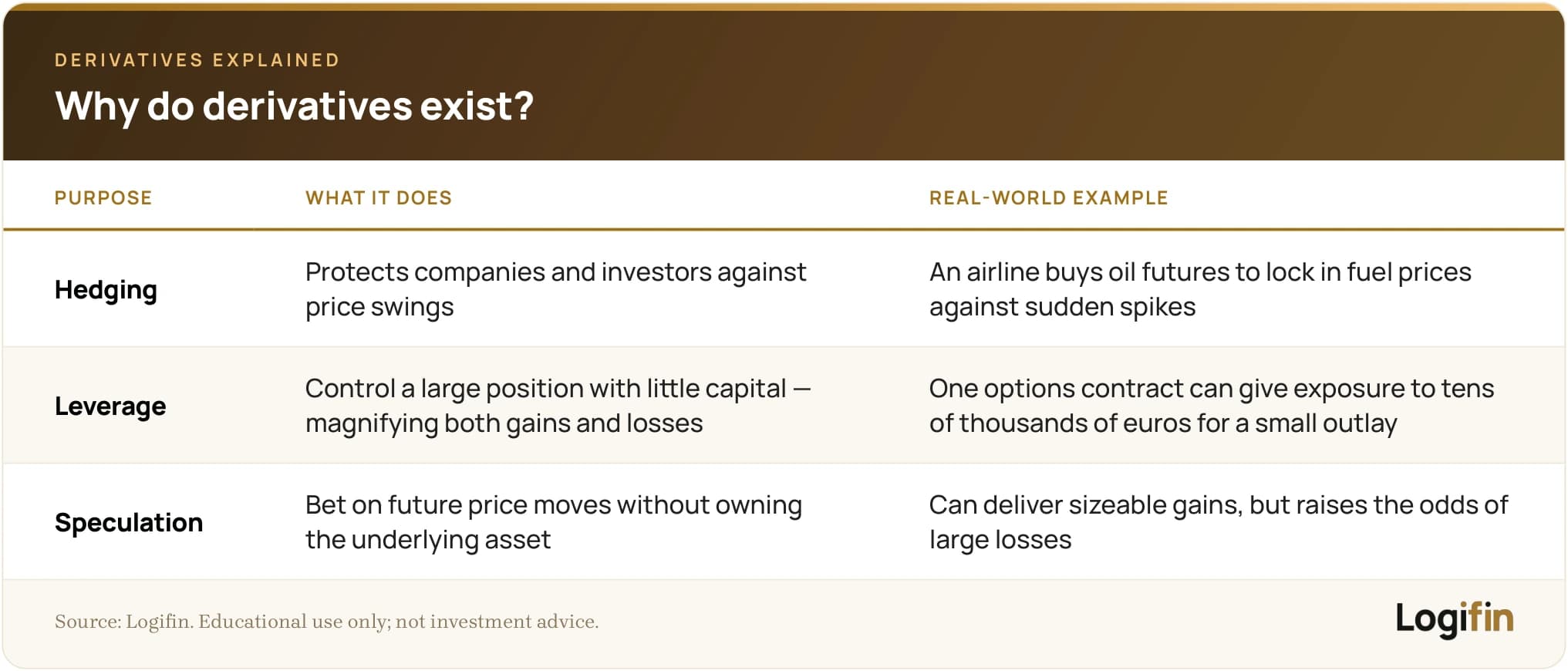
🔶 Why do derivatives exist?
Derivatives were not created by chance; they serve practical market needs.
From protection against unpredictable shifts to the ability to run more targeted strategies, the reasons for their existence are concrete:
🔶 Risk hedging:
Companies and investors use them to protect themselves from price fluctuations.
An airline can buy oil futures to “lock in” the price of its fuel and avoid being affected by sharp increases.
🔶 Leverage:
With a small amount of capital you can take a high-value position. This multiplies potential gains, but also potential losses.
An options contract can give you exposure to stocks worth tens of thousands of euros while investing only a small amount.
🔶 Speculation:
Many investors use derivatives to bet on future price moves, without having to buy or sell the asset itself.
This can bring significant gains, but at the same time increases the likelihood of large losses.
Futures: How do they work and what are they used for?
Futures are perhaps the best-known and most widespread type of derivative.
They are contracts that bind two parties to buy or sell an underlying asset (a stock, index, commodity, currency) at a predetermined price and date in the future.
Their core strength is that they provide certainty about the price of a future transaction, reducing uncertainty for those who want to protect themselves or to speculate.
🔶 How they work in practice
The buyer of the contract is obliged to buy the asset at expiry, while the seller is obliged to deliver it.
In reality, however, most investors never reach physical delivery of the good (e.g. barrels of oil or tonnes of wheat). They usually close their position earlier, taking a profit or loss from the difference in the contract’s price.
Trading takes place on organised derivatives exchanges, such as CME Group in the US or Eurex in Europe, with strict rules and supervision, so that the transparency and reliability of transactions are ensured.
They are widely used by companies that want to stabilise their costs, particularly in fuel or raw materials.
Example:
- An airline can buy oil futures to secure a stable fuel price for the next six months.
- If the oil price rises, e.g. from $80 to $100 per barrel, the company still pays the agreed price of $80 thanks to the contract.
- This way it is protected from a significant increase in its operating cost, which could reduce its profits or force it to raise ticket prices.
- Conversely, if the price drops to $70, the company "misses" the chance to buy cheaper fuel; but it knows its cost in advance and avoids unpleasant surprises.
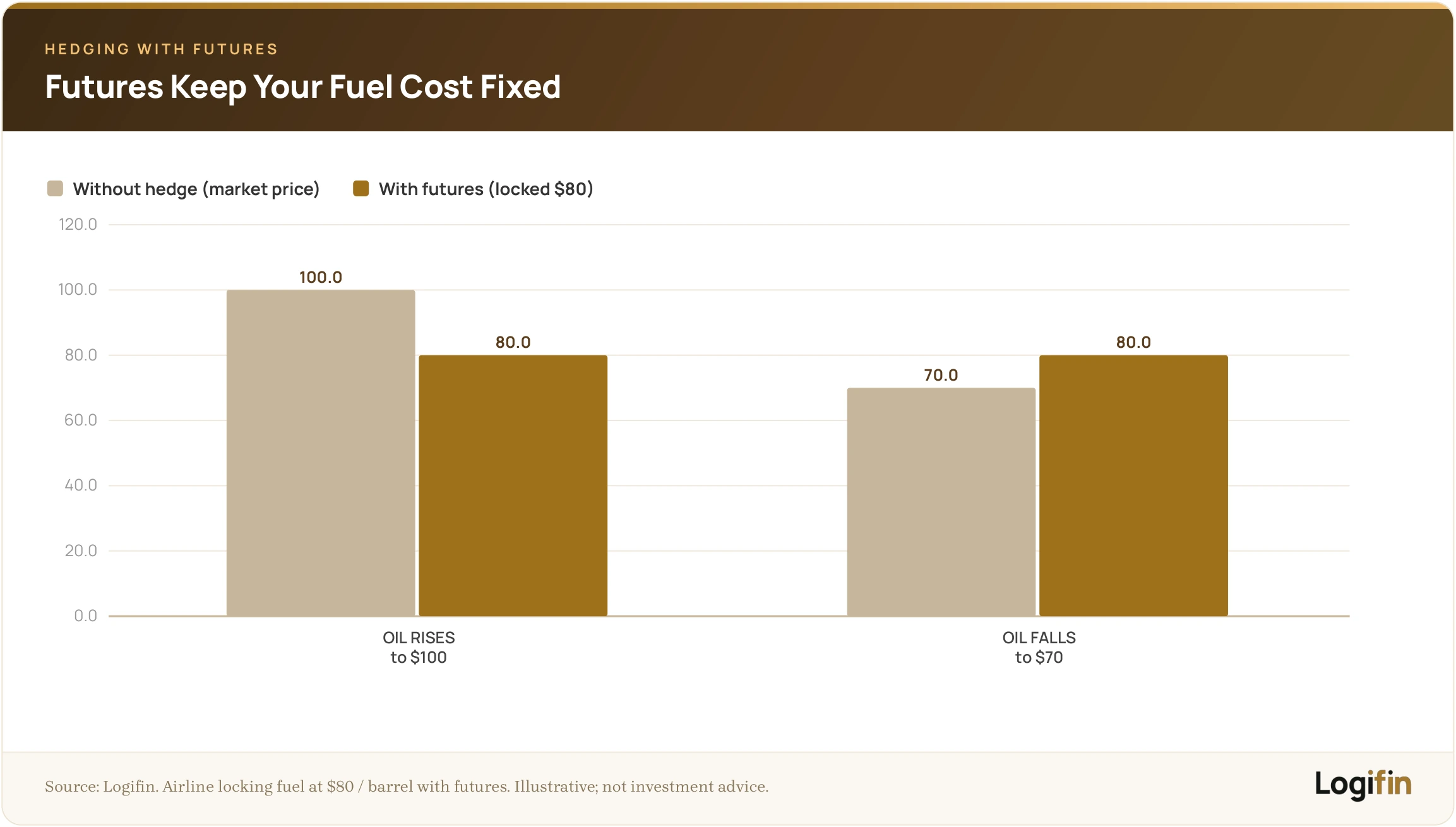
This shows how futures work as an income-stabilisation tool, even if they mean sacrificing part of the upside.
🔶 What Futures are used for
Futures are not merely theoretical tools: they have practical applications that touch both institutional and retail investors.
Depending on the goal, they can function either as a means of protection or as a tool for speculation.
- Hedging:
Futures are a basic risk-hedging tool, as they allow companies and investors to “lock in” prices and protect themselves from adverse market moves.
An exporter can use currency futures to avoid losses from euro/dollar fluctuations, knowing in advance the exchange rate that will apply to his transaction.
Thus, futures act as an “insurance policy,” reducing uncertainty in markets with strong volatility.
- Leverage:
One of the most powerful features of futures is leverage. With a relatively small deposit (margin), the investor can control a position of much greater value.
This multiplies potential gains, but also losses, which is why it is considered a double-edged sword.
Example: An investor who puts up 10,000 € as margin can control a position worth 100,000 €. If the market moves +5% in his favour, he gains 5,000 €. But if it moves -5% against him, he loses 5,000 €, i.e. 50% of the capital he had committed.
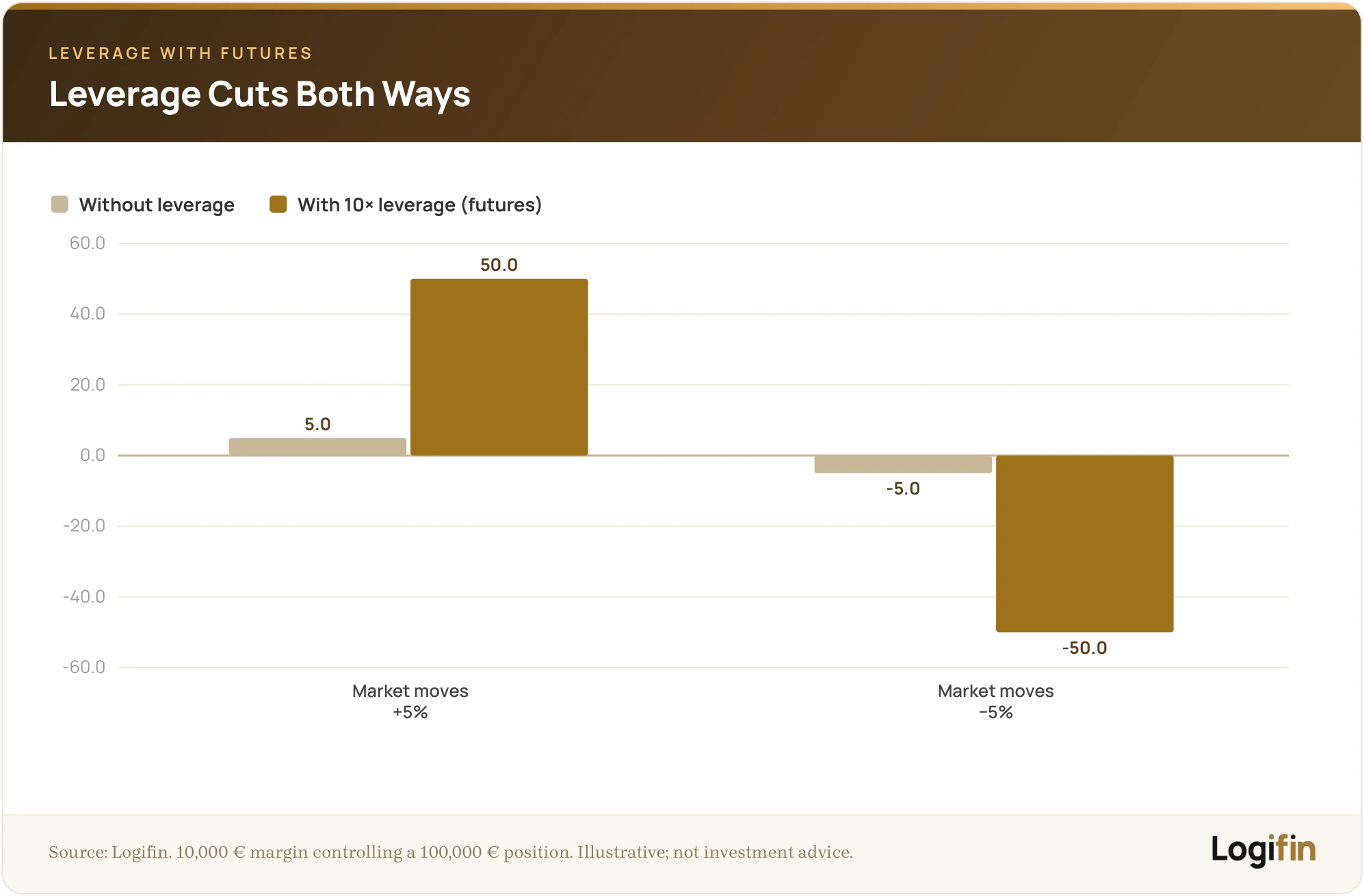
That is why proper risk management is crucial. Without discipline, leverage can lead to a rapid depletion of capital.
- Speculation:
Beyond hedging, futures are also widely used for speculation.
Traders can bet on the rise or fall of prices without having to own the asset itself.
- In rising markets, they open long positions to benefit from the upside.
- In falling markets, they open short positions, profiting from the price decline.
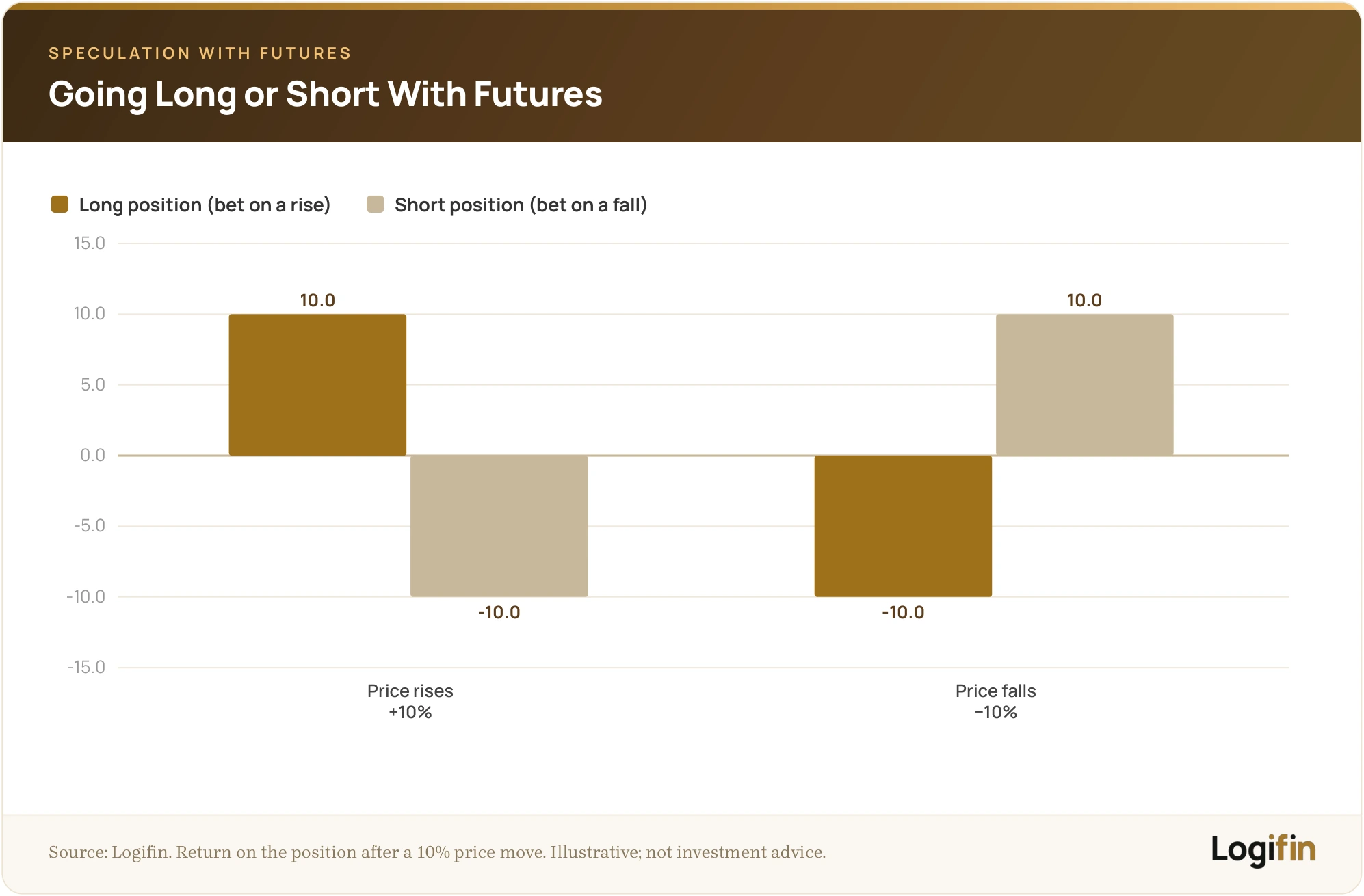
This makes it possible to profit in any market environment, as long as the trader predicts the direction correctly.
But that same flexibility also means higher risk, since wrong moves are punished just as quickly.
Options: How do they work and what is their difference from futures?
Options are a more “flexible” form of derivative.
Unlike Futures, they do not oblige the investor to buy or sell the underlying asset at expiry; they simply grant the right (but not the obligation).
This freedom makes them especially useful, but also more complex, since their value depends on many factors.
🔶 How they work in practice
Options have a purchase cost (premium) that the investor pays to acquire the right.
The seller of the option (writer) takes on the obligation to fulfil the contract if the buyer chooses to exercise it.
The value of an option is determined by many factors:
- the current price of the underlying security,
- the time remaining until expiry,
- the volatility of the market.
The more uncertain or “nervous” the market, the more expensive options become.
🔶 Two basic types of options
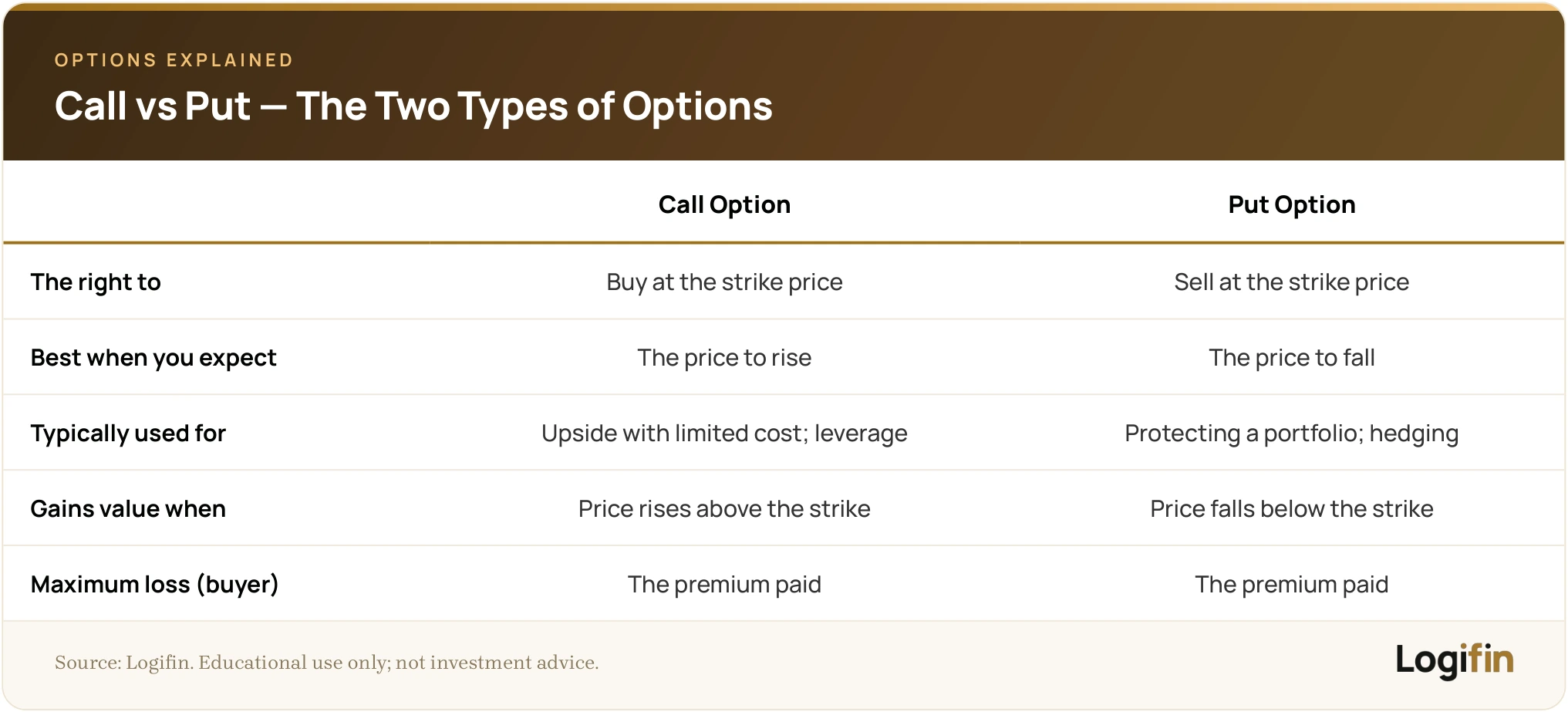
The two basic types are call and put options.
- Call Option
A call option gives its holder the right to buy an asset at a predetermined price, known as the strike price, up to or on the expiry date.
It is typically used when the investor:
- expects a rise in the price of the underlying asset
- wants to benefit from the upside with a limited initial cost
- seeks leverage with controlled risk
If the asset’s price exceeds the strike price, the call gains value. If not, the option may expire worthless, with the loss limited to the premium paid.
- Put Option
A put option gives its holder the right to sell an asset at a predetermined price (strike price).
It is typically used when the investor:
- expects a fall in the market
- wants to protect a portfolio from losses
- seeks risk hedging
If the asset’s price falls below the strike price, the put increases in value. If not, here too the maximum loss is limited to the premium.
🔶 Example:
- If you buy a call option on Apple stock with a strike price of $150 and the stock rises to $170, you have the right to acquire it at $150, thus gaining $20 per share.
- In practice, the option works like a “ticket” that lets you buy more cheaply than the current market price.
- But if the price stays below $150, you simply do not exercise the option. In that case, your loss is limited solely to the premium you paid for the option (i.e. the cost of buying the contract).
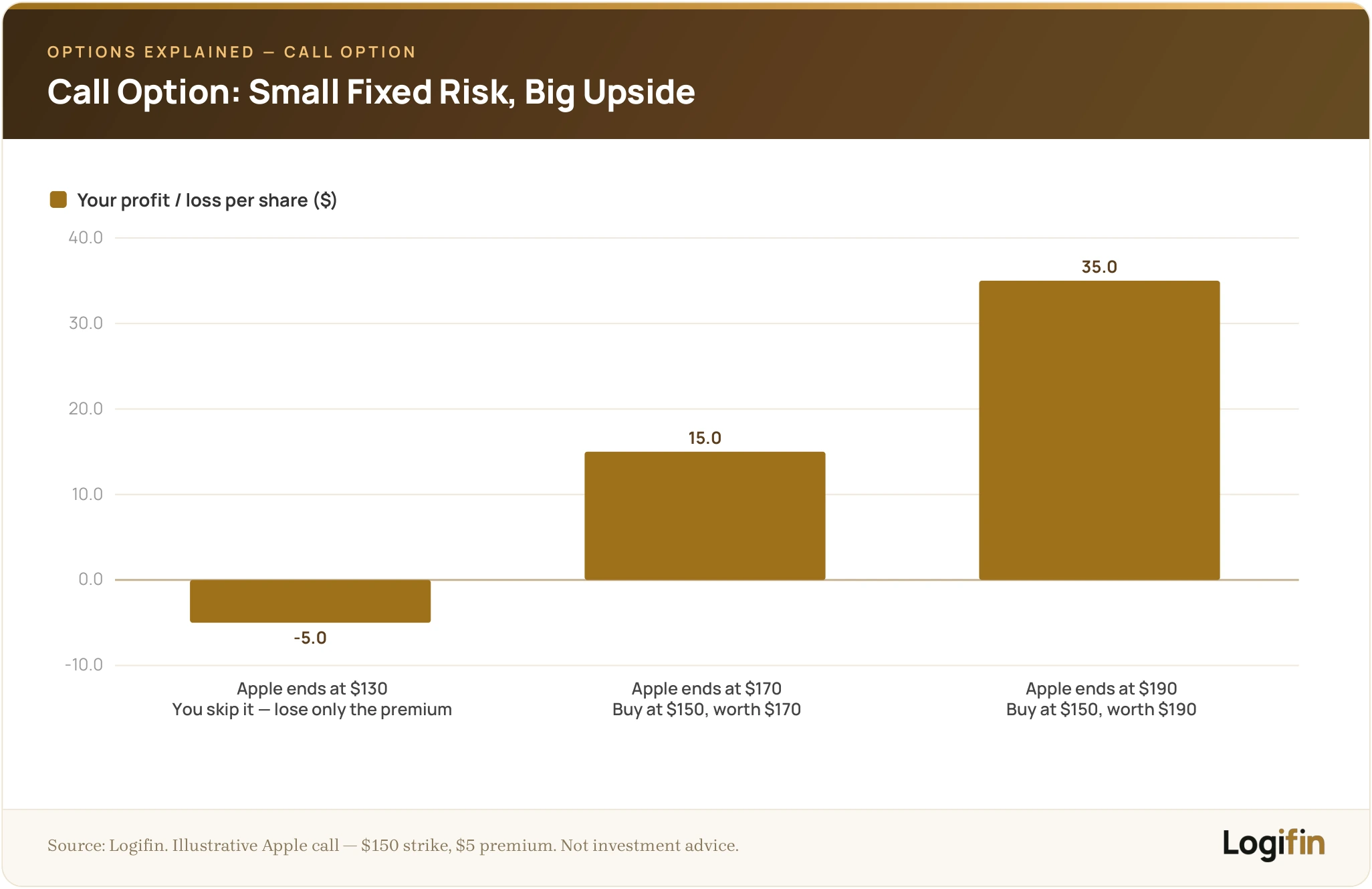
This way, you know your maximum risk from the start: you cannot lose more than the premium, while your potential gain is theoretically unlimited as the stock rises.
🔶 Options vs Futures: The key differences
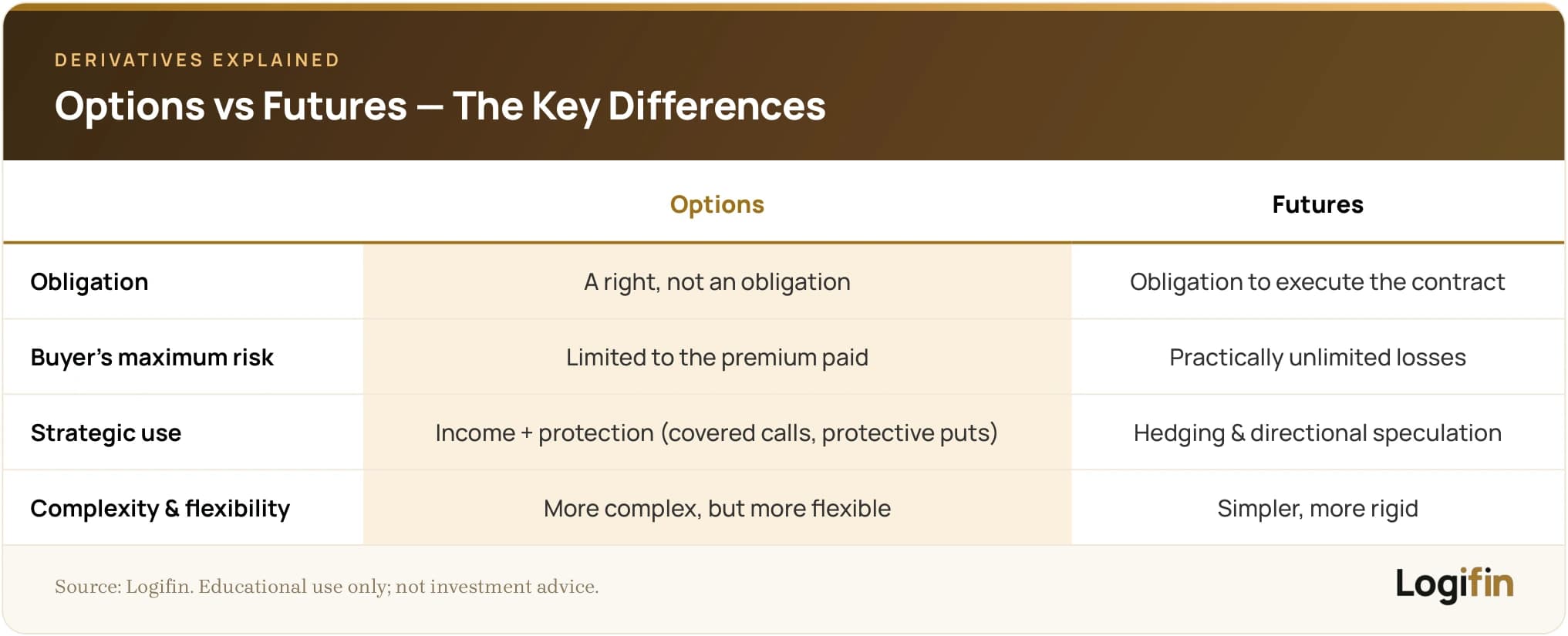
Options are more complex but also more flexible than Futures.
They allow risk control, income generation or speculation with little capital. However, they require experience, a good understanding of strategy and proper management, because wrong moves can be costly.
The key differences between options and futures are:
- Obligation: With Futures there is an obligation to execute, whereas with Options there is only a right.
- Risk: The buyer of an option can lose only the premium; by contrast, with Futures the losses can be practically unlimited.
- Strategic use: Options enable more sophisticated strategies (e.g. covered calls, protective puts) that can combine income with protection. Thus, they are not merely a speculation tool but also a risk-management tool.
👉 Options are often used as a kind of insurance policy.
An investor who owns stocks can buy put options to protect against a possible market decline, a strategy known as portfolio insurance.
Swaps – Exchanges of financial flows
Swaps are derivative contracts in which two parties agree to exchange financial cash flows in the future, based on predetermined terms.
Unlike Futures and Options, Swaps are usually not traded on organised exchanges but over-the-counter (OTC), i.e. in private agreements between banks, companies or institutional investors.
This means there is greater flexibility in their design, but also increased counterparty risk.
🔶 How they work in practice
The most common form is the Interest Rate Swap, where two parties exchange interest payments:
- one pays a fixed rate and receives a floating one,
- while the other does the opposite.
This way, a company with a floating-rate loan can “lock in” its financing cost, avoiding the fluctuations caused by central-bank moves.
Other categories of Swaps:
Currency Swaps: Exchange of payments in different currencies, in order to reduce foreign-exchange risk.
Commodity Swaps: Contracts where payments are based on the price of a commodity (e.g. oil, natural gas, grains).
🔶 Example:
- A shipping company with a dollar-denominated loan worries that the euro/dollar exchange rate may move against it.
- If the euro weakens, then the dollar loan instalments will cost more in euros, increasing its expenses.
- To protect itself, it enters into a currency swap with a bank: they agree that the company will pay principal-and-interest in euros, while the bank will cover the corresponding payments in dollars.
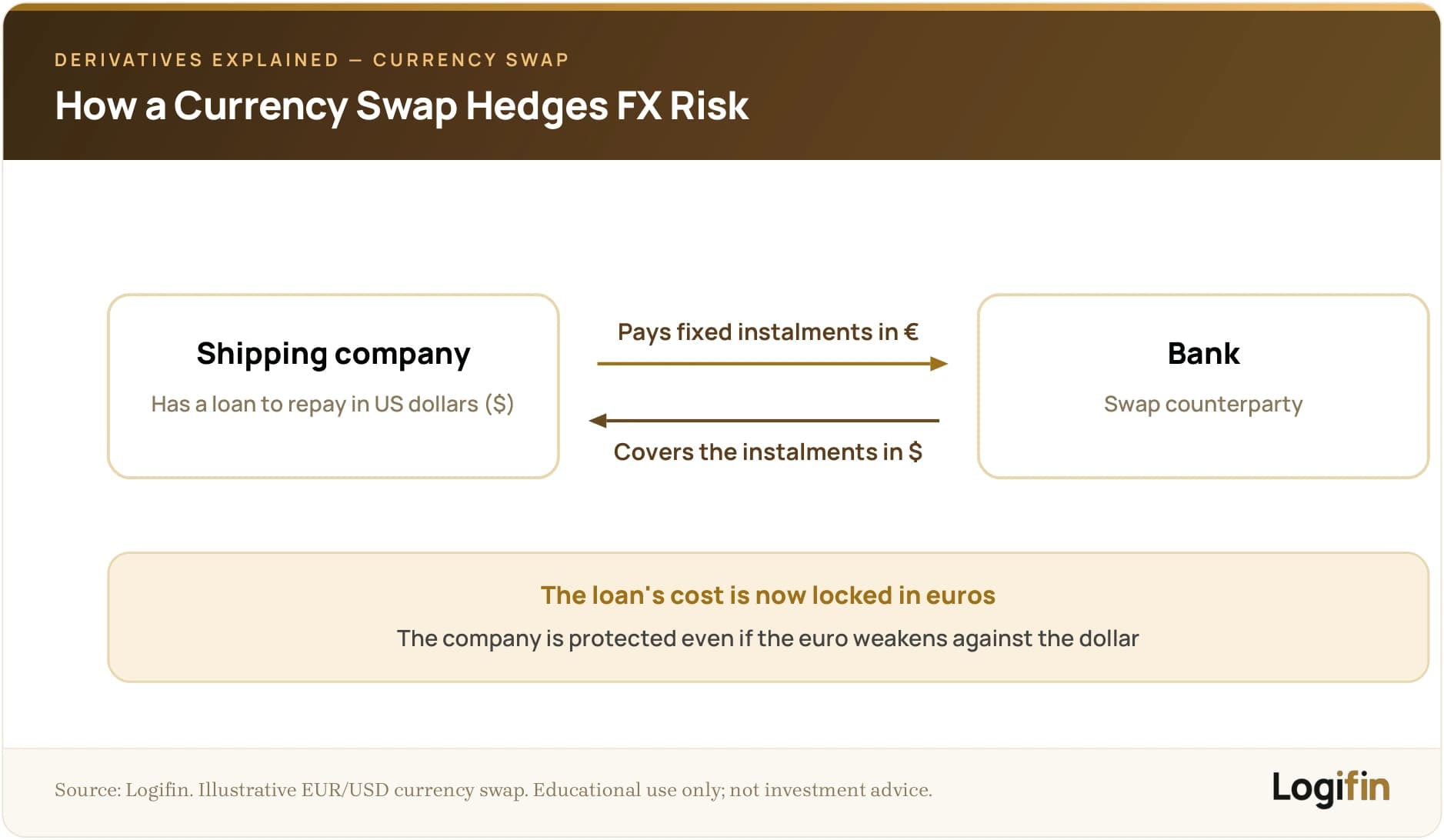
This way, the shipping company “locks in” its payments in euros, eliminating the foreign-exchange risk.
The bank, on the other hand, benefits from fees and from hedging the risk with other transactions.
🔶 What Swaps are used for
Swaps are not meant for speculation on short-term market moves, but for risk management and the optimisation of financing at large scale.
They are mainly useful in the following areas:
- Risk management (hedging): Companies and banks use them to stabilise borrowing costs or to limit foreign-exchange risks.
- Financing flexibility: They allow a company to “reshape” its borrowing terms without having to issue a new loan.
- Institutional use: Because of their large size and complexity, they are used almost exclusively by institutional players (banks, funds, multinationals) and far less by small investors.
Special category: Credit default swaps (CDS)
Let us suppose a bank holds Greek government bonds:
- To protect itself from default risk, it buys CDS from an international investment bank.
- If Greece cannot repay its debt, the issuer of the CDS is obliged to cover the loss, paying the buyer the amount corresponding to the loss.
In practice, a CDS works like an insurance policy, with the difference that you are not required to own the “insured” asset.
This means that even investors who do not own the bond can buy CDS, simply betting on whether the issuer will default.
🔶 What CDS are used for
- Risk management (hedging): Banks and funds use them to protect their portfolios from possible defaults of companies or states.
- Speculation: Investors can buy CDS as a “bet” on a possible default, even if they do not own the related bond. This can yield huge gains in times of crisis, but also creates risks of systemic instability.
- Price discovery: The price of a CDS reflects the perceived default risk of a country or company. Thus, it works as a “barometer” for the market’s credit assessment.
🔶 An interesting fact
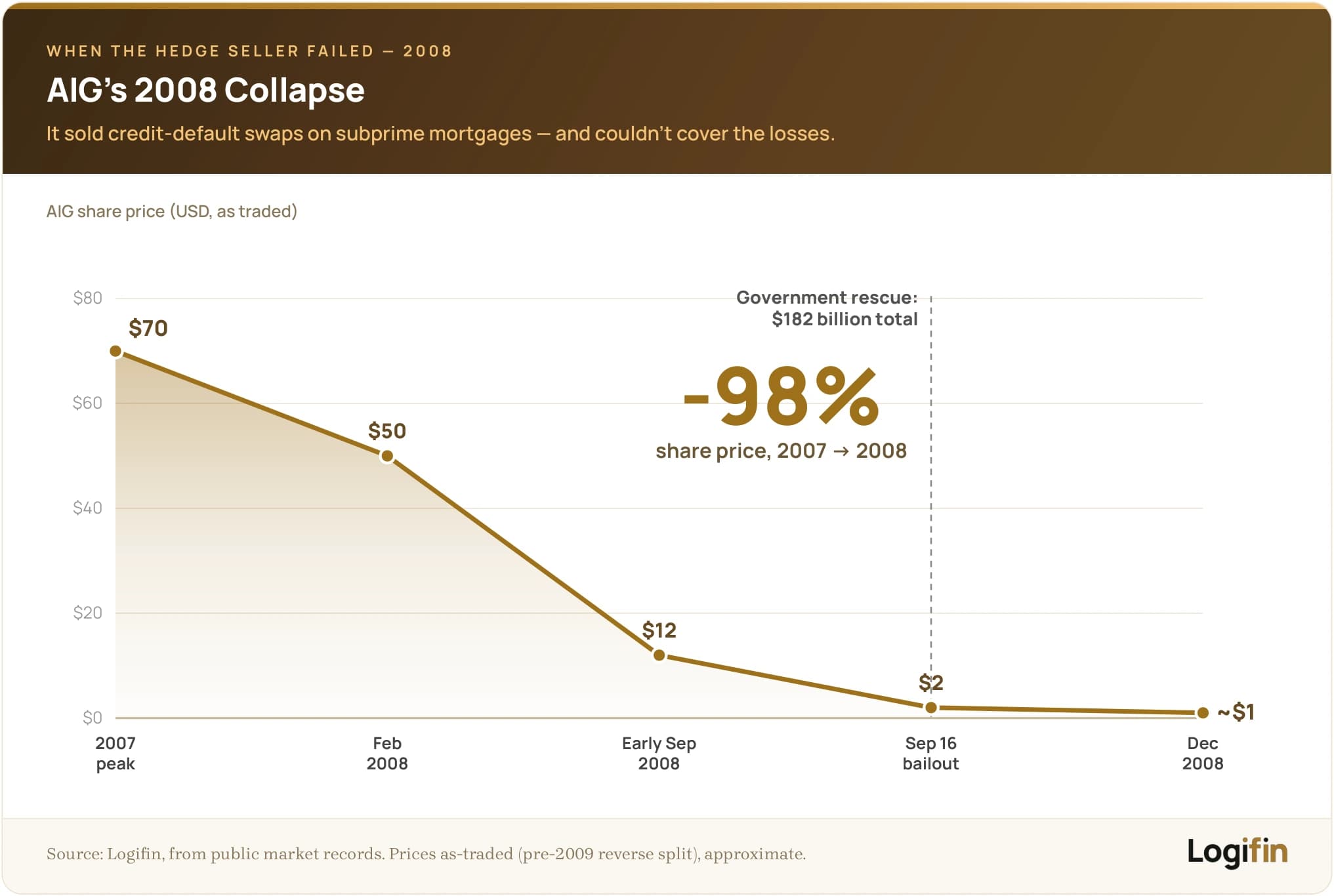
According to ISDA data, the total notional amount of credit default swap (CDS) contracts peaked at the end of 2007 at around $60–62 trillion, exceeding in notional value many individual bond markets.
Although CDS were designed as risk-hedging tools, they were also widely used for pure speculation.
AIG, the world’s largest insurance company at the time, found itself exposed to a huge volume of CDS without sufficient collateral, which led to a government bailout of about $182 billion, aimed at preventing a systemic crisis in the global financial system.
Who are derivatives suitable for?
Derivatives are not for everyone.
Although they are at the heart of global markets and move trillions daily, their use varies according to the profile and needs of each investor or organisation.
The same category of products can mean security for an institution and pure speculation for a trader.
🔶 Institutional Investors
- Insurance companies and pension funds use derivatives to hedge risks (e.g. from interest rates, inflation or currencies). Without them, managing their enormous balance sheets would be practically impossible.
- Hedge funds exploit leverage and complexity (e.g. by combining swaps, options and CDS) to pursue high returns in a short period, or to take positions on events such as defaults of states and companies.
- Banks use them daily for balance-sheet management, to limit risks on loans and interest rates, as well as to create “artificial liquidity.” For example, through credit default swaps (CDS) they can move credit risk off their books.
Some examples:
- A large pension fund that fears a stock decline can buy put options on an index such as the S&P 500, to protect the value of its portfolio.
- Likewise, a bank can enter into interest rate swaps to stabilise its financing cost.
🔶 Companies & Producers
Companies active in commodities or international trade have direct exposure to price and currency risks.
For them, derivatives are not a luxury but a survival mechanism.
Some examples:
- An airline buys fuel futures to stabilise its operating cost and avoid losses from sudden increases in the price of oil.
- A farmer sells wheat futures to secure his income, regardless of where the market moves.
- An exporting business can enter into currency swaps so as not to be affected by fluctuations in the euro/dollar exchange rate.
This is the “primary” function of derivatives: stability for businesses, not speculation.
🔶 Professional Traders
Traders use futures, options and other complex products (e.g. CDS on government bonds) to speculate on short-term market moves.
Leverage gives them the potential for large gains, but also huge losses. That is why they often apply complex strategies (spreads, straddles, iron condors, arbitrage on swaps).
According to analyses by NCAs under the supervision of ESMA, 74–89% of retail investor accounts in CFDs record losses, a very high rate, indicative of the risks of leverage and the absence of risk management.
By contrast, successful professional investors usually rely on systematic risk management, such as the use of stop-loss, position sizing and hedging, not on random or impulsive moves.
🔶 Retail Investors
Although derivatives are also accessible to retail investors, they require a high level of understanding and experience.
Without proper education, the probability of loss is greater than the probability of gain.
An advanced retail investor can use them in a complementary way, e.g. buying put options as “insurance” for his portfolio or using small futures contracts for hedging.
However, the use of more complex products such as CDS or structured swaps is rarely appropriate for a retail audience.
In the 2002 Berkshire Hathaway annual report, Warren Buffett described derivatives as “financial weapons of mass destruction”, noting that they embed risks which may not be immediately visible but can prove extremely dangerous over time.
💡 Derivatives are for advanced investors, but organising your finances starts with the basics.
Subscribe for free to the Logifin newsletter for practical ideas without noise and use the Logifin Portfolio Tracker to see every broker and asset in one file.

Advantages of derivatives
Despite their reputation as “complex” or “dangerous,” derivatives are a crucial tool for global markets.
The reason they are so widely used is that they provide advantages that no other category of financial products offers with the same flexibility.
For exactly this reason, they are at the heart of the operations of banks, funds and businesses around the world.
🔶 Risk Hedging
The greatest advantage of derivatives.
Companies and institutional investors can “lock in” prices and protect themselves from unpredictable changes in interest rates, currencies, raw materials or even credit risk.
Some examples:
- An airline that buys fuel futures reduces its exposure to a rise in the price of oil.
- Likewise, a bank can use credit default swaps (CDS) to insure itself against the possibility of default on a large loan.
🔶 Leverage
With a small amount of capital (margin) you can control a high-value position.
This allows investors to use their money more efficiently and to achieve returns that would otherwise be impossible.
Leverage, however, is a “double-edged sword”: it increases returns, but also multiplies losses.
For institutional investors it is an everyday tool; for retail investors, a trap if there is no discipline.
🔶 Strategic Flexibility
Options, futures and also more specialised products such as swaps enable complex strategies that combine income, protection and speculation.
An investor can make a profit even if the market moves sideways or downward (e.g. through covered calls or protective puts).
Likewise, interest rate swaps allow a company to convert a floating rate into a fixed one, “locking in” the financing cost for years.
🔶 Liquidity and Market Depth
The derivatives markets (CME, Eurex, CBOE) are among the most liquid in the world.
This means low spreads, fast execution and the ability to move huge amounts of capital without disrupting the market.
For institutional investors, this feature is invaluable: they can manage portfolios worth billions without “turning” the market against themselves.
🔶 Transparency and Standardisation
On organised exchanges, derivatives contracts are standardised and supervised.
This reduces default risk, offers price transparency and facilitates oversight by the authorities.
By contrast, in over-the-counter (OTC) markets such as swaps or CDS, there is greater flexibility but also increased counterparty risk.
Risks of derivatives
Although derivatives are a useful tool for institutions and businesses, they hide significant risks.
These risks are the reason they are often considered “products for advanced users” and not for beginner investors.
Used correctly they can act as a shield; used incorrectly, as a catalyst for disaster.
🔶 High complexity
Derivatives require specialised knowledge. The combination of premium, strike price, volatility and margin is not easy for a beginner to understand.
The difficulty is not limited to options and futures; with more advanced products such as swaps or CDS, understanding the risk becomes even more complex.
A single miscalculation can lead to large losses.
For example, a company that signs a swap with wrong assumptions about interest rates may end up paying more than double the interest it expected.
🔶 Leverage risk
The same leverage that enables large gains can cause catastrophic losses.
Example #1:
- With 20:1 leverage, 5,000 € of margin is enough to control a position of 100,000 €.
- If the market moves just -5% against you, the 5,000 € loss wipes out all of your initial capital, showing how quickly leverage can zero out an account.
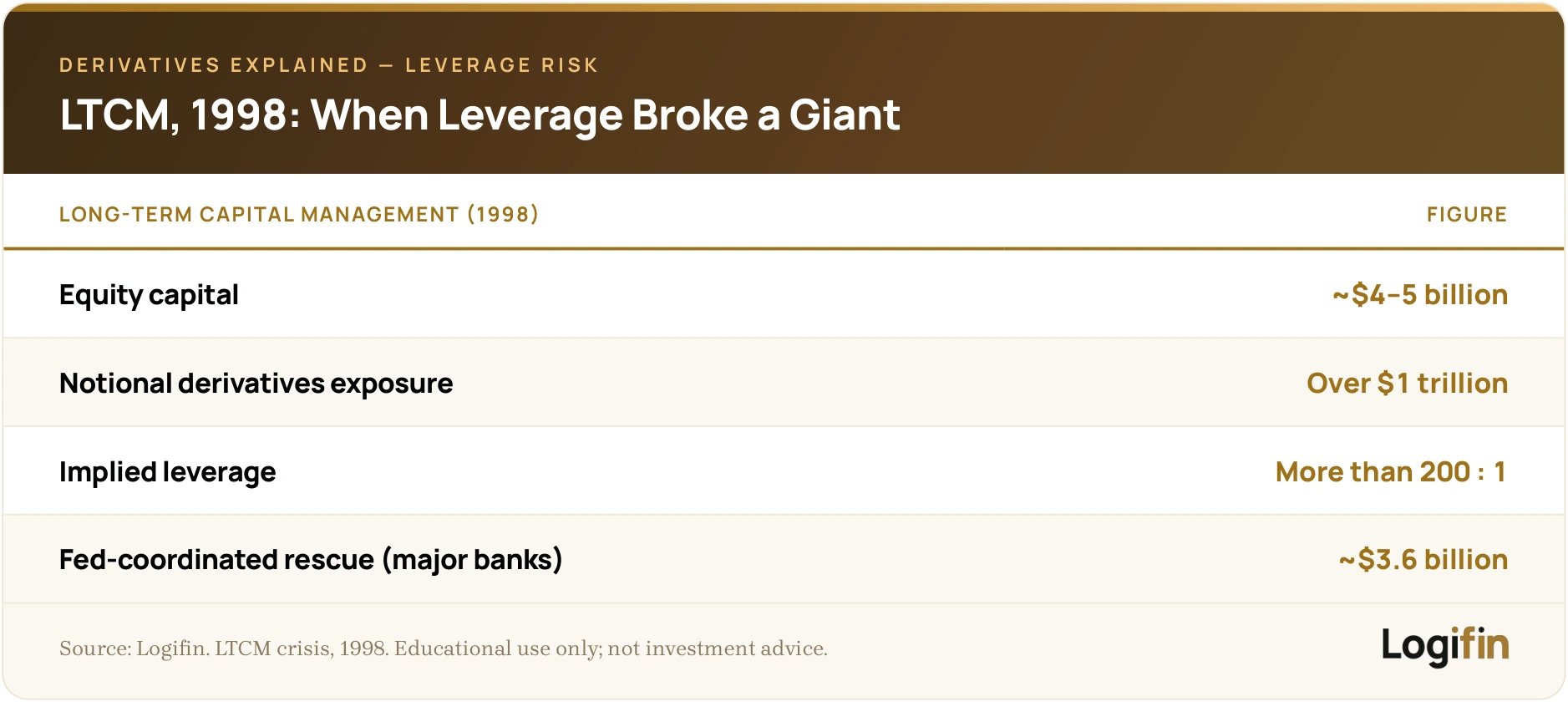
Excessive leverage was a central factor in several major fund collapses.
Example #2:
- A characteristic case is that of Long-Term Capital Management (LTCM) in 1998.
- The hedge fund managed equity of about $4–5 billion, while it had a notional derivatives exposure exceeding $1 trillion.
- After the Russian debt crisis, its heavily leveraged positions suffered large losses and the fund came to the brink of collapse.
- To avoid systemic risk, the Federal Reserve coordinated a private bailout, in which large banks provided a total of about $3.6 billion in capital.
🔶 Volatility
Derivatives markets often move more violently than the markets for stocks or bonds.
A single event (e.g. a CPI release or a Fed decision) can cause huge moves in options or futures, with the result that investors lose or gain large amounts within minutes.
Volatility also affects the price of options: an option can become significantly more expensive not because of a move in the stock, but simply because expected instability in the market has increased.
🔶 Time risk (Time decay in Options)
An option loses value as its expiry date approaches (time decay).
This means that even if the stock stays flat, the option can lose value solely because of time.
For an inexperienced investor who does not understand this dimension, the experience can be frustrating: watching the stock “do nothing” while his option keeps losing value.
🔶 Counterparty risk
Despite standardised exchanges, there are also OTC (over-the-counter) derivatives, where the transaction is made directly with another party.
There, counterparty risk is real: if the counterparty cannot pay, the investor is exposed to losses.
The 2008 crisis was a classic example: CDS (Credit Default Swaps) led to systemic risk when large counterparties, such as AIG, could not meet their obligations.
The domino effect from that failure almost brought down the entire financial system.
Conclusion and practical takeaways
Derivatives are among the most fascinating but also the most controversial tools in the markets.
Their value depends on who uses them and for what purpose.
For a professional trader, they are a means for leverage and high-precision strategies. For a beginner investor without experience, however, they can prove a trap that leads to large losses.
🔑 What to keep in mind
- Derivatives draw their value from underlying assets (stocks, indices, commodities, interest rates, credit instruments).
- Futures are contracts with an obligation, while Options are contracts with a right.
- Swaps and CDS are used mainly at the institutional level: the former for managing interest-rate and currency risk, the latter for transferring credit risk.
- The main role of all of these: risk hedging, leverage and return strategies.
- In the hands of professionals, they are precision tools. In the hands of the inexperienced, they can turn into a dangerous trap.
Practical Tips for new investors:
-
Learn before you invest
If you do not fully understand what strike price, margin, time decay or counterparty risk are, it is better to stay away.
-
Start with simulations or small positions
Many platforms offer “paper trading.” It is better to learn with virtual money before risking real money.
-
Use them for protection, not for gambling
A put option on your portfolio can act as insurance. An interest rate swap can stabilise the cost of a loan. By contrast, going “all-in” on options or CFDs is almost always a recipe for failure.
-
Check the counterparty
If you deal with OTC products (e.g. swaps, CDS), the reliability of the counterparty is crucial.

The content of this article is provided exclusively for informational and educational purposes and does not constitute investment advice or a recommendation to buy or sell financial products. The information is based on publicly available sources considered reliable, without any guarantee of accuracy or completeness. Before making any financial or investment decision, it is recommended that you consult a certified professional advisor or accountant, taking into account your own financial situation and risk profile. The Logifin team bears no responsibility for any direct or indirect damages arising from the application of the information presented.
Related articles

What is the stock market? The complete beginner's guide
Understand how it works, who participates and why it is a central pillar of the global economy.
20 min read

What is hedging and when do we need it?
What hedging is, which tools investors use for it, what it costs in giving up return and when a private investor genuinely needs it.
17 min read

How to build a resilient portfolio
A guide for investors who want to build something stable, simple and rewarding over the long term.
19 min read

What is a recession and how it affects investors?
How a recession is defined, what causes one, how the markets usually behave during it and what an investor can do to prepare in advance.
24 min read
EXPLORE LOGIFIN
Everything you need in order to learn, plan and track your investments.
Logifin Blog
Learn everything you need to get your finances in order and invest with confidence.
Logifin Insights
What moves the markets and what it means for a long term investor. Short and without the noise.
Logifin Tools
Free, inside the site, no signup. Everything you calculate stays on your device.
Logifin ETF Hub
Find the ETF that fits you: 550+ UCITS ETFs, smart filters and in-depth comparisons.
Logifin Guides
A series of guides that builds your investment plan step by step. The first guide is free for everyone.
Logifin Circle
The tools and the Hub are free for everyone. You become a member for the intelligence that never stops.