What is hedging and when do we need it?
What hedging is, which tools investors use for it, what it costs in giving up return and when a private investor genuinely needs it.
30 August 2025 · 17 min read

What does “hedging” mean?
Hedging is a strategy that aims to reduce the potential losses from investment positions.
Its goal is not to generate profit; its purpose is protection.
With hedging, the investor sacrifices part of the potential return in order to reduce uncertainty and shield their portfolio against adverse developments.
In simple terms, it is like buying insurance for your investments: you pay a "cost" (either through hedging instruments or through lost potential return), but you ensure that, in case of an unexpected negative development, the losses will be more limited and manageable.
Example:
- If you hold a portfolio of European stocks and fear a drop due to a recession, you can buy a put option on the EuroStoxx 50 index.
- If the market does fall, the losses on your stocks will be offset by the gains on the option.
- This way, you reduce the overall risk of your portfolio.
🔶 What hedging is NOT
- It is not a method of "guaranteed profit": it works preventively, not aggressively.
- It does not eliminate risk entirely: it only limits specific risks.
- It is not free; it always has some cost, whether visible (e.g. an option’s premium) or "hidden" (lost potential return if the market does well).
Why is hedging important?
Markets are unpredictable. No investor, however experienced, can know with precision how prices will move in the future.
Hedging is essential because it works as a defence mechanism against unforeseeable factors, reducing losses when things do not go as expected.
🔶 Protection from external shocks
- Geopolitical crises, wars, natural disasters or pandemics can cause sharp drops in the markets.
- The investor does not need to "guess" when they will happen; with a hedge they know they have a safety net if they do occur.
- In extreme conditions, the hedge acts like an "insurance premium", giving the investor time to stay calm.
Example:
During the outbreak of the pandemic in 2020, investors who had hedged with put options on indices dramatically limited their losses, while markets collapsed by over 30% within a few weeks.
🔶 Reducing portfolio volatility
Hedging smooths the fluctuations in a portfolio’s value. As a result, the investor:
- avoids large losses over a short period,
- stays more disciplined in their strategy,
- reduces the risk of wrong decisions driven by panic.
Psychology is half the game in investing.
A hedge that reduces fluctuations can keep the investor "calm" and consistent with their long-term plan.
🔶 Managing currency risk
Investments in foreign assets mean exposure to different currencies, which can boost or reduce your final return independently of the market’s path.
For a European investor, exposure to USD, GBP or other currencies works as a second layer of risk, but also of opportunity.
If the foreign currency strengthens against the euro, your returns increase. If it weakens, it can "eat" part of the gains or add to the losses.
Example:
- If the euro strengthens against the dollar, a European investor can lose on the conversion, even if the U.S. stock has risen.
- By using currency futures or options, the currency risk is limited.
This is why large funds apply currency hedging to their international portfolios, especially when interest-rate differences between currencies are pronounced.
🔶 A corporate need
Hedging is not only about individual investors; it is also a critical tool for businesses that want to stabilise revenues and costs.
Example:
- A European airline can buy oil futures to "lock in" fuel prices.
- This way it knows its cost in advance, even if the price of oil skyrockets.
- Similarly, exporting companies use currency swaps to protect themselves from unfavorable exchange rates.
The main hedging tools
Hedging can be achieved through various means.
Some are simple and accessible to individual investors, while others are more complex and common among institutional players.
Each instrument has its own advantages and disadvantages, but they all share a common goal: to limit losses in times of turmoil.
1. Options
Perhaps the most classic and recognizable hedging tool.
A put option works like "insurance" for stocks: if the price falls below a threshold, the option gains and covers part of the losses.
Example:
- If you hold stocks worth 10,000 € in the EuroStoxx 50 and worry about a possible market drop, you can buy a put option that activates if the index falls by more than 10%.
- So, if your portfolio’s value drops to 9,000 €, the gain on the option (e.g. +1,000 €) will offset part or even all of the loss.
- Conversely, if the market keeps rising, you do not lose the returns on your stocks; you simply "sacrifice" the cost of the option (premium), just as you pay car insurance without wishing for an accident.
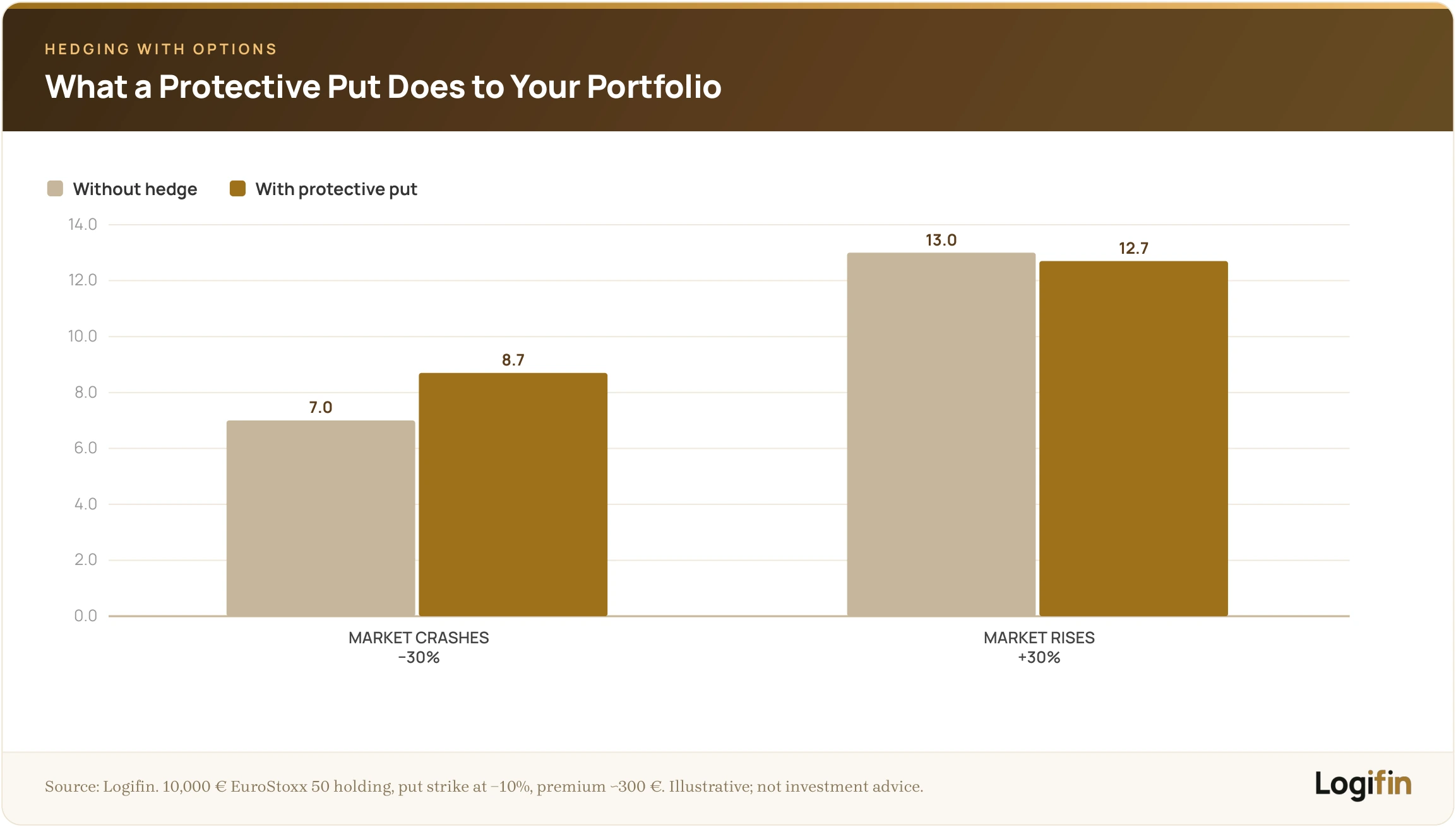
This way, hedging with options offers you psychological calm and greater resilience in periods of intense volatility, without having to sell your stocks.
The cost of an option (premium) is essentially the "insurance premium" you pay for this protection.
2. Futures
Futures are contracts that allow the investor to "lock in" prices for future transactions.
They carry an obligation to execute, unlike options which merely grant a right.
This means the investor must be prepared for possible losses too, not only gains.
They are widely used by companies that want to stabilise their costs, particularly in fuel or raw materials.
Example:
- An airline can buy oil futures to secure a stable fuel price for the next six months.
- If the oil price rises, e.g. from $80 to $100 per barrel, the company still pays the agreed price of $80 thanks to the contract.
- This way it is protected from a significant increase in its operating cost, which could reduce its profits or force it to raise ticket prices.
- Conversely, if the price drops to $70, the company "misses" the chance to buy cheaper fuel; but it knows its cost in advance and avoids unpleasant surprises.
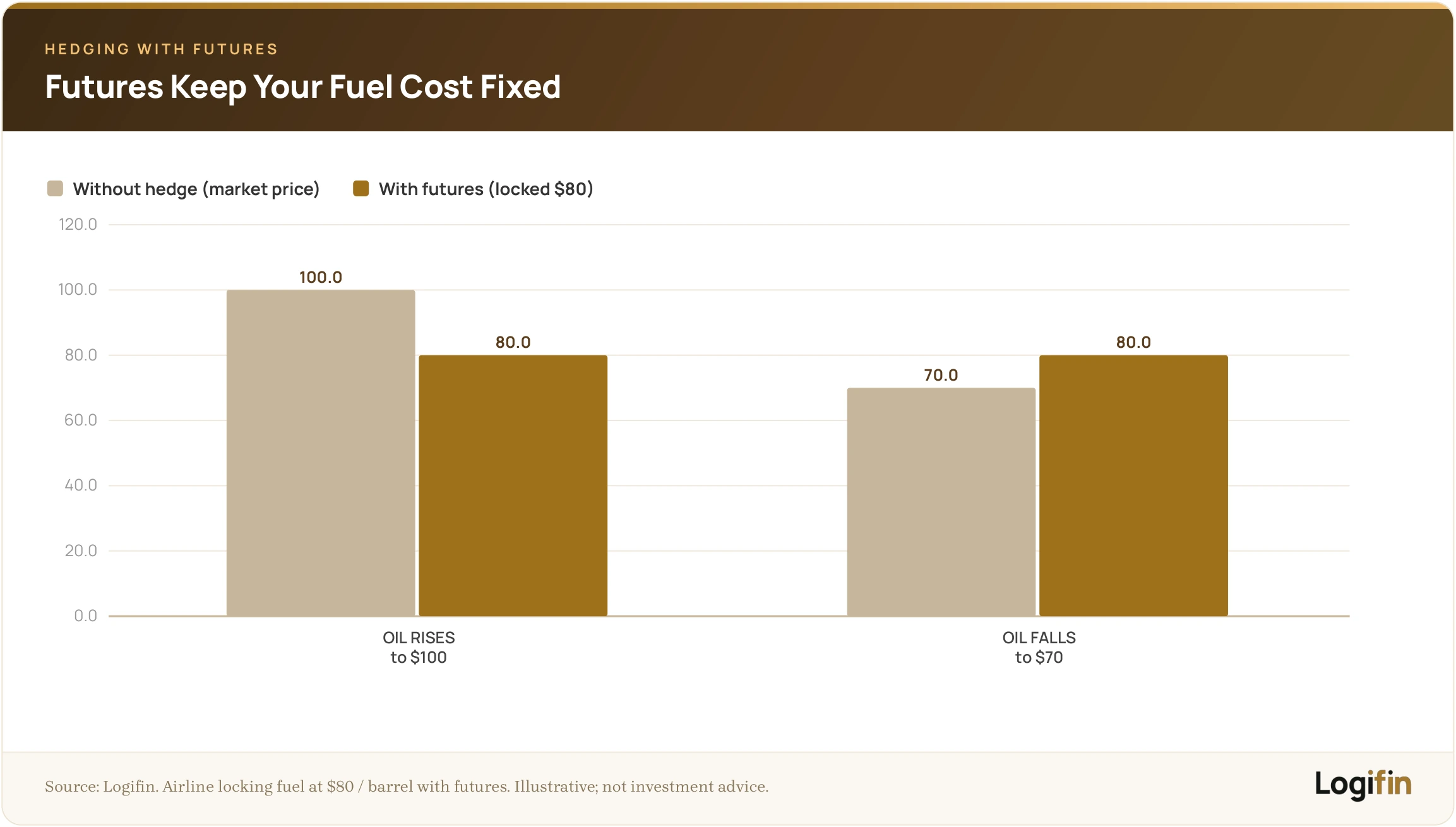
This shows how futures act as a cost-stabilisation tool, reducing uncertainty in one of the most volatile areas of the market.
3. Currency hedges
Exchange rates are a significant source of risk for investors who hold assets in a foreign currency.
With tools such as currency forwards, futures or even currency ETFs, one can protect against unwanted moves.
Example:
- A European investor holding U.S. stocks worth $50,000 benefits when the stocks rise, but is at the same time exposed to the currency risk of the dollar.
- If the dollar weakens against the euro (e.g. from 1.05 to 1.15 EUR/USD), the value of his investments in euros will fall, even if the stocks do not change price.
- To protect himself, the investor can buy EUR/USD futures.
- If the dollar does weaken, the gains on the futures contract will offset the loss he would have had from the exchange rate.
- Thus, his net return will depend mainly on the path of the stocks and not on currency fluctuations.
- Conversely, if the dollar strengthens, the investor "misses" the benefit from the exchange rate, but keeps the stability he wanted from the start.
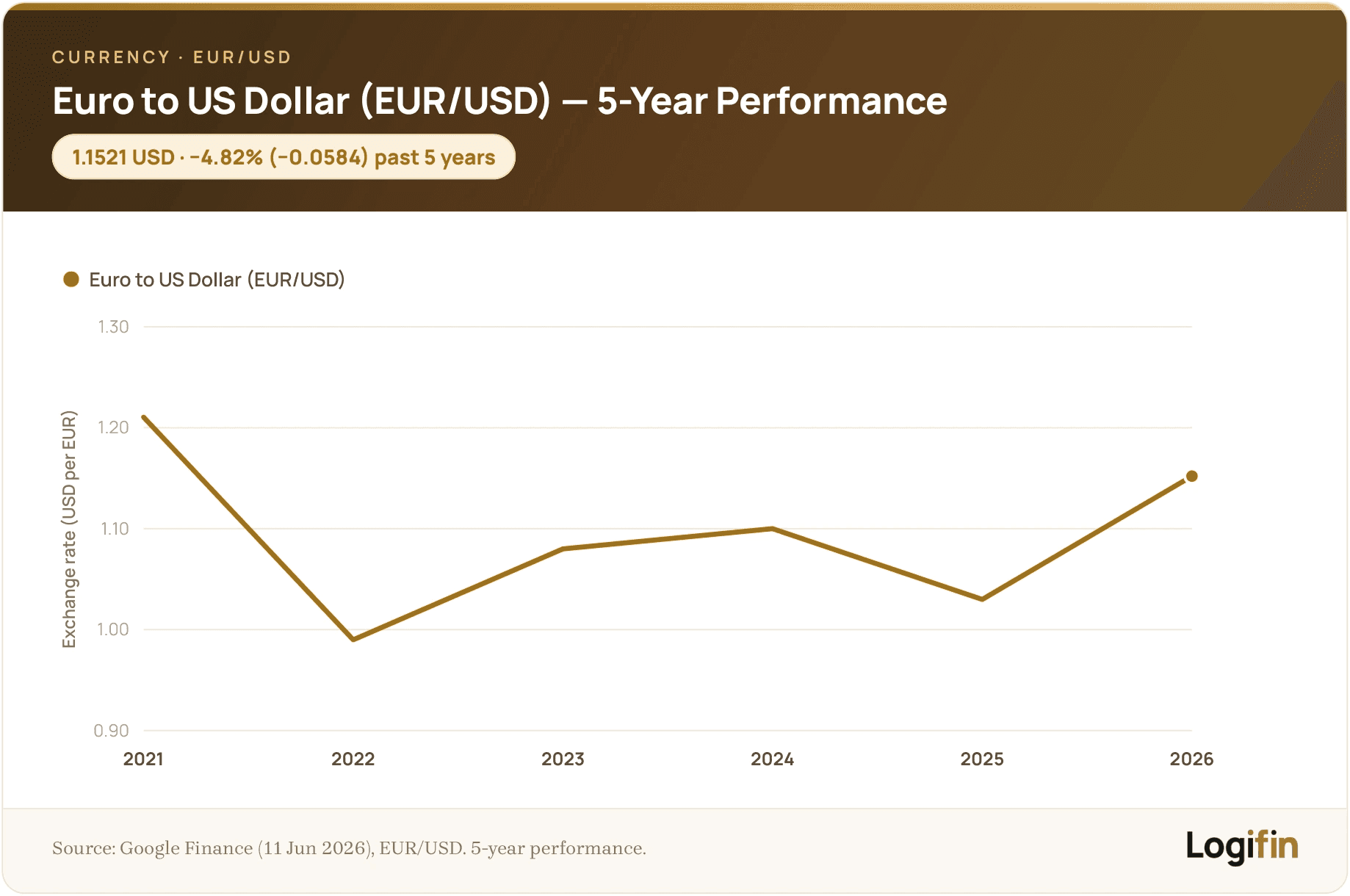
A hedge does not maximise profit; but it reduces uncertainty, offering predictability.
4. Bonds & Inflation-linked Bonds
An important category of hedging instruments is bonds that offer protection against inflation.
The best known are TIPS (Treasury Inflation-Protected Securities) in the U.S. and ILBs (Inflation-Linked Bonds) in Europe.
Their core function is that they adjust the nominal value of the bond and the coupons (interest) that are paid based on the consumer price index.
This way, when inflation rises, the bond’s value "goes up" accordingly, protecting the investor from the erosion of their purchasing power.
Example:
- If an investor holds TIPS worth $1,000 and inflation in one year is 5%, the bond’s nominal value is readjusted to $1,050.
- The interest paid afterwards is calculated on this new amount, offering immediate protection against price increases.
Conversely, in an environment of low or zero inflation, inflation-linked bonds offer a return similar to classic bonds, without giving the investor any particular "bonus".
5. Real Assets (Real Estate, Gold, Commodities)
"Real assets" are often used as a natural hedge against inflation or geopolitical crises, because they have a physical substance and their value is directly linked to the real economy.
Gold:
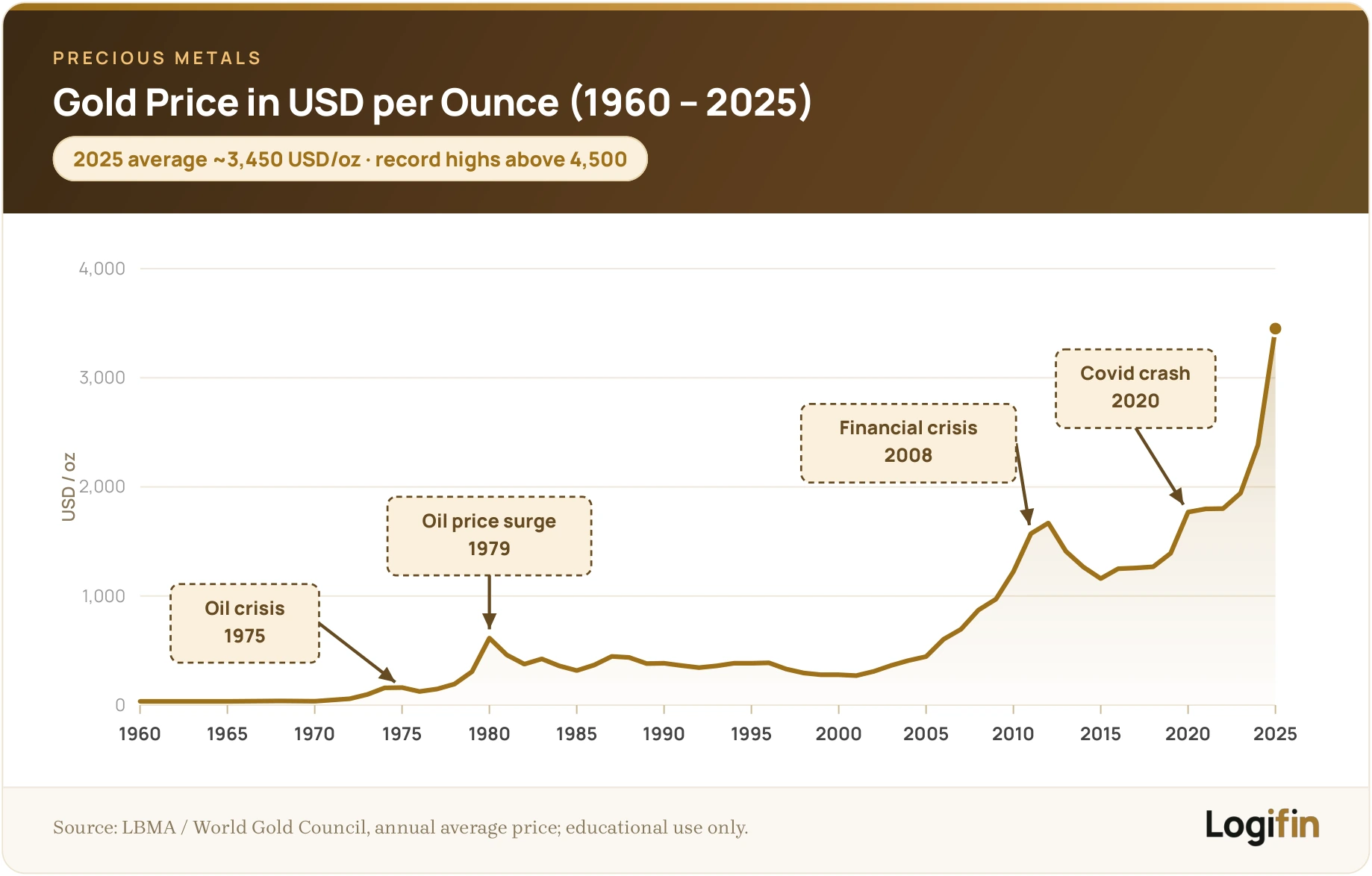
- Traditionally considered the investors’ "safe haven".
- In periods of monetary instability, wars or crises, investors turn to gold to protect their purchasing power.
- Although it offers no regular income (e.g. dividends or coupons), its steady demand in critical periods makes it valuable over time.
Real estate:
- Real estate can maintain or even increase its value, especially when tied to rental income.
- Rents are often adjusted to inflation, thus providing a natural protection mechanism.
- Especially in a low-interest-rate environment, real estate also works as an alternative to bonds.
Commodities:
- Products such as oil, grains and metals often rise in periods of high inflation or supply-chain disruptions.
- Their value increases when demand exceeds supply, making them a strong "hedge" in crises.
Advantages of hedging
Hedging is not just a "theoretical" tool.
In practice, it can be the difference between an investor who stays calm and disciplined and one who panics at the first losses.
The value of hedging is measured not only in numbers, but also in the stability it brings to the investor’s behaviour.
🔶 Capital protection
The biggest advantage of hedging is that it allows the investor to protect part or even all of their portfolio from sudden drops.
Although it costs (like any insurance), it can make the difference in times of crisis.
Example:
- A fund managing €500 million in U.S. stocks can buy put options on the S&P 500.
- If the market falls 15%, the portfolio losses are offset by the gains on the options, reducing the overall impact and allowing the fund to continue its strategy without panic.
🔶 Reduced volatility
- With proper hedging, portfolio fluctuations become more "smooth".
- This does not mean the risk disappears, but that it becomes more manageable.
- Lower volatility means less psychological pressure, easier adherence to the investment plan and a reduced risk of hasty decisions.
Tip: Reducing volatility does not equal zero risk; it means you "smooth out" the sharp moves so you can stay in the game long-term.
🔶 Psychological benefit
Knowing you have a "safety net" allows for calmer, cooler decisions.
Investors who apply hedging are less likely to sell in panic during a drop, because they know they have taken protective measures.
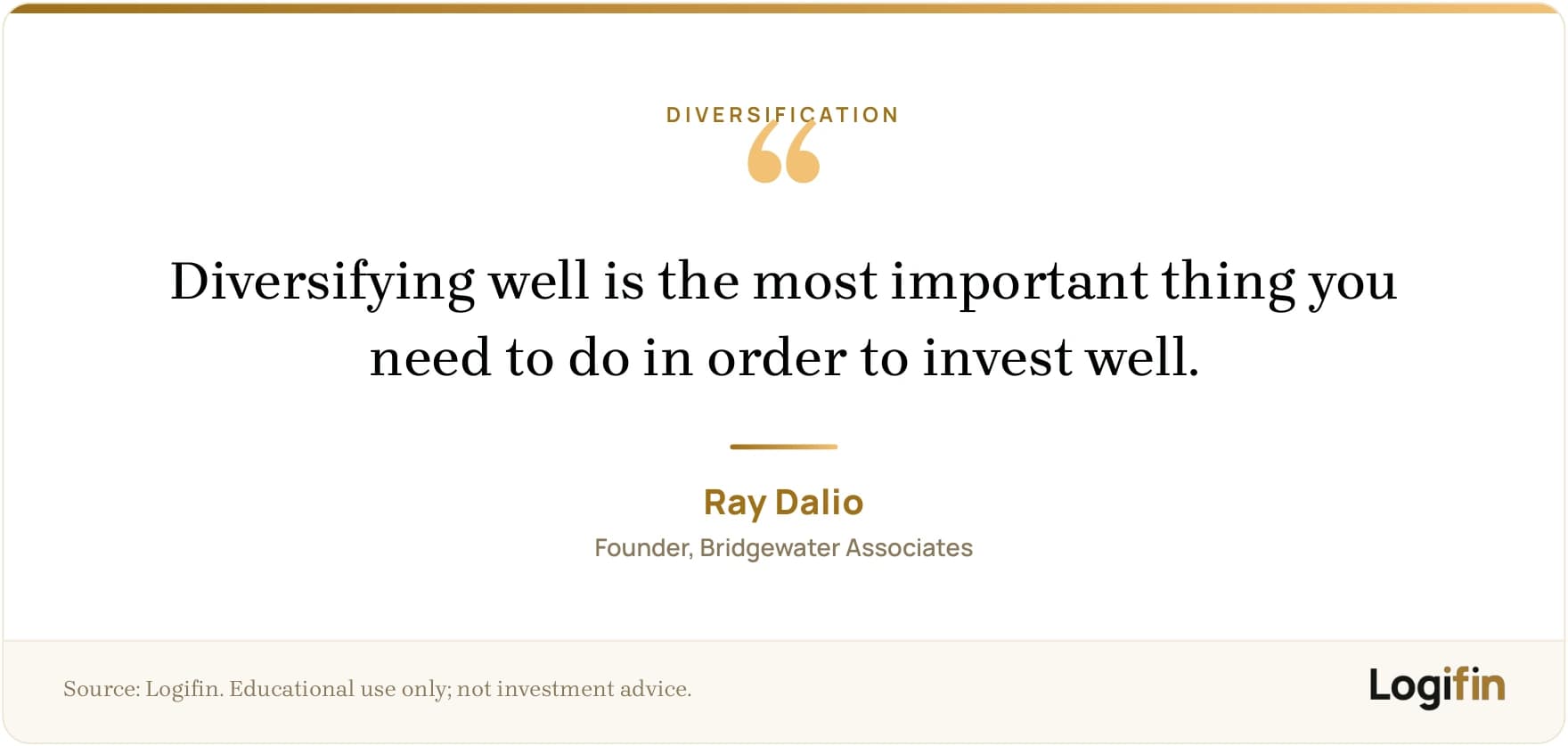
Ray Dalio has consistently stressed the importance of diversification and risk management, noting that "Diversifying well is the most important thing you need to do in order to invest well".
Without these, investing amounts to excessive risk, like driving without a seatbelt.
🔶 Flexibility and strategy
Hedging is not a "one size fits all" tool.
It can be adapted to the needs and profile of each investor, depending on their time horizon, risk tolerance and strategy.
- Conservative investors
They use simpler means that require no specialised knowledge, such as high-grade bonds, income-producing real estate or gold.
These assets offer a natural hedge against inflation or crises, without requiring daily monitoring.
Example: An investor nearing retirement can direct a larger share into real assets to protect the purchasing power of their capital.
- Professional traders
They apply more complex strategies with options, futures or combinations of derivatives (e.g. protective puts, covered calls, spreads).
These techniques allow for more dynamic and targeted protection, depending on market moves.
Example: A hedge fund can use long/short strategies in stocks and derivatives to reduce its exposure to specific sectors, while keeping profit potential.
The key point is that hedging is scalable: from simple solutions for individuals to sophisticated derivatives for professionals.
Risks and disadvantages of hedging
Despite its significant benefits, hedging is not a panacea.
Like any strategy, it also has drawbacks the investor should know before applying it.
🔶 Cost of implementation
No hedge is free. Each instrument has its own "price":
- Options require paying a premium.
- Futures need margin, i.e. "tying up" capital that cannot be used elsewhere.
- Inflation-linked bonds offer protection, but usually have a lower return in periods of normal inflation.
Example: If you buy a put option to protect a 100,000 € portfolio, you may pay 2,000 € in premiums. If the market does not fall, that money essentially "vanishes" as an insurance cost.
🔶 Reduced potential return
Protection always has a price: it limits the upside.
- A covered call strategy can bring you income from premiums, but limits the chance of a large gain if the stock surges.
- A currency hedge protects you from losses when the currency moves against you, but does not let you gain when it moves in your favour.
In short, every hedge is a trade-off: you reduce the risk, but you also "cut" part of the return.
🔶 Complexity
Some hedging instruments are particularly complex. Options, for example, require understanding concepts such as strike price, implied volatility, time decay.
If you do not know how to use them, you may end up with a hedge that:
- does not protect you as much as you thought, or
- costs you far more than it is worth.
For individual investors, complexity is one of the biggest risks. It often requires expert advice or the use of simpler tools.
🔶 Systemic risk
At the market level, excessive use of derivatives can create chain reactions that far exceed the original risk of a single position.
Derivatives link many participants together through contracts, margin requirements and counterparties.
This mechanism can turn a local problem into a systemic crisis, especially when there is high leverage and a lack of liquidity.
History has shown that in such cases the effects are not limited to professional traders, but affect the entire financial system.
Example:
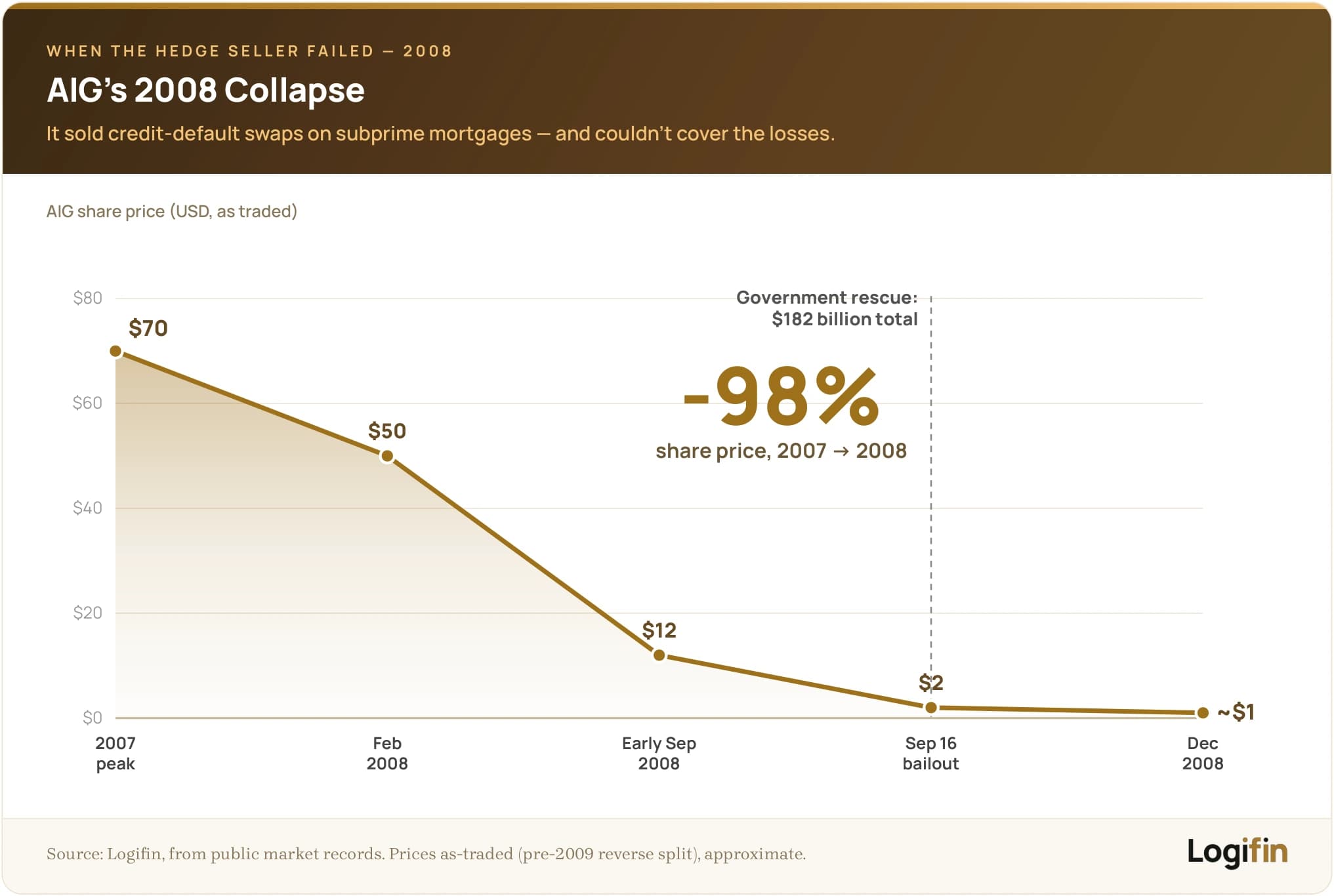
- In the 2008 crisis, CDS (Credit Default Swaps) were used massively as a hedge against corporate and mortgage bonds.
- But when the counterparties collapsed (notably AIG), the "safety net" turned into a risk multiplier, threatening the entire financial system.
🔶 Wrong timing or poor implementation
Even a good hedging tool can fail if used at the wrong time or in the wrong way:
- A hedge applied too late (e.g. after the market has already fallen significantly) offers no real protection.
- Overusing hedging can continuously "eat" return, leaving the portfolio stagnant over the long term.
The balance between protection and return is critical.
When is hedging truly necessary?
Hedging is not something applied constantly and in every situation.
It has a cost, requires expertise and can reduce part of the gains in rising markets.
That is why it should be used strategically, when conditions demand it, like "insurance" that activates at critical moments.
🔶 In periods of high uncertainty
- When markets are in intense volatility due to geopolitical or economic events (wars, energy crises, pandemics).
- In such conditions the hedge works like an "insurance premium" that may cost in calm periods, but pays off when the market enters a storm.
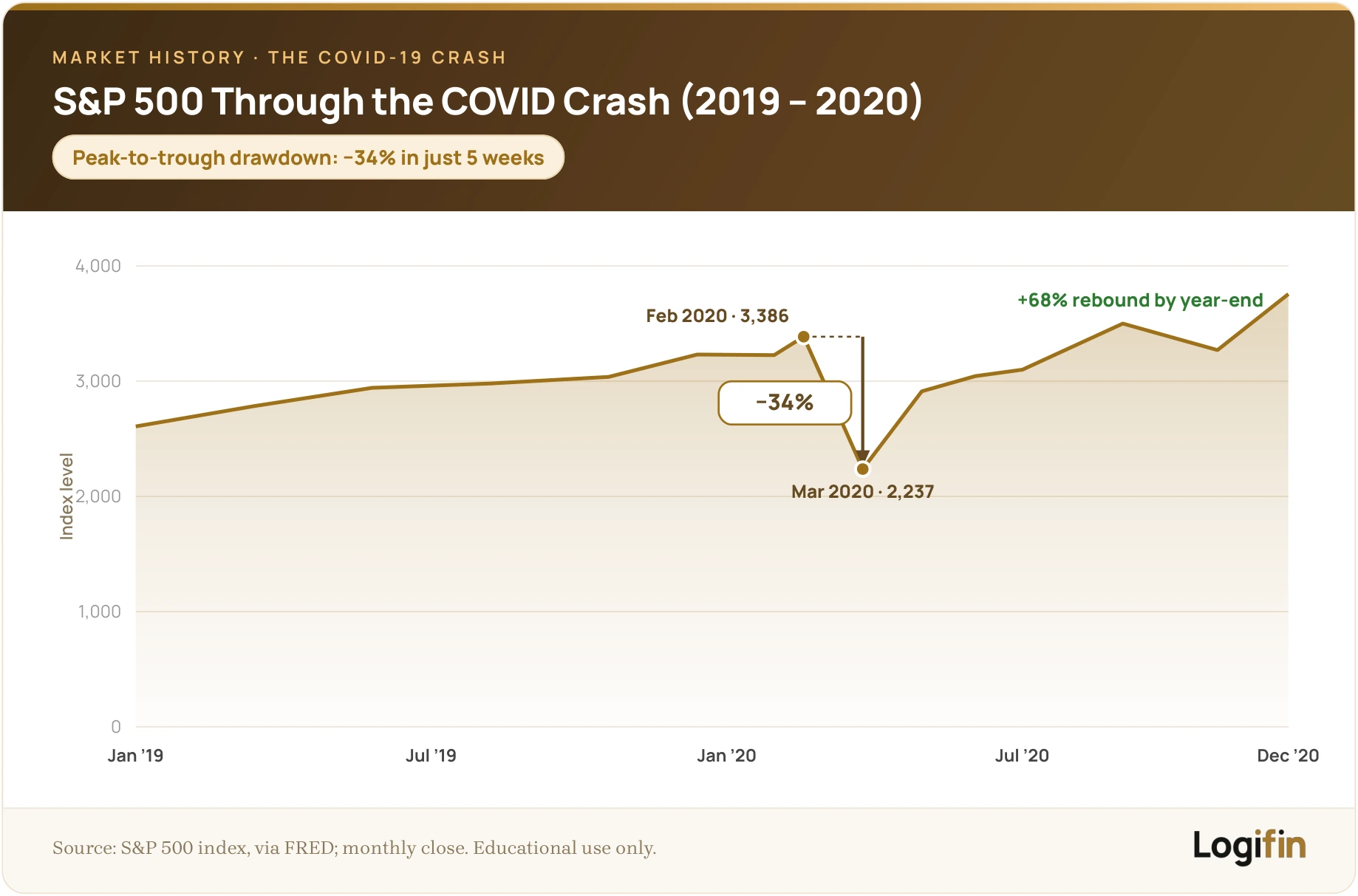
Example: In 2020, investors who had hedging via put options or gold significantly limited their losses, while the S&P 500 fell by about –34% within just one month.
🔶 When you have short-term liquidity needs
If you know you will need capital in a short period (e.g. to buy a house, a business investment or to cover expenses), you can apply a hedge so that a sudden market drop does not catch you unprepared.
Example: An investor expecting to liquidate in 12 months can protect themselves with more conservative assets or short-term hedges, avoiding the risk of being "trapped" in a bear market.
🔶 When there is currency risk
Investments in foreign assets mean exposure to currencies. An adverse move in the exchange rate can wipe out the gains.
Example:
- In 2017, the dollar weakened by about 12% against the euro.
- A European investor with U.S. stocks who had no hedge saw a large part of their returns evaporate.
- Those who had applied currency hedging kept their return intact.
Tip: Currency-hedged ETFs are a practical solution for individual investors who want international exposure without currency shocks.
🔶 When the portfolio is concentrated
The more concentrated a portfolio is, the more vulnerable it becomes to sharp and asymmetric market moves.
Large exposure to one sector, one country or a specific asset class increases the risk of taking a heavy hit from a negative event that concerns only that piece.
In such cases, hedging can act as a defence mechanism and not as a speculation tool.
Example:
- An investor with excessive exposure to tech stocks can use put options on the Nasdaq to limit the risk of a sudden correction.
- If the market falls sharply, the portfolio loss is partly offset by the gain on the options.
The point here is not to "predict" the drop, but to buy time and stability in a portfolio that would otherwise be overly exposed.
🔶 For institutional and large investors
For institutional players such as pension funds, insurance companies and large funds, hedging is not a matter of choice or market timing. It is a fundamental operating rule.
These organisations:
- have long-term obligations towards millions of citizens
- cannot absorb large losses without consequences
- must maintain stability and predictability
That is why they systematically use hedging instruments to limit downside risk, even if it means sacrificing part of the potential return.
Conclusion and practical takeaways
Hedging is one of the most important risk-management tools in the markets.
It does not create wealth on its own; instead, its role is to protect the wealth you have already built.
Like car or health insurance, it may seem like an unnecessary cost while everything goes well; but when the crisis comes, it becomes invaluable.
🔑 What to keep in mind
- Hedging reduces losses, but always has a cost (premium, lost returns).
- It is not for every portfolio; it makes sense in cases of high risk or uncertainty.
- Its tools include options, futures, inflation-linked bonds, real assets and currency hedges.
- Its use must be targeted and deliberate, not impulsive.
Practical tips for new investors:
1. Start simple
- If you are a beginner, first learn how the basic products work (ETFs, bonds, stocks).
- Use a hedge only when you fully understand the tool and can assess the cost/benefit.
2. Calculate the cost
- A hedge that constantly "eats" your return without a real need can be more harmful than the market itself.
- Overusing hedging can "cancel out" the power of compounding.
3. Think of diversification as your first hedge
- The simplest and most effective form of hedging is diversification: different countries, sectors, currencies and asset classes.
- The right allocation reduces risk at no extra cost.
The content of this article is provided exclusively for informational and educational purposes and does not constitute investment advice or a recommendation to buy or sell financial products. The information is based on publicly available sources considered reliable, without any guarantee of accuracy or completeness. Before making any financial or investment decision, it is recommended that you consult a certified professional advisor or accountant, taking into account your own financial situation and risk profile. The Logifin team bears no responsibility for any direct or indirect damages arising from the application of the information presented.
Related articles

What are derivatives (futures, options, swaps) and how do they work?
The tools professionals use for hedging, leverage and high-precision strategies
22 min read

How to build a resilient portfolio
A guide for investors who want to build something stable, simple and rewarding over the long term.
19 min read

Investing in gold through ETCs: The complete guide
When does it make sense to add gold to your portfolio and which ETCs are worth considering?
15 min read

What is a recession and how it affects investors?
How a recession is defined, what causes one, how the markets usually behave during it and what an investor can do to prepare in advance.
24 min read
EXPLORE LOGIFIN
Everything you need in order to learn, plan and track your investments.
Logifin Blog
Learn everything you need to get your finances in order and invest with confidence.
Logifin Insights
What moves the markets and what it means for a long term investor. Short and without the noise.
Logifin Tools
Free, inside the site, no signup. Everything you calculate stays on your device.
Logifin ETF Hub
Find the ETF that fits you: 550+ UCITS ETFs, smart filters and in-depth comparisons.
Logifin Guides
A series of guides that builds your investment plan step by step. The first guide is free for everyone.
Logifin Circle
The tools and the Hub are free for everyone. You become a member for the intelligence that never stops.