What is a stock and how does it generate profit?
What owning a share of a company means, how profit comes from capital gains and dividends, what sets the price and what the risks are.
18 August 2025 · 16 min read

What is a stock?
A stock is a share of ownership in a company: when you buy a stock, you become a shareholder and acquire a small piece of the business. It is the most fundamental and recognizable form of investment in the capital markets.
This is not merely a “piece of paper” or an electronic title, but a stake in the business itself.
This means you are entitled to benefit from:
- The increase in the company’s value (through the rise of the stock)
- A share in the profits (through dividends, when the company distributes them)
- The right to vote at General Meetings (mainly for large institutional shareholders, but technically applies to everyone)
The concept of the stock is tied to the very concept of capitalism: businesses raise capital from investors to fund their growth and in return they share the value they create.
Example: If you buy one share of Apple, you do not just hold a financial product. You are, even if minimally, a co-owner of one of the largest technology companies in the world.
🔶 However, not all stocks are the same.
- Common shares grant voting rights and a share in the company’s potential dividends.
- By contrast, preferred shares secure a fixed dividend and priority in the event of liquidation, but usually carry limited or no voting rights.
How does an investor make money from a stock?
Stocks are attractive because they offer two main routes to profit: capital return and the dividend.
These two mechanisms work in a complementary way, but they are not the same nor do they offer the same risk and stability profile.
For an investor, understanding their difference is essential, as it affects the way they will build their portfolio.
🔶 Capital Gains
When the value of a stock rises and you sell it at a higher price than you bought it, that profit is called a capital gain.
It is the most “visible” way to make money from stocks and often the main goal of investors seeking high growth.
Example: If you had bought 1 Meta share on 31/12/2022 at a price of 119.29 USD/share (the stock’s low after the major drop of 2022), your return in approximately 3.5 years would have been +390.66%, as its price reached 585.30 USD/share (10/06/2026). In other words, your initial investment would have almost quintupled.

Capital returns, however, are uncertain: they may require patience, as a stock’s price does not always move upward.
In certain periods the market may be declining, which is why investors who rely exclusively on this type of return need resilience to the fluctuations.
Growth stocks, such as technology companies, tend to rely more on this type of profit, as they reinvest their earnings instead of distributing a dividend.
🔶 Dividends
A dividend is a portion of profits that a company distributes to its shareholders.
It is not mandatory; it depends on each company’s policy and the stage of its life cycle.
- More mature companies (e.g. telecoms, energy, consumer goods) tend to pay a dividend, because they have stable profits and fewer opportunities for explosive growth.
- High-growth companies (e.g. Tesla, Amazon in their early years) usually do not pay a dividend, but keep their profits to fund their expansion.
Example: Procter & Gamble has increased its dividend for over 70 years.
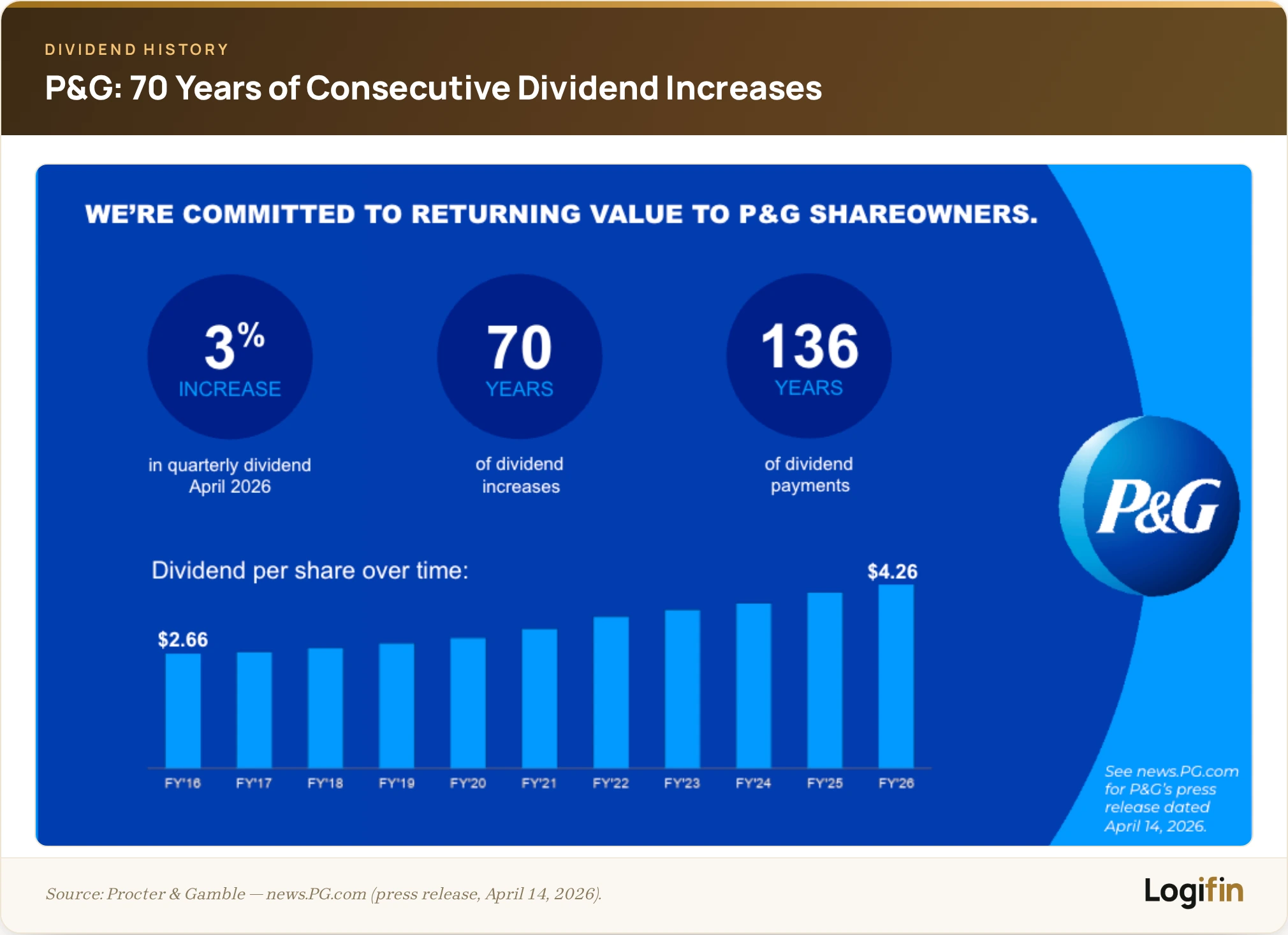
This offers a more predictable income stream, which many investors value highly.
🔶 Combining returns
- The Total Return of a stock results from the combination of capital gains and dividends.
- An investor can thus benefit both from the increase in price and from the regular inflow of cash.
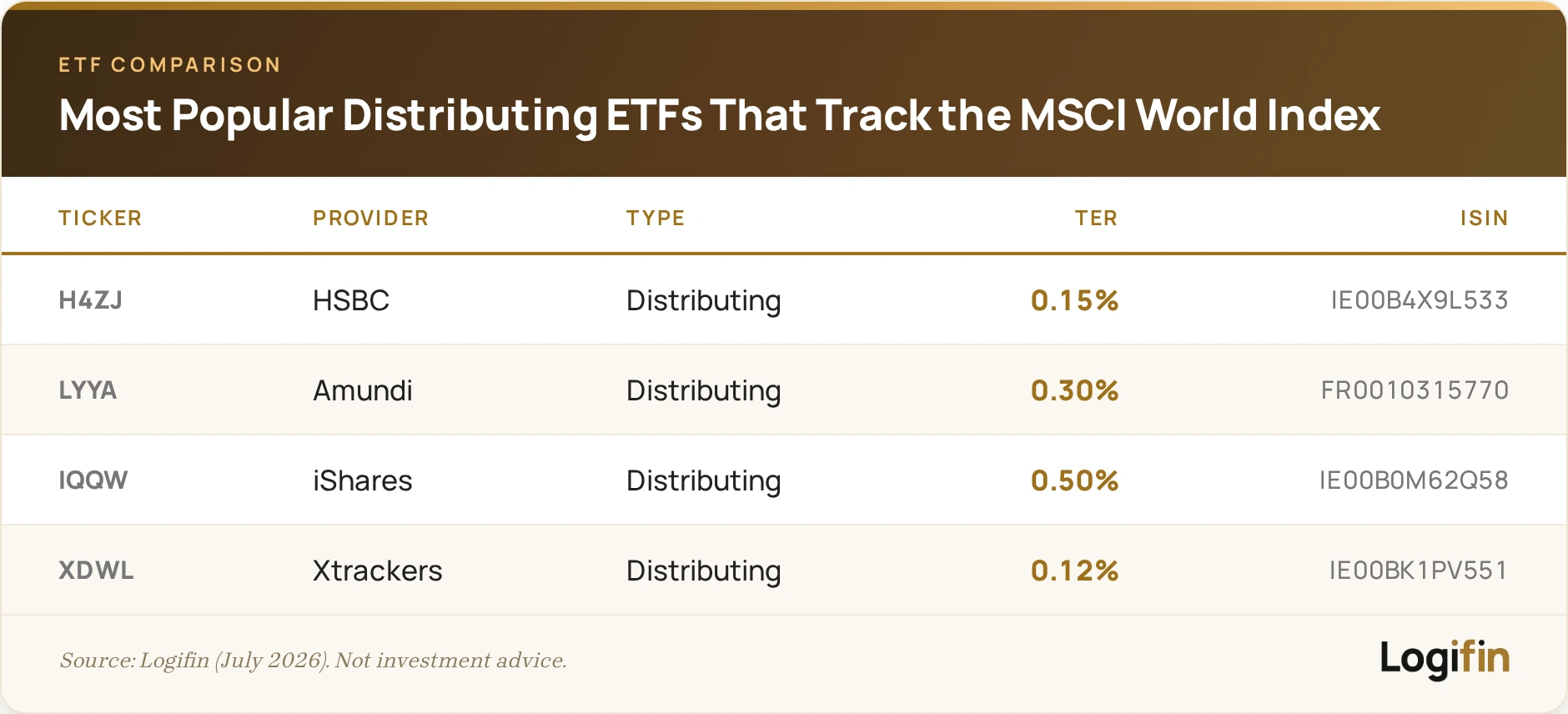
- That is why distributing ETFs attract investors who want a more balanced model: steady income from dividends together with the prospect of capital appreciation.
Why do companies issue shares?
Why would a company share its ownership with thousands or millions of investors? The answer lies in the need for capital.
1. Funding growth
A company that wants to grow needs significant and continuous capital.
Expansion is not limited to increasing sales. It requires investment in factories, research and development, new technologies, entry into new markets or even acquisitions of competitors.
All of this presupposes access to large amounts of funding.
Issuing shares through an Initial Public Offering (IPO) or through secondary offerings gives the company the ability to raise capital directly from the market.
In this way it funds its growth without increasing bank borrowing or fixed interest obligations.
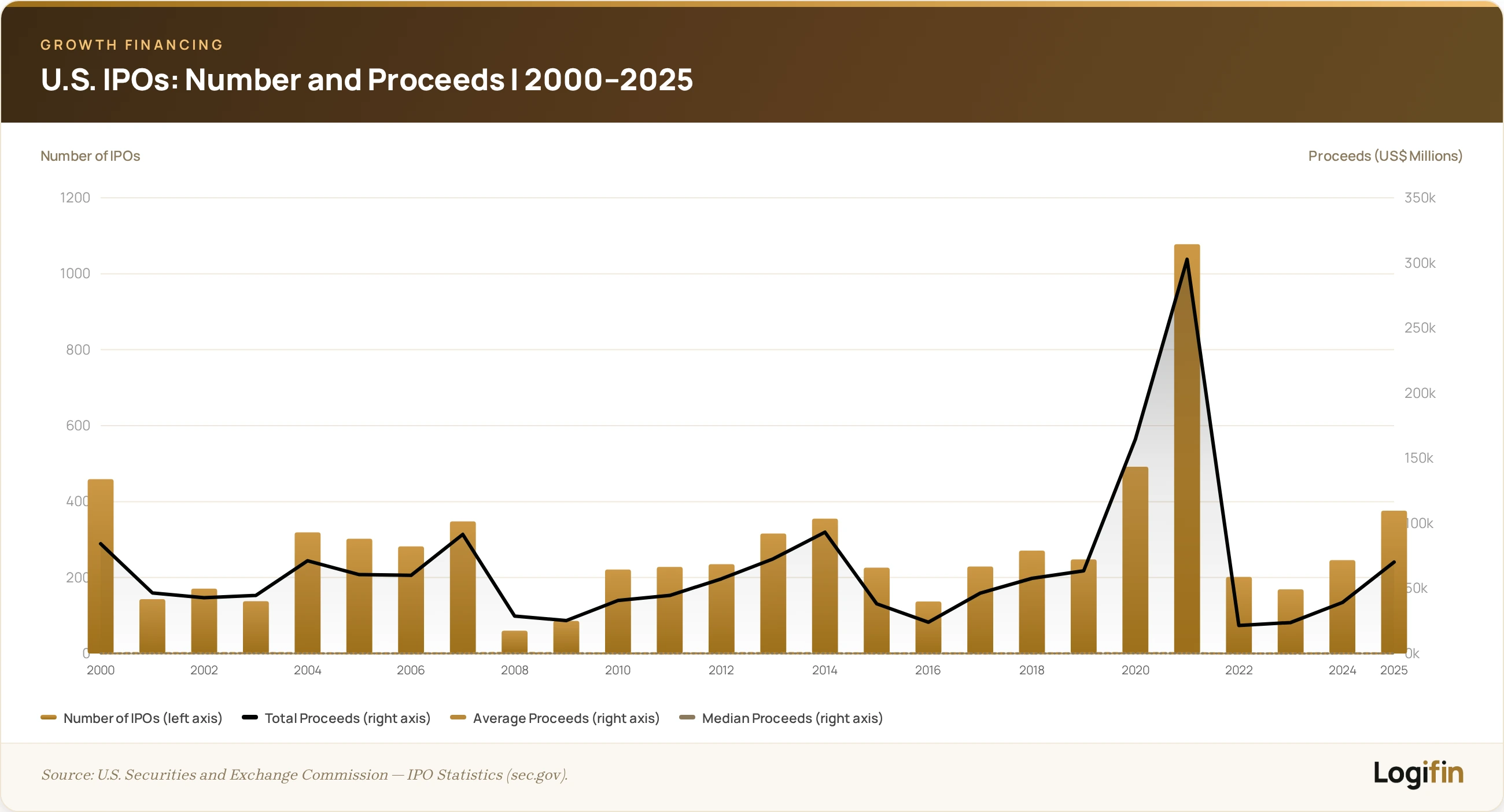
For many businesses, especially in a phase of rapid growth, access to the stock market is the most flexible and sustainable way to support their next steps, while maintaining a strong balance sheet and strategic freedom.
2. Reducing dependence on debt
Borrowing is a fast way to finance, but it comes with fixed obligations.
Interest and principal repayments must be paid regardless of whether the company is profitable or facing difficulties. In periods of slowdown, this can seriously strain liquidity and raise the risk of bankruptcy.
Issuing shares works differently. It creates no obligation to pay interest, nor does it require a specific repayment schedule.
This offers the company greater flexibility, a stronger balance sheet and better resilience across economic cycles.
For many businesses, especially those in a growth phase or operating in cyclical sectors, reducing dependence on debt is a strategic advantage that supports long-term viability.
3. Strengthening image & reputation
Listing a company on the stock exchange is not only a financial decision. It is also a strategic move of prestige. The fact that a company is listed often increases its credibility in the eyes of the market and strengthens its reputation.
Investors, customers and partners tend to trust a listed company more, because it:
- is subject to strict rules on publishing financial data
- is audited regularly by supervisory authorities
- operates with greater transparency and accountability
This transparency reduces uncertainty and creates a sense of stability.
For the company, this can translate into better partnerships, easier access to capital in the future and a stronger competitive position.
In other words, a stock market presence strengthens not only the balance sheet. It also strengthens the business image, something that plays a decisive role in long-term success.
4. Incentives for employees
Many modern companies use shares or stock options as part of the total compensation of their employees.
This practice is not accidental. It is a powerful incentive mechanism that aligns the interests of employees with those of the company and its shareholders.
When employees gain a stake in the company:
- they feel like co-owners and not merely employees
- they care more about the long-term success of the business
- they directly benefit when the company performs better and the stock rises
This alignment creates a culture of responsibility and cooperation. The better the company does, the more everyone benefits, from management to executives and the workforce.
For the business, stock-based incentives are also a tool for attracting and retaining talent, especially in competitive sectors such as technology.
For the investor, they are a sign that incentives within the company are structured in a way that supports long-term value.
Types of stocks and their differences
Not all stocks are the same. Although their basic logic (participation in the ownership of a company) stays the same, there are different types that serve a variety of investor and company needs.
Understanding these differences is crucial so you know what you are really buying and what you can expect from your investment.
🔶 Common Shares
They are the most widespread type of stock and the ones most investors know. They grant:
- Voting rights at General Meetings, influencing important company decisions.
- A right to a dividend, although its distribution depends on the company’s policy.
- A right to part of the assets in the event of the company’s dissolution, but they come last in line, after bondholders and preferred shareholders.
The shares you buy through an online broker are almost always common shares. They are the “everyday” form of participation in a listed company.
🔶 Preferred Shares
Preferred shares are an intermediate category, with characteristics that make them resemble a hybrid between a stock and a bond.
- They usually offer a fixed dividend, which must be paid before the dividends of common shares.
- They have priority in the event of bankruptcy or liquidation.
- They provide no (or very limited) voting rights.
That is why they often attract investors who seek a predictable income stream, but are not as interested in management influence.
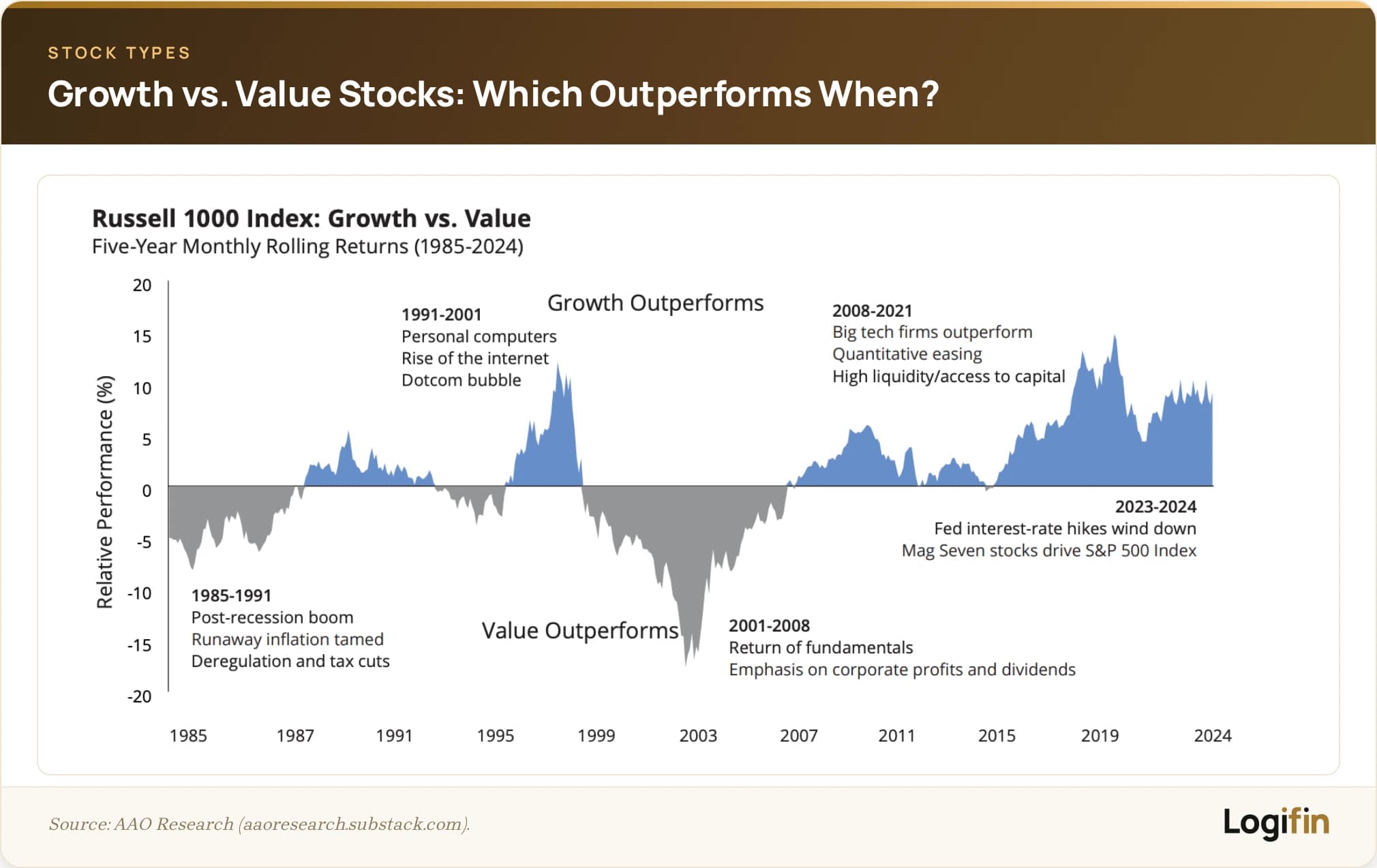
🔶 Growth Stocks
- These are companies that focus on reinvesting their profits rather than distributing dividends.
- They usually offer no dividend, because their priority is rapid growth.
- Investors rely mainly on the rise in price for profit.
- They are associated with sectors such as technology, startups and innovation.
Example: Tesla, Nvidia, Meta. Growth stocks are often considered higher risk, but also with a greater prospect of high returns.
🔶 Value Stocks
- Value stocks belong to companies that already have stable profits and often distribute significant dividends.
- They attract investors who seek stability and more predictable returns.
- They are often considered undervalued relative to their fundamentals, which leaves room for profit if the market revises their price upward.
Example: Banks, energy giants, consumer goods companies. In other words, companies that form a “backbone” of the economy and rarely disappear from one day to the next.
🔶 Blue Chip Stocks
- These are the shares of large, established groups that have a long history of profitability, stable dividends and high credibility.
- They form the backbone of many portfolios because they offer a combination of safety and liquidity.
- Because of their reputation, they are often used as a “safe haven” in periods of instability.
Example: Coca-Cola, Johnson & Johnson, Microsoft. They are considered “reference companies” in the markets.
What determines the price of a stock?
A stock’s price is not arbitrary; it results from the constant interaction of supply and demand.
But what drives investors to buy or sell depends on many, often interdependent, factors.
🔶 Financial results
A company’s health (revenue, profits, debt level, cash flows) is always the first thing investors look at.
The stronger the financial figures, the greater the confidence they inspire.
Strong earnings announcements often send a stock’s price soaring, while negative surprises can lead to a plunge.
Example:
- Meta Platforms announced on 1 February 2024 its results for Q4 2023, recording revenue of $40.1 billion (+25% year over year) and net income of $14.0 billion (200%+ YoY).
- At the same time, it announced the first quarterly dividend in its history ($0.50/share) and a $50 billion expansion of its share buyback programme.
- The market reacted immediately: in the session of 2 February 2024 the stock posted a strong rise (about +20%), adding roughly $190+ billion to the company’s market capitalisation.
🔶 Expectations for the future
Even if a company is doing well today, if its outlook points to falling sales, rising costs or loss of market share, the stock may come under pressure.
Investors do not buy only the present, but also the narrative about tomorrow.
It is no coincidence that it is often said: “Markets buy the rumour and sell the news.”
Prices discount expectations before they are confirmed.
🔶 Economic environment
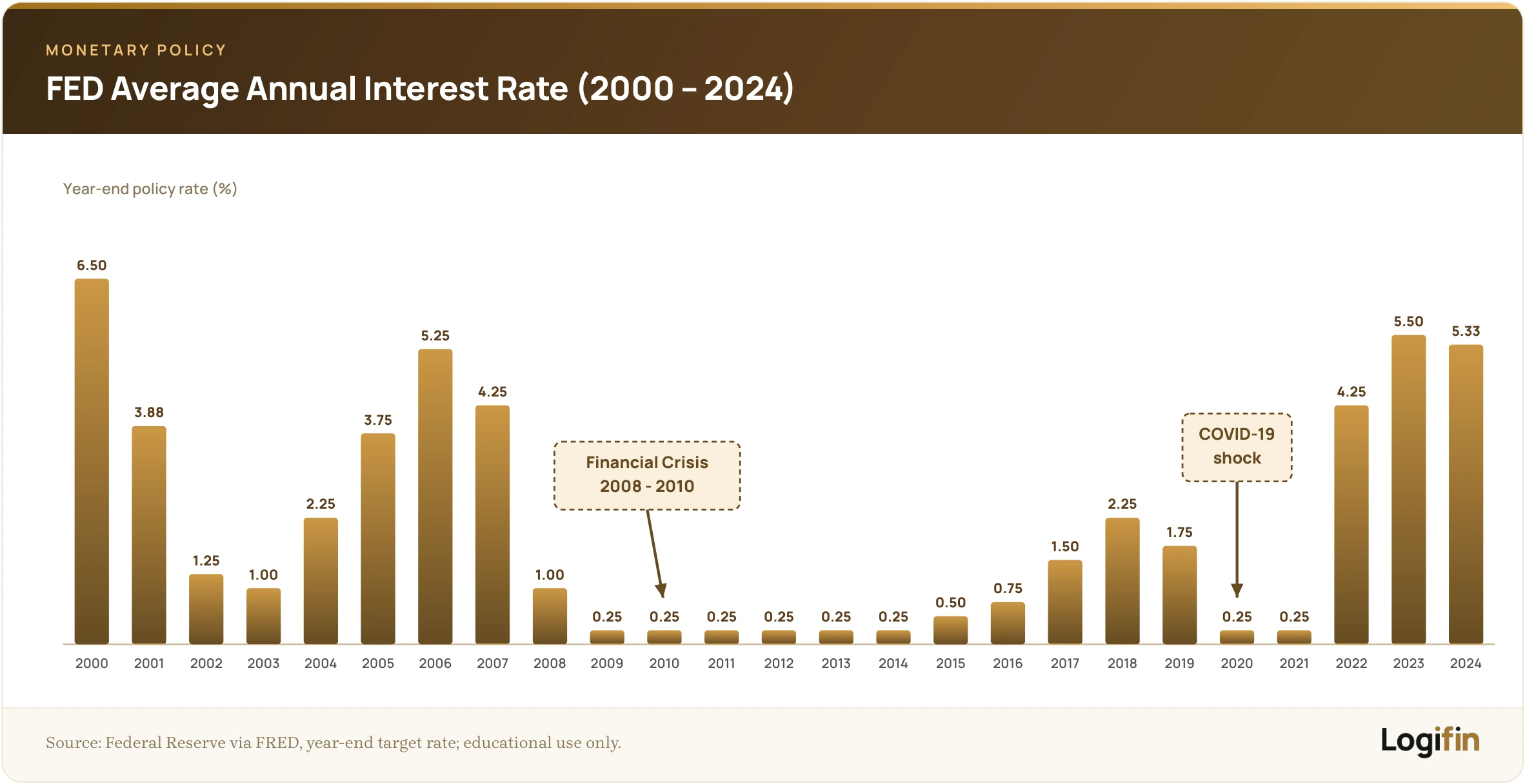
Inflation, interest rates, unemployment and geopolitical events can decisively affect how investors view a company.
In periods of low interest rates, stocks are favoured because bonds yield less; conversely, when interest rates rise, valuations come under pressure.
Research by the Federal Reserve and the ECB concludes that an unexpected tightening of monetary policy tends to push stock valuations downward, with stronger effects on growth stocks and high-valuation markets.
🔶 Competition & sector
A company’s position in its sector is crucial.
In sectors such as technology, innovation can create explosive growth (e.g. the rise of NVIDIA thanks to the development of artificial intelligence).
By contrast, in traditional sectors (such as energy or raw materials) prices are affected more by external factors, such as international oil prices or government policies.
Thus, the same investor may face very different volatility depending on the sector.
🔶 Psychology & news
Markets are not always rational. Investors are often driven by fear, excitement or greed.
Social media, fast-moving news and rumours can create “bubbles” or panics.
Example:
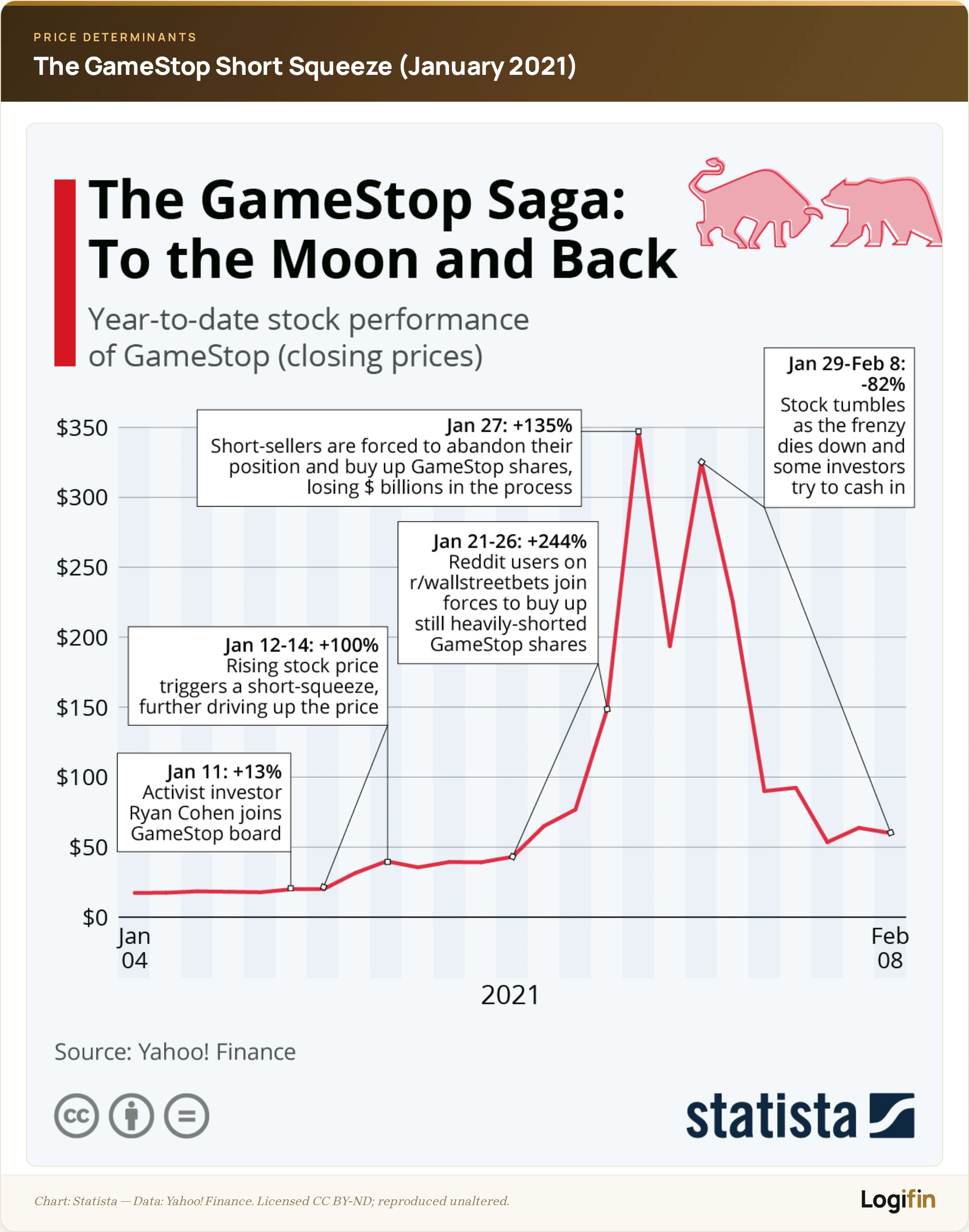
- In early 2021, GameStop’s stock posted an extreme rise of over 1,000% within a few weeks, in an environment of intense speculation.
- The move was fueled by massive retail investor participation, extremely high short interest and short and gamma squeeze mechanics, without the company’s financials and fundamentals justifying such a valuation.
🔶 Supply of shares
A stock’s price is affected not only by the company’s profits or prospects.
It can also be affected directly by management’s own decisions regarding the supply of shares to the market.
Issuing new shares
- When a company issues new shares, it increases the total number of shares outstanding.
- This usually leads to dilution of existing shareholders’ value and can push the stock price down, at least in the short term.
- The market often reacts cautiously, unless the new issue is accompanied by a clear and convincing growth plan.
Share buyback programmes
- In the opposite direction, when a company buys back its own shares, it reduces the number of securities outstanding.
- This means profits are “spread” over fewer shares, which often increases their value.
- Buybacks are usually read as a positive signal, because they show that management believes the stock is undervalued and that the company’s prospects are strong.
For the investor, monitoring the policy of share issuance and buybacks is important. It shows not only how the company manages its capital, but also how it perceives its own value in the market.
Risks of investing in stocks
Stocks offer high returns over the long term, but they also come with risks that every investor must know.
To invest with confidence, you need to understand not only the benefits but also the traps the market may hide.
🔶 Volatility
Stock prices can change abruptly within days or even hours.
Volatility is a natural feature of markets, as it reflects the constant adjustment to news, company results and economic conditions.
Example:
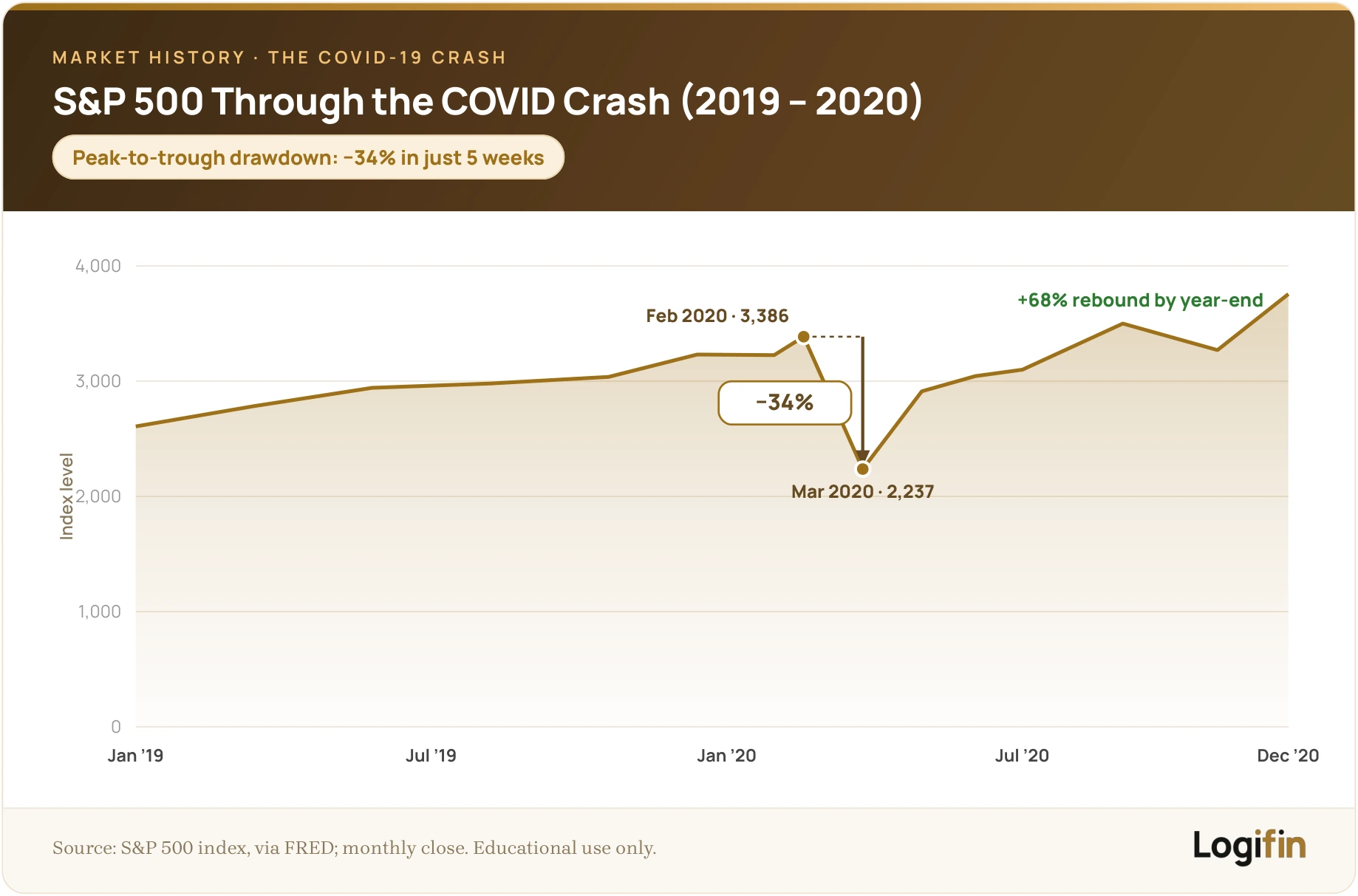
- In 2020, with the spread of the COVID-19 pandemic, the S&P 500 fell more than 30% in a little over a month.
- The market then recovered dynamically in an environment of unprecedented monetary and fiscal support, showing how a sudden crisis can cause intense short-term turmoil.
🔶 Emotional decisions
Fear and greed are the investor’s greatest enemies.
So-called FOMO (Fear Of Missing Out) often leads to buying at the top, while panic leads to selling at the bottom.
Most investors who act on emotion lose money, because they buy and sell at the wrong moments.
Warren Buffett describes it simply: “Be fearful when others are greedy and greedy when others are fearful.”
A phrase that reminds us that composure and patience are among the greatest advantages in long-term investing.
🔶 Lack of strategy
Buying stocks without a plan (such as diversification, a time horizon and clear goals) dramatically increases the risk.
An investor who does not know in advance when and why they will sell or buy is more vulnerable to the fluctuations of the market.
By contrast, a steady strategy (e.g. Dollar Cost Averaging, or systematic investing into a basket of stocks/ETFs) reduces the risk of wrong decisions at the wrong moment.

🔶 Capital loss
Yes, you can lose money. If a company fails, its stock can go to zero, leaving shareholders with nothing.
This happens because shareholders come last in the repayment hierarchy, after creditors and bondholders.
Unlike bonds, where there is some security (even partial), stocks carry a greater risk of total loss.
The example of Lehman Brothers in 2008 reminds us that even giants can collapse.
🔶 Macroeconomic and geopolitical risks
Stocks are also affected by external factors beyond a single company’s control.
Changes in interest rates, inflation, wars, energy crises or trade tariffs can upend the balance of the market.
No one can fully predict how investors will react under such conditions, but history shows that markets always adjust over the long term.
For the investor, what matters is to recognise that such risks will inevitably appear and to build their portfolio in a way that can withstand them.
Conclusion and practical takeaways
Stocks are the heart of the markets and the main way investors build wealth over time.
But they are not a “magic ticket”; they require knowledge, discipline and patience.
🔑 What to remember:
- With a stock you are not buying “paper”; you are buying a piece of a real business.
- Returns can come from a rise in price or from dividends.
- Markets are influenced both by financial data and by psychology.
- Risk is always present, but that is also the reason stocks have the highest historical return of any investment class.
Practical tips for new investors:
-
Start with small amounts and learn by doing
You do not need thousands of euros. Even 50–100 € a month is enough to gain experience through DCA (Dollar Cost Averaging).
-
Diversification
Do not put all your money in one stock. An ETF that holds hundreds or thousands of companies reduces the risk dramatically.
-
Keep discipline
The biggest losses do not come from the market, but from impulsive decisions. Think long term.
-
Keep learning continuously
Knowledge is your best tool. Read financial news, analyses and studies.

The content of this article is provided exclusively for informational and educational purposes and does not constitute investment advice or a recommendation to buy or sell financial products. The information is based on publicly available sources considered reliable, without any guarantee of accuracy or completeness. Before making any financial or investment decision, it is recommended that you consult a certified professional advisor or accountant, taking into account your own financial situation and risk profile. The Logifin team bears no responsibility for any direct or indirect damages arising from the application of the information presented.
Related articles

What is the stock market? The complete beginner's guide
Understand how it works, who participates and why it is a central pillar of the global economy.
20 min read

ETF or stocks: Which strategy is right for you?
A guide for investors weighing single stocks against ETFs, covering diversification, cost, taxes and the time each approach really demands.
15 min read

What are bonds and why do professionals invest in them?
What a debt security is, which types of bonds exist, what risks come with them and the role they play inside a portfolio.
13 min read

What is a recession and how it affects investors?
How a recession is defined, what causes one, how the markets usually behave during it and what an investor can do to prepare in advance.
24 min read
EXPLORE LOGIFIN
Everything you need in order to learn, plan and track your investments.
Logifin Blog
Learn everything you need to get your finances in order and invest with confidence.
Logifin Insights
What moves the markets and what it means for a long term investor. Short and without the noise.
Logifin Tools
Free, inside the site, no signup. Everything you calculate stays on your device.
Logifin ETF Hub
Find the ETF that fits you: 550+ UCITS ETFs, smart filters and in-depth comparisons.
Logifin Guides
A series of guides that builds your investment plan step by step. The first guide is free for everyone.
Logifin Circle
The tools and the Hub are free for everyone. You become a member for the intelligence that never stops.