How to start investing: A beginner's guide
The complete guide to start investing: strategy, products, choosing a platform and the traps you need to avoid.
22 July 2025 · 15 min read

Why you should start investing
Investing means placing money in assets, such as stocks, bonds or ETFs, with the goal of growing their value over time.
It is not gambling, nor a privilege of the wealthy: it is the basic tool with which an ordinary person can build capital from their salary.
Contrary to the image the movies paint, it requires no screens, shouting or daily trades; the most effective strategies for individuals are almost boringly simple.
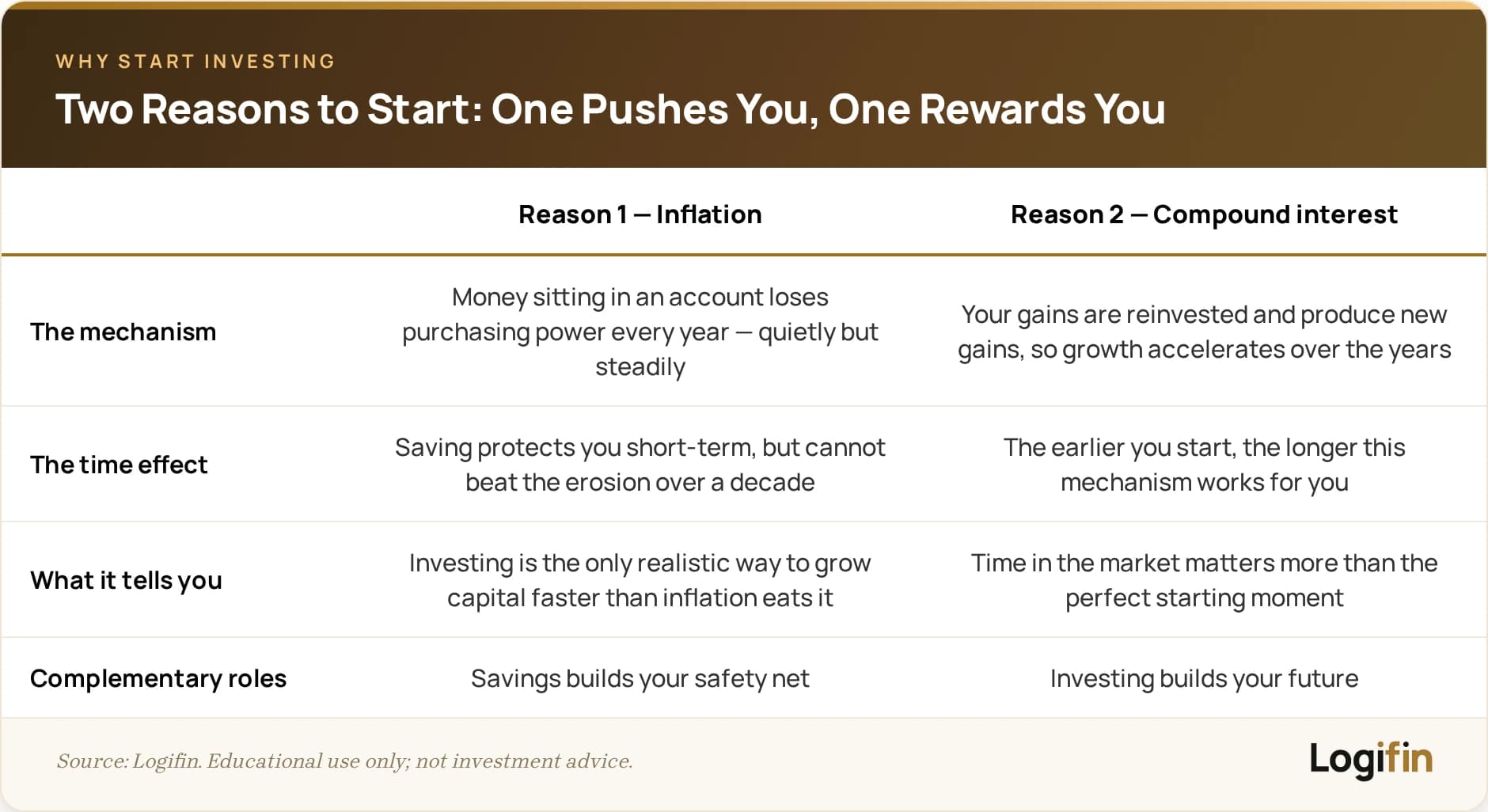
The first reason to do it has a name: inflation. Money sitting in an account loses purchasing power every year, quietly but steadily.
Saving protects you in the short term, but it cannot beat this erosion over a decade.
Investing is the only realistic way for your capital to grow at a rate higher than the one at which inflation gnaws at it.
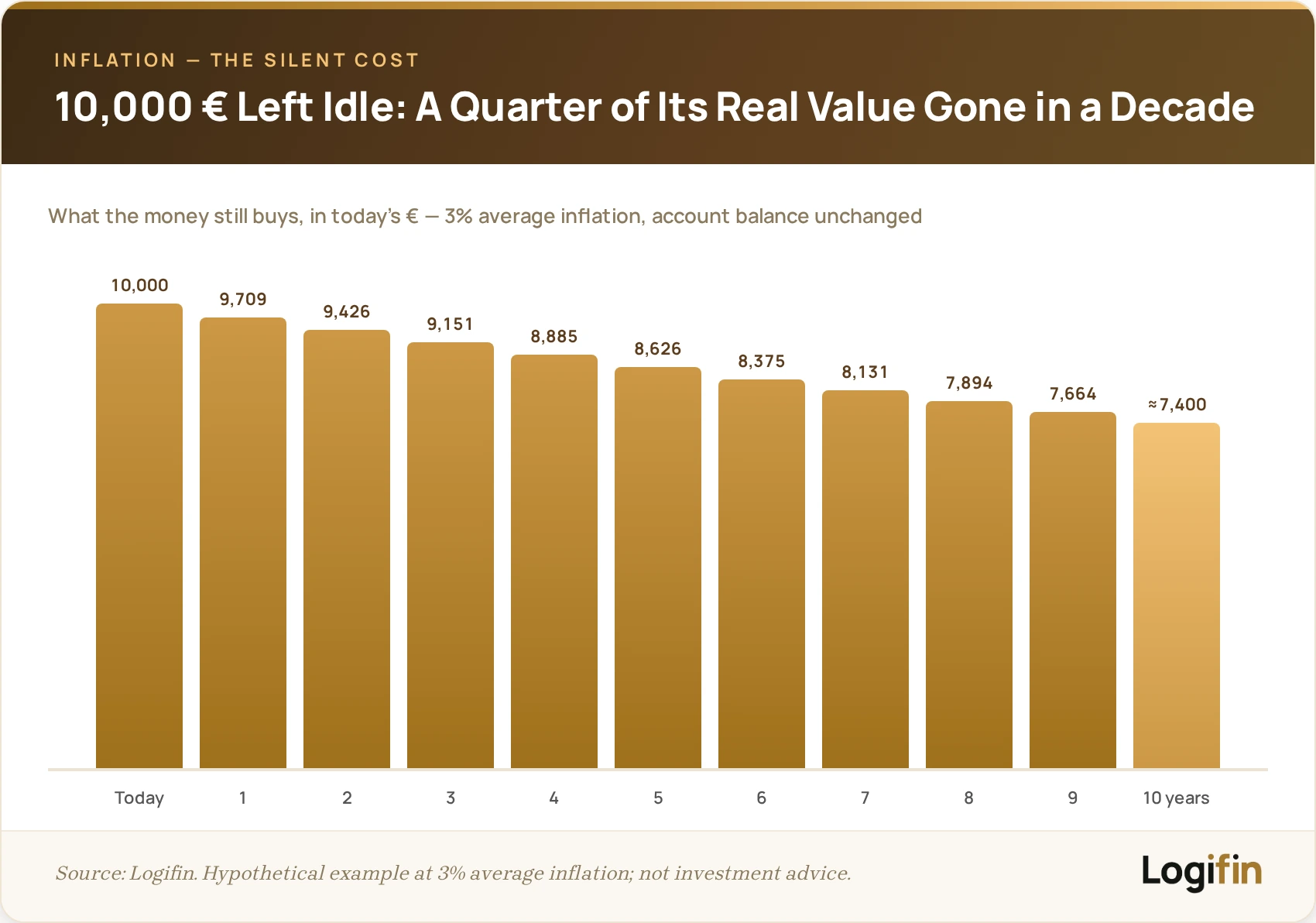
Example: with average inflation of 3%, 10,000 € left idle for a decade will buy at the end of it what roughly 7,400 € buys today. You did not lose a single euro in the account, yet you lost about a quarter of its real value.
The second reason is compounding: your gains are reinvested and produce new gains, so growth accelerates as the years pass.
The earlier you start, the more this mechanism works for you.
The two roles are complementary, not competing: saving builds your safety net, investing builds your future.
In this guide we will walk through the second part step by step: how to think, how much to start with, what to buy, where to open an account and which traps to avoid.
Before the first euro: Think like an investor
The biggest difference between a successful and a frustrated investor is not knowledge, it is the way of thinking.
The investor who lasts does not chase miracles and tips from acquaintances, does not stress over every market swing and does not change course based on the day’s news. He operates with a system and with clear goals.
Think of the difference between a trader and a long-term investor.
- The trader tries to guess where the price will move next week, buying and selling constantly.
- The long-term investor buys a piece of real businesses and lets their profits work for him over the years.
The second approach is not merely calmer; it is also the only one that works with a few minutes of attention per month, something critical for anyone with a job, a family and very little free time.
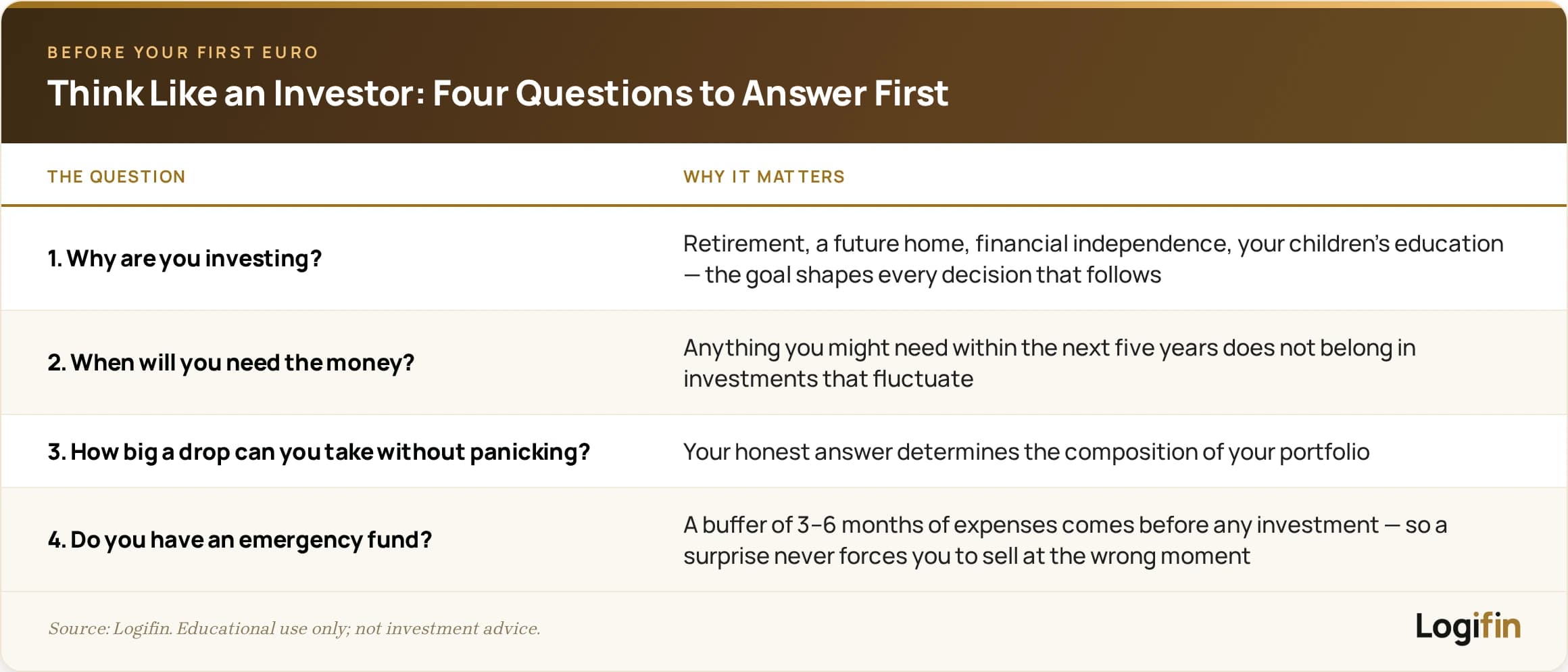
💡 Before you put in the first euro, answer four questions:
- Why are you investing? Retirement, a future home purchase, financial independence, your children’s studies. The goal shapes every decision that follows.
- When will you need the money? Whatever you may need within the next five years does not belong in investments that fluctuate.
- How much of a drop can you endure without panicking? The honest answer determines the composition of your portfolio.
- Do you have an emergency fund? Before any investment comes a reserve of 3-6 months of expenses, so that a surprise never forces you to sell at the wrong moment.
How much do you start with?
Less than you think. Even 20-50 € per month is enough for a start, while a reasonable starting point for a steady income is 5-10% of net salary, as we saw in detail in the article on how much to save and invest.
The critical thing is not the initial amount, but consistency: the compounding mechanism works with time, not with the size of the first deposit.
Which investment strategy suits you?
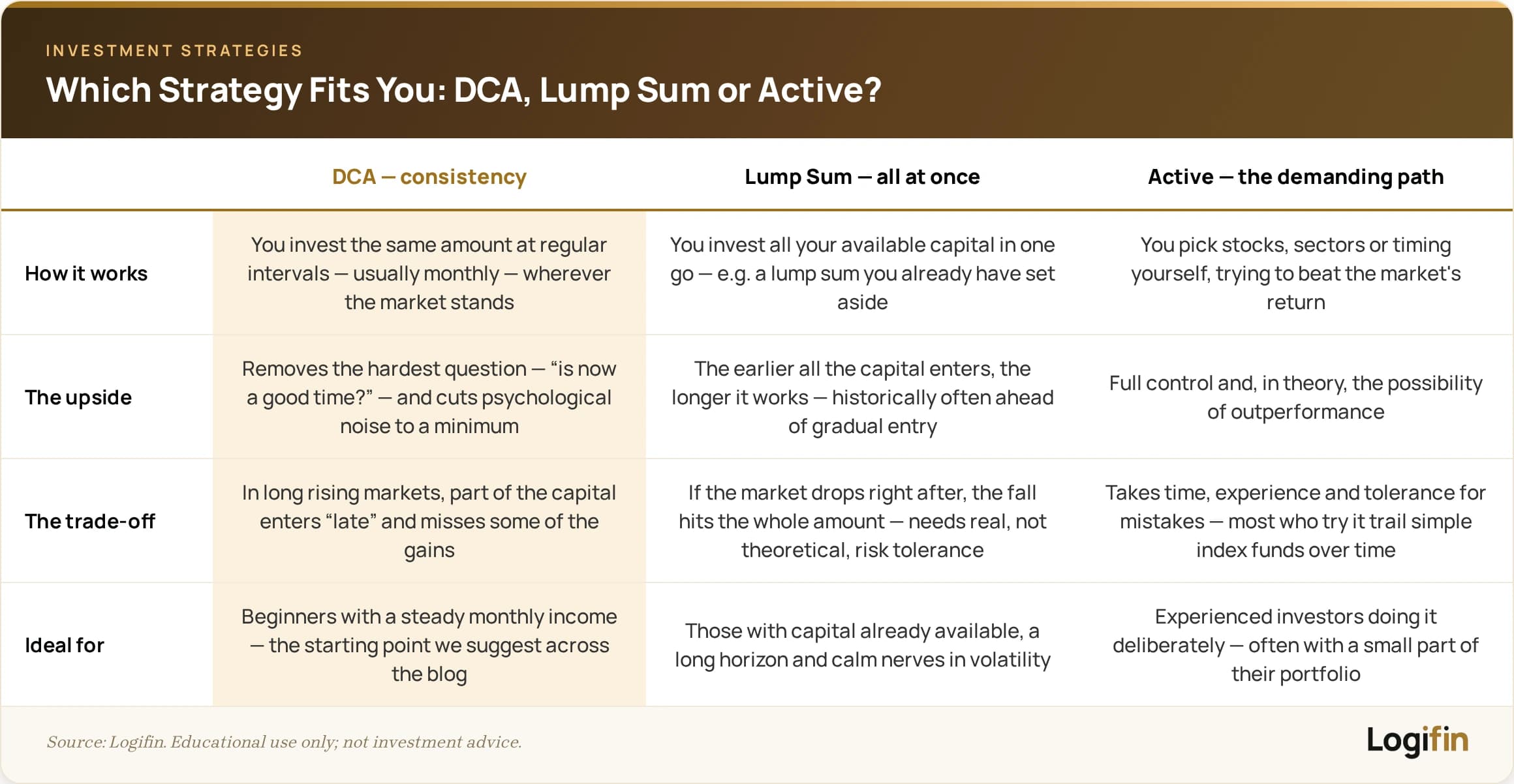
Strategy does not mean complicated systems. It means one clear rule about when and how your money enters the market. The three basic approaches:
🔶 DCA (Dollar Cost Averaging): the strategy of consistency
You invest the same amount at regular intervals, usually every month, regardless of where the market stands. When prices fall you buy more shares, when they rise fewer, resulting in a smooth average purchase cost.
- The gain: it removes the hardest question (is this a good moment?) and reduces psychological noise to a minimum.
- The trade-off: in long-rising markets, part of the capital enters late and misses a piece of the rise.
Ideal for: beginners with a steady monthly income. It is the strategy we recommend as a starting point throughout the blog.

🔶 Lump Sum: the one-off placement
You invest all available capital at once, for example a lump sum or a payout you already have set aside.
- The gain: historically, the earlier the whole capital enters the market, the more time it has to work, which often gives a better long-term result than a gradual entry.
- The trade-off: if the market falls right after, the drop hits the whole amount at once. It requires real, not theoretical, risk tolerance.
Ideal for: those who already have capital available, a long horizon and calm nerves in the face of swings.

🔶 Active management: the demanding route
You pick stocks, sectors or timings yourself, trying to beat the market’s return.
- The gain: full control and, in theory, the possibility of outperformance.
- The trade-off: it requires time, experience and tolerance for mistakes, while the historical record shows that the majority of those who attempt it lag simple indices over time.
Ideal for: experienced investors who approach it consciously, often with a small part of their portfolio.
For most people starting out, the combination that has prevailed internationally is simple: DCA into a broadly diversified low-cost ETF.
We will see right away what this means in practice.
What you invest in: the basic products
The market offers thousands of products, but for your start it is enough to understand four:
🔶 ETFs: the basket in one move
An ETF buys dozens or hundreds of stocks on your behalf in one go, following an index. An S&P 500 ETF, for example, gives you exposure to roughly the 500 largest US companies with a single purchase.
With low cost and automatic diversification, this is why ETFs have become the starting product for most new investors.

For which version to prefer, see our article on Accumulating vs Distributing ETFs.
🔶 Stocks: a piece of a company
By buying a stock you become co-owner of a specific business, with whatever good or bad happens to it.
Individual stocks fluctuate more than a basket and require knowledge of the company.

A sensible order for a beginner: first the base with ETFs, later, if you wish, individual stocks with a small part of the portfolio.
🔶 Bonds: the loan with interest
With a bond you lend money to a state or a company at a pre-agreed interest rate. The fluctuations are smaller than stocks, as are, usually, the long-term returns.
Their role in a portfolio is stability: they soften the swings as your need for predictability grows.

🔶 Mutual funds: active management for a fee
A professional manager picks the positions on your behalf.
It sounds convenient, but the total expense ratio (TER) is often a multiple of an ETF’s, while the extra cost compounds against you every year.
Before any choice, always compare the TER.
The practical conclusion for your first account is the same as in the previous chapter: one low-cost, broadly diversified ETF covers 90% of a beginner’s needs with a single product.
Diversification: the protection that costs nothing
Diversification means that your portfolio does not depend on one company, one sector or one country.
It is the only free protection in investing: it reduces risk without necessarily sacrificing expected return.
In its geographic dimension, the basic zones a global portfolio covers are four:
- United States: the largest and most dynamic market in the world, home to technology giants such as Apple and Microsoft. For the European investor, though, it also adds currency risk, since the exposure is in dollars.
- Europe: a mature market with more restrained valuations and milder swings. For euro-area investors it also has the practical advantage of the common currency.
- Emerging markets: countries such as India and Brazil, with young populations and a growing middle class. Higher growth potential, with correspondingly higher risk and volatility.
- Japan and developed Asia: a combination of mature stability and dynamic economies, complementary to Western markets.
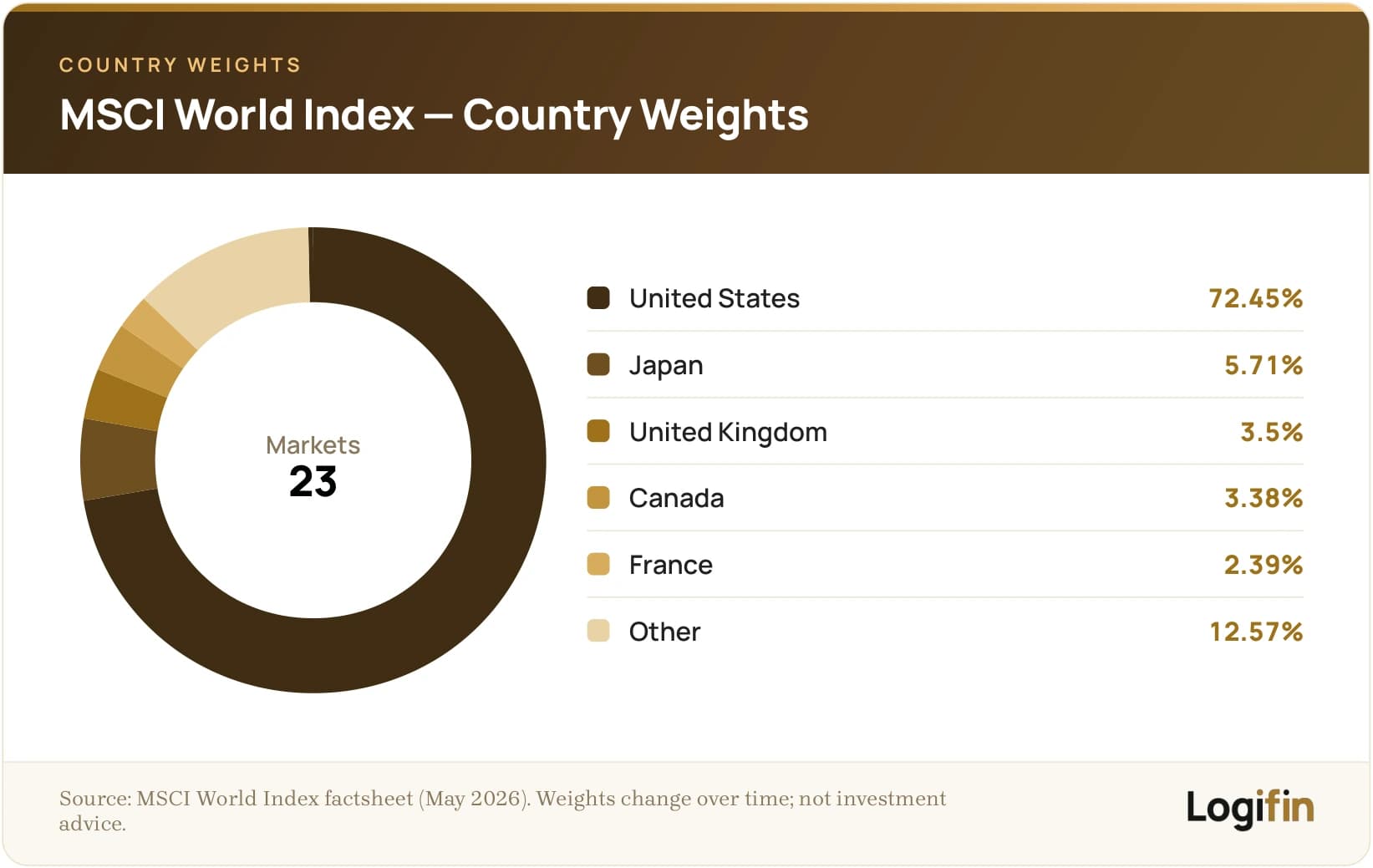
The good news: you do not need to buy each region separately.
A global ETF on an index such as the MSCI World or the FTSE All-World gives you ready-made diversification across hundreds or thousands of companies in dozens of countries, with a single purchase.
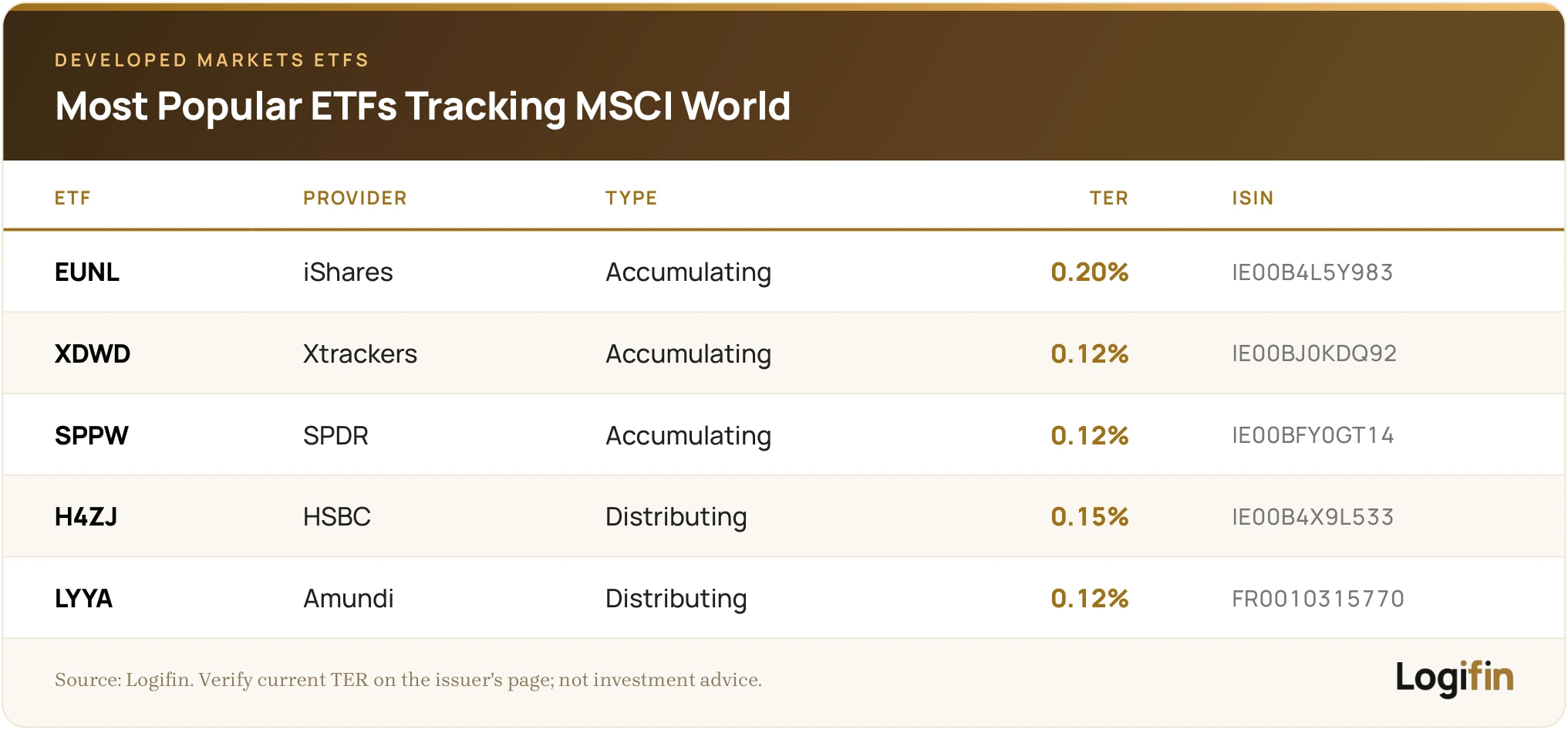
For most beginners, this one product is their diversification.
⚠️ One footnote: global does not always mean balanced. The big global indices today carry significant US weight, so open the factsheet and look at the geographic composition before you buy, not just the name.
Finally, geography is only one dimension.
Diversification also means many sectors, from technology to healthcare and energy, so that a crisis in one industry does not drag down the whole portfolio.
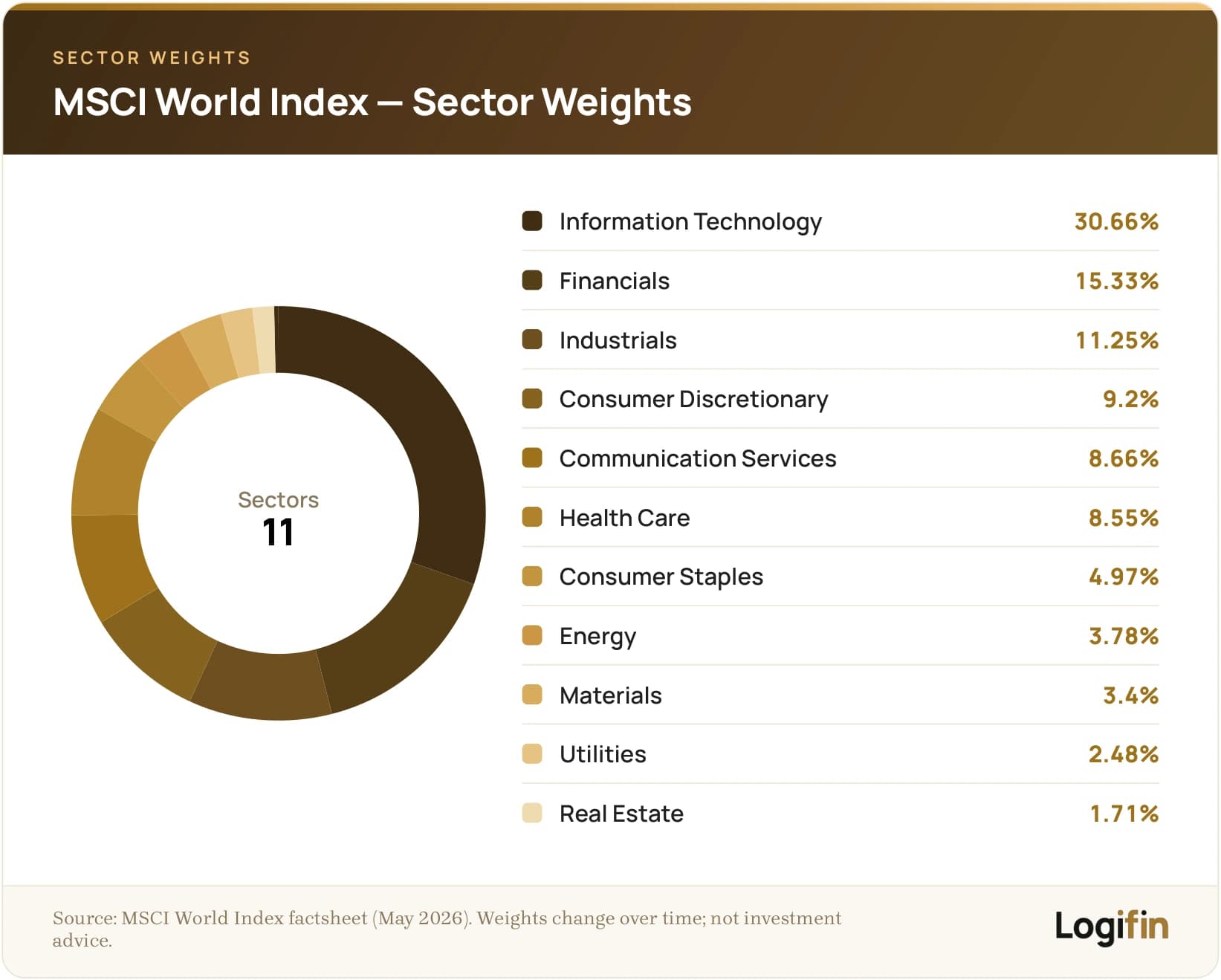
At a later stage it also means different asset classes, most commonly combining stocks with bonds, something that will concern you more as the portfolio grows and your horizon draws closer.
Account and platform: the practical part
Opening an investment account is today a matter of 10-15 minutes from your phone. You will need an ID card or passport, a bank account (IBAN), your tax number, a selfie or short video for identity verification, while you will also answer a short investor-profile questionnaire required by regulation.
Platforms fall into three big families:
- international low-cost platforms with access to ETFs and stocks worldwide,
- traditional banks with in-person service but usually higher fees and
- European online brokers focused on UCITS ETFs. For most of a beginner’s needs, the two decisive differences are cost and ease of use.
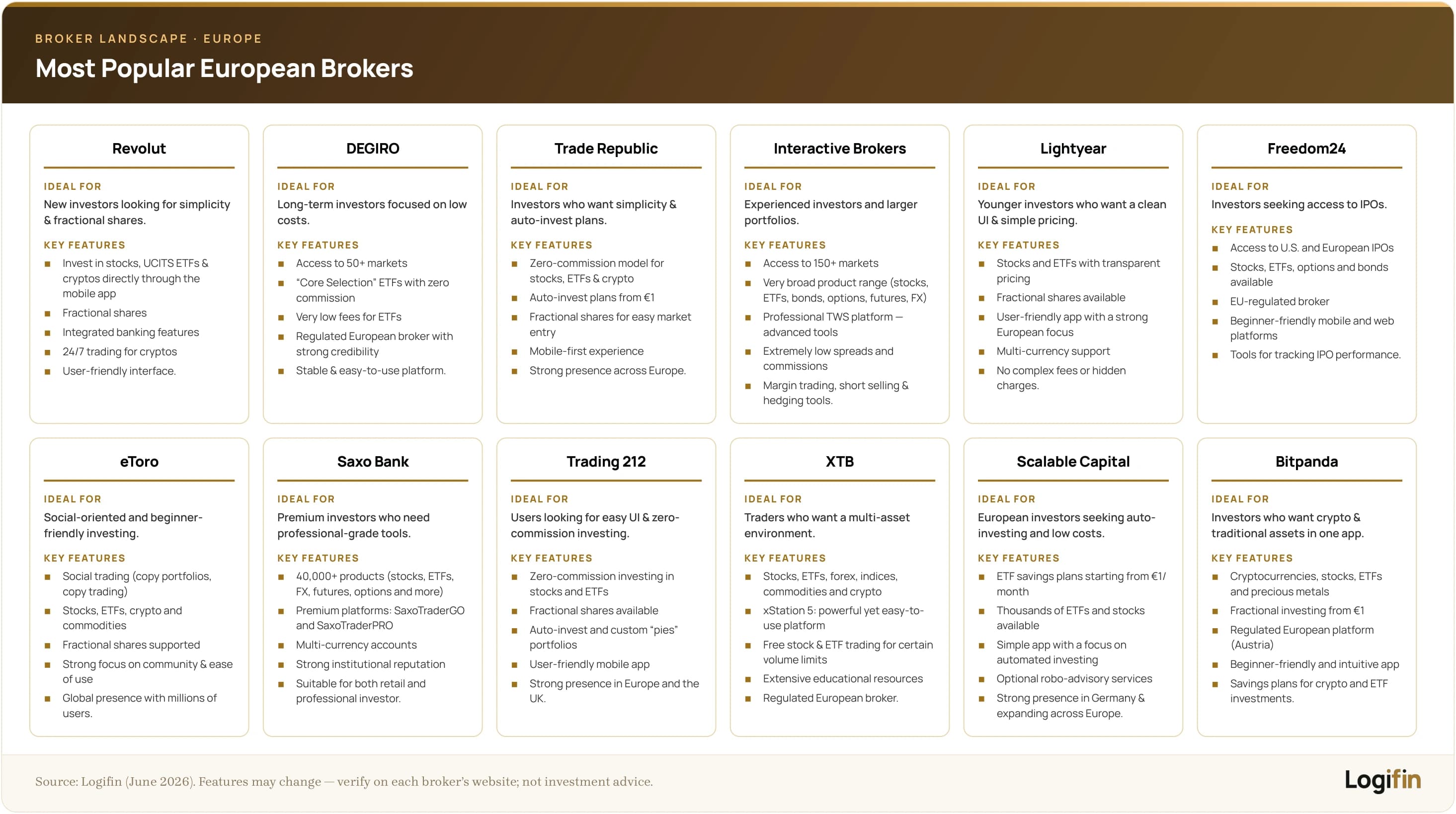
Before you choose, run every candidate platform through six questions:
- How much does each transaction cost and are there fixed monthly fees?
- Are there hidden charges, such as currency conversion or inactivity fees?
- Does it offer fractional purchases? Important for small monthly amounts.
- Does it have the products you want, that is global UCITS ETFs and not only individual stocks?
- Does it provide an annual tax report suitable for your country’s obligations?
- Is it licensed by a European supervisory authority (such as CySEC, BaFin or the Bank of Lithuania) with investor protection?
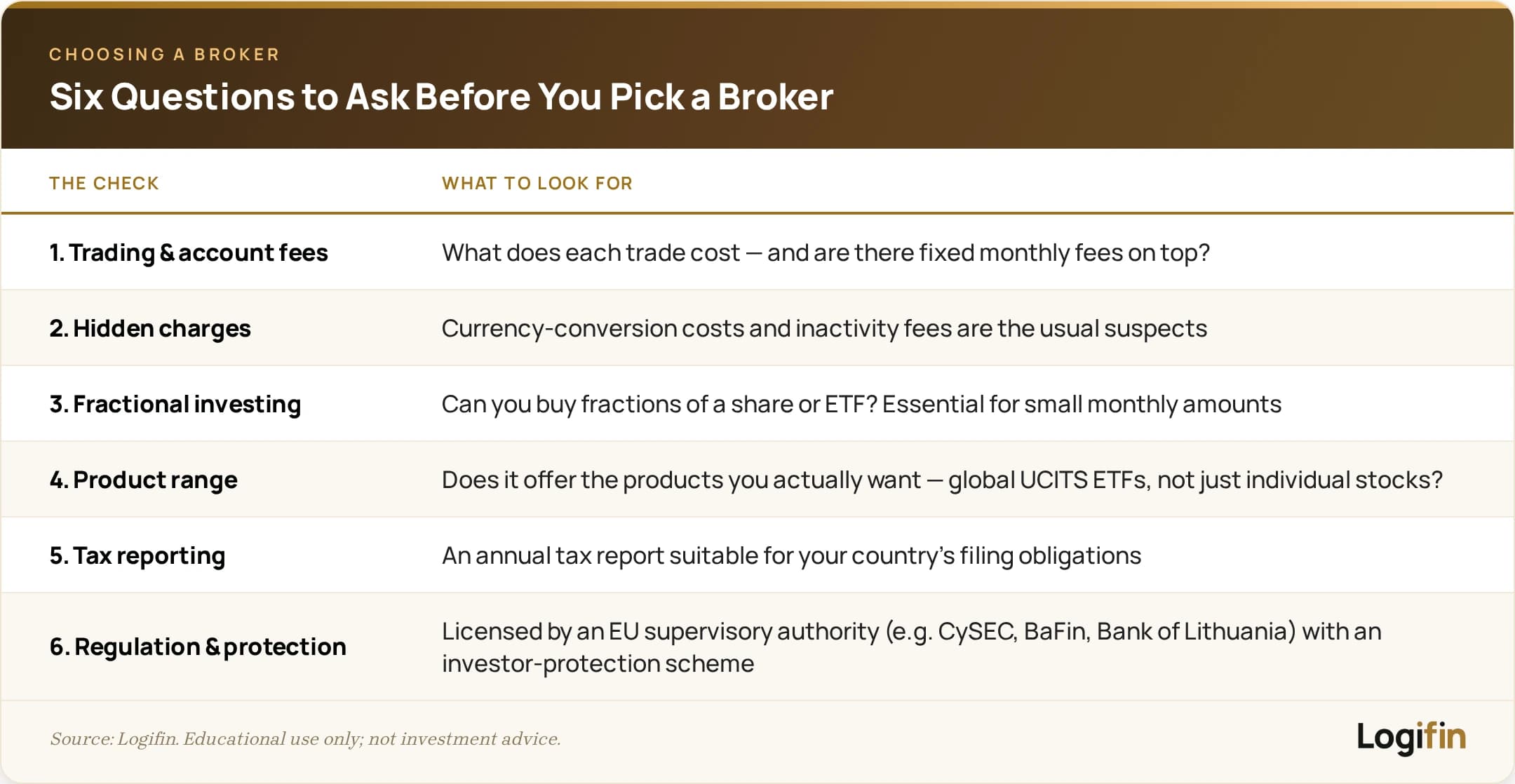
For a beginner, the priorities rank simply: first licensing and safety, then cost transparency and then ease of use.
Whatever you do not understand in a platform’s price list, you will pay for.
One point that reassures most beginners once they learn it: on licensed European platforms your products are held in segregated custody accounts, in your name.
If the platform shuts down, your investments do not disappear with it, while European investor compensation schemes offer additional protection up to a limit.
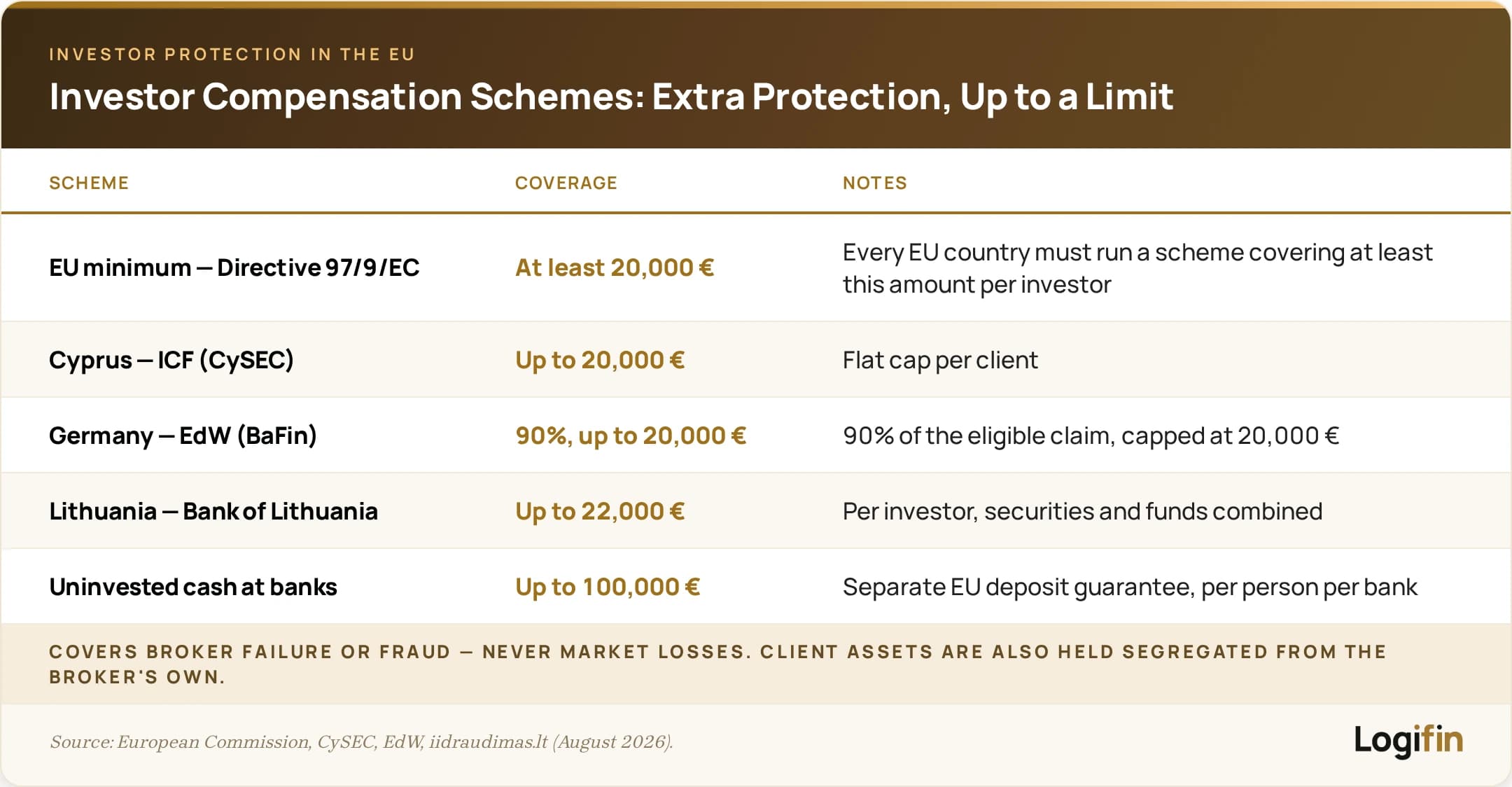
This is why licensing is the first criterion rather than a mere bureaucratic detail.
The psychology traps (and how to avoid them)
Most investing mistakes are not caused by bad products, but by human reflexes.
Studies of investor behaviour, such as Morningstar’s annual "Mind the Gap" report, consistently show that the average investor earns a lower return than the very products they hold, precisely because they move in and out at the wrong moments.
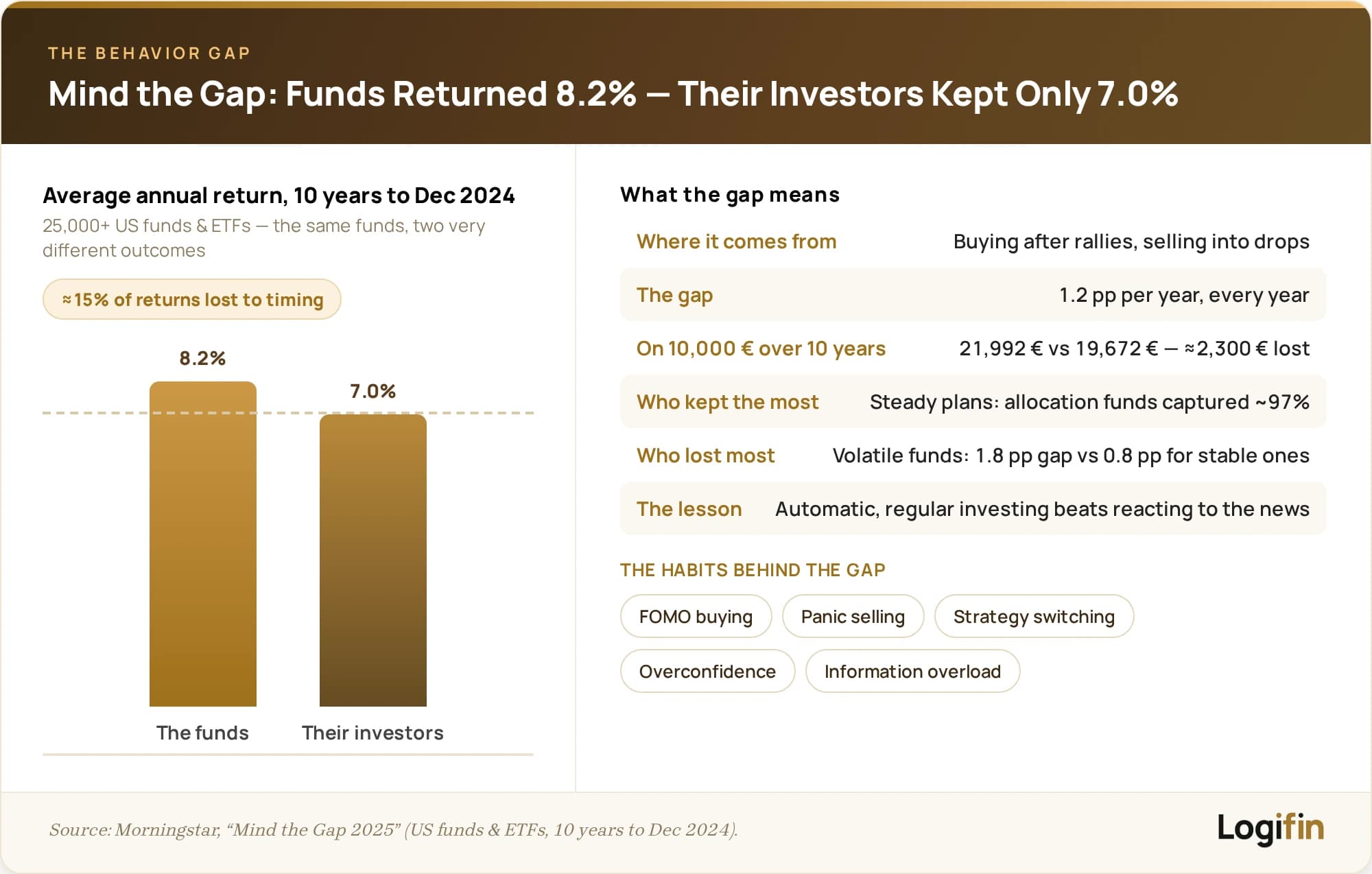
Five traps appear again and again among new investors:
- FOMO: you enter a hot investment because everyone talks about it, usually after it has already risen a lot, so what you mostly collect is the correction that follows.
- Panic selling: you sell into the drop to save what can be saved, you lock in the loss and you miss the recovery that historically follows.
- Constant strategy changes: from ETFs to stocks, then to cash and back again. Every change resets the advantage of time, as we saw in the compounding article.
- Overconfidence: a few good first months convince you that you have got it, you raise the risk recklessly and the market’s first adverse move finds you exposed.
- Information overload: news, Reddit, TikTok and YouTube deliver conflicting sure directions every day, until too much information ends in paralysis or impulsive moves.
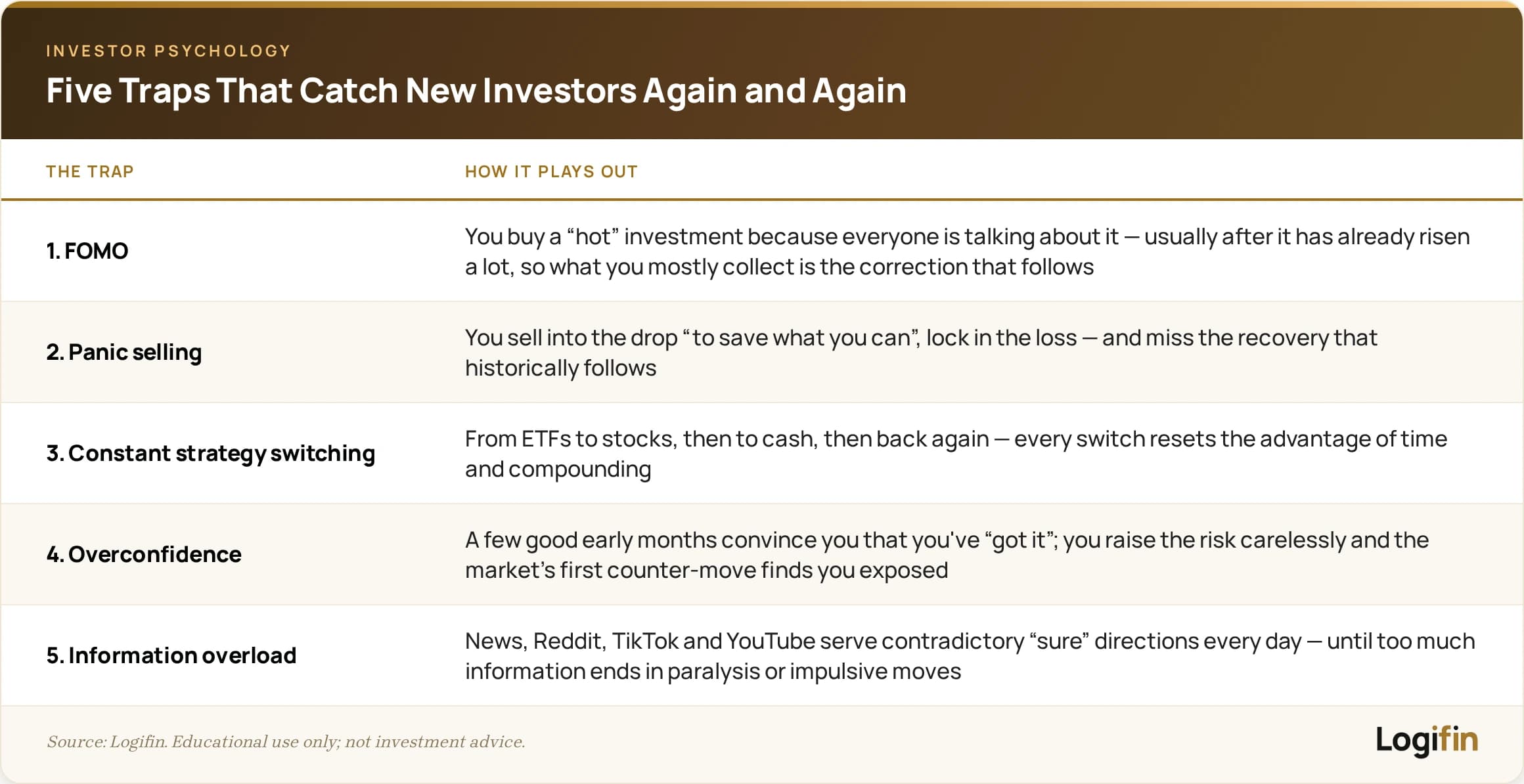
The protection against all five is the same and already familiar to you:
- a simple, written plan that reminds you of your goal,
- automated monthly investments that require no decision,
- acceptance of fluctuations as a normal part of the journey and
- conscious silence when the market makes the most noise.
The most valuable indicator of a new investor is not the first year’s return, but whether they are still consistent in the second.
Conclusion and practical takeaways
Starting to invest requires neither large capital nor special knowledge.
It requires a clear why, a small steady amount and a system that works without asking you for decisions every month.
Everything else, from product choice to psychology, serves one principle: consistency beats the perfect start. The 50 € per month investor who never stops almost always beats the one waiting for the ideal moment to put in a lot.
🔑 What to keep in mind:
- Inflation does not wait: idle money loses purchasing power every year. Investing is the realistic way to outpace it over time.
- Emergency fund first, investments second: 3-6 months of expenses set aside mean that no difficult moment will force you to sell in a downturn.
- DCA into a global, low-cost ETF: the simplest combination of strategy and product for a beginner, with ready-made diversification in one move.
- The biggest risk is you: FOMO, panic and information overload cost more than any commission. Automation is the antidote.
Practical Tips — start investing in 5 steps:
-
Open an account with a licensed platform.
Run it first through the six questions in "Account and platform". The process takes 10-15 minutes and only basic documents.
-
Choose one simple, broadly diversified ETF.
A global product on an index such as the MSCI World or the FTSE All-World is enough as a core. Check the composition and the cost in the factsheet.
-
Set your monthly amount.
Even 20-50 € is enough to set the mechanism in motion.
-
Automate the investment.
A standing order on payday, so that consistency does not depend on mood or on the news.
-
Stay calm and do not touch the system.
A check-in every quarter, not every day. Downturns are part of the journey and, for whoever keeps buying, an ally.
The content of this article is provided exclusively for informational and educational purposes and does not constitute investment advice or a recommendation to buy or sell financial products. The information is based on publicly available sources considered reliable, without any guarantee of accuracy or completeness. Before making any financial or investment decision, it is recommended that you consult a certified professional advisor or accountant, taking into account your own financial situation and risk profile. The Logifin team bears no responsibility for any direct or indirect damages arising from the application of the information presented.
Related articles

When should you start investing?
Why time in the market matters more than perfect timing, how much delay actually costs you and how to begin with small amounts and DCA.
15 min read

5+1 reasons to start investing today
Six reasons to start investing now instead of waiting for the right moment, from compounding and small amounts to the discipline it builds.
9 min read

DCA: The most stable investment strategy
What dollar cost averaging is, how it lowers risk and when it beats lump sum investing.
15 min read

What is a recession and how it affects investors?
How a recession is defined, what causes one, how the markets usually behave during it and what an investor can do to prepare in advance.
24 min read
EXPLORE LOGIFIN
Everything you need in order to learn, plan and track your investments.
Logifin Blog
Learn everything you need to get your finances in order and invest with confidence.
Logifin Insights
What moves the markets and what it means for a long term investor. Short and without the noise.
Logifin Tools
Free, inside the site, no signup. Everything you calculate stays on your device.
Logifin ETF Hub
Find the ETF that fits you: 550+ UCITS ETFs, smart filters and in-depth comparisons.
Logifin Guides
A series of guides that builds your investment plan step by step. The first guide is free for everyone.
Logifin Circle
The tools and the Hub are free for everyone. You become a member for the intelligence that never stops.