This guide is your compass for getting started. It takes you from "I do not know where to start" to the point where you can make your first investment with confidence, understanding what you are doing and why.
It will not promise you fast riches. It will not show you "the top stock of 2026". It will give you something far more valuable: a clear framework for thinking that works equally well in Paris, in Berlin, in Lisbon and in Athens, because it is built on principles and not on predictions.
By the time you reach the end of it, you will have a clear framework for how an investing journey begins.
How to read this guide
The guide has twelve chapters. It starts with the why, moves to the what and ends with the how, all the way to your plan on a single page. Every chapter stands on its own, but the order matters: each idea rests on the one before it.
Two notes before we begin:
- This guide is educational. Logifin does not know your personal situation and does not tell you where to put your money. It explains how things work, so that the decisions are yours.
- You do not need large amounts. The most common mistake is waiting "until I have saved enough". The habit is built with 50€ or 100€ per month. Larger amounts follow your income, not the other way around.
1. Why invest at all
Let us start with an uncomfortable truth that is rarely said plainly: money that sits still loses value every year. Not in theory but in very practical terms. The reason is called inflation: the gradual rise in prices that makes the same basket of goods a little more expensive every year.
The European Central Bank targets inflation of roughly 2% per year. It sounds negligible. Now look at what this "negligible" percentage does over time:
The silent erosion
In twenty years, your 10,000€ buy what 6,730€ buy today. A third of your purchasing power has vanished without you spending a single euro. The bank account shows the same number; everything around it simply became more expensive.
Investing is the answer to this problem. When you invest, you put your money to work in the real economy: in companies that produce, innovate and grow. Historically, global stock markets have returned roughly 7% per year on average over multi-decade periods, before inflation is subtracted. No single year is "average": there are years of +25% and years of −20%. Over decades, however, the trend of the global economy has so far been steadily upward. That 7% is a historical observation and not a forecast: in this guide, as in the Logifin calculators, it is used as a working assumption so that the examples stay comparable.
You do not invest to get rich quickly. You invest so that you do not become poorer slowly.
That sentence deserves to stay with you throughout this guide. Investing is neither gambling nor a sprint. Investing in productive assets over the long run is one of the main ways in which you can protect and grow your purchasing power over time.
A hypothetical example shows how large the difference made by time can become. Take 1,000€ at an average return of 7% per year and see what it becomes by the time you are 65, depending on when you invested it: at 25 it grows to roughly 15,000€; at 35, roughly 7,600€; at 45, barely 3,800€. Same amount, same return. The only thing that changed is time. Every decade of waiting cuts the final result roughly in half.
If you want to go deeper, inflation and the question of "when should I start" each have their own article on the blog: What is inflation and When should you start investing?.
2. Before the first euro
The enthusiasm of a new investor is precious. The right order of moves, however, is even more precious. Before you buy anything, make sure you are standing on solid ground. Logifin sees it as four levels, built from the bottom up:
The right order
Level 1: Safety fund. A common starting point is 3 to 6 months of essential expenses in an instantly accessible account; where inside that range someone lands depends mostly on how stable their income is. This money is not an investment. It is the cushion that lets you invest calmly. Without it, the first car repair or job change will force you to sell your investments at the worst possible moment. If you struggle to see what is left over each month, the 50-30-20 rule is a simple starting point. The Logifin Budget Tracker even has it built in.
Level 2: Expensive debt. If you are paying a credit card or consumer loan at 12% or 18% interest, paying it off is the best "investment" you will ever make: a guaranteed return equal to the interest rate, with zero risk. No market promises anything like that. To see how hard this mechanism works: when a card at 18% interest is serviced only with the minimum payment, repayment can stretch on for years and the total interest paid can end up comparable to the original debt itself. It is the very same compounding you will meet in chapter 3, only here it works against you. A mortgage at a low rate does not belong here; it can coexist comfortably with your investments.
Level 3: Regular investing. This is where this guide lives: steady, scheduled contributions into broadly diversified products, with a horizon of five years or more. Money you may need within a year or two (for a home, for studies or for a wedding) has no place in the stock markets.
Level 4: More advanced moves. Individual stocks, alternative holdings, more active strategies. An optional level for later. It comes only once the first three run on autopilot.
3. The compounding engine
If investing has one "secret", this is it. And it is not even a secret. It is called compounding: your gains begin to produce gains of their own.
The logic is simple. You invest 100€ and the first year returns 7%: you have 107€. In the second year, the 7% is calculated on 107€, not on 100€. The difference looks insignificant at first. It is not:
The compounding engine
Look at the chart carefully. At 5 years, the investment is almost entirely your own money; the gains are barely visible. At 30 years, you have put in 72,000€ and the portfolio is worth roughly 234,000€: the gains are more than double your contributions. The golden part of the bars, the work your money did on its own, grows faster and faster, while your own part rises at a steady pace.
From this follows the most important conclusion of the entire guide: time is your most powerful asset. Someone who starts at 25 with 100€ per month usually ends up with more than someone who starts at 40 with 300€. Not because they are smarter, but because they gave the compounding engine more time to work.
How critical is the first decade? Consider this comparison. Someone invests 200€ per month at 7% from age 25 to 35 and then stops completely: 24,000€ in total contributions. At 65 they end up with roughly 281,500€. Someone else starts at 35 and invests the same 200€ without interruption until 65: 72,000€ in contributions, three times the money. They end up with roughly 234,000€. The first person put in a third and still won, because their first decade had three full decades of compounding ahead of it.
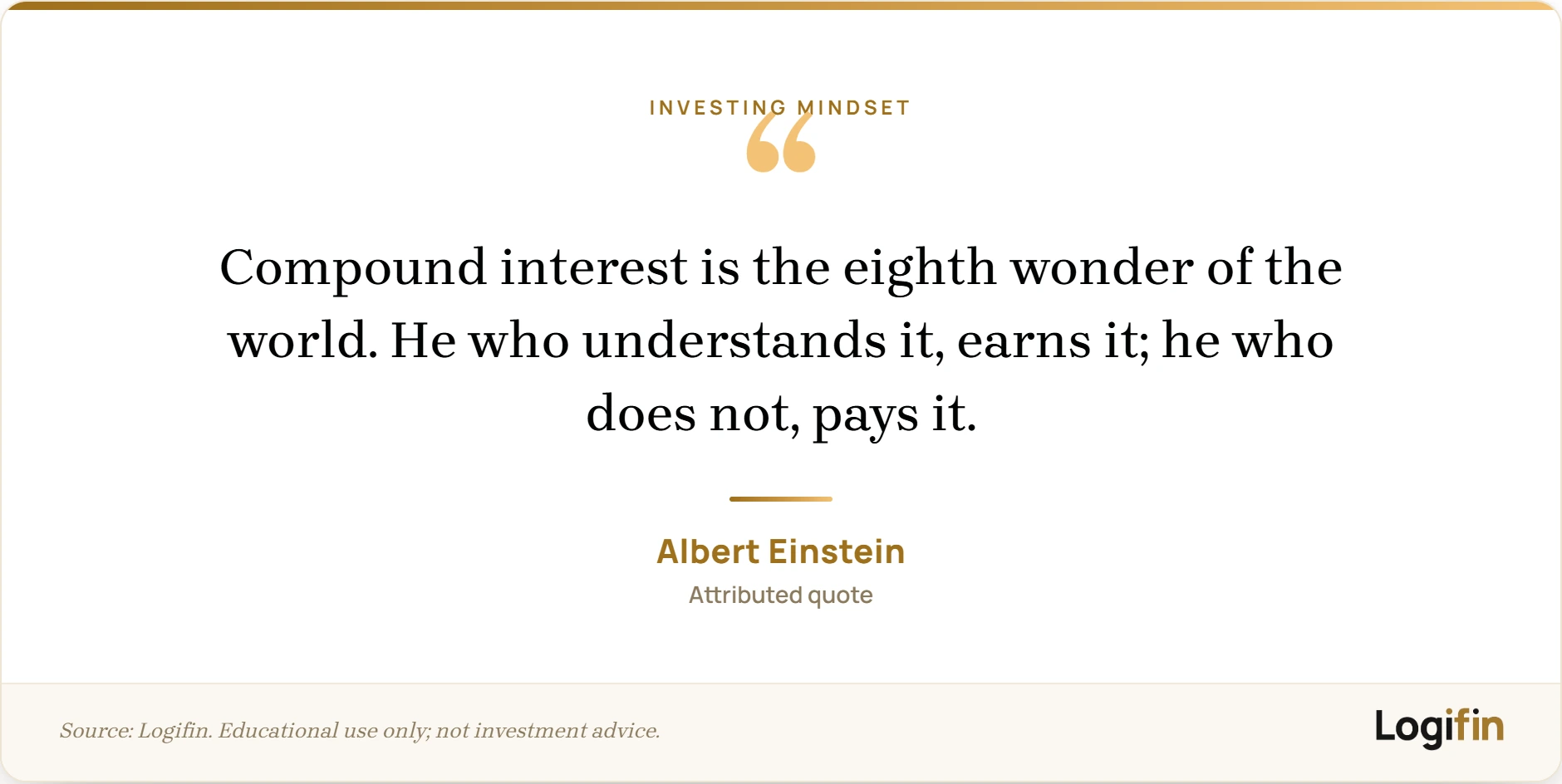
The source of the phrase has never been verified. Its essence, however, is entirely accurate in both directions: the same mechanism that builds fortunes also inflates the unpaid debts of chapter 2. More examples and the mistakes that cancel it out are in the article Compound interest and the eighth wonder of the world.
There is even a moment on the journey (Logifin calls it the Compound Crossover) when your total gains overtake the money you have put in. From that point on, your money works harder than you do.
4. The main investment categories
Before we get to "what should I buy", it is worth seeing the map. Investments fall into large families (professionals call them asset classes) and each has its own character: a different expected return and different swings along the way.
Risk and return
Cash and money market. Deposits and very short-term lending products. Almost no swings, but returns that rarely beat inflation. Their role: the safety fund and money you will need soon.
Bonds. You lend money to governments or companies and collect interest. Calmer than stocks, with more modest returns. In a portfolio, their role is to soften the swings: they do not raise the return, but they make the ride more bearable.
Stocks. Ownership shares in companies. Historically it is the category with the highest long-term return, but also with the largest swings. A 30% drop in a bad year is not a doomsday scenario. It has happened many times and it will happen again.
Gold and commodities. They produce nothing, neither interest nor dividend. Historically, however, they hold their value in turbulent times. A supporting role, if any, in a small dose.
Speculative: crypto and similar. Enormous swings, with no underlying production of value in the classical sense. If you choose to participate, do it only with amounts you can afford to lose entirely. Never with the foundations of your plan.
The critical lesson of the chart: return and risk are inseparable. Anyone promising you high returns "without risk" is lying to you. Always. The point is not to avoid risk, but to consciously take on as much as suits you, in the right dose for your horizon.
5. ETFs: the European investor's tool
Time to meet the protagonist. An ETF (Exchange Traded Fund) is a basket of hundreds or thousands of stocks or bonds that is bought and sold on the stock exchange like a single share. With one move and a few euros, you gain economic exposure to thousands of companies across the planet.
Most ETFs follow an index: a list of companies with clear rules. The MSCI World, for example, contains roughly 1,400 large companies from 23 developed economies. An ETF on this index does not try to "pick the winners"; it buys the whole list, automatically and with discipline.
Why is that a big deal? Three reasons:
- Diversification. The old market saying goes: do not search for the needle in the haystack; buy the whole haystack. When your exposure spans 1,400 companies, no single bankruptcy can seriously hurt you.
- Low cost. Because nobody is being paid to guess, the annual costs are remarkably low, often below 0.20% per year. In the next chapter you will see why this changes everything.
- Transparency. You know at any moment exactly what you own: the index is public and its rules are known.
As a European investor, you will meet five letters everywhere: UCITS. It is the European regulatory framework for investment funds: strict rules on diversification, safekeeping of assets and transparency, designed to protect the private investor. The ETFs aimed at Europeans are almost always UCITS and these are what you will find on European platforms.
One more word you will see often: replication. "Physical" means the ETF actually buys the shares of the index; "synthetic" means it reproduces the performance through contracts with banks. Physical replication is usually easier to understand for someone starting out. That does not make it better by definition than synthetic replication: these are two different structures, and it is worth understanding both before you compare products. For a full tour of their world (types, structure, advantages and what to watch out for) there is a detailed guide on the blog: What is an ETF.
6. Costs matter
If one chapter will pay you back in euros more than any other, it is this one. Market returns are uncertain; costs are the only certain quantity. And they work against you every day, silently, through the very same compounding mechanism we saw in chapter 3.
The basic cost figure of an ETF is called the TER (Total Expense Ratio). It is the annual percentage automatically withheld from the fund's value to cover management expenses. For large UCITS ETFs it typically ranges from 0.07% to 0.25%. For traditional actively managed funds, total annual costs often reach 1.5% or more.
How big a difference can a "point something" percent make? Look:
Costs matter
Same money, same market return, same amount of time. The only difference is the annual cost. And at the end almost 70,000€ are missing. The market did not take them; the fees did, year after year, together with all the gains that money would have produced.
Beyond the TER, two more costs deserve your attention:
- Transaction fees. Whatever your broker charges per purchase or sale. On modern platforms they are often zero or a few cents. Check them though, especially if you invest small amounts every month.
- Spread. The small gap between the buying and the selling price at the moment of the trade. On large, heavily traded ETFs it is usually negligible; on very small or thinly traded ones it can be noticeably wider.
The practical principle of this chapter fits in one line: the higher the annual cost, the stronger the justification has to be for what the product offers in return. Cost is not the only criterion, however: fund size, age, index and tracking accuracy matter too. Every ETF profile in the Logifin ETF Hub puts them side by side for you. The full list lives in the article How to choose between ETFs that track the same index.
7. Accumulating or Distributing?
The companies in your basket occasionally pay a dividend: a slice of their profits in cash. Your ETF collects it on your behalf. The question is what it does next. Here ETFs split into two schools:
Where the dividend goes
| Feature | Accumulating (Acc) | Distributing (Dist) |
|---|---|---|
| What happens to the dividend | Reinvested automatically | Deposited into your account |
| Ideal for | Building capital over time | Regular income from the portfolio |
| Your action | None | You decide what to do with the cash |
For the investor who is building capital (that is, for the reader of this guide) the logic of Accumulating is hard to beat. The dividend never passes through your hands, so you are never tempted to spend it. On top of that, it compounds from day one without any action from you. Distributing becomes meaningful later, once the portfolio matures and you want to draw income from it.
A note: the treatment of dividends differs from country to country across Europe. Before you choose, spend a little time on the rules that apply in your own country of residence. It is one of the few details this guide cannot answer uniformly for everyone.
In the Logifin ETF Hub, every profile states clearly whether the ETF is Acc or Dist. Many popular ETFs even exist in both versions, from the same provider, on the same index. The question, specifically for the European investor, is analysed in the article Accumulating vs distributing ETFs.
8. How to choose a broker
To buy ETFs you need a broker: the platform that executes your orders on the exchange and holds your securities. It is the most "administrative" decision of the journey. It is worth making once and properly, because this account will accompany you for years.
The criteria that actually matter, in order of importance:
- Authorisation and supervision. The broker must be supervised by an authority of an EU or EEA state. Look up which authority supervises it on its website; they always state it, usually in the footer.
- Asset protection. In the EU, your securities are kept separate from the broker's own assets and investor compensation schemes offer an additional safety net. Your securities belong to you; the broker merely keeps them.
- Costs. Fee per trade, custody charges, currency conversion cost. For monthly purchases of small amounts what matters is the ratio: a 5€ fee on a 100€ contribution eats 5% of every purchase. The smaller the cost relative to the size of the trade, the less friction your DCA carries.
- Available products. Make sure it offers the UCITS ETFs you care about. If it also offers automatic investment plans (savings plans), regular investing can be made fully automatic.
- Fractional purchases. The ability to buy a fraction of a share means your entire amount gets invested every month. Useful when one share costs, say, 120€ and your contribution is 100€.
- Usability. You will use this platform for years. A clean, understandable app is not a luxury: it reduces mistakes.
9. DCA: the system that beats emotion
You now have all the "what". This chapter answers the hardest "when". The answer will be a relief: you never need to guess the right moment.
DCA (Dollar Cost Averaging) means: you invest the same amount, on a fixed date, every month, whatever the market is doing. First of the month, 200€ into the same ETF. The market is rising? You buy. It is falling? You buy again, this time more cheaply: more shares for the same money.
See it in numbers, with an example from the Logifin article on DCA. You invest 100€ per month in an ETF whose price dives and recovers within six months:
| Month | Unit price | Units for 100€ |
|---|---|---|
| January | 100€ | 1.00 |
| February | 80€ | 1.25 |
| March | 50€ | 2.00 |
| April | 40€ | 2.50 |
| May | 80€ | 1.25 |
| June | 100€ | 1.00 |
| Total | 600€ | 9.00 |
After six months you have put in 600€ and collected 9 units. Your average cost is 66.67€ per unit, while the simple average of the period's prices was 75€. Without predicting anything, you automatically bought more when it was cheap and less when it was expensive. The drop that would have frightened anyone ended up working on your behalf.
One honest footnote. If you already have a large lump sum available, it is worth knowing what the best-known study on the subject found: Vanguard (2012), across rolling ten-year periods in the United States, the United Kingdom and Australia. Investing the whole amount immediately performed better roughly two times out of three, because the money participates in the rise from day one. The same research, however, showed that DCA produced fewer and smaller losses in the bad periods. For anyone investing out of a salary, the dilemma does not even arise: DCA is simply the natural way to invest monthly income.
The power of DCA is not primarily mathematical; it is psychological. Without a system, emotion leads to predictable mistakes: you are afraid to buy during drops ("wait, it will fall further") and you get excited during rallies ("it is going up, put in more"). In other words, you buy expensively and hesitate when it is cheap, exactly backwards. DCA takes the decision away from emotion and hands it to the calendar.
Two principles complete the system:
Time in market beats timing the market. Time spent inside the market beats every attempt to predict it. How expensive is it to "step out for a while"? A J.P. Morgan analysis of the S&P 500 over 2000-2019 measured it: $10,000 that stayed fully invested became $32,421. Missing only the 10 best days of the twenty-year period cuts the final amount to $16,180. Missing the 20 best days wipes out almost the entire gain. The most treacherous finding: seven of the 10 best days occurred within two weeks of the 10 worst ones. Whoever steps out "until things calm down" almost certainly misses the recovery as well.
Automate everything. A standing order at the bank, an automatic investment plan at the broker. The best investment strategy is the one that executes even in the months when you are stressed, busy or on holiday: that is, the one that does not depend on you at all.
10. Your first purchase, step by step
The theory is over. If, after weighing your own financial situation, your horizon and the risk you are able to take, you decide to start, a typical first ETF purchase looks roughly like this on your screen:
Step 1: Set the monthly amount. An amount you will not miss. A common rule of thumb is 10-15% of net income, but even 50€ is enough to build the habit. The amount can grow later. Consistency is the one thing that cannot be made up for.
Step 2: Open a broker account. Using the criteria of chapter 8. The process is fully digital: an ID card or passport, a few details and usually one or two days of waiting for approval.
Step 3: Find your ETF by its ISIN. Every ETF has a unique 12-character code, the ISIN (for example IE00BK5BQT80). Always search with it: commercial names resemble each other dangerously, while the ISIN is unique and unambiguous. You will find it on every profile in the Logifin ETF Hub.
Step 4: Place the order. You will see two basic options: a market order (buys immediately at the current price) and a limit order (buys only up to the price you set). On large, liquid ETFs during exchange opening hours, many investors use market orders for the sake of simplicity; a limit order gives you control over the maximum execution price. Check the preview (amount, fee, total) and confirm.
Step 5: See what you have just acquired. You have just gained economic exposure to hundreds or thousands of companies. The first feeling is often… disappointment: "that was it?". Yes, that was it. Good investing is boring. What follows is repetition, not drama.
Step 6: Set up the automation. A standing order from your bank and, if your broker offers it, an automatic purchase plan. From here on, the system runs on its own.
Step 7: Record it and forget it. Note the purchase in the Logifin Portfolio Tracker and then close the app. Your next appointment with your portfolio is in one month, at the next contribution.
11. The seven mistakes of the first year
An investor's first year has predictable traps. And whatever is predictable can be avoided. Here are the seven most expensive ones:
1. Waiting for the "perfect moment". The market "is high", "a correction is coming", "let me wait for the elections". There is always a reason to postpone. Meanwhile, the markets keep doing their work. The DCA system exists precisely so that you never have to answer this question.
2. Checking the portfolio every day. On a daily basis, markets are close to a coin flip: half the days red, half green. You will see "losses" half of your life for no reason. A monthly appointment is more than enough.
3. Chasing what went up yesterday. The sector that doubled last year is the favourite bait of the first year. When something has already taken off and you hear about it everywhere, the easy gain has already been distributed to others.
4. Underestimating costs. "Half a percent more, what is the big deal." Look again at the chart in chapter 6: the "no big deal" cost 70,000€.
5. Investing the safety fund. When everything is rising, the safety cushion looks like "dead money". Until the moment you need it. Then you will be selling investments at the worst possible moment and locking in losses.
6. Selling in the first big drop. At some point (not "if" but "when") your portfolio will show −20% or worse. That is the moment the whole plan is judged. For a sense of scale: in the 2008 crisis the S&P 500 lost 57% from peak to bottom (October 2007 - March 2009). From that bottom it rose 85% within the following two years. Those who sold in the panic lost twice: they locked in the damage and missed the recovery. Those who kept contributing bought at the best prices of the decade.
7. Confusing investing with entertainment. If the adrenaline of trading attracts you, consciously confine it to a small, separate "play money" amount you can afford to lose. Your core plan must remain boring; that is where all its power hides.
12. Your plan on a single page
Twelve chapters, one plan. Everything you have read, condensed into ten actions. Tick them off one by one over the coming months:
Keep this page. In six months go through the list again. You will be surprised how many of these have become routine.
What comes next?
The compass has brought you this far: you know why you invest, with which tools and with which system. The next question is more personal: what does your own portfolio look like? How much in stocks, how much in bonds, which indices, in what proportion?
That is where the series continues: The FOUNDATION guide builds your first portfolio piece by piece, ATLAS maps the World ETFs, RHYTHM perfects the DCA system and ANCHOR helps you keep the plan steady when markets fall.
Until then, you already have everything you need for the first step. And the first step, as you saw in chapter 3, is the one that time multiplies more than anything else.
Enjoy the journey.
What comes next
The other guides in the series
Five guides, one plan. Continue with the one you are missing.
Guide II · Plan & Grow
FOUNDATION
Your first portfolio: allocation, ETF selection and your first purchase with confidence.
Guide III · Plan & Grow
ATLAS
The complete map of World ETFs: what exists, how they differ and how you choose.
Guide IV · Plan & Grow
RHYTHM
The DCA system in practice: automation, discipline and handling the drops.
Guide V · Plan & Grow
ANCHOR
Bonds and cash: the anchors that keep your plan steady in every market.
EXPLORE LOGIFIN
Everything you need in order to learn, plan and track your investments.
Logifin Blog
Learn everything you need to get your finances in order and invest with confidence.
Logifin Insights
What moves the markets and what it means for a long term investor. Short and without the noise.
Logifin Tools
Free, inside the site, no signup. Everything you calculate stays on your device.
Logifin ETF Hub
Find the ETF that fits you: 550+ UCITS ETFs, smart filters and in-depth comparisons.
Logifin Guides
A series of guides that builds your investment plan step by step. The first guide is free for everyone.
Logifin Circle
The tools and the Hub are free for everyone. You become a member for the intelligence that never stops.