When should you start investing?
Why time in the market matters more than perfect timing, how much delay actually costs you and how to begin with small amounts and DCA.
31 August 2025 · 15 min read

Why is timing so important?
When should you start investing? The short answer is: as early as possible (ideally today), because what builds wealth is not finding the perfect moment, but the time you stay invested and the power of compounding.
In the world of investing there is a timeless saying: "It is not about timing the market, but about time in the market."
In other words, the real power lies not in "guessing" when markets will rise or fall, but in starting early and letting time work for you.
The reason is simple: the more years you are invested, the more compounding works.
Your gains start to generate further gains, creating over time a snowball of wealth.
🔶 Example:
- Two people invest 200 €/month at a 7% average return.
- The first starts at 25 and invests until 35, contributing 24,000 € in total. After that they add no new capital, but let the amount compound until 65.
- The second starts at 35 and invests continuously until 65, contributing 72,000 € in total.

Even though the second invests three times the capital, the first ends up with a larger sum at 65, because their money had three decades to work with the power of time and compounding.
The role of compounding in wealth creation
Compounding is considered by many to be the most powerful tool in building wealth.
It is the mechanism that lets time work in your favour in a way that is almost invisible, yet extremely effective.
It allows your money to work not only for you, but also for… itself, generating gains on top of gains.
🔶 How it works in practice
Compounding is not complex. It is repetitive:
- You invest an initial amount.
- The gains (dividends, interest or capital gains) are added to the capital.
- The new total is reinvested, automatically or manually.
- In the next period, gains are calculated on a larger base.
The same cycle repeats again and again. At first, progress seems slow and discouraging. The numbers move in small steps.
But as the years pass, the curve turns from linear to exponential. That is where compounding "wakes up".
🔶 Example of a 10,000 € investment at a 7% average annual return
The amount grows exponentially the longer the period you stay invested:
- After 10 years → ~19,700 €
- After 20 years → ~38,700 €
- After 30 years → ~76,100 €
- After 40 years → ~149,700 €

In investing, time and discipline are the real multipliers of wealth, not whether you started with little or a lot.
🔶 Why is it so powerful?
Compounding needs two simple but crucial ingredients: time and discipline.
- The earlier you start, the more growth "cycles" you have.
- Even small amounts invested systematically can grow into substantial capital over time.
- It is an "automatic growth mechanism" that works for you even when you do nothing.
Think of compounding as a financial snowball. At first it starts small and moves slowly, but as it rolls through time it becomes huge and unstoppable.
🔶 The other side of the coin
Compounding can also work negatively, especially with high-interest debt. In that case, interest "compounds" and creates debt that balloons out of control.
Example: A credit card with an 18% interest rate can double your debt in less than 5 years if it is not repaid.
This shows that compounding is a neutral mechanism: it can become your best ally or your worst enemy, depending on how you use it.
Why delaying costs more than you think
The most common excuse people use for not investing is: "I do not have enough money now, I will start later."
This delay, however, carries an enormous cost. The time lost at the start is the most valuable, because it deprives your money of the chance to benefit from compounding.
🔶 The power of the first decade
- The first decade of investing is the most critical and often underestimated.
- The money you put in early has more decades ahead of it to grow through compounding.
- The earlier you start, the more times your money compounds, which multiplies the results.
- If you start at 25 instead of 35, that decade is not simply "10 extra years of investing", but can make a difference of hundreds of thousands of euros by retirement.
🔶 Example:
- If you invest 1,000 € at 25 at a 7% average annual return, by 65 it will have grown to roughly 15,000 €.
- If you do it at 35, it will have grown to roughly 7,600 €.
- If you wait until 45, it will have grown to just 3,800 €.

The difference is striking: the same 1,000 €, if you delay 20 years, yields almost 4 times less.
And the key point is that this difference is due neither to the amount nor to the interest rate. It is due solely to lost time.
🔶 The "opportunity cost"
When you delay, you do not only lose the returns you could have had; you also lose the opportunities the markets themselves create.
The market moves in cycles: bull markets, bear markets, recessions and recoveries. If you stay out, you lose the chance to buy at low valuations and benefit from future rallies.
🔶 Example:
- Anyone who invested after the 2020 pandemic-driven drop was able to see impressive returns within a few years.
- Those who waited for "the picture to clear" often entered later, missing the largest part of the upswing.
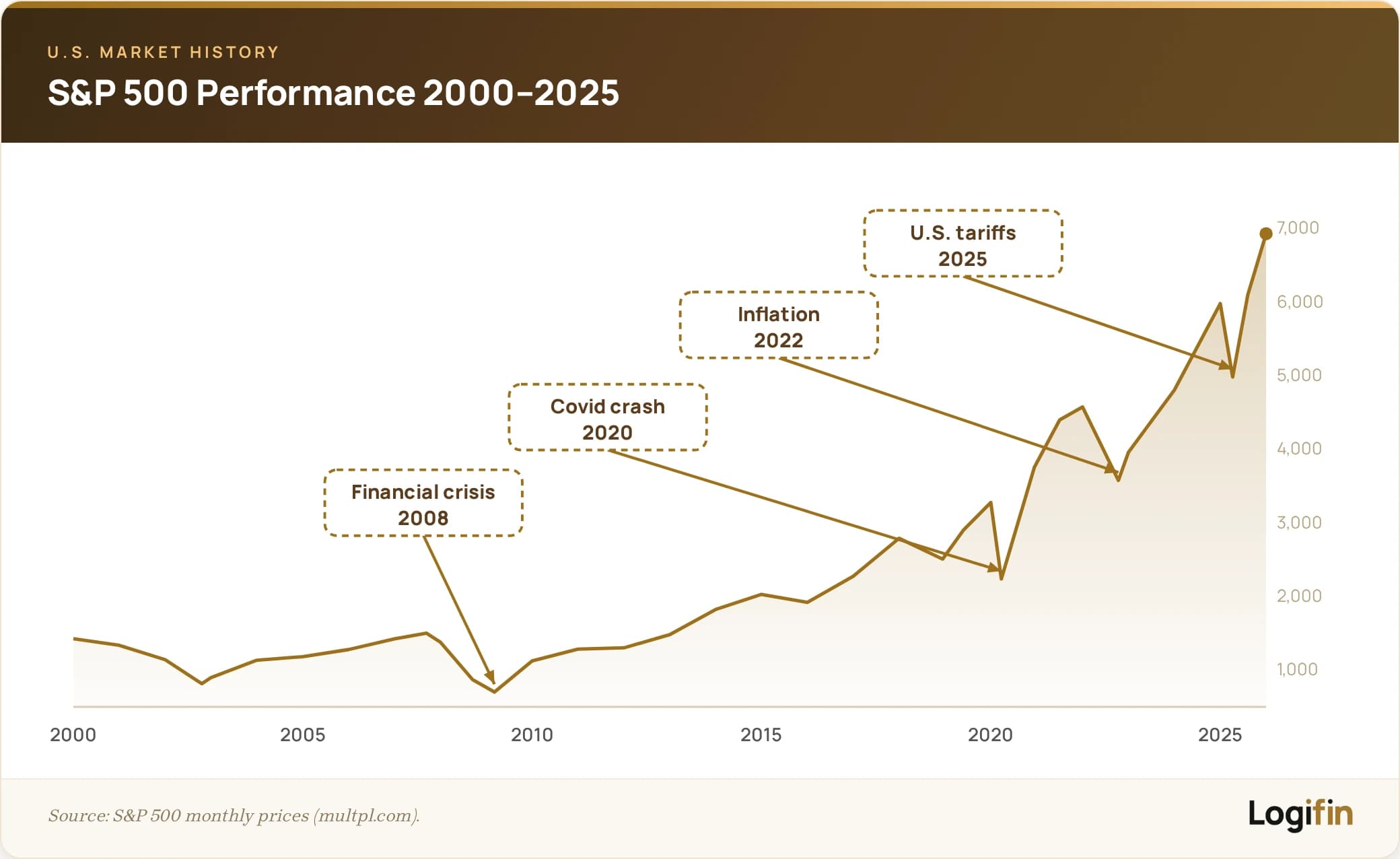
In simple terms: every year you stay out of the market, you reduce your chances of being present during its most profitable periods.
And history shows that just a few days or months of strong gains can make a difference of decades in your final return.
🔶 Psychological trap
Many people delay starting to invest because they believe they need "a higher income" or "more comfort".
The truth, though, is that expenses almost always grow alongside income: new family costs, children, a home, travel, obligations. So the longed-for "perfect moment" never arrives.
The reality is that the best time to invest is when you can start, even with small amounts.
Consistency and discipline build wealth, not waiting for a large amount to be left over.
Why you don’t need a lot of money to start investing
One of the biggest obstacles that discourages many people from investing is the belief that they need "a large capital" to start.
In reality, most modern investment platforms let you take the first step with very small amounts, even with 20 € or 50 € per month.
This means there is no excuse to wait "until you have saved enough".
🔶 The power of consistency
The initial amount matters far less than consistency in contributing.
The combination of small regular amounts with compounding leads to impressive results over time.
🔶 Example: 150 € per month at a 7% average return becomes more than 270,000 € in 35 years.

This shows that the key is not to start with a lot, but to start early and continue with discipline.
🔶 Small steps, big results
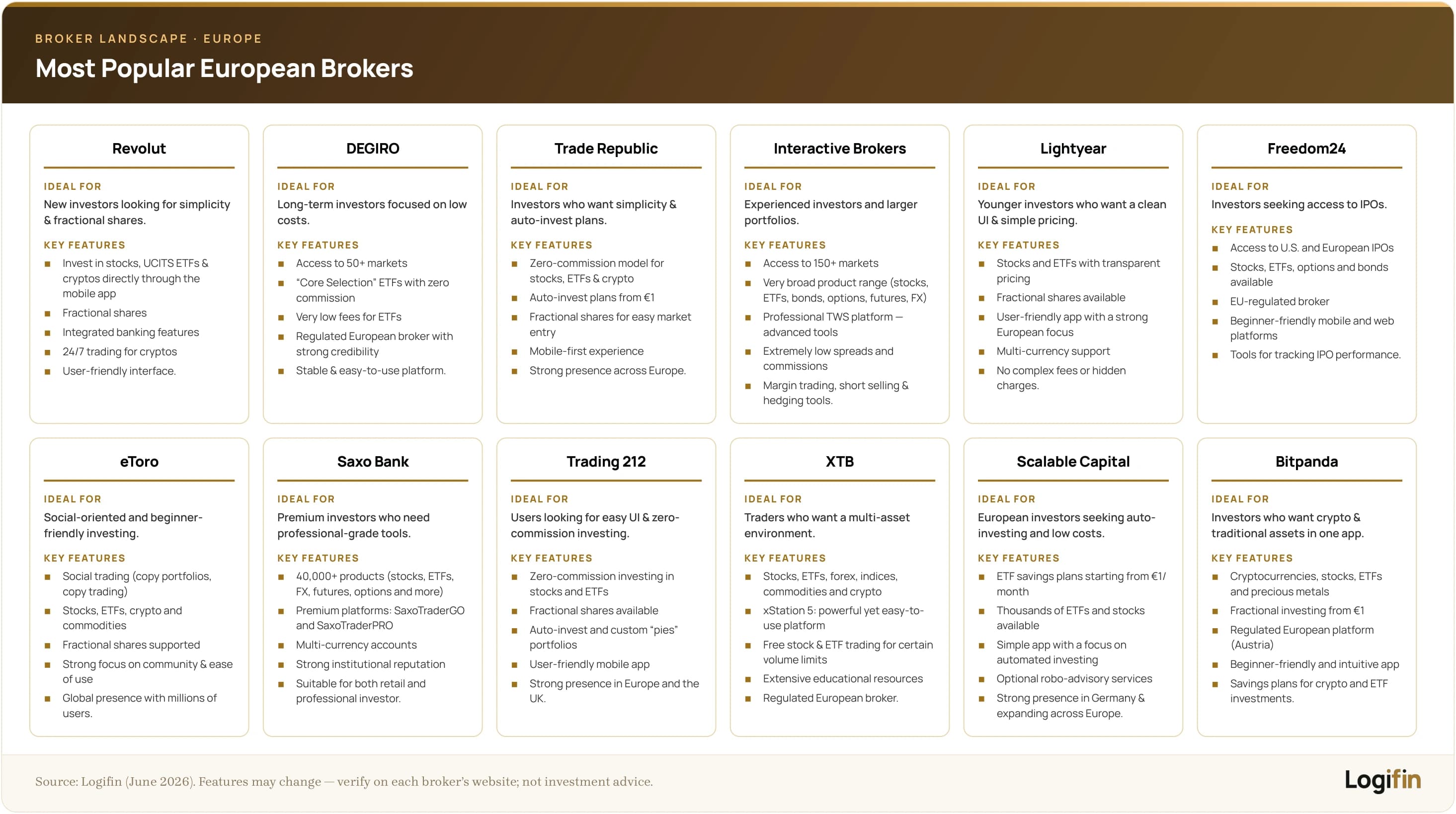
- Today, almost all well-known platforms offer the option to buy fractional shares, that is, fractions of a stock or ETF.
- So you can invest in top companies or ETFs with small amounts, without needing to buy a whole share.
🔶 Mindset matters more than capital
- Starting small builds habit and discipline.
- It is more important to build the investor’s routine than to wait to accumulate a large amount.
- When your income grows, you can increase your investments accordingly.
- Think of investing like exercise: you do not need 2 hours a day from the start; you need consistency. Over time, small steps turn into big results.
The role of DCA (dollar cost averaging) for beginner investors
The simplest yet also the most powerful strategy for anyone starting to invest is Dollar Cost Averaging (DCA).
It is the systematic contribution of a fixed amount at regular intervals (e.g. every month), regardless of whether the market is rising or falling.
With this method, the investor avoids the mistake of market timing (that is, trying to guess when the "right moment" to enter the market is) and focuses on consistency.
🔶 How it works in practice
The philosophy of Dollar Cost Averaging (DCA) is simple but particularly effective: you invest the same amount at regular intervals, regardless of whether the market is rising or falling.
You do not try to predict the "right timing". You let time and consistency do the work.
In practice this means:
- When the market is expensive, the same amount buys fewer units.
- When the market is cheap, the same amount buys more units.
- Over time, these purchases at different price levels create an average purchase cost that tends to smooth out.
You do not always buy "cheap", nor always "expensive". You buy systematically.
🔶 Example:
Let us say you decide to invest 100 € every month in an ETF. Its price changes from month to month, but you keep putting in the same amount, without worrying whether the price is “good” or “bad”.
- January: the price is 100 € per unit. With 100 € you buy 1 unit.
- February: the price drops to 80 €. The same amount buys 1.25 units.
- March: the price falls to 50 €. Now 100 € gets you 2 units.
- April: the price hits 40 €, its lowest point. The same 100 € buys 2.5 units.
- May: the price recovers to 80 €: 1.25 units again.
- June: the price returns to 100 €: 1 unit.

After 6 months you have invested 600 € in total, but you have bought a different number of units each time: more when they were cheap, fewer when they were expensive. Altogether you collected 9 units.
The result: Your average purchase price comes to 66.67 € per unit (600 € ÷ 9 units), lower than the simple average of the period’s prices, which was 75 €. And all without having to predict anything.
🔶 Why is it ideal for beginners?
- You do not need to predict the market: you avoid the pressure of "when do I get in".
- It protects you from the fear of missing out (FOMO) and the panic that volatility causes.
- It creates habit and discipline: every month you invest the same amount, as you would pay a bill.
- It gradually builds a relationship of "comfort" with the market, as you learn to see it over the long term and not through short-term swings.
DCA is not only a strategy; it is also a psychological tool that keeps you calm when markets fall. You know you are buying cheaper, which reduces fear.
🔶 What does the research show about DCA?
- Vanguard research shows that, although lump-sum investing has historically tended to perform better over a long horizon, the DCA strategy can reduce the risk of poor entry timing and limit short-term volatility, especially during sharp market declines.
- At the same time, it supports investor consistency and reduces the temptation of market timing.
Why markets reward patient investors
Markets never rise in a straight line. They have cycles of rises (bull markets), falls (bear markets) and periods of stagnation.
This cyclicality can scare beginners, but history shows that whoever stays invested over the long term is rewarded generously.
🔶 The power of time
In the short term, markets are unpredictable and often chaotic.
An announcement, a crisis or even a rumour can cause sharp swings, creating the sense that investing is a "bet".
In the long term, however, the picture changes dramatically.
- Markets tend to rise, following the growth of economies, rising productivity and the progress of technology.
- The power of compounding over decades more than offsets short-term turbulence.
🔶 Example:
The S&P 500 has gone through numerous corrections and bear markets over the last century: the 1929 crash, the 2000 dot-com bubble, the 2008 global crisis, the 2020 pandemic.
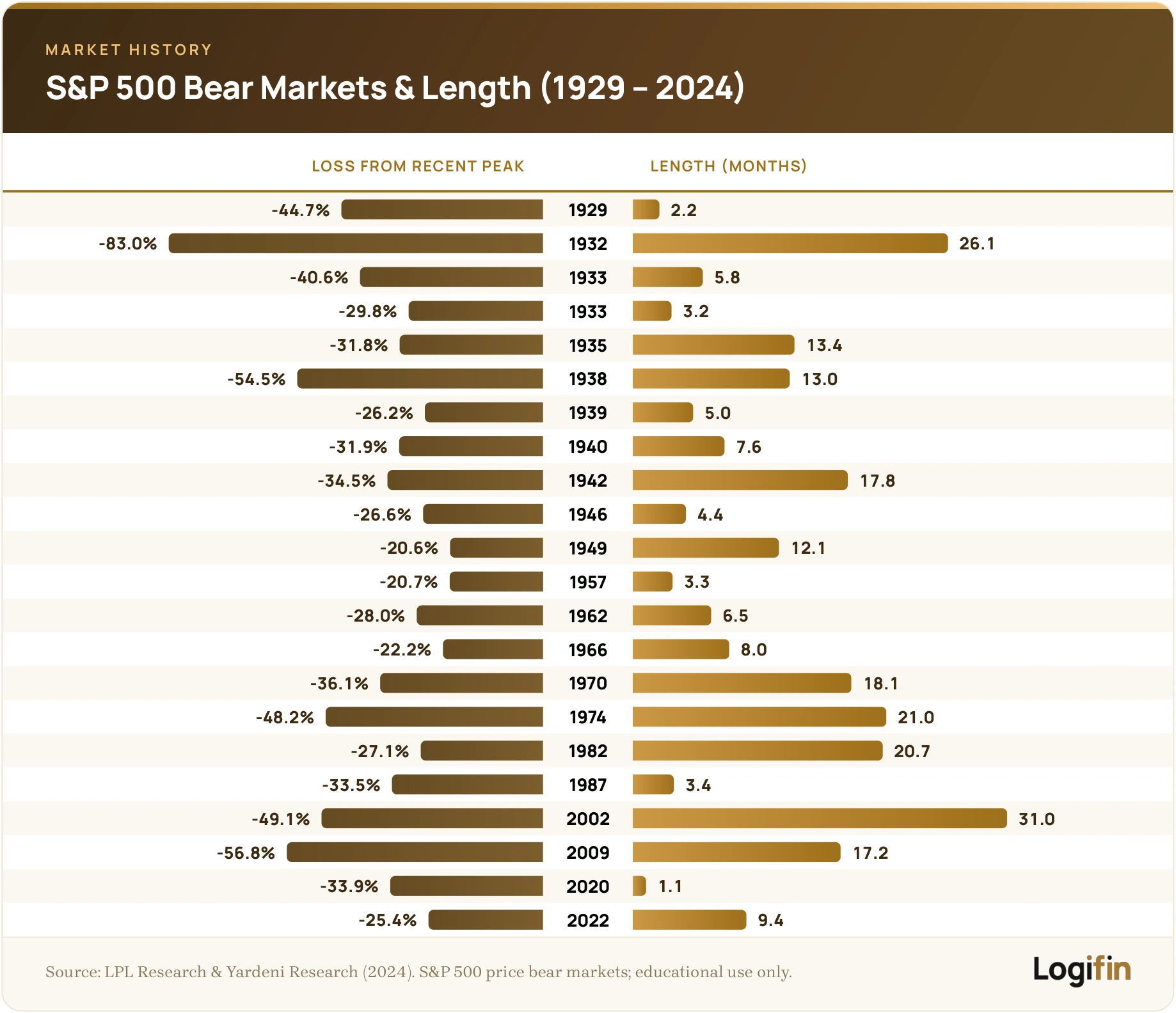
Despite all this, its average annual return remains around 10% (nominal), proving that whoever stays invested over time is rewarded.
Short-term drops are almost a certainty, but over 15–20 years, the historical probability of a positive return tends to approach 100%.
Time is the investor’s most powerful "risk hedge".
🔶 Psychology & patience
The investor’s greatest enemy is not the market, but their own emotional reactions.
Human nature pushes us to be fearful when prices fall and overly optimistic when they rise. This often leads to wrong moves: buying at the top and selling at the bottom.
Those who do not panic in downturns have a significant advantage. They see corrections as buying opportunities and not as a reason to flee.
In practice, composure and discipline are more important than any forecasting model or technical strategy.
🔶 Example:
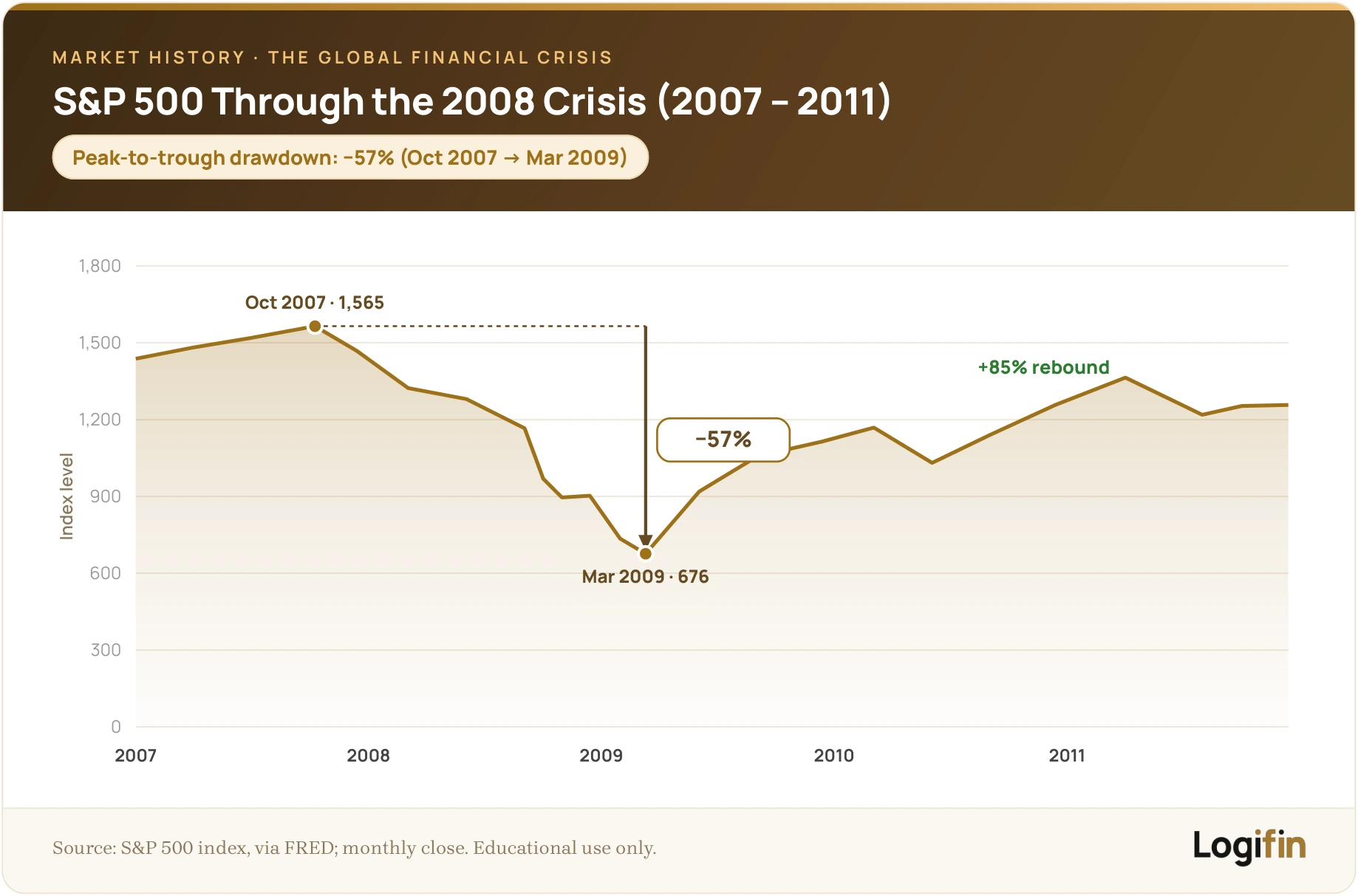
- In the 2008 crisis, the S&P 500 lost more than –50% of its value over roughly 17 months (Oct. 2007–Mar. 2009).
- Investors who sold under pressure needed years to "recoup" their losses, often missing the next upswing as well.
- By contrast, those who stayed invested or dared to buy at low prices saw their portfolios, within the next 4–5 years, not only recover but also surpass their previous levels.
The biggest risk in investing is not the market itself; it is the decisions we make under pressure. Discipline, patience and consistency are the real "weapons" of the successful investor.
🔶 What does the research show?
- According to a J.P. Morgan Asset Management analysis of the S&P 500 over 2000–2019, an investor who stayed fully invested saw $10,000 grow to $32,421, an average annual return of 6.06%.
- But missing just the 10 best days of those two decades cut that to $16,180 (2.44%).
- Missing the 20 best days brought the return almost to zero (0.08%), while from 30 missed days onward, the investor ended up with a loss.
- The key finding: 7 of the 10 best days happened within two weeks of the 10 worst. Anyone who sells in a panic to "dodge" the bad days will almost certainly miss the good ones that follow.
- That is why what matters is time in the market, not timing it.

Conclusion and practical takeaways
When you should start investing is one of the most frequent questions.
The answer, though, is simple: the earlier, the better. Time is the investor’s most valuable tool. Every delay carries an enormous cost, because it reduces the power of compounding.
🔑 What to keep in mind
- Compounding works like a "snowball" that grows with the years.
- Even small, regular investments gain power when made consistently.
- DCA helps you start without the fear of "bad timing".
- Markets reward patience and discipline far more than frequent buying and selling.
Practical tips for new investors:
1. Start with small amounts
- Do not wait until you have a large capital.
- Even 50–100 € per month is enough to build a habit and put time on your side.
2. Apply DCA
- Invest steadily every month, regardless of whether markets are rising or falling.
- This smooths your purchase cost and avoids the mistake of market timing.
3. View investments over the long term
- Do not be discouraged by short-term drops; they are part of the game.
- History has shown that, over time, markets always rise.

The content of this article is provided exclusively for informational and educational purposes and does not constitute investment advice or a recommendation to buy or sell financial products. The information is based on publicly available sources considered reliable, without any guarantee of accuracy or completeness. Before making any financial or investment decision, it is recommended that you consult a certified professional advisor or accountant, taking into account your own financial situation and risk profile. The Logifin team bears no responsibility for any direct or indirect damages arising from the application of the information presented.
Related articles

5+1 reasons to start investing today
Six reasons to start investing now instead of waiting for the right moment, from compounding and small amounts to the discipline it builds.
9 min read

How to start investing: A beginner's guide
The complete guide to start investing: strategy, products, choosing a platform and the traps you need to avoid.
15 min read

Compound interest: Why it is called the "eighth wonder of the world"
The phenomenon that turns time into the strongest ally of your investments. And how not to cancel it.
11 min read

What is a recession and how it affects investors?
How a recession is defined, what causes one, how the markets usually behave during it and what an investor can do to prepare in advance.
24 min read
EXPLORE LOGIFIN
Everything you need in order to learn, plan and track your investments.
Logifin Blog
Learn everything you need to get your finances in order and invest with confidence.
Logifin Insights
What moves the markets and what it means for a long term investor. Short and without the noise.
Logifin Tools
Free, inside the site, no signup. Everything you calculate stays on your device.
Logifin ETF Hub
Find the ETF that fits you: 550+ UCITS ETFs, smart filters and in-depth comparisons.
Logifin Guides
A series of guides that builds your investment plan step by step. The first guide is free for everyone.
Logifin Circle
The tools and the Hub are free for everyone. You become a member for the intelligence that never stops.