What is the stock market? The complete beginner's guide
Understand how it works, who participates and why it is a central pillar of the global economy.
18 August 2025 · 20 min read

What is the stock market? – In simple terms
The stock market is an organised space where buyers and sellers meet to trade shares and other financial securities.
It resembles a highly sophisticated “marketplace”, like a bazaar, except that instead of fruit or clothes, what is traded are ownership stakes in companies.
When you buy a share, you are not buying a “bet”; you acquire a small part of a business. That gives you the right:
- to share in its profits (e.g. through a dividend)
- to benefit from a rise in the share’s value
- but also to take on the corresponding investment risk
🔶 How does it work in practice?
The stock market works like an organised “intermediary” that ensures transactions happen quickly, accurately and under strict rules.
Buyers and sellers do not meet in person; instead, they use trading platforms and brokers to place their orders.
The process in brief:
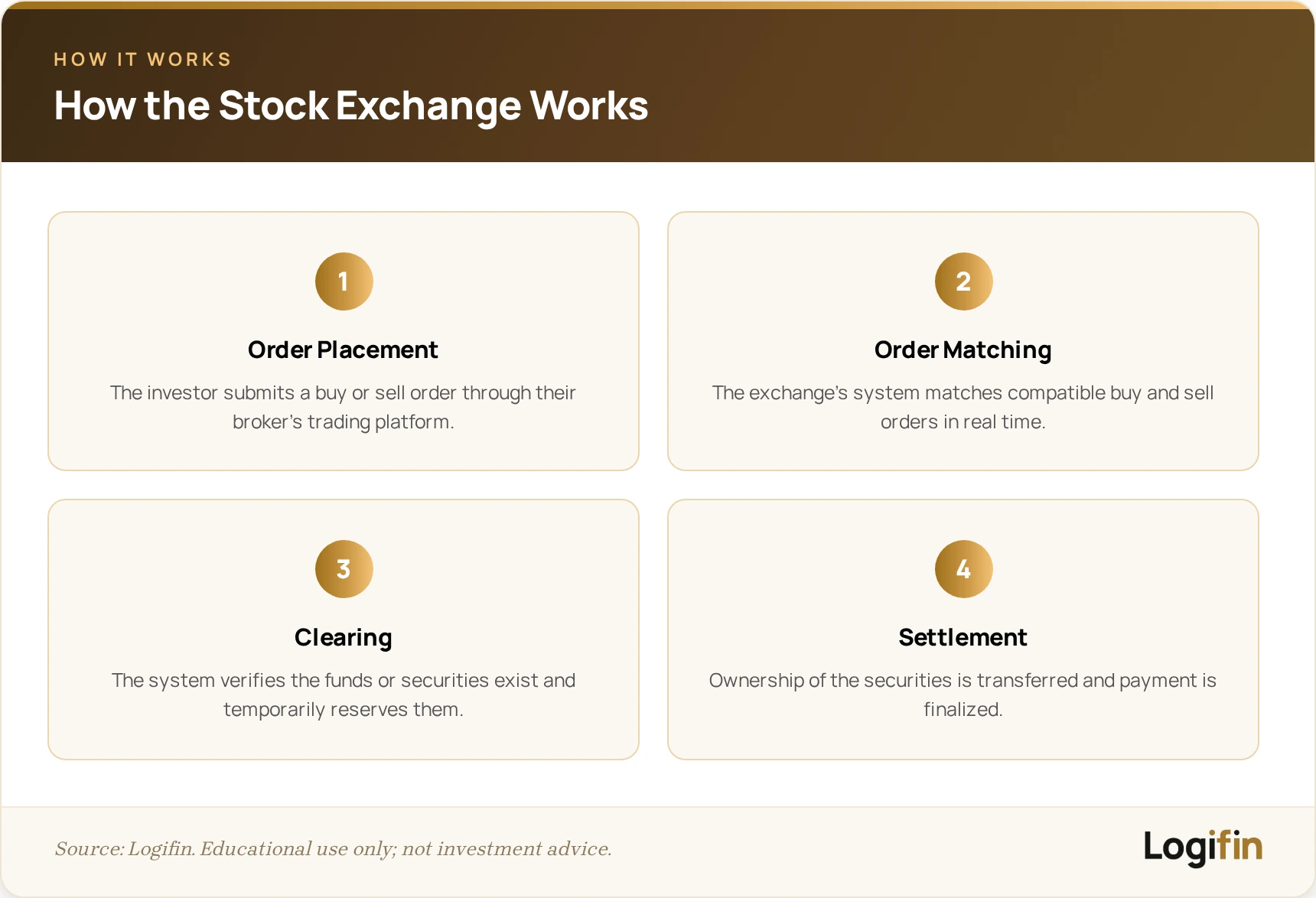
- Order entry – The investor places a buy or sell order through the broker’s platform.
- Order matching – The exchange’s system finds a match between buyers and sellers.
- Clearing – It is verified that the funds or securities exist and are temporarily reserved.
- Settlement – The transfer of securities and the payment are completed.
On the major exchanges (e.g. NYSE, Nasdaq, Euronext), the whole process can be completed in fractions of a second thanks to advanced electronic systems.
At the same time, to ensure transparency and reliability, companies listed on the stock market are required to publish financial statements regularly and to comply with strict corporate-governance rules.
Liquidity is the “oxygen” of the stock market. The more participants there are, the more easily and fairly prices are formed.
What is the role of the stock market in the economy?
Beyond facilitating the buying and selling of securities, the stock market is an institution that affects the entire economy.
Its functions touch businesses, investors and even citizens’ everyday lives.
🔶 Funding for businesses
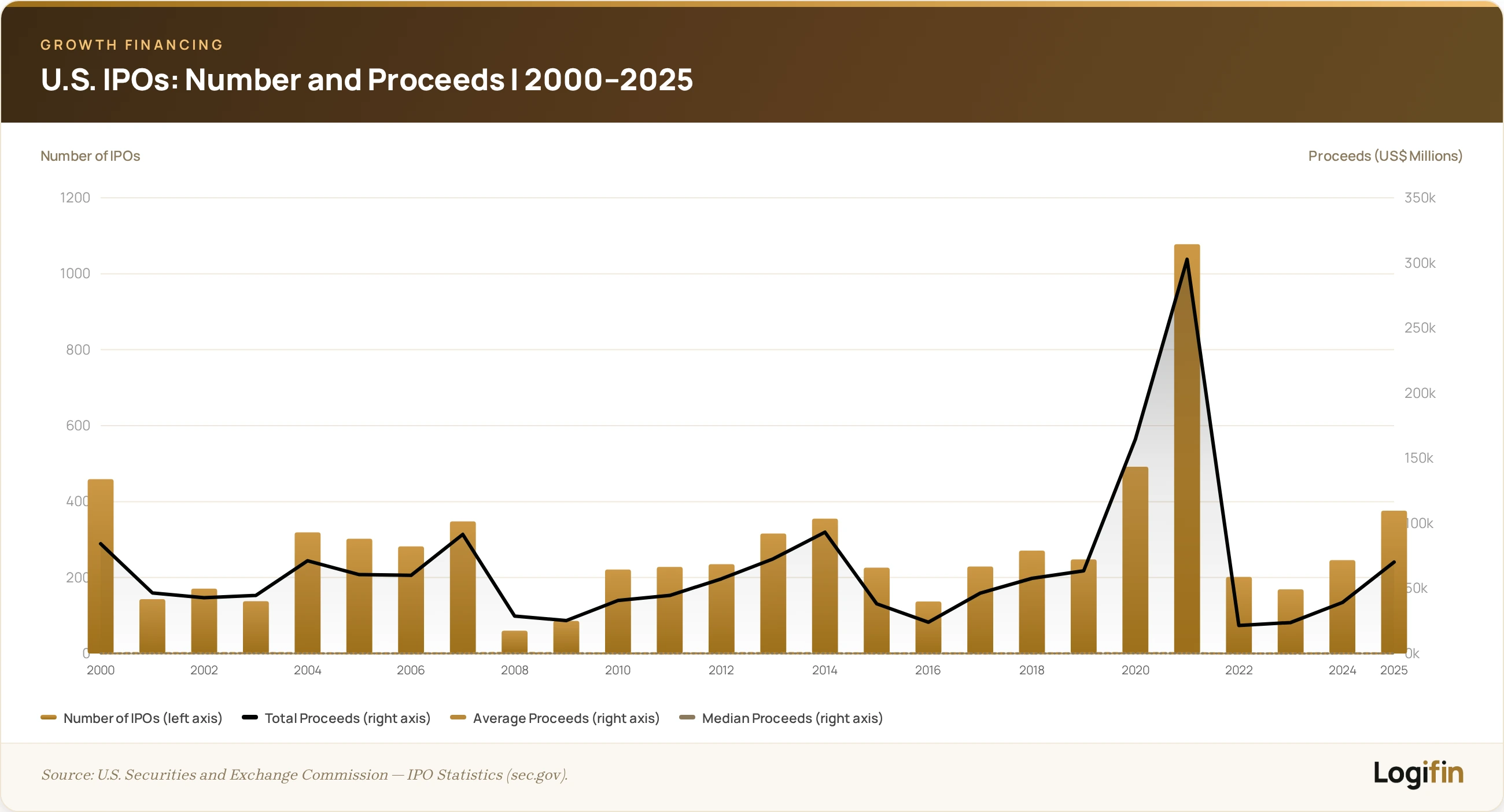
- Through an Initial Public Offering (IPO) or later issuances, a company can raise capital to fund growth, research, investments or debt repayment.
- This process reduces dependence on bank lending and opens up new growth opportunities.
🔶 Valuation and assessment
- A share’s price is a “vote of confidence” from the market.
- It reflects expectations about the company’s trajectory and offers a continuous reference point for investors and analysts.
🔶 Liquidity
- Liquidity is the ability to convert an asset into cash quickly and at a fair price.
- The stock market offers this advantage: you can sell your shares at any time at a price set transparently by supply and demand.
🔶 Transparency and safety
- Listed companies are required to publish financial statements, announce material events and follow strict corporate-governance rules.
- This protects investors and maintains trust in the system.
🔶 Risk management
- Through derivatives or other instruments, companies can protect themselves from sudden changes in commodity prices, interest rates or exchange rates.
- This reduces uncertainty and stabilises their strategy.
🔶 A barometer of economic health
- The main stock-market indices often act as a barometer for the broader economic climate.
- Their rise or fall can affect the psychology of investors and businesses, leading to changes in strategy or spending.
What are the main types of stock exchanges?
Although most people, when they hear “stock market”, automatically think of equity markets, the reality is far richer.
There are several types of exchanges, each with its own specialisation, infrastructure and role in the global economy.
Understanding their differences is crucial, because each market operates with different rules, products and levels of risk.
🔶 Stock Exchanges
They are the best-known type of exchange: the central space where investors, companies and market professionals meet to trade securities with transparency and safety.
Here, what is traded includes:
- shares of listed companies
- ETFs and other tradable products
- certificates, warrants and certain derivatives
Indicative examples:
- NYSE (New York Stock Exchange): The largest in the world by market capitalisation, it hosts giants such as JPMorgan and Coca-Cola.
- Nasdaq: Focuses mainly on technology companies such as Microsoft, Amazon and Tesla.
- Euronext: The largest pan-European market, with a presence in the Netherlands, France, Belgium, Italy and more.
🔶 Derivatives Exchanges
Derivatives exchanges specialise in trading products such as futures and options, that is, contracts whose value derives from some underlying asset.
The underlying can be a share, an index, a commodity, a currency or even an interest rate.
Derivatives exchanges are a critical part of the financial infrastructure. They allow investors to:
- hedge risks
- take targeted positions with leverage
- express specific views without buying the underlying product
These are more sophisticated instruments used mainly by professionals and institutional investors.
Indicative examples:
- CME Group (Chicago Mercantile Exchange): The world’s largest derivatives group. On CME, contracts are traded covering everything from oil and gold to foreign currencies, interest rates and global indices.
- Eurex: The leading European market for contracts on indices, bonds and interest rates. It is used extensively by professional traders and institutional investors.
🔶 Commodities Exchanges
Commodities exchanges are the markets where physical goods or their derivative contracts are traded.
From metals and energy to agricultural products, these exchanges are a cornerstone of the global economy, influencing consumer prices, industrial production and international trade.
Indicative examples:
- London Metal Exchange (LME): The best-known market for industrial metals. It specialises in copper, aluminium, nickel and other base metals that lie at the heart of manufacturing and the technology industry.
- Chicago Board of Trade (CBOT): Plays a pivotal role in price formation for the global food market. It trades contracts on grains, corn, soybeans and wheat, as well as on precious metals and energy such as gold and oil.
Prices on commodities exchanges are particularly sensitive to:
- geopolitical events, such as conflicts or sanctions
- weather conditions, especially in agricultural markets
- Worldwide demand, which is linked to economic growth
- moves in the dollar, since most commodities are priced in USD
This high sensitivity makes them ideal for hedging but also demanding for investors seeking stability.
🔶 Electronic Markets (Electronic Communication Networks, ECNs)
Electronic markets, or ECNs, are digital platforms that allow investors and financial institutions to connect directly.
They largely bypass the traditional role of the broker and offer a more modern, automated way of executing transactions.
ECNs stand out because they provide:
Execution speed
- Transactions are completed almost instantly, thanks to their fully electronic structure.
- This is particularly important in fast-moving markets.
Often lower costs
- Direct order matching reduces intermediaries and often leads to more competitive fees for the investor.
The ability to trade outside regular hours
- ECNs allow pre-market and after-hours trading, offering greater flexibility to those who cannot follow the markets during standard hours.
Indicative examples:
- Instinet: One of the first and most recognised ECN platforms worldwide. It played a decisive role in the evolution of electronic trading and remains a reference point for institutional investors seeking speed and precision.
- Archipelago (ARCA): One of the most influential ECN platforms in the history of electronic trading. Its great success ultimately led to its acquisition by the NYSE, shaping today’s NYSE Arca, a key platform for ETF trading in the US.
The participants in the stock market
The stock market is a living ecosystem in which a multitude of different players move simultaneously.
Each group has its own role, its own interest and its own way of influencing the flow of transactions and the movement of prices.
Understanding this “map” is essential to see how the market really works.
🔶 Retail Investors
These are the everyday investors who put their own capital into shares, ETFs, bonds or other products.
- Their decisions are heavily influenced by news, trends and opinions circulating on social media.
- They invest either long-term to build capital, or more short-term for gains from price swings.
- They often invest small amounts periodically, following strategies such as DCA.
The arrival of “zero-commission” brokers opened the door to millions of new investors, increasing transaction volumes worldwide.
🔶 Institutional Investors
They include large organisations such as mutual funds, insurers, pension funds, sovereign wealth funds and hedge funds.
- They manage vast amounts of capital, with specialised analysis teams and access to advanced tools.
- They can move the market significantly when they change positions or strategy.
- They use complex techniques to minimise risks and maximise returns.
Their moves have a major influence on the market, as they often signal or accelerate large trends, especially in periods of uncertainty.
🔶 Listed Companies
At the heart of stock-market activity are the listed companies: the businesses that issue shares and offer them to the public.
Listed companies:
Raise capital through IPOs or secondary issuances
- The money they raise is used for investments, expansion, research and development, or even debt reduction.
- This process strengthens their competitiveness and supports their business growth.
Are required to be transparent and to disclose regularly
- They must periodically publish financial statements, results updates and material corporate developments.
- These rules protect investors and ensure fair information.
Are directly reflected in their share price
- The corporate image, earnings, strategic decisions and market expectations are reflected daily in the share price.
- Investors “vote” with their capital, rewarding strong companies and punishing those that fail to meet expectations.
Listed companies are the cornerstone of every exchange.
Without them, markets would have no substance, nor would investors have access to business opportunities with growth potential.
🔶 Market Makers
Market makers are special participants who take on the critical role of keeping the market liquid and functional.
They continuously offer buy and sell prices on a share or ETF, ensuring that there is always someone available to make a trade.
In practice, this means that they:
- narrow the spreads
- keep the market orderly
- help transactions execute immediately and at fair prices
Market makers are usually large investment banks or specialised trading firms with high-speed technology.
Without them, prices would show more “gaps”, transactions would be delayed and the market would be noticeably more unstable.
🔶 Regulators
Regulators are international and national bodies that supervise the financial market, ensuring it operates with transparency, legality and investor protection.
Their role includes:
- enforcing compliance and corporate-governance rules
- monitoring for market manipulation, insider information or violations
- intervening when needed to protect the stability of the financial system
International examples include the SEC in the US and ESMA in Europe, while at national level there are authorities such as the Hellenic Capital Market Commission.
Without regulators, the market would be vulnerable to abuse and unfair practices, which would undermine investor trust.
🔶 Intermediaries & Technical Providers
Intermediaries and technical providers are the “invisible” but absolutely critical part of the financial system.
They are the entities that ensure every transaction (from the buy order to the final transfer of securities) is completed smoothly, quickly and safely.
This category includes:
- Brokers and trading platforms, which offer access to the markets and order-execution tools
- Custodians, which hold and safeguard investors’ securities
- Clearing and settlement systems, which confirm that money and shares change hands without the risk of a failed transaction
Their role is fundamental:
- They provide the technical infrastructure that makes it possible to execute millions of transactions per day.
- They ensure that settlement is secure, reducing the risk that securities or money “get lost” in the process.
- They support the market’s credibility, creating an environment where investors can trade with confidence.
Without these mechanisms, markets would not operate with the stability and speed we take for granted.
The benefits of the stock market for an investor
The stock market is one of the most effective tools for growing your wealth over time.
Although it is often surrounded by fear or prejudice, the numbers and history tell a different story: investors who follow a steady strategy and stick to their plan are rewarded.
It is no accident that most institutional investors, pension funds and large university endowments place a significant part of their capital in equities.
The main benefits for the long-term investor are:
🔶 The potential for higher returns than any other investment
Stocks (and especially broadly diversified ETFs) have the potential to outperform:
- deposits (which rarely keep up with inflation)
- government bonds (which have lower returns but lower risk)
- real estate (which carries maintenance costs, taxes and limited liquidity)
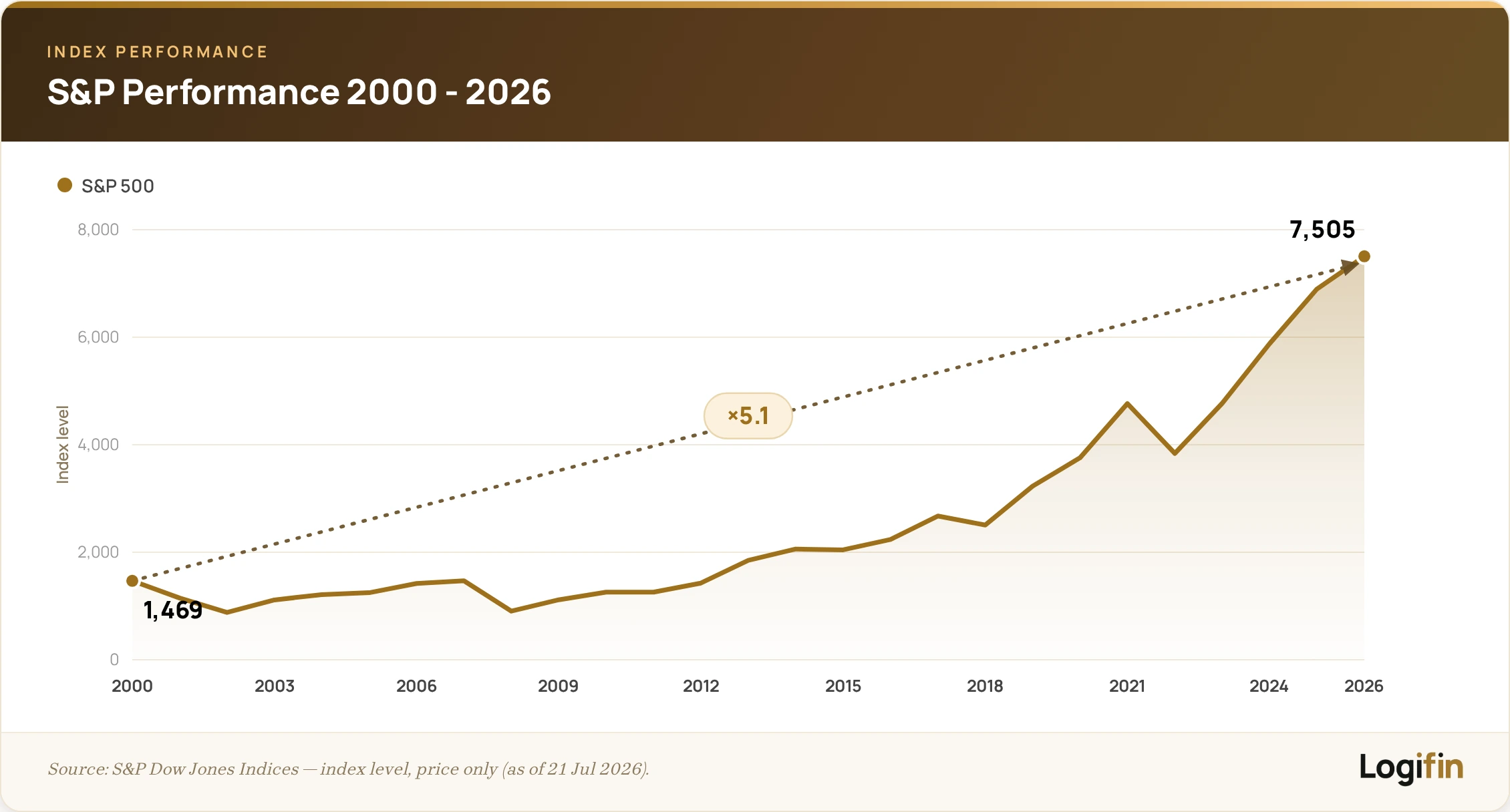
Example: If you had invested 10,000 € in the S&P 500 at the beginning of 2000, by 2026 it would have almost quintupled.
🔶 High liquidity and immediate management
Unlike other investments (such as real estate or private placements), shares and ETFs can be:
- bought or sold within seconds
- partially liquidated, depending on your needs
- adjusted in real time based on your strategy
Liquidity means flexibility, which matters in a fast-changing world.
🔶 Low entry cost and high accessibility
Today you do not need large capital or “market connections” to start. With 50 € you can buy:
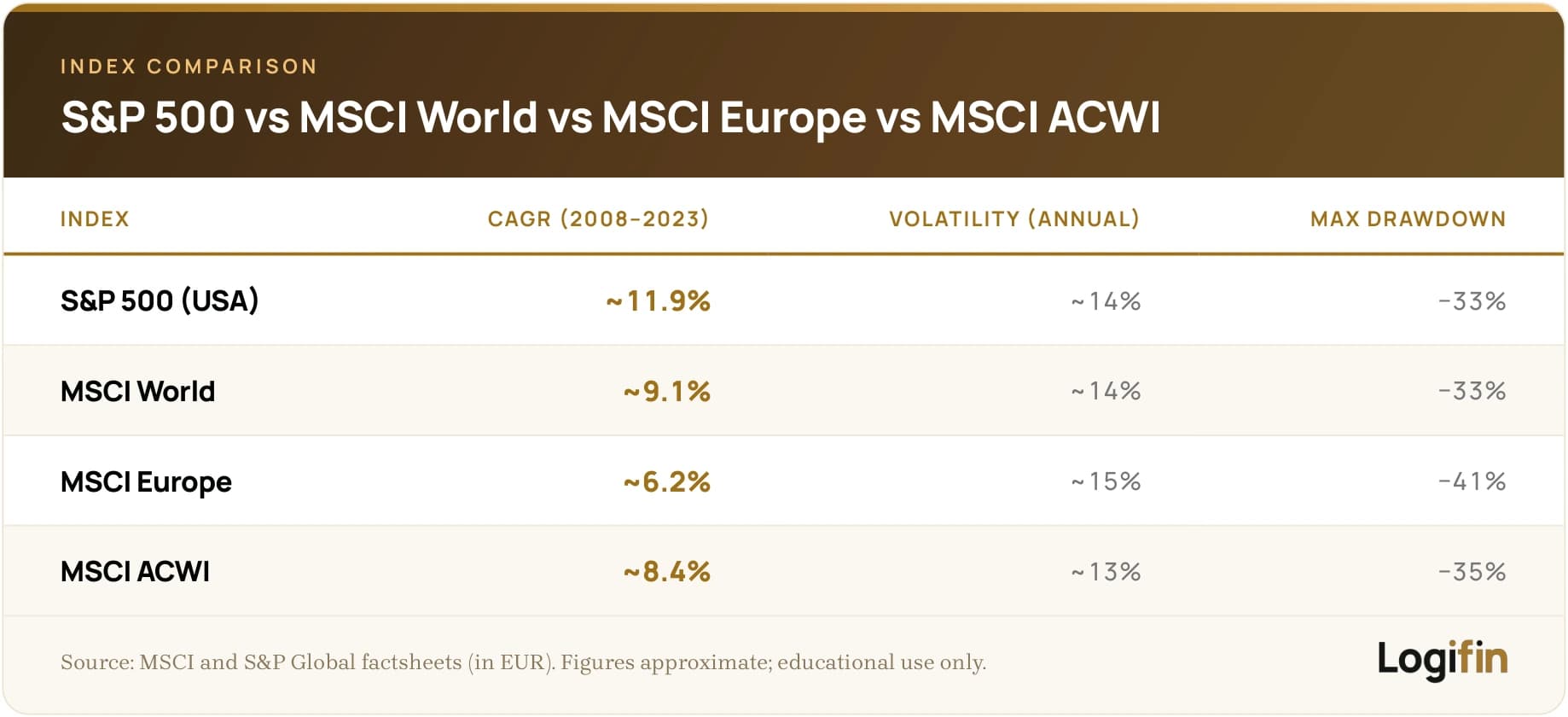
- an MSCI World ETF with exposure to ~1,300 stocks
- an S&P 500 ETF representing the largest US companies
- or even shares of specific companies that interest you
Transaction costs on many platforms are almost zero, while information is accessible to everyone.
🔶 Global diversification with no effort
Through a single ETF you can invest in dozens of countries, thousands of companies and different sectors, something that was unthinkable 20 years ago without professional management.
Example: IWDA (iShares Core MSCI World) gives you exposure to companies from the US, Canada, Europe, Japan, Australia and other developed markets, with a single click.
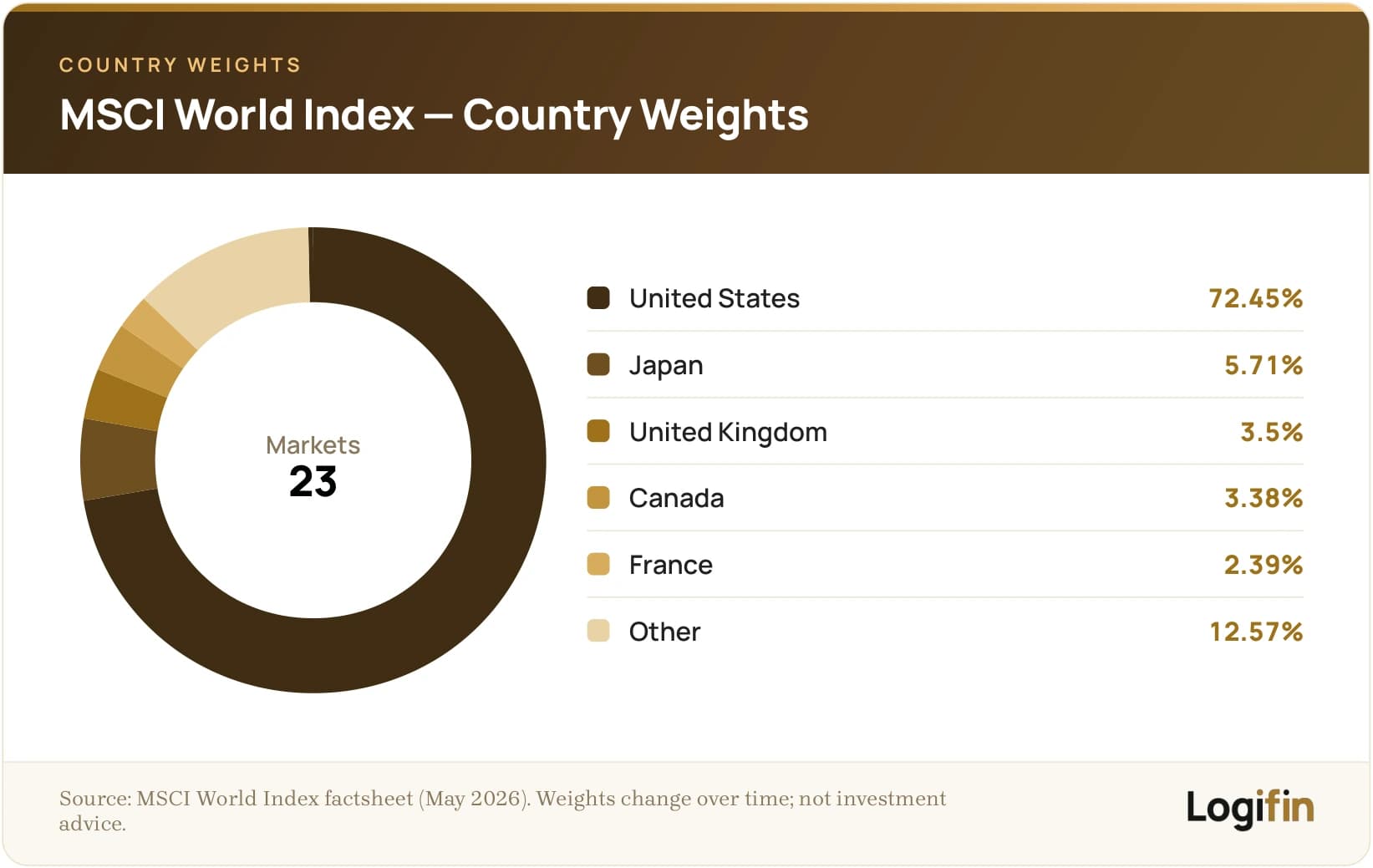
This means less risk than individual markets or sectors and greater resilience in crises.
🔶 A connection to the real economy and to progress
By investing in stocks, you become a participant in the growth of the global economy. You are not buying “securities”. You are investing in companies that:
- innovate (e.g. artificial intelligence, renewable energy)
- employ people
- create value and shape our everyday lives
Long-term investing is not a gamble. It is a way to take part, at your own pace, in the creation of wealth.
What are the main risks of the stock market?
The stock market can be an excellent tool for building wealth, but it is not without risks.
If you invest without a strategy or without knowing how the market works, it is easy to get discouraged, or even to lose money.
This does not mean you should fear it. It means you need to know what the real risks are and how to deal with them.
The main risks to keep in mind are:
🔶 Short-term volatility
The market does not always move upward. On a weekly or monthly basis, the prices of shares and ETFs can fall sharply, without warning.
Example:
- During the 2020 pandemic, global markets fell by about –30% in less than a month.
- For an investor with no tolerance for volatility, that is enough to sell at the wrong moment and “lock in” the losses.
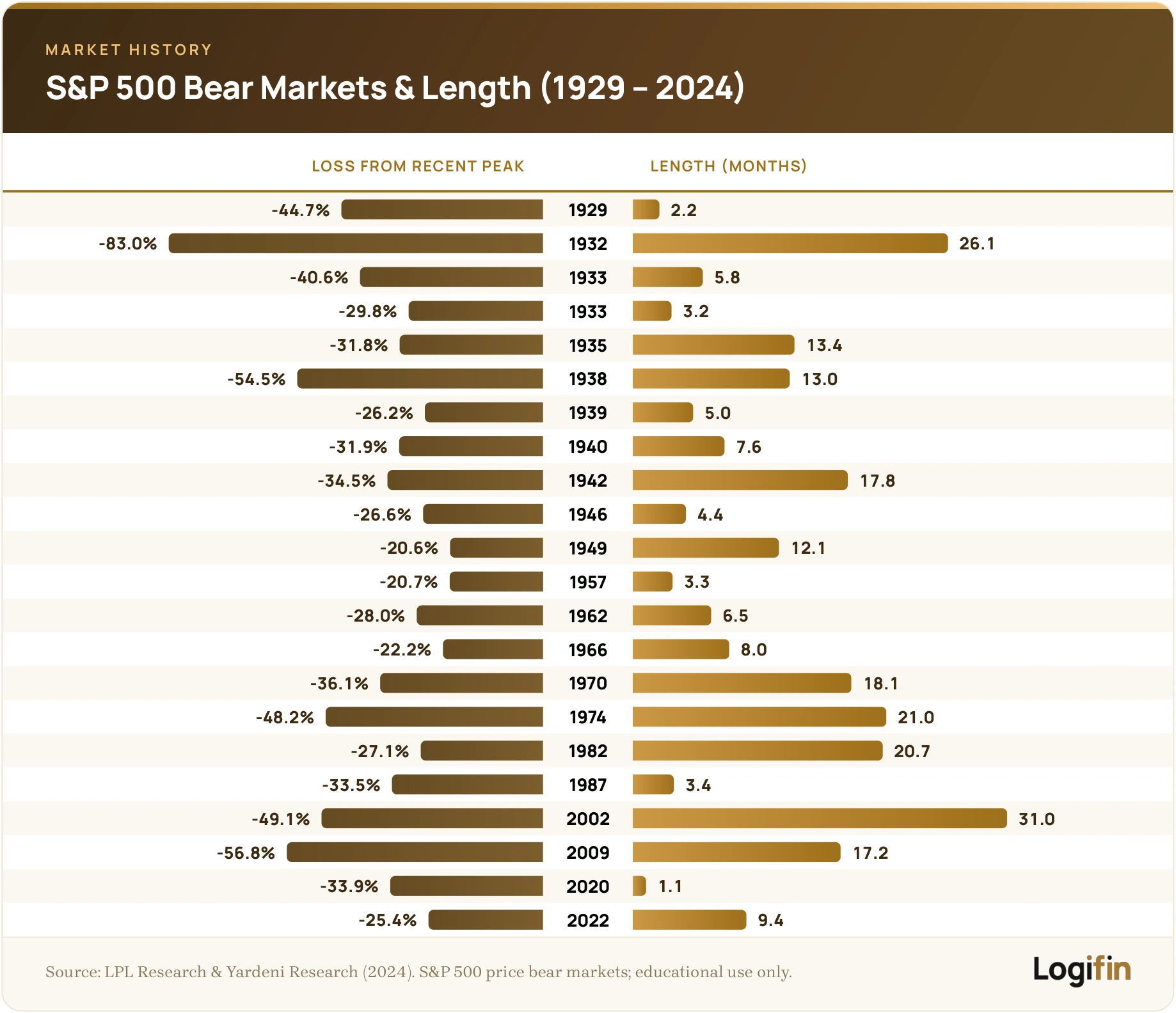
The solution is becoming familiar with fluctuations and adopting a long-term horizon, which reduce the impact of short-term moves.
🔶 Emotional decisions
Markets are not only numbers. They are also psychology.
The biggest risks often lie not in the market, but within us.
- The fear that “you will lose your money”
- Greed when you see something rising quickly
- FOMO (Fear Of Missing Out) when “everyone is getting in”
- Panic when you see red numbers in your portfolio
These impulses often lead to buying at the top and selling at the bottom, that is, the opposite of what you want to achieve.
🔶 Lack of strategy or knowledge
“Investing without knowing” can offer a momentary thrill, but it often leads to disappointment.
Example: If you believe your ETF is global but it actually has 70% exposure to the US, then you have taken on a risk you had not realised.
Information, self-awareness and a clear strategy act as a steady antidote to fear and uncertainty.
🔶 The possibility of capital loss
Yes, you can lose money. That is part of the game. The risk increases when you:
- invest in individual stocks without diversification
- get carried away by trends or hype
- liquidate in a downturn out of panic
- have a short-term horizon and little tolerance for fluctuations
This risk does not turn the stock market into gambling.
It does, however, highlight the importance of long-term planning, diversification and composure.
🔶 Economic and geopolitical events you do not control
Interest rates, inflation, armed conflicts, political developments and changes in monetary policy can affect markets abruptly.
No one can predict or control them.
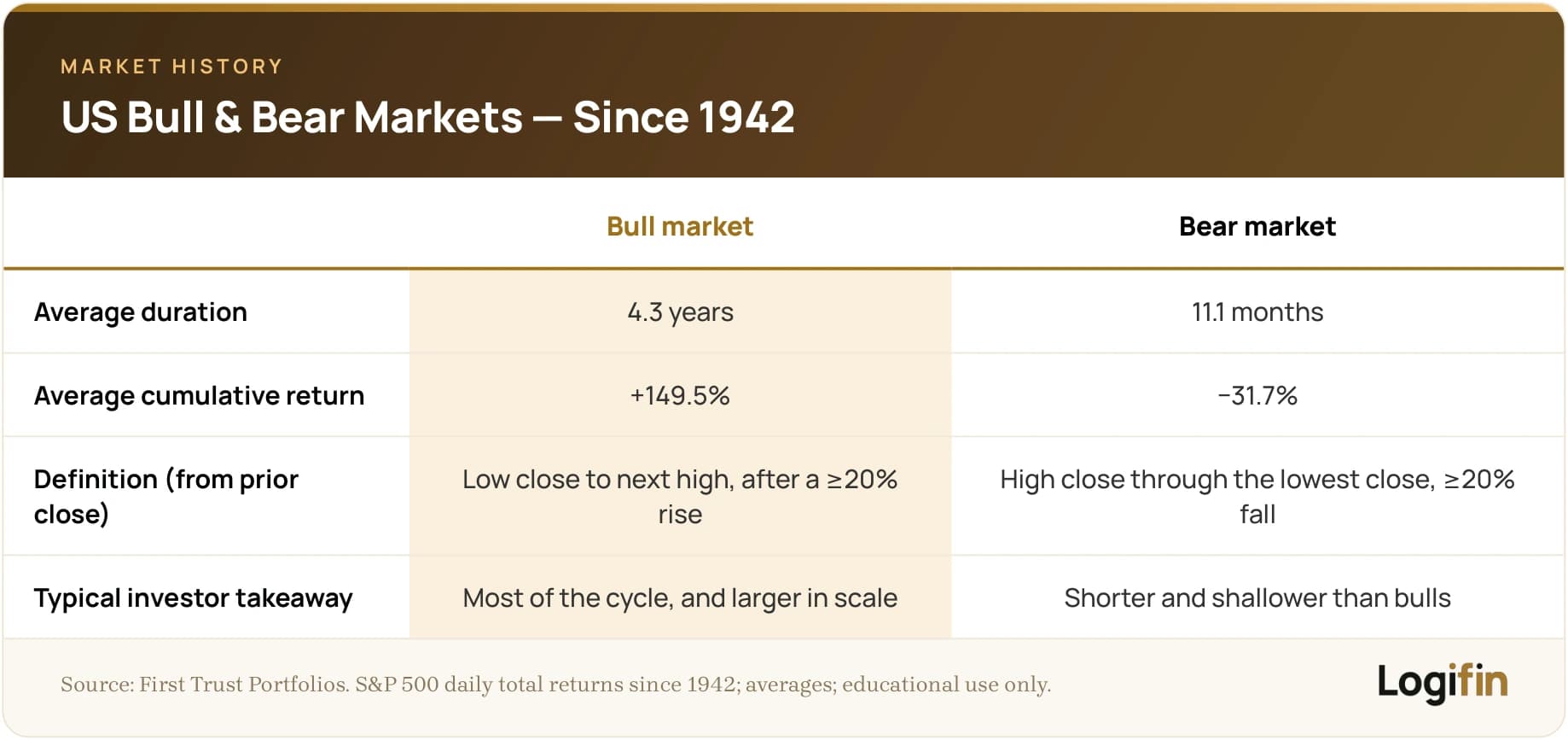
What you can control is the resilience of your portfolio, so that it withstands cycles of rise and fall.
A well-structured portfolio not only protects against risks: it lets you sleep better.
How to start investing in practice — Step by step
By now you have understood what the stock market is, what a share means, the difference between investing and speculation, the benefits and also the risks.
Now comes the key question: “How do I start?”
The answer is simpler than you think. You do not need large capital or special knowledge. What you need is structure, a goal and consistency.
1. Define your goal
Every investment decision starts from a clear “why”. The goal is the compass that sets your course and helps you interpret market fluctuations correctly.
What do you want to achieve?
- Build capital for the future?
- Financially secure your children?
- Create income for retirement?
- Protect your savings from inflation?
If you do not know what you are trying to achieve, you cannot know whether you achieved it.
A clear goal keeps you focused and reduces the chance of being swept along by short-term noise.
2. Define your investor profile
Your profile is the combination of your psychology, your financial situation and your time horizon.
It determines what you will invest in, at what pace and for how long.
Ask yourself:
- How much risk can I really tolerate?
- In how many years will I need this money?
- Can I follow the market, or do I want something more “automatic”?
- How will I invest: a lump sum or gradually with DCA?
The better you know your profile, the easier it becomes to choose the right tools, the right ETFs and the strategy that helps you stay consistent.
3. Choose a tool/platform
To start investing, you need an online broker, that is, a platform through which you can buy and sell shares or ETFs.
The good news is that today an investor in Europe has access to quality and accessible options, even without large initial capital.
Not all platforms are the same: they differ in cost, usability, currencies, product options and support.
Let us look at the best-known names in the European market:
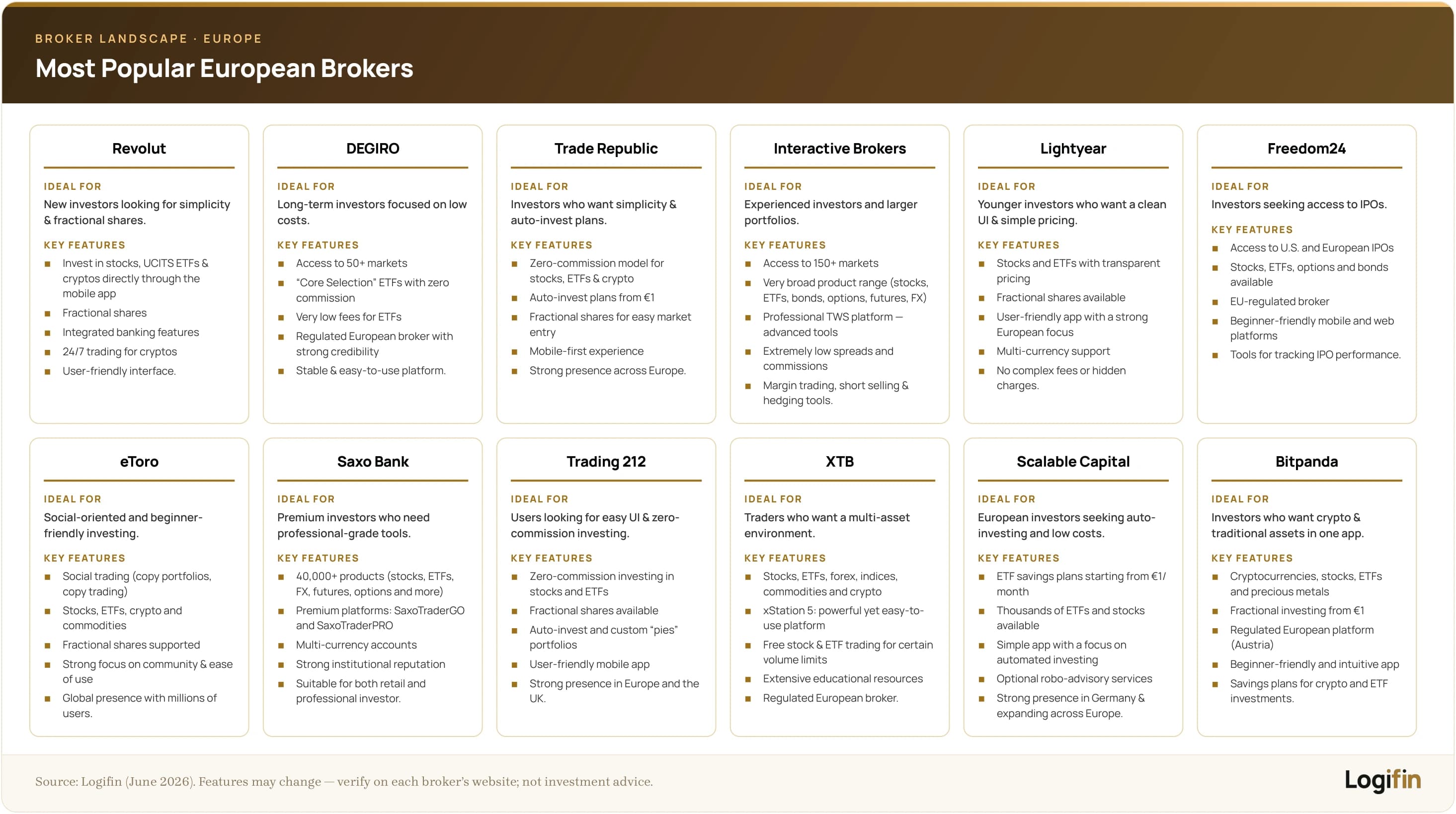
What to watch for:
- Prefer platforms with UCITS ETFs in EUR
- If you do DCA, check whether they support savings plans / auto-invest
- If you are starting out, do not choose a platform with a complex UI
- If you have more than 10,000 €, look at the custody terms and inactive-account fees
4. Start with something simple
One of the most common mistakes of new investors is trying to do everything from day one.
You do not need to start with ten stocks, five ETFs and complex allocations. Simplicity is an advantage, not a weakness.
You can start with even a single ETF that tracks a broad and diversified index, such as:
- MSCI World for global diversification across developed markets
- S&P 500 for pure exposure to the US
- An MSCI ACWI ETF for the whole world in one product
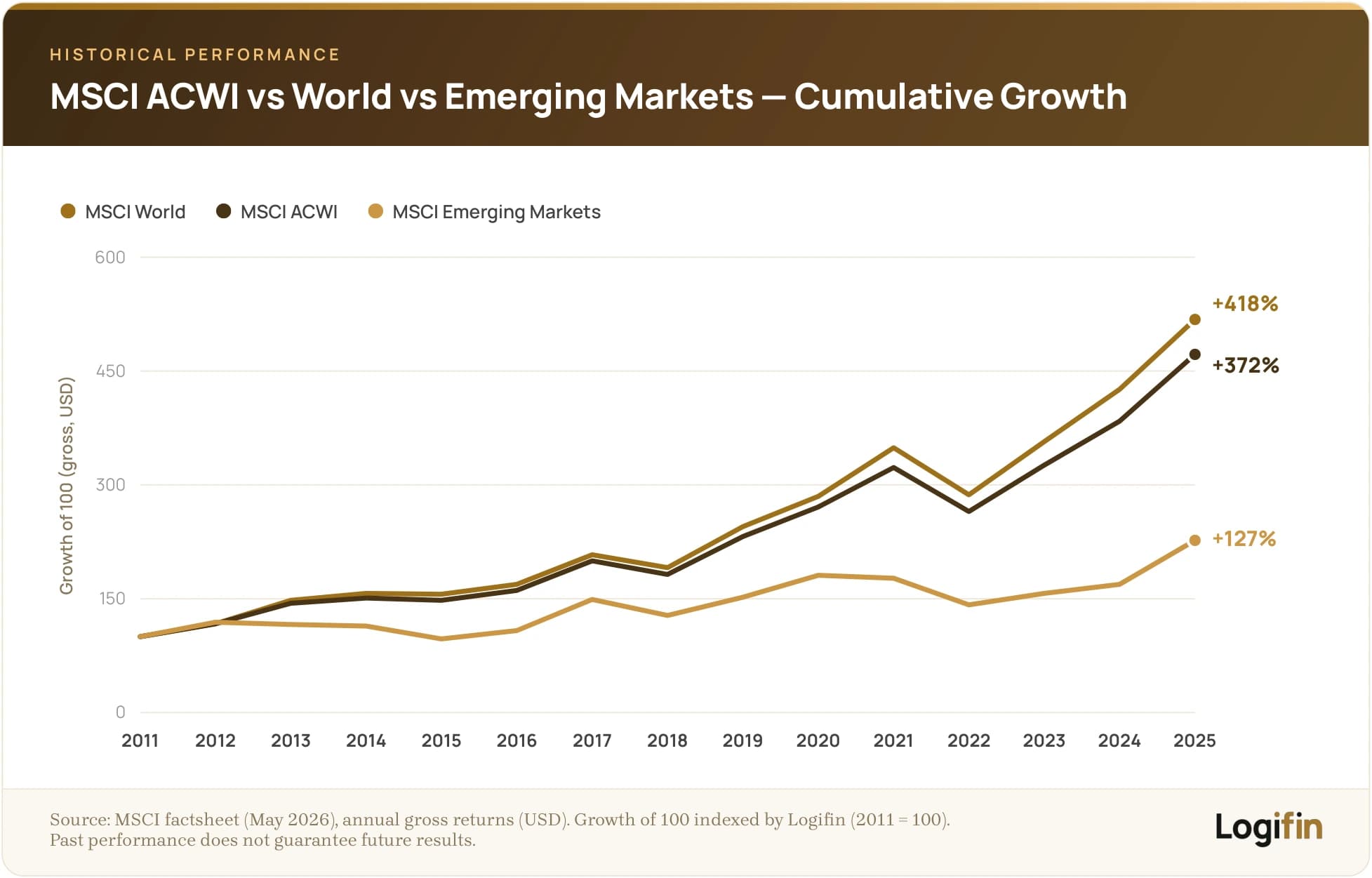
These options give you immediate diversification, low cost and a clear strategy without unnecessary decisions.
Most importantly, you do not need large capital to start.
Even with 50–100 € per month, you can apply DCA and begin building your portfolio with steadiness and discipline.

5. Set rules and stay consistent
The hardest part of investing is not starting. It is consistency over time.
Returns do not come from “clever moves”, but from following your plan even when the market tests your psychology.
Keep a few simple rules:
- Do not chase “opportunities” every month. Most turn out to be noise.
- Do not sell because you see a 10% drop. Corrections are a normal part of the market.
- Do not compare your returns daily. Constant monitoring creates anxiety and bad decisions.
Investments do not pay off every month. They pay off over the course of years.
The more you respect time, the more it works in your favour.
Conclusion and practical takeaways
The stock market is not a mystery, not gambling, not only for “experts”.
It is a way to put your money to work, with risk, yes, but also with enormous potential.
If you have read this far, you have already taken the most important step: understanding.
🔶 What to keep in mind:
- The stock market is a global market of companies. You invest, you do not bet.
- Shares are ownership stakes, which matters. See what a stock is.
- Investing means a long-term goal, not “easy profit”.
- Your profile and your strategy matter more than when you start.
- Returns come with time, not from luck or timing.
- You do not need a lot of money: you need understanding and discipline.
🔶 How do you start?
- Define your goal
- Choose a simple, diversified ETF
- Start with a small amount, even 50 € or 100 € per month
- Do DCA (e.g. a monthly investment)
- Do not obsessively track performance; track your consistency
The content of this article is provided exclusively for informational and educational purposes and does not constitute investment advice or a recommendation to buy or sell financial products. The information is based on publicly available sources considered reliable, without any guarantee of accuracy or completeness. Before making any financial or investment decision, it is recommended that you consult a certified professional advisor or accountant, taking into account your own financial situation and risk profile. The Logifin team bears no responsibility for any direct or indirect damages arising from the application of the information presented.
Related articles

How do economic indicators affect the stock market?
GDP, inflation, unemployment, interest rates: how economic indicators move the stock market and what investors should watch.
15 min read

What is a stock and how does it generate profit?
What owning a share of a company means, how profit comes from capital gains and dividends, what sets the price and what the risks are.
16 min read

What is a market maker and why is it critical to the market?
How a market maker quotes a continuous buy and sell price, how they make money from the spread and why they keep trading liquid and orderly.
12 min read

What is a recession and how it affects investors?
How a recession is defined, what causes one, how the markets usually behave during it and what an investor can do to prepare in advance.
24 min read
EXPLORE LOGIFIN
Everything you need in order to learn, plan and track your investments.
Logifin Blog
Learn everything you need to get your finances in order and invest with confidence.
Logifin Insights
What moves the markets and what it means for a long term investor. Short and without the noise.
Logifin Tools
Free, inside the site, no signup. Everything you calculate stays on your device.
Logifin ETF Hub
Find the ETF that fits you: 550+ UCITS ETFs, smart filters and in-depth comparisons.
Logifin Guides
A series of guides that builds your investment plan step by step. The first guide is free for everyone.
Logifin Circle
The tools and the Hub are free for everyone. You become a member for the intelligence that never stops.