What is a market maker and why is it critical to the market?
How a market maker quotes a continuous buy and sell price, how they make money from the spread and why they keep trading liquid and orderly.
23 August 2025 · 12 min read

What is a market maker?
A Market Maker is a specialised participant in the financial markets with a critical role: they undertake to provide a continuous buy and sell price for a financial product (a stock, ETF, bond, derivative), so that there is always liquidity and the market can function smoothly.
Put simply, they are the “player” who guarantees that, even if you want to sell, there will be someone to buy – and vice versa. This prevents “dead spots” in trading and keeps the market alive.
Example:
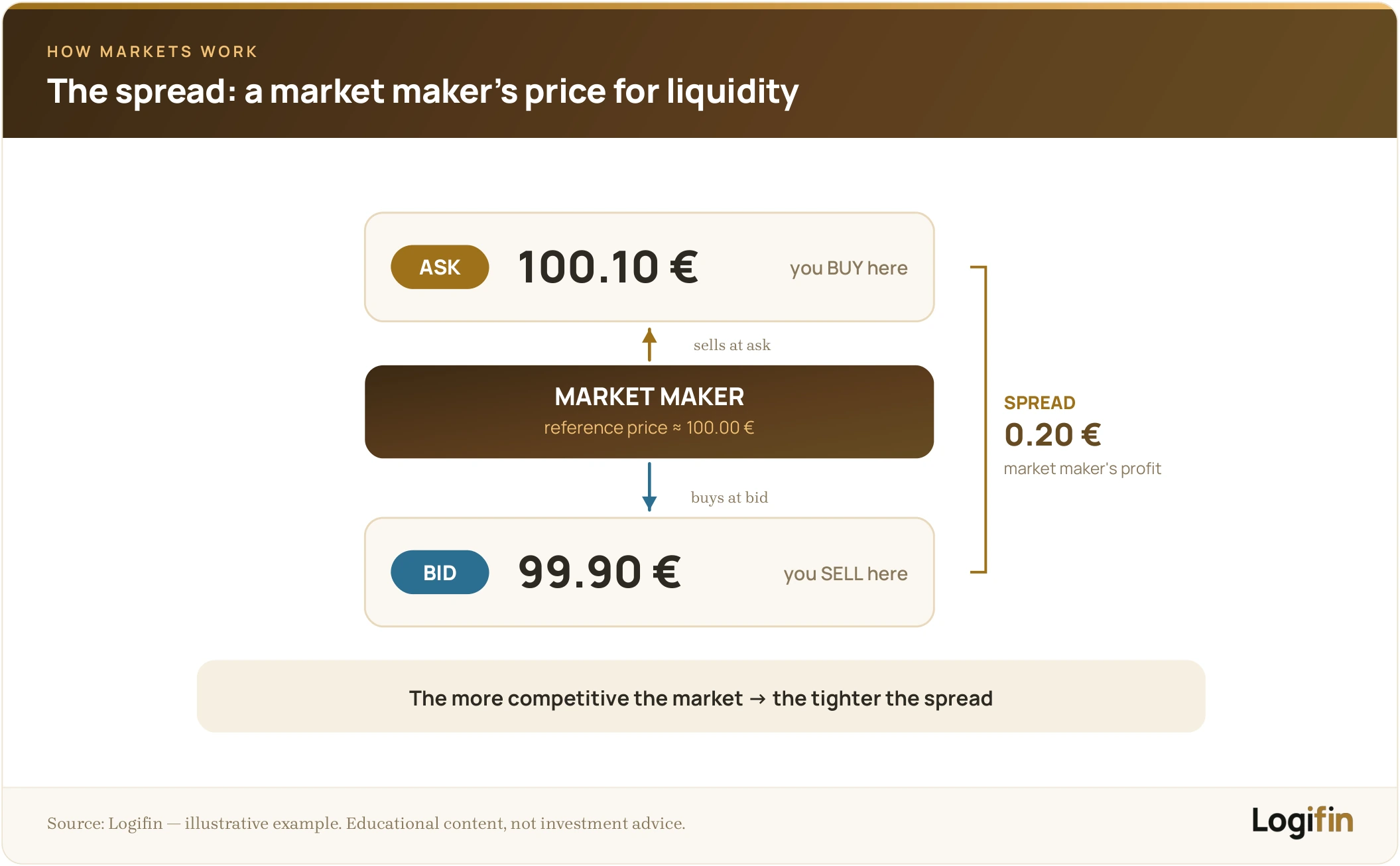
- If a stock trades at 100 €, the market maker may offer to buy it at 99.90 € and sell it at 100.10 €.
- This difference is called the spread and is their main profit for the liquidity service they provide.
- The more competitive the market, the smaller the spread.
🔶 Why does this role exist?
- To ensure there are no “gaps” in the market and that the investor can always find a counterparty.
- To reduce volatility, as the market maker absorbs short-term supply–demand imbalances.
- So that even large institutional investors can execute high-volume orders without “blowing up” the price.
- To increase market efficiency, allowing fairer and faster price formation.
Without market makers, retail investors would struggle to buy or sell quickly at fair prices, while the market would be far more unstable.
ETFs, for example, rely heavily on the action of market makers to stay close to their net asset value (NAV).
How does a market maker work in practice?
The role of the Market Maker is to keep the market alive by continuously offering buy (bid) and sell (ask) prices.
This creates a mechanism that ensures any investor who wants to buy or sell can do so immediately and without significant delay.
In short, the market maker is the “bridge” that keeps the market’s liquidity stable.
🔶 The operating mechanism
The market maker’s operation is based on three core concepts:
- Bid Price
This is the price at which the market maker declares itself willing to buy a stock or other product. If an investor wants to sell immediately, this is the price they will receive.
- Ask Price
This is the price at which the market maker is willing to sell the same product. If someone wants to buy immediately, this is the price they will pay.
- Spread
- The spread is the difference between the buy price (bid) and the sell price (ask).
- It is the market maker’s main profit margin and compensates for the risk they take by maintaining a constant presence in the market.
- In highly liquid markets the spread is small, while in less liquid markets it tends to widen.
Example:
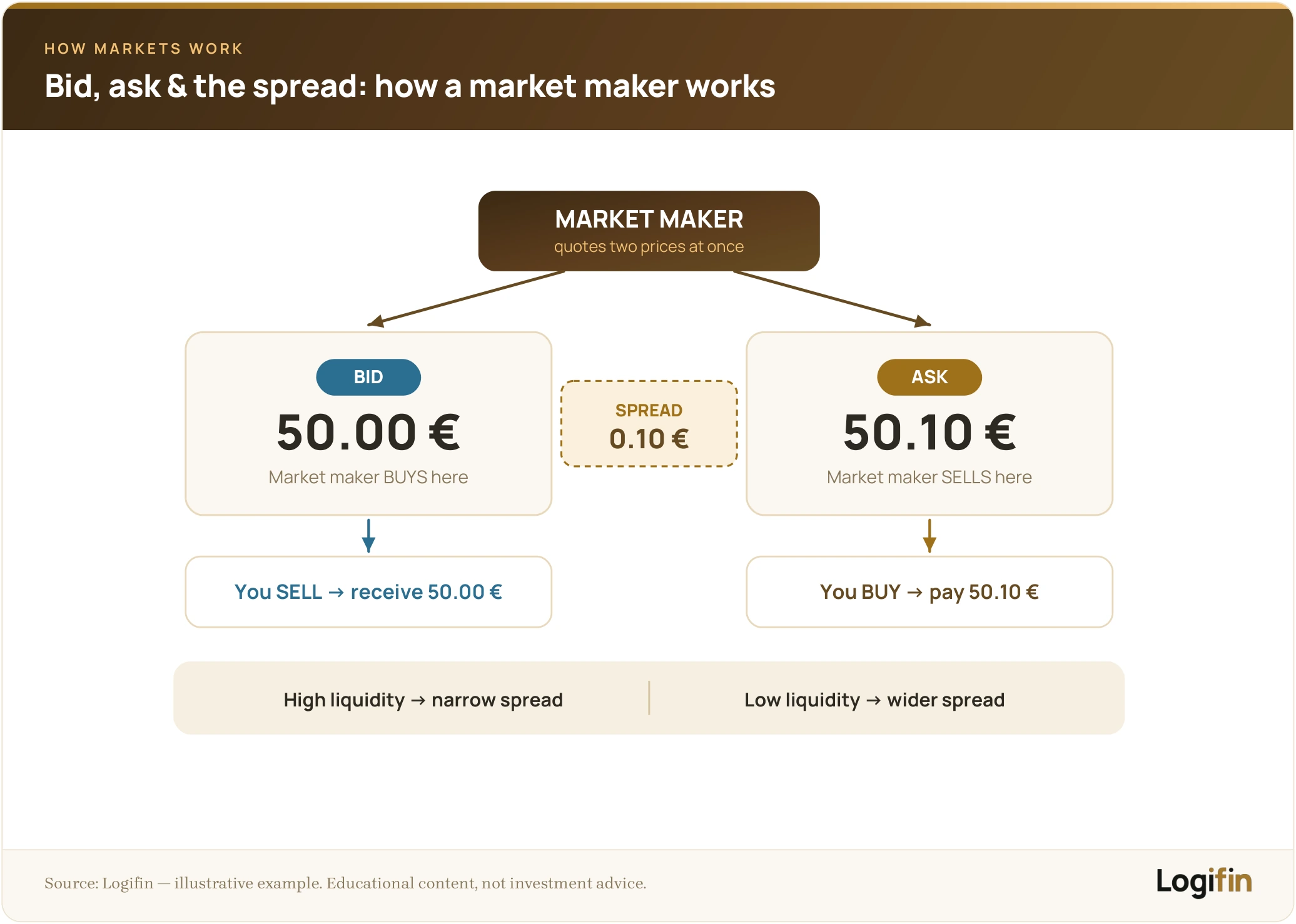
- If for an ETF the market maker quotes a bid of 50 € and an ask of 50.10 €, then the spread is 0.10 €.
- Whoever buys pays 50.10 €, whoever sells receives 50 €.
- The market maker earns the difference, while the investor has the certainty that their transaction will be executed immediately.
🔶 Continuous price flow
Market Makers are obliged, under the rules of the exchanges, to provide prices throughout the entire trading session.
This means that even in periods of low interest or uncertainty, there is always someone “on the other side” of the transaction.
In this way, liquidity gaps are reduced and the extreme price swings that could harm small investors are avoided.
🔶 Supporting large volumes
Institutional investors (e.g. funds, insurance funds) often need to buy or sell huge volumes of stocks or ETFs.
Without market makers, such a large order would violently push the market price up or down.
Market makers “absorb” this volume, providing liquidity and stability so that prices form smoothly.
🔶 Support for ETFs
ETFs rely heavily on market makers. Without them, trading ETFs would be difficult and costly, especially for more specialised or less popular ETFs.
Thanks to their action, even ETFs with limited demand can have liquidity and tight spreads, keeping their price close to NAV (Net Asset Value).
In many cases, market makers are not “a single person”, but large financial firms and banks that operate with sophisticated algorithmic trading systems.
This allows them to quote prices on thousands of products simultaneously, ensuring liquidity across the entire financial ecosystem.
How do market makers make money?
Market Makers do not provide liquidity “for free”. Their role is professional and is based on specific profit mechanisms.
As they execute hundreds of thousands of transactions per day, even small spreads or fees translate into significant amounts.
In reality, their business model rests on frequency and volume, not on a large profit margin on each individual transaction.
1. Spread (Bid–Ask)
The primary revenue comes from the difference between the buy price (bid) and the sell price (ask).
- If they buy a stock at 99.90 € and sell it at 100.10 €, they earn 0.20 € per share.
- Across a huge volume of transactions, this small margin becomes a large profit.
Example: If a market maker moves 1 million shares with a spread of just 0.05 €, the net revenue is 50,000 € from this market alone.
2. Technology & Algorithmic Trading
The large market makers (e.g. Citadel Securities, Virtu Financial) use sophisticated algorithmic trading systems that “scan” the markets and see thousands of prices in seconds.
This allows them to exploit tiny price differences that exist only for fractions of a second.
Essentially, competition no longer happens with “shouts on the trading floor”, but with supercomputers that execute millions of trades in milliseconds.
Today’s market makers are essentially highly specialised technology companies, where speed and data matter more than human instinct.
3. Arbitrage Opportunities
Beyond the spread, market makers often use the technique of arbitrage – that is, the simultaneous buying and selling of the same security in different markets or forms.
Example:
- If an ETF trades on the exchange at 100 €, while its net asset value (NAV) is 100.20 €, the market maker can buy the ETF and sell the underlying assets, earning the difference.
- In this way, beyond profit, they also help keep the ETF’s price close to NAV.
4. Agreements with Exchanges & Providers
Many exchanges offer incentives (rebates) to market makers to secure liquidity on their platform.
This means that beyond the spread, market makers may also earn extra revenue every time they “fill” the order book with buy and sell offers.
Thus, the interests of the exchanges and the market makers are often aligned: more liquidity → more activity → more revenue for both sides.
5. Statistical risk management
Market makers base their profitability on a statistical edge. Because they execute thousands of transactions per day:
- They may lose on some individual positions.
- However, the systematic exploitation of spreads and arbitrage allows them to have a positive result overall.
In other words, they do not bet on one big speculative trade; they “play” the law of probabilities across huge volumes.
Advantages of the market maker system
Market Makers are an integral part of the modern capital market.
Although they often remain “invisible” to the general public, their contribution is critical to the smooth functioning of the markets.
Without them, the market would be more expensive, slower and clearly more unstable.
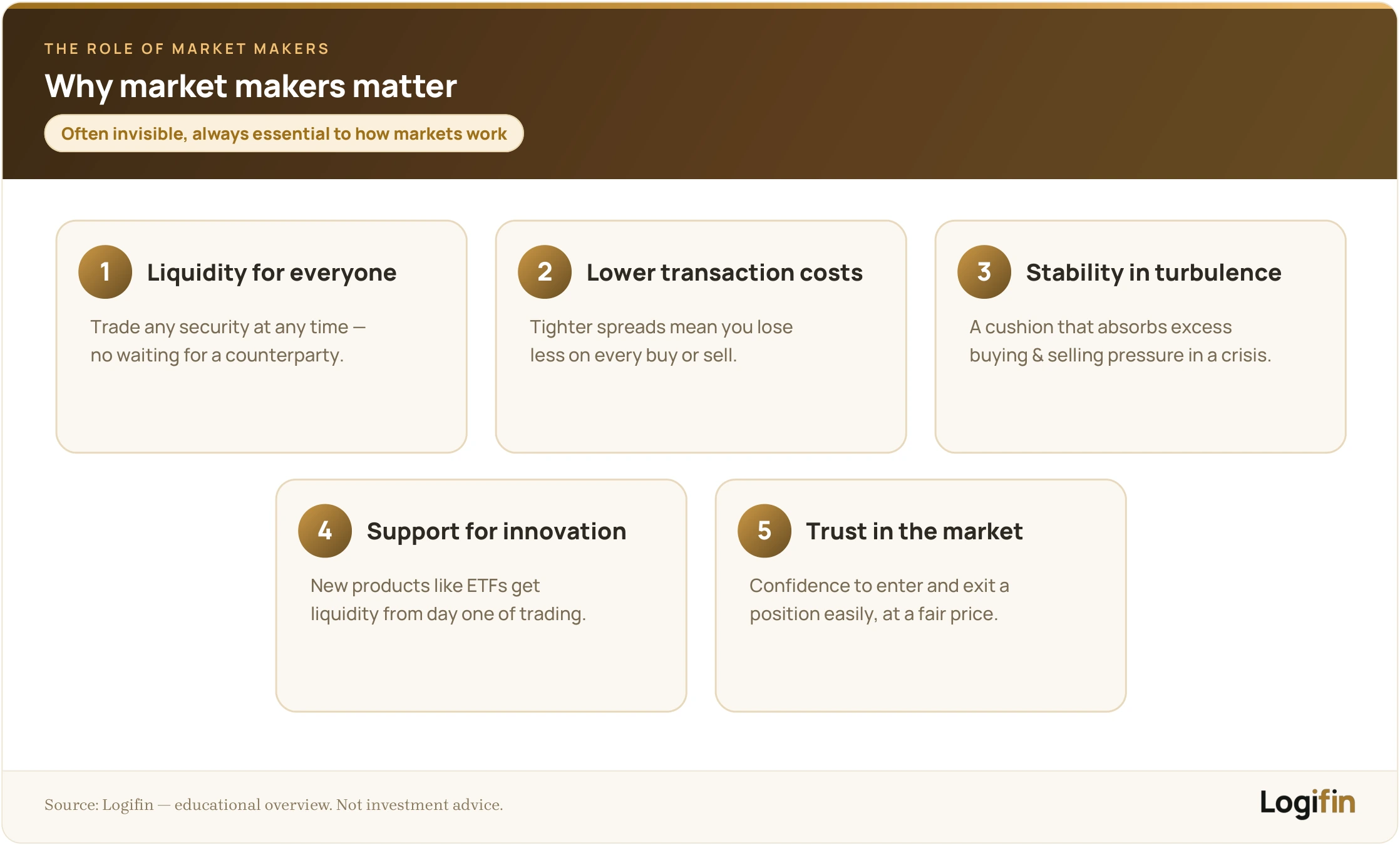
🔶 Liquidity for everyone
Thanks to market makers, investors (institutional and retail) can buy or sell securities at any time, without waiting for a counterparty to be found.
Example:
- A small-market ETF could have had zero demand without market makers.
- With their presence, it remains tradable with a tight spread, ensuring access even to more “specialised” markets.
🔶 Lower transaction costs
By keeping spreads tight, market makers indirectly reduce the cost for the investor.
The smaller the spread, the less you “lose” on each buy or sell.
In highly liquid stocks such as Apple or Microsoft, spreads, thanks to the action of market makers, are often just 0.01 $, making transactions almost “instant and free of charge”.
🔶 Stability and absorption of volatility
- In times of crisis, market makers act as a “cushion”, absorbing the excessive pressure of buying and selling.
- They do not eliminate volatility, but they help prevent the market from completely derailing.
🔶 Support for institutions and innovation
Market makers enable the development of new products such as ETFs and structured products, ensuring they have liquidity from the first day of trading.
- They make markets more attractive for institutional and retail investors, since they know they can liquidate immediately.
- Without them, many new products would remain “frozen” in the market, without interest or trading volume.
🔶 Strengthening trust in the market
- The existence of market makers reduces the risk of being “trapped” in a security without liquidity.
- Thus, investors have greater confidence that they can enter and exit a position easily and at a fair price.
- This element is fundamental to the development of capital markets and the attraction of new capital.
Risks and criticisms surrounding market makers
Despite their significant contribution, Market Makers are not free of criticism.
Because they sit at the “centre” of the market and have access to huge volumes of data and capital, questions are often raised about transparency, fair treatment and the potential distortions they cause in how the markets function.
🔶 Conflict of interest
Market Makers execute transactions on behalf of others, but also for their own benefit.
This dual role creates the risk that they prioritise their own profit at the expense of investors.
Example: If they detect a sudden increase in demand for a stock, they may temporarily widen the spread, increasing the transaction cost for investors and maximising their own profit.
🔶 Involvement in Flash Crashes
The algorithmic nature of market makers means they react in milliseconds.
This makes them prone to accelerating violent market moves when they massively withdraw liquidity.
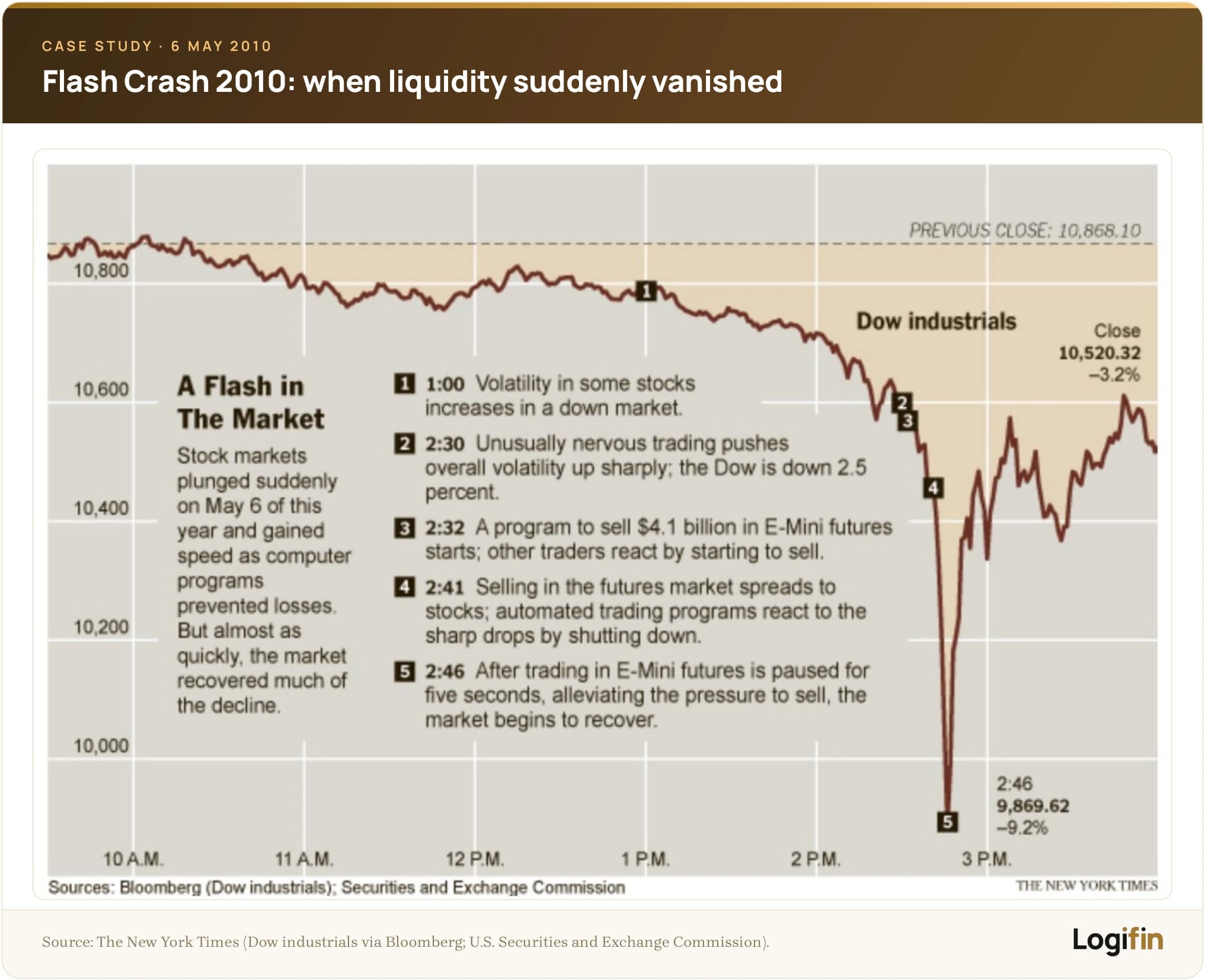
Example: In the “Flash Crash” of May 2010, the Dow Jones lost about 1,000 points within minutes. The trigger was a large automated sell order; however, one of the main accelerators was considered to be the withdrawal of liquidity by market makers relying on automated algorithms, which “froze” in the face of the extreme volatility.
🔶 Lack of transparency
- Many market makers are large financial institutions with complex trading desks.
- The opacity of their practices makes it difficult to verify whether their decisions always serve the common interest of the market.
- For this reason, regulators such as the SEC and ESMA impose strict rules on how and how tightly spreads must be maintained, in order to limit abusive practices.
🔶 Concentration of power
- The market-making business is largely controlled by a few firms, such as Citadel Securities and Virtu Financial.
- This concentration of power raises concerns about excessive influence on price formation and potential manipulation.
- The fewer the players, the more fragile the market can become if one of them runs into trouble.
🔶 Systemic risk
Because Market Makers are so “embedded” in how the markets function, a failure on their part could cause a wider systemic shock.
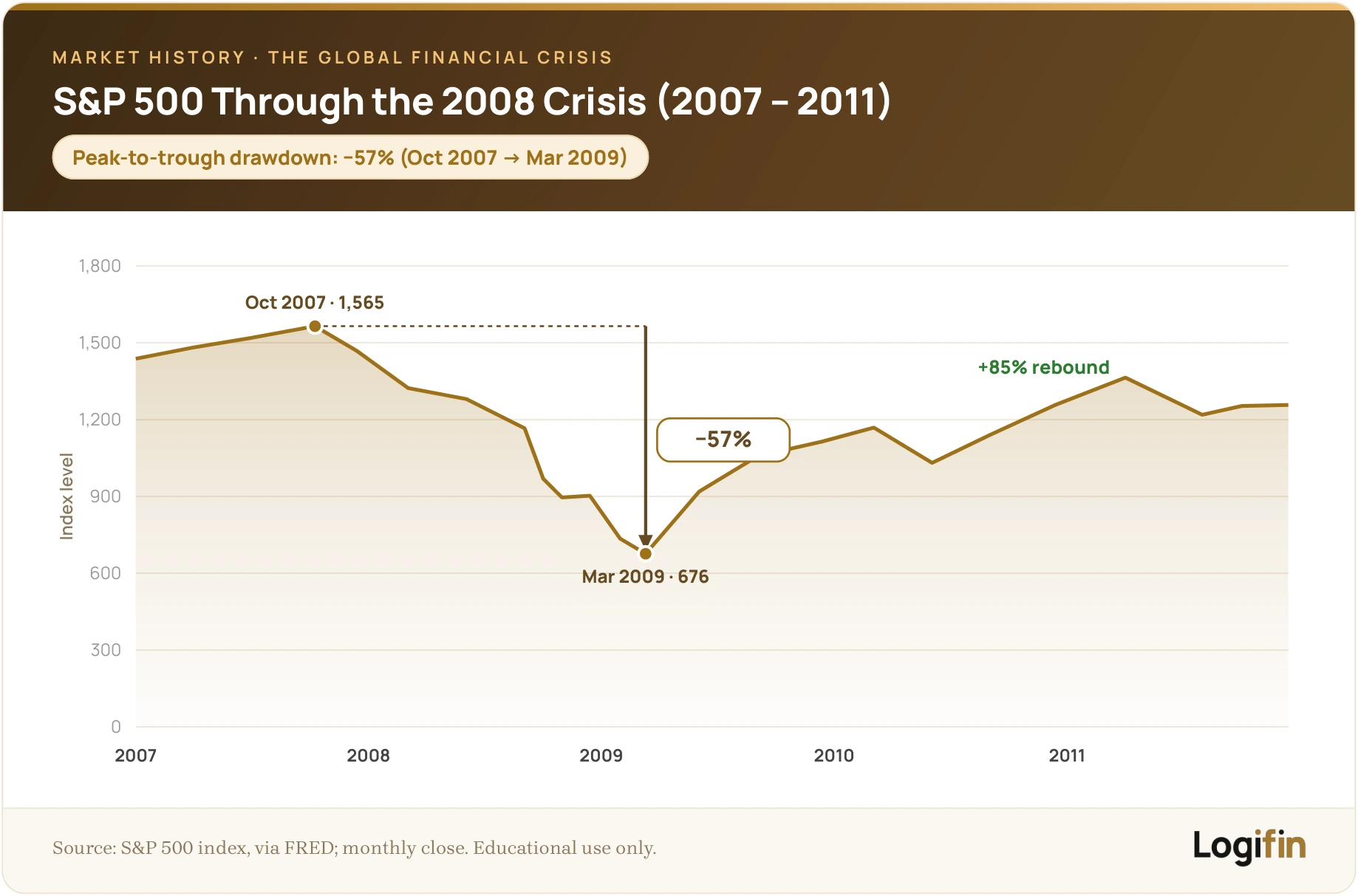
Example: The 2008 crisis showed how dangerous the financial system can become when intermediaries are unable to meet their obligations. Similarly, the failure of a large market maker could create a liquidity domino across many markets at once.
Conclusion and practical takeaways
Market Makers are among the most “quiet” but also most critical players in the markets.
Without them, liquidity would be lower, transactions more expensive and volatility more intense.
At the same time, however, the power and complexity of their operation also create reasonable concerns around transparency and excessive concentration of power.
🔑 What to keep in mind
- Market Makers provide continuous liquidity and help keep spreads tight.
- They ensure that investors, from the small retail investor to the largest institutional one, can buy and sell immediately, without delays.
- They earn mainly from spreads and arbitrage, operating across huge volumes of transactions, with profit based on statistical repetition.
- The risks relate to opacity, the concentration of power in a few firms and the potential systemic risk in case of their failure.
Practical Tips
1. Watch the spreads
- When you choose a stock or ETF, look at how tight the bid–ask spread is.
- A tighter spread means lower cost for you, especially if you trade frequently.
2. Prefer securities with active market making
- In less popular securities or low-volume ETFs, the transaction cost can be higher due to wider spreads.
- Active market makers reduce this problem.
3. Understand their role
- Do not see them as “opponents”; they do not directly compete with the investor.
- Their role is to keep the market alive, but always with their own profit in mind.
- Knowing how they work helps you better assess the real cost of your transactions.

The content of this article is provided exclusively for informational and educational purposes and does not constitute investment advice or a recommendation to buy or sell financial products. The information is based on publicly available sources considered reliable, without any guarantee of accuracy or completeness. Before making any financial or investment decision, it is recommended that you consult a certified professional advisor or accountant, taking into account your own financial situation and risk profile. The Logifin team bears no responsibility for any direct or indirect damages arising from the application of the information presented.
Related articles

What is the stock market? The complete beginner's guide
Understand how it works, who participates and why it is a central pillar of the global economy.
20 min read

What are derivatives (futures, options, swaps) and how do they work?
The tools professionals use for hedging, leverage and high-precision strategies
22 min read

What is a money market fund and how does it work?
How a fund that holds short dated, high quality debt securities works, what it returns, what risks it carries and when it belongs in a portfolio.
10 min read

What is a recession and how it affects investors?
How a recession is defined, what causes one, how the markets usually behave during it and what an investor can do to prepare in advance.
24 min read
EXPLORE LOGIFIN
Everything you need in order to learn, plan and track your investments.
Logifin Blog
Learn everything you need to get your finances in order and invest with confidence.
Logifin Insights
What moves the markets and what it means for a long term investor. Short and without the noise.
Logifin Tools
Free, inside the site, no signup. Everything you calculate stays on your device.
Logifin ETF Hub
Find the ETF that fits you: 550+ UCITS ETFs, smart filters and in-depth comparisons.
Logifin Guides
A series of guides that builds your investment plan step by step. The first guide is free for everyone.
Logifin Circle
The tools and the Hub are free for everyone. You become a member for the intelligence that never stops.