Investing in gold through ETCs: The complete guide
When does it make sense to add gold to your portfolio and which ETCs are worth considering?
8 August 2025 · 15 min read

Why does gold remain a “safe haven”?
Gold holds a distinctive place in the investing world because it preserves its value over time, even when everything around it looks unstable. The most practical form of exposure for a European investor is a Gold ETC, an exchange-traded product that tracks the price of gold, without the need for physical possession, storage or insurance of bars.
It does not depend on corporate profits, governments or interest rates; that is why it is considered the "last refuge" in periods of intense uncertainty.
In periods of recession, inflation or geopolitical tension, demand for gold often rises.
Investors treat it as a means of protection against unforeseen events because it cannot go bankrupt, does not "belong" to any country and is not directly affected by the course of an economy.
🔶 Low correlation with equities
- One of gold’s most important advantages is that it does not move in parallel with equity markets.
- When equities correct, gold often acts as a counterweight.
- This reduces the overall volatility of a portfolio.
- It does not mean it always rises, but that it often protects against extreme swings.
🔶 Resilience in periods of high inflation
- When money loses purchasing power, gold often strengthens, because it is considered a real asset with limited supply.
- Its production grows slowly, which makes it a relatively stable "store of value" in periods of monetary easing.
🔶 A stabilising role in the portfolio
Gold’s goal is not to outperform equities. Its role is different:
- to reduce risk,
- to add resilience,
- and to act as a "cushion" in difficult periods.
Although there are periods when gold stays flat or declines, historically it has proven to offer valuable stability when other markets are tested.
How does a gold ETC work: Physical gold or synthetic exposure?
Gold ETCs (Exchange Traded Commodities) let you invest in gold without needing storage, security or physical possession of bars.
Although they seem simple to operate, there are substantial differences between products that hold real gold and those that offer synthetic exposure through derivatives.
Understanding these differences helps the investor choose the right structure for their own strategy.
🔶 What does a physically backed gold ETC mean?
In this type of product, the issuer buys real gold bars and stores them in high-security vaults.
This means that:
- the ETC reflects the spot price of gold with great accuracy
- the structure is simple and transparent
- counterparty risk is limited, since the gold actually exists
- the most reliable issuers even publish the list of bars (serial numbers)
For a European investor, this category is usually the clearest form of exposure to the precious metal.
🔶 What does a synthetic or "swap-based" Gold ETC mean?
In this structure, the issuer does not hold physical bars. Instead, the value of the ETC arises from derivatives such as swaps or futures.
This implies that:
- there is indirect exposure to the price of gold
- a counterparty is involved (e.g. a bank)
- tracking error may arise over short periods
- the structure is more complex and requires a better understanding of the mechanisms
Synthetic ETCs may hold positions in markets where physical possession is difficult or expensive, but they carry increased technical complexity.
🔶 Difference in cost and management
There are specific differences between the two structures:
Physically-backed ETCs
- require storage and insurance of the bars
- therefore have a slightly higher operating cost
- but are considered more transparent and simple for the investor
Synthetic ETCs
- may have a lower TER
- but require technical management of derivatives
- and carry counterparty risk
🔶 What this means in practice for the investor
For the majority of European investors:
- physically-backed Gold ETCs are the most suitable choice when the goal is stability, simplicity and a long-term strategy.
- synthetic Gold ETCs make sense only in more specialised strategies, where a specific type of exposure or hedging is required.
How has gold performed historically and what can an investor expect?
Gold is one of the most misunderstood assets when it comes to performance.
Some consider it "a safe haven that always rises", while others argue that "it gains nothing over the long run".
The truth lies somewhere in between. To understand it properly one needs to see the historical context and gold’s role in the global economy.
Gold does not generate income, nor does it have a growth mechanism. Its value comes from a different characteristic: preserving purchasing power over time.
🔶 Historical behaviour over long periods
If we look back over many decades, we observe that gold:
- has long phases of stagnation,
- experiences sharp rises in periods of inflation or geopolitical tension,
- acts more as protection than as a driving force of returns.
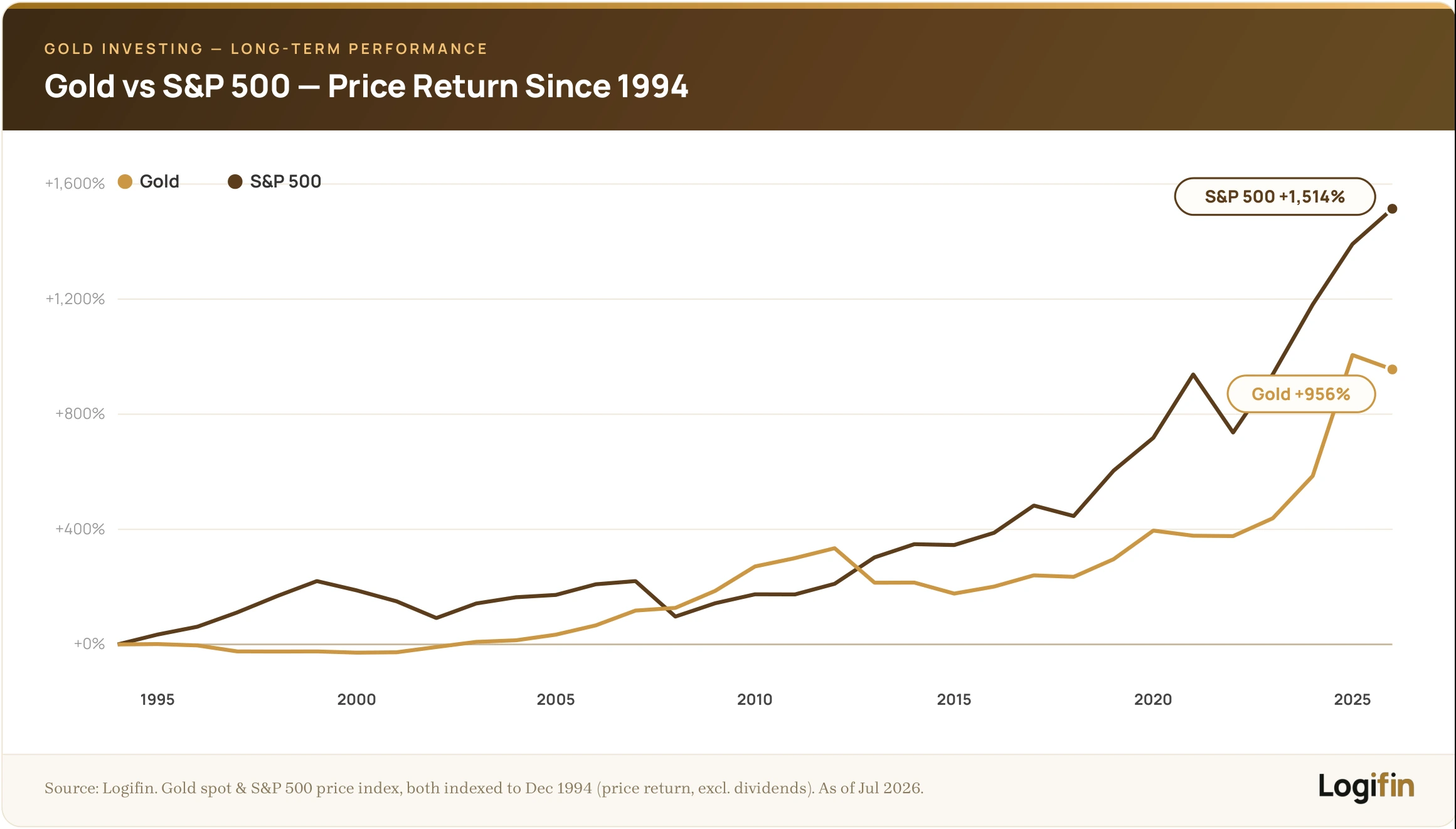
What matters is that gold has the ability to rise when other assets are under pressure, something that does not happen with equities or bonds.
🔶 Gold as a "crisis hedge"
In periods when investment markets faced sharp corrections, gold often moved differently:
- in high-uncertainty environments, demand for gold rises,
- in phases of monetary intervention, many prefer it as a store of value,
- when inflation rises, gold often acts as a hedge.
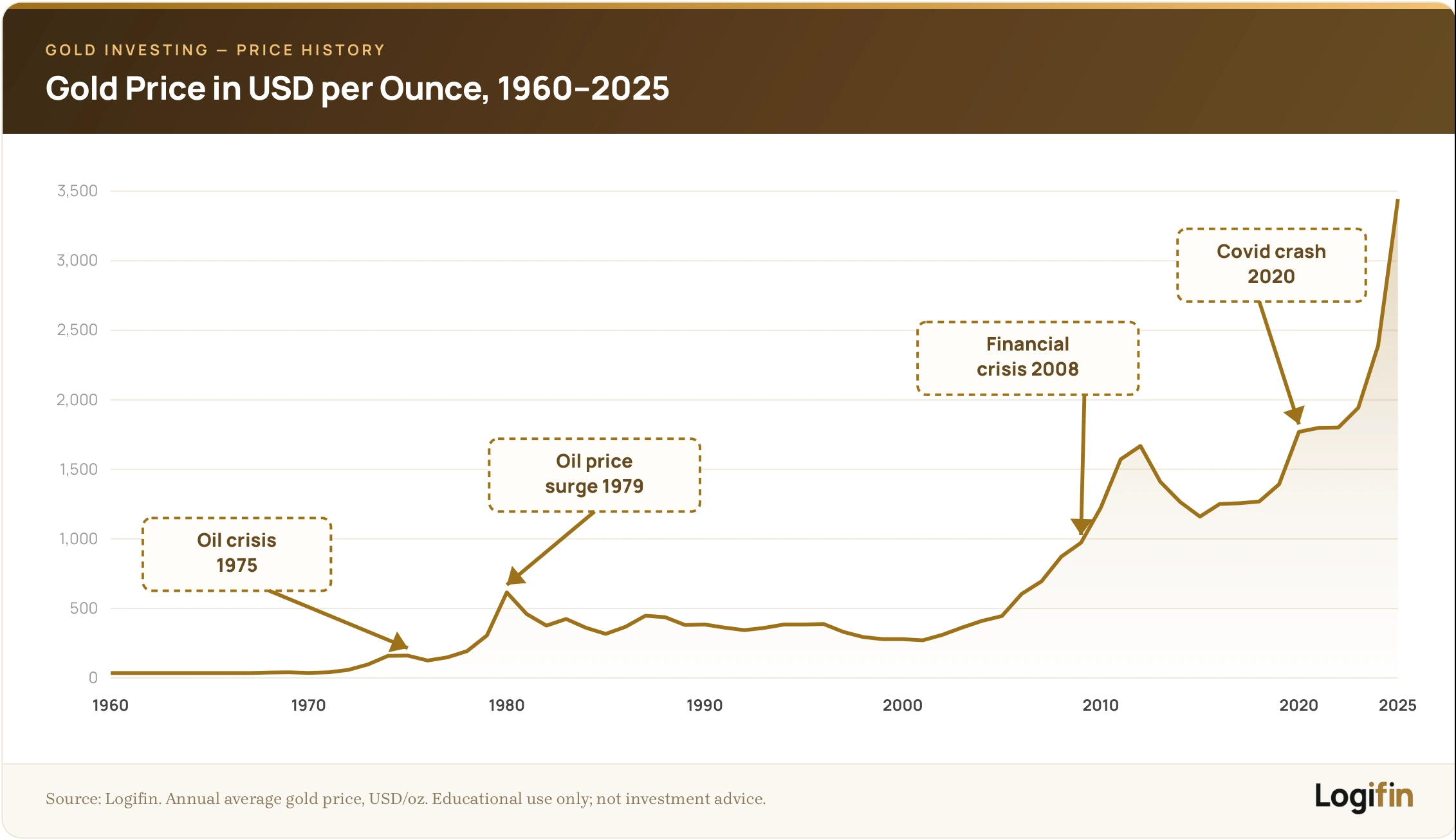
This does not mean that gold "always rises" in crises.
Historical data show that its behaviour depends on the nature of the crisis, monetary policy and international conditions.
Even so, gold’s stabilising power in difficult periods is one of the most consistent findings in economic history.
For context, during 2024–2025 gold moved to historic highs, surpassing $4,000/oz, as central banks increased their purchases and demand for safe havens strengthened.
🔶 What return can an investor expect?
Gold does not have an "expected return" like equities, because it does not produce profits, dividends or interest.
Its future path depends on:
- inflation
- the path of interest rates
- investor psychology
- geopolitical developments
That is why economists often refer to gold as risk insurance, not as a tool for capital growth.
That is how the investor should view it too: as an element that strengthens the portfolio’s resilience.
Which gold ETCs are popular in Europe?
In the European market, most providers offer gold through ETCs (Exchange Traded Commodities): products that trade on the stock exchange and track the price of gold in almost the same way an ETF works, but with a different legal structure.
In practice, many investors perceive ETCs as ETFs because of the same exchange behaviour, high liquidity and low cost.
Even so, it is important to use the correct terminology: in Europe we invest in gold through ETCs, not through ETFs.
Below are the four basic categories of Gold ETCs a European investor encounters, along with a clear description of how they work.
1. Physically Backed Gold ETCs (Allocated)
This is the most common and reliable category in European markets. Typical characteristics:
- The product holds real gold bars in a high-security vault
- The bars are fully allocated to specific investors
- The issuer often publishes a list with the number and weight of the bars
- It closely tracks the spot price of gold
This model offers transparency and simplicity, which is why it is the most popular among European investors.
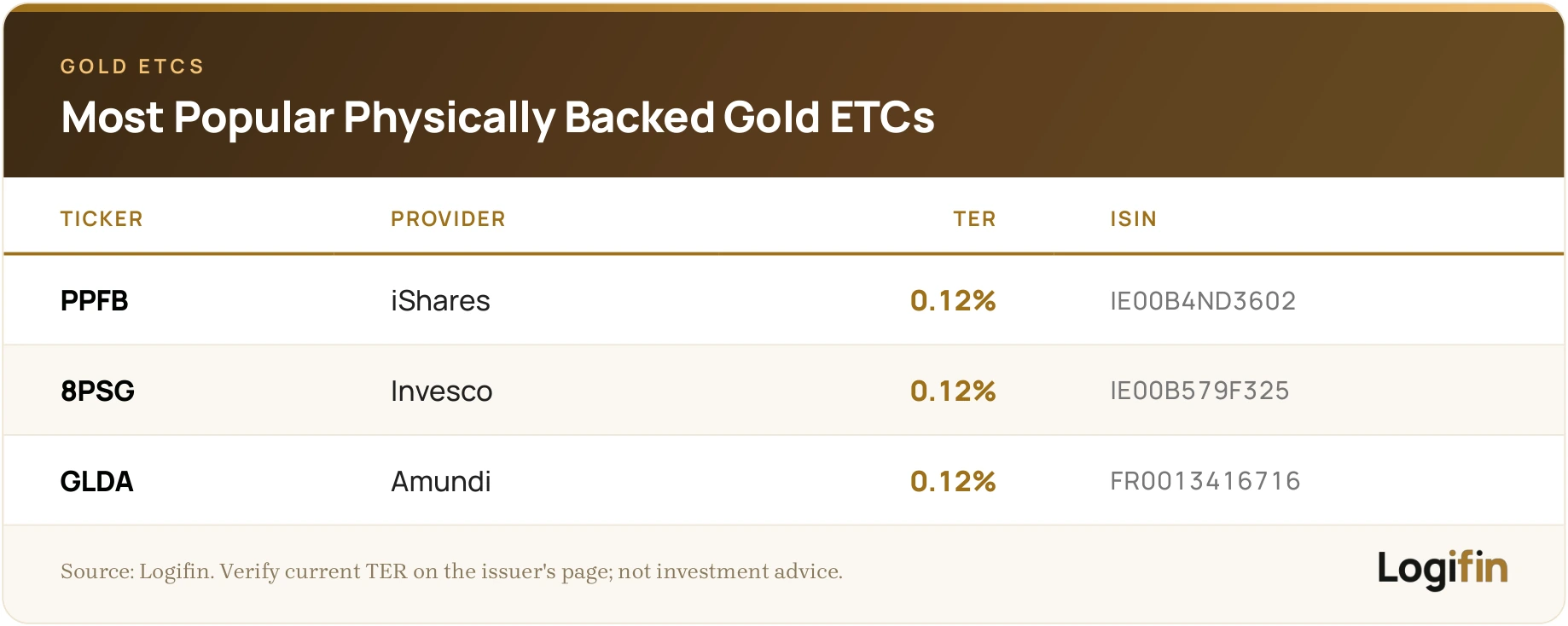
2. EUR-Hedged Physically Backed Gold ETCs
Here we have products that offer physical gold holding, but add an important feature: they hedge the currency risk from the USD/EUR exchange rate.
This helps European investors who want clean exposure to the price of gold without their return being affected by dollar fluctuations.
Typical characteristics:
- ideal in periods of strong EUR/USD volatility
- more stable behaviour in euros
- slightly higher cost due to hedging
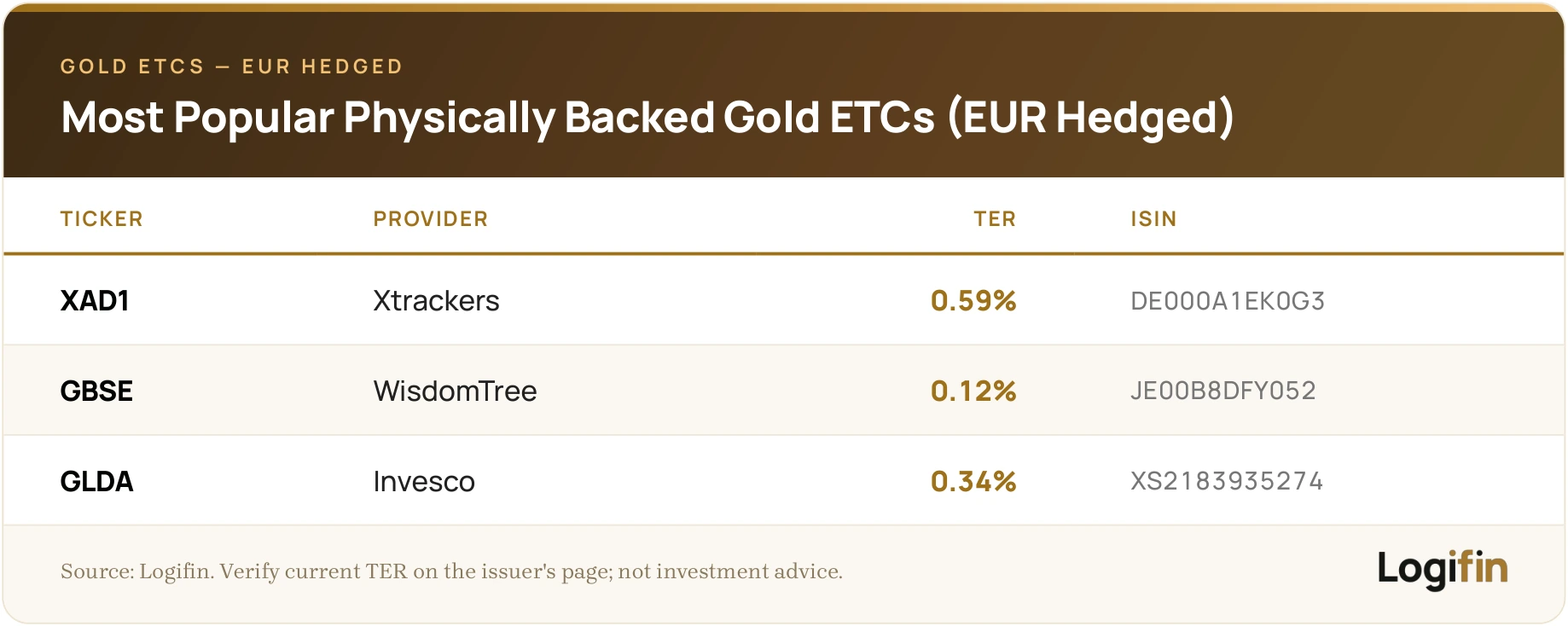
This category is aimed at investors who want "clean" gold in euros, without dollar fluctuations.
3. Synthetic / Swap-Based Gold ETCs
In this category, the product does not hold physical metal but uses derivatives (swaps, futures) to replicate the price of gold.
On a technical level, this category is useful for understanding how the different price-replication mechanisms work, even though it is not the most widespread choice for the average European investor.
Typical characteristics:
- more complex structure than physical ETCs
- counterparty risk is present
- tracking error may appear over short periods
- some have an extremely low TER
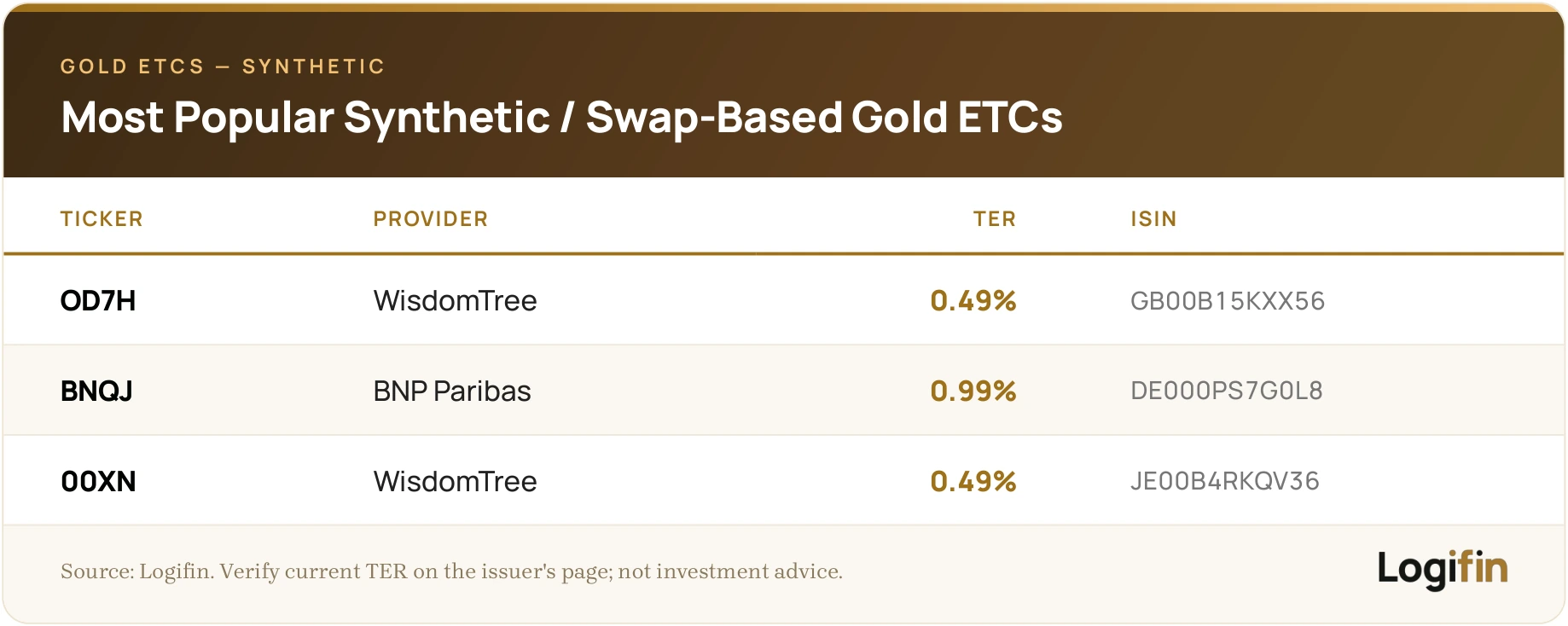
Although less popular, they play a role in the ecosystem and often appear in comparison tables.
4. Gold ETCs with physical delivery (Physical Redemption)
This includes products that, under specific conditions, allow holders to request a physical gold bar by exchanging their exchange-traded units.
They are not often used by retail investors, but are considered a sign of high transparency and reliability of the structure.
Typical characteristics:
- a strong commitment from the provider that the gold actually exists
- a premium option for those interested in real ownership via the exchange
- a minimum number of units is usually required
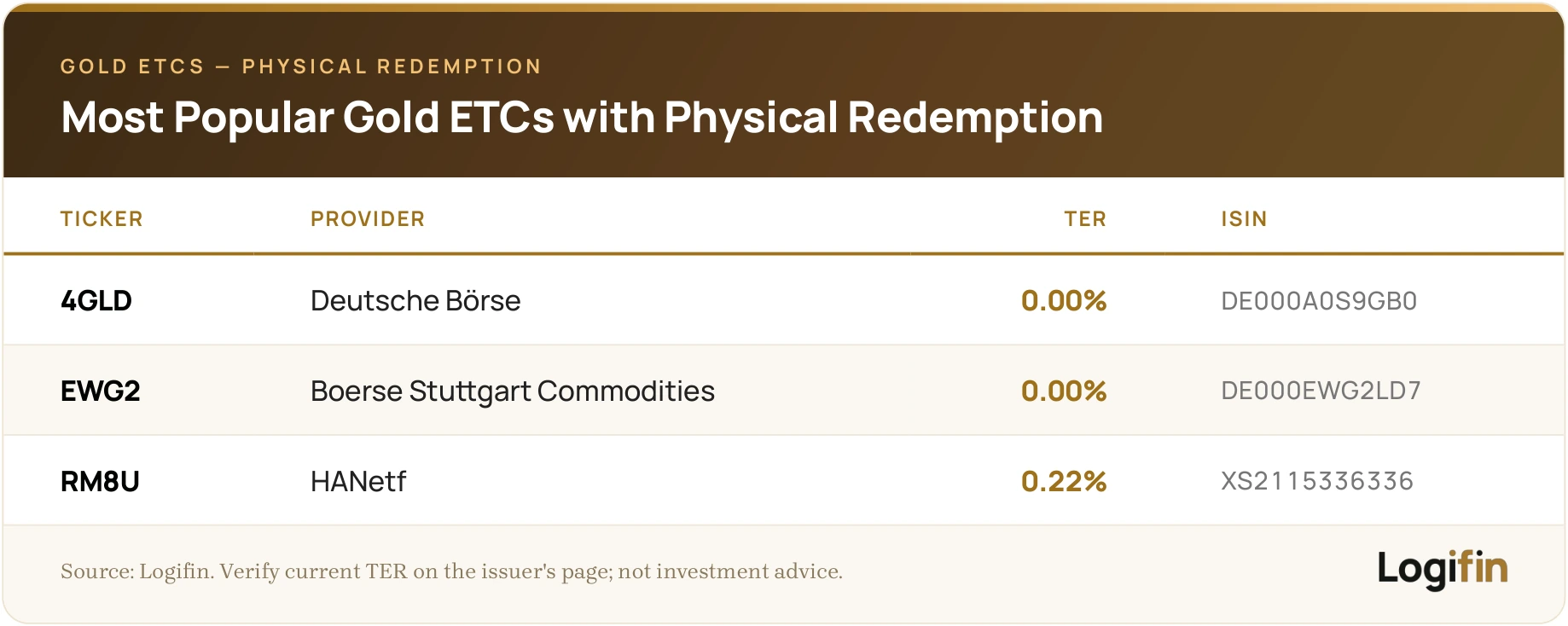
These are products that "bridge" the world of Gold ETFs with the world of physical gold.
Conclusion
The European market offers a wide and comprehensive range of Gold ETCs, from fully physically backed products to more sophisticated synthetic solutions and physical-delivery options.
Which product is suitable does not depend on its name, but on:
- its structure
- its cost
- its liquidity
- the quality of custody
- the type of exposure the investor seeks
The investor’s role is not to "chase the best ETC", but to understand which structure best serves their own strategy and risk tolerance.
What is the right place for gold in a portfolio?
The discussion about how much gold a portfolio "should" hold is one of the most frequent and, at the same time, one of the most misunderstood.
There is no single "magic" answer that fits all investors.
What exists is historical data and academic research showing in which cases gold improves a portfolio’s risk profile and in which it does not.
Gold is not a wealth-creation tool like equities. It is a tool of stability, hedging and risk reduction.
For this reason, its place in the portfolio should be treated as part of the investor’s defensive strategy.
🔶 What historical research shows about the optimal allocation
Studies spanning decades show that adding gold to a portfolio of equities and bonds can:
- reduce overall volatility
- boost returns in periods of crisis
- improve the return-to-risk ratio
Most analyses conclude that a range of 5–10% is enough to offer protection without "weighing down" the portfolio excessively.
🔶 When lower exposure fits (e.g. 0–5%)
This is preferred when the investor:
- has a long-term horizon and can withstand volatility
- wants to maintain greater exposure to equities
- is not as worried about short-term geopolitical swings
- already has other hedging elements (e.g. high-quality bonds)
For investors following strictly equity-focused strategies, gold acts more as an "insurance premium" than as a core part of returns.
🔶 When higher exposure fits (e.g. 10–15%)
It may be considered when the investor:
- wants strong hedging against inflation
- is concerned about macroeconomic uncertainty
- is in a pre-retirement phase and prioritises stability
- has a portfolio that depends heavily on one economy or currency
Higher gold percentages strengthen defence but reduce potential long-term growth, since gold produces no income.
🔶 How much gold does a European investor need?
Gold’s place for European investors also has an additional dimension:
- it provides diversification from the euro,
- it acts as protection against inflation at the EU level,
- it does not depend on ECB interest rates or local economic cycles.
For this reason, many Europeans maintain some exposure to gold, even if their core strategy is based on equities.
Gold ETCs vs physical gold: pros and cons
The choice between Gold ETCs and physical gold is not simply a matter of preference.
It is a decision that affects cost, convenience, liquidity and the way gold "works" within a portfolio.
Both options can have a place for a European investor, but they serve different needs.
Physical gold has historical prestige and tangible value, while Gold ETCs are designed for simplicity, access and accurate tracking of the spot price.
🔶 Advantages of Gold ETCs
- High liquidity
Gold ETCs trade on exchanges like a stock. This means:
- immediate buying and selling
- low spreads
- full transparency in pricing
- Lower cost compared to physical gold
There are no costs for storage, insurance or transport of bars. The only cost is the TER, which is usually low.
- Simple access and easy automation (e.g. DCA)
With a Gold ETC you can:
- buy gradually, even in small amounts
- include the product in a DCA strategy
- manage your position without practical constraints
With physical bars, such a thing is essentially impossible.
- Accurate tracking of the spot price
Most physically backed Gold ETCs accurately reflect the price of gold, without premiums or discounts.
- Zero custody risks on the investor’s side
The issuer takes on:
- custody
- insurance
- audits
The investor does not carry these responsibilities.
🔶 Disadvantages of Gold ETCs
- You do not have gold "in your hands"
Even if the ETC holds physical bars, the investor has no access to them (except for special products with physical redemption).
- Dependence on the issuer (counterparty risk)
The risk is small in physically backed ETCs, but it exists. In synthetic ETCs it is greater.
- TER charge
Even if it is low, there is an annual cost that does not exist with physical holding.
🔶 Advantages of physical gold
- Direct ownership
You have the metal in your hands, without third parties. This is important for investors who want absolute control.
- No annual management cost
No TER charge. You buy once and it remains yours.
- Resilience to extreme events
In hypothetical scenarios of systemic risk, physical gold is considered the ultimate reserve of value.
🔶 Disadvantages of physical gold
- Premiums and spreads at purchase
Bars and coins are sold with a significant markup over the spot price.
- High cost of storage and insurance
Especially if you do not keep it in a bank safe-deposit box. The risk of theft is real.
- Limited liquidity
Selling physical gold is not an immediate process. It requires:
- physical transport
- quality assessment
- procedural costs
- Difficulty automating and buying gradually
You cannot practically build a long-term position with DCA through physical gold.
Conclusion
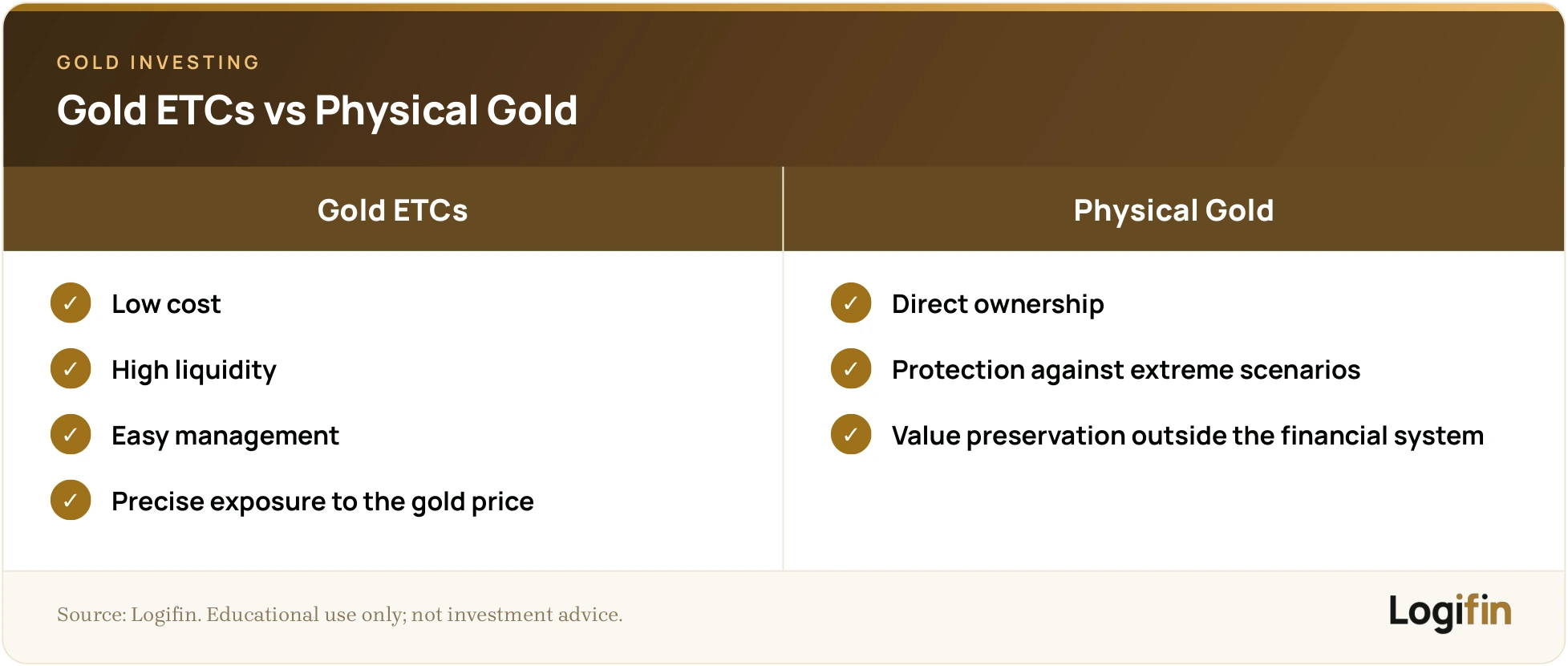
Gold ETCs are ideal for investors who want:
- low cost
- high liquidity
- easy management
- accurate exposure to the price of gold
Physical gold is better suited to investors who prioritise:
- direct ownership
- protection against extreme scenarios
- preserving value outside the financial system.
Conclusion and practical takeaways
Investing in gold through ETCs is not a "trick" or a strategy that promises impressive returns.
It is a way to shield your portfolio, reduce overall risk and protect yourself in periods of economic uncertainty.
Gold does not replace the core investment tools, but it adds balance. Used the right way, it can strengthen a portfolio’s resilience without sacrificing your long-term strategy.
Practical tips for a new investor
1. Do not overestimate gold’s role
Gold is a defensive tool. It does not replace equities, nor is it meant for aggressive growth. For most investors, a range of 5–10% is enough.
2. Prefer physically backed ETCs for simplicity and transparency
For a European investor, products that hold real bars in a vault are usually the cleanest solution.
3. Pay attention to cost (TER)
Management cost reduces returns over the long run. Low-cost ETCs usually offer the best balance of cost and quality.
4. Do not "chase" the short-term price of gold
Gold can have large corrections or stay flat for years. Its value shows mainly in difficult periods.
5. If you want simplicity, think DCA instead of market timing
Buying gradually through a Gold ETC is more practical and predictable than trying to "catch" the right timing.
6. Make sure it fits your overall strategy
Gold should not be an isolated decision. Ask yourself:
- What am I trying to protect?
- Do I already have other defensive elements?
- How much volatility actually bothers me?
7. Avoid physical holding if you cannot manage cost and security
Bars and coins carry premiums, need storage and are not easily liquidated. For most investors, Gold ETCs are a more functional solution.

The content of this article is provided exclusively for informational and educational purposes and does not constitute investment advice or a recommendation to buy or sell financial products. The information is based on publicly available sources considered reliable, without any guarantee of accuracy or completeness. Before making any financial or investment decision, it is recommended that you consult a certified professional advisor or accountant, taking into account your own financial situation and risk profile. The Logifin team bears no responsibility for any direct or indirect damages arising from the application of the information presented.
Related articles

How to build a resilient portfolio
A guide for investors who want to build something stable, simple and rewarding over the long term.
19 min read

What is the right geographical allocation for a European investor?
Europe, USA or global? How to build a balanced portfolio based on geography
18 min read

What is hedging and when do we need it?
What hedging is, which tools investors use for it, what it costs in giving up return and when a private investor genuinely needs it.
17 min read

What is a recession and how it affects investors?
How a recession is defined, what causes one, how the markets usually behave during it and what an investor can do to prepare in advance.
24 min read
EXPLORE LOGIFIN
Everything you need in order to learn, plan and track your investments.
Logifin Blog
Learn everything you need to get your finances in order and invest with confidence.
Logifin Insights
What moves the markets and what it means for a long term investor. Short and without the noise.
Logifin Tools
Free, inside the site, no signup. Everything you calculate stays on your device.
Logifin ETF Hub
Find the ETF that fits you: 550+ UCITS ETFs, smart filters and in-depth comparisons.
Logifin Guides
A series of guides that builds your investment plan step by step. The first guide is free for everyone.
Logifin Circle
The tools and the Hub are free for everyone. You become a member for the intelligence that never stops.