What are thematic ETFs and are they worth having in your portfolio?
From AI and clean energy to biotechnology: investing in trends or a hype trap?
7 August 2025 · 16 min read

What are thematic ETFs and why are they constantly gaining ground?
In recent years, the word “thematic” has swept through the world of investing. And yet, behind the term lies something simple: a Thematic ETF is an exchange-traded product that invests in companies built around a specific macroeconomic, social or technological theme, regardless of sector or country.
In the ETF space in particular, so-called Thematic ETFs have become especially popular, not only because they offer something different from classic indices, but also because they promise exposure to trends that are changing the world.
🔶 The definition in plain words
It does not care where these companies are located, nor whether they belong to the same sector or index. The key criterion is the theme.
Theme examples:
- Artificial Intelligence (AI)
- Clean Energy
- Robotics & Automation
- Cybersecurity
- Population ageing
- Sustainable consumption
- Blockchain & Fintech
- Space & aerospace
Unlike an index such as the S&P 500, which selects companies based on market capitalisation and geography**, Thematic ETFs select companies based on their participation in a structural global trend, regardless of sector or country.**
🔶 Why are they so popular?
There are several reasons for the growing appeal of thematic ETFs:
They give the investor meaning
- Instead of investing abstractly in a broad market, you feel you are backing a sector or a trend that inspires you, from clean energy to cloud computing or artificial intelligence.
- That emotional connection makes the process more interesting and easier to sustain over the long term.
They follow megatrends that shape the future
- Thematic investments focus on long-term changes in the economy and society, such as digitalisation, population ageing, the green transition and AI technologies.
- These are areas with the potential to create new markets and to redefine entire industries.
They attract younger investors
- For Gen Z and Millennials, the “theme” often matters more than whether a company sits in a traditional index.
- The idea that you are investing in something that reflects your values or interests carries significant psychological weight.
They offer the potential to outperform
- If the trend the ETF targets accelerates, returns may significantly exceed the broader market.
- We saw it with AI, cloud software and clean energy plays, where thematic ETFs posted striking gains over short periods.
Example: An ETF such as iShares Global Clean Energy (INRG) invests exclusively in companies active in renewables: solar, wind, energy storage, smart grids, etc.
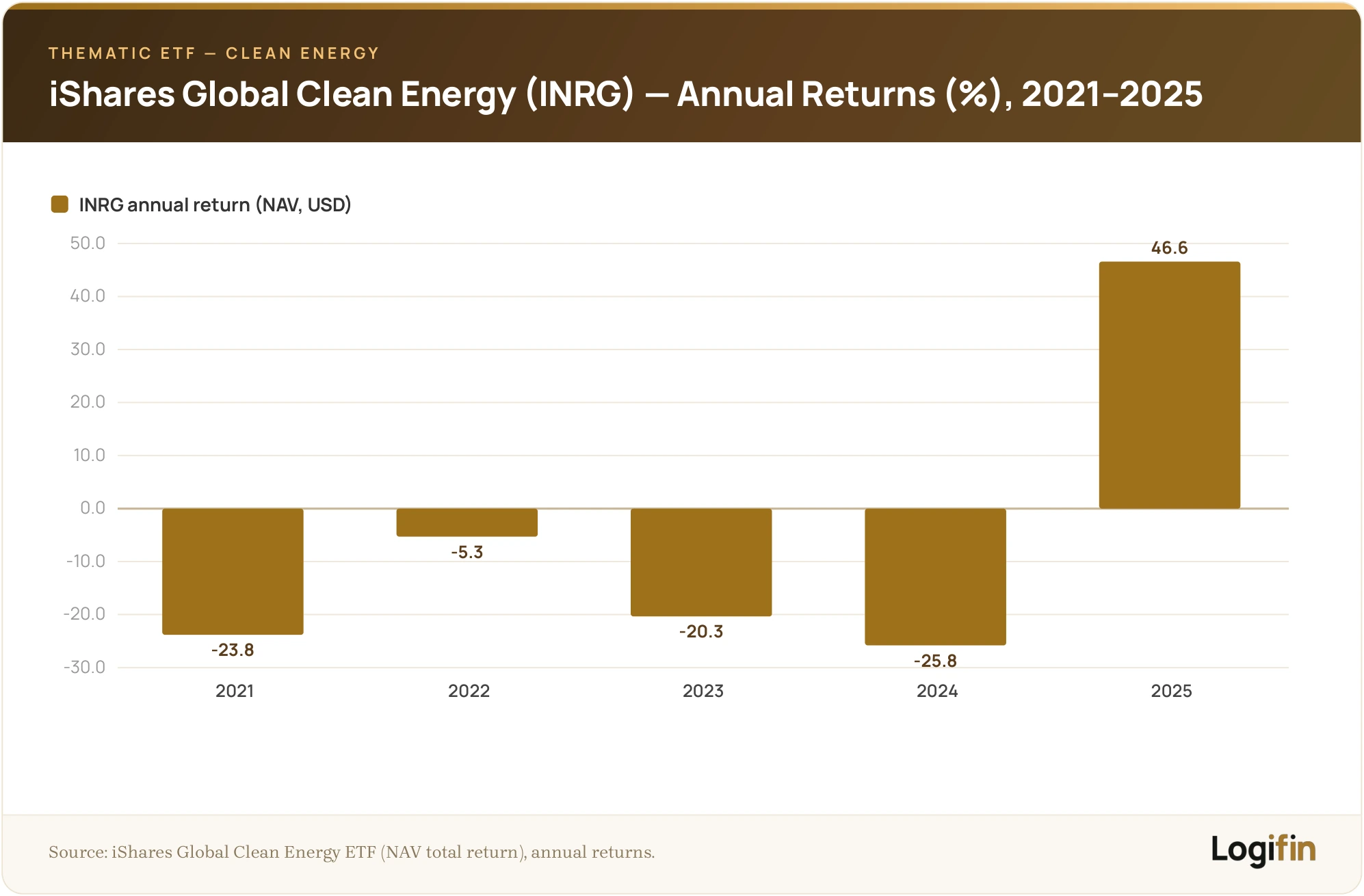
It does not matter whether these companies are small or large, in the US or China. What matters is that they actively participate in the “green transition”.
How do thematic ETFs differ from traditional indices?
If you have already invested in ETFs that track well-known indices such as the S&P 500 or the MSCI World, you may be wondering:
“But are thematic ETFs not just a basket of stocks too?”.
The answer is yes, but… Thematic ETFs are similar in structure but differ radically in how they choose what to include and why. Their main differences are:
1. The stock-selection criteria
Their basic difference starts from how the stocks that enter their portfolio are selected.
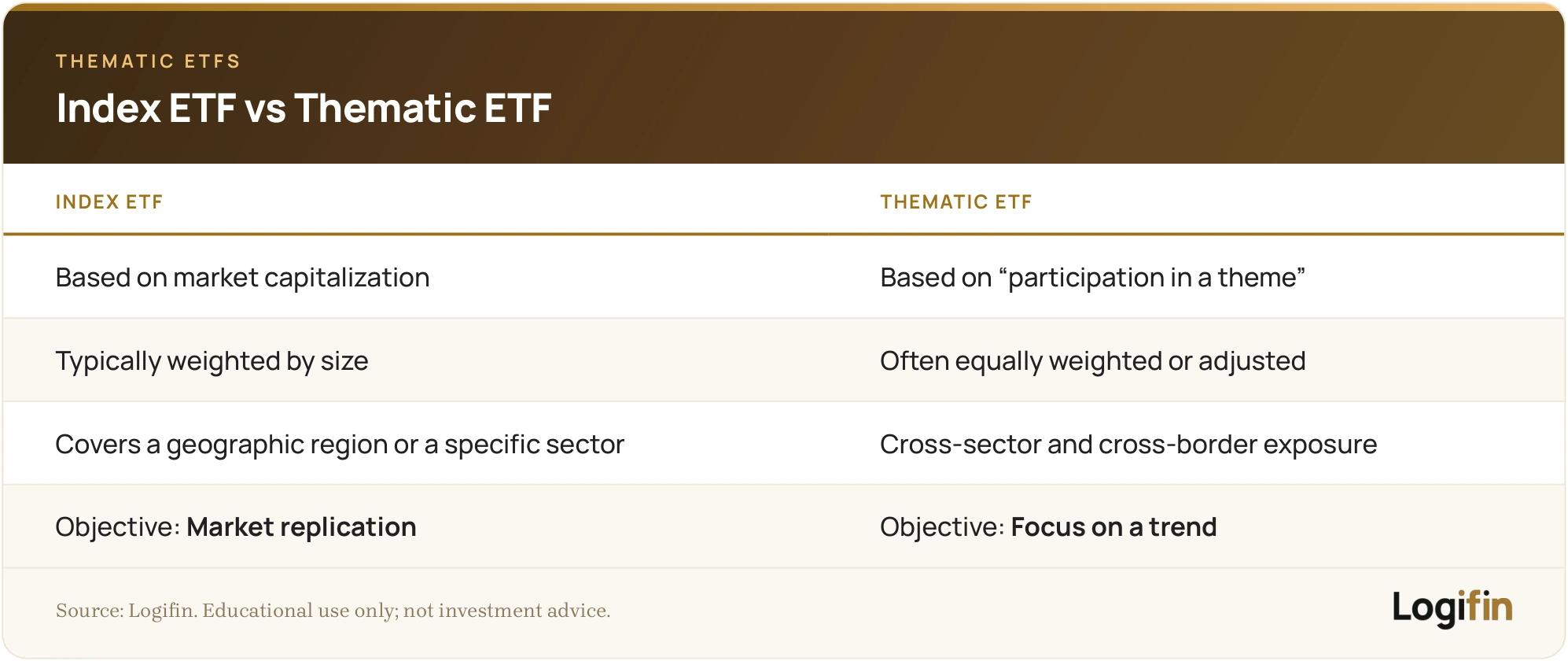
Index ETF
- Based on market capitalisation
- Usually weighted by size
- Covers a geographic area or sector
- Goal: Representing the market
Thematic ETF
- Based on “participation in a theme”
- Often equally weighted or adjusted
- Covers across sectors and across borders
- Goal: Focusing on a trend
Example:
- The MSCI World selects the largest companies across 23 developed countries.
- An AI thematic ETF, however, may include both Microsoft and small specialised startups in South Korea or Sweden, as long as they operate in that specific field.
2. Geographic and sector concentration
Traditional indices, such as the MSCI World or the S&P 500, are built on principles of broad diversification.
They spread their exposure across many countries, many sectors and large-cap, highly liquid companies. This creates a more balanced and stable investment base.
By contrast, thematic ETFs operate on an entirely different philosophy and often show high risk concentration:
Heavy concentration in a few stocks
- Many thematic ETFs hold 20–40 stocks and often the 5 largest positions account for 40–50% of the fund.
- This increases sensitivity to developments affecting one or two companies.
Geographic over-exposure
- Several themes, such as cybersecurity or cloud computing, are almost exclusively American.
- So, despite the “global” label, the exposure is essentially US-centric and less diversified than it appears.
Preference for mid and small caps
- Thematic ETFs often invest in smaller companies with high growth potential but also greater volatility.
- Their lower liquidity can increase spreads and risk during difficult periods.
3. Return and volatility
Thematic ETFs can deliver striking returns when their theme is in a phase of intense growth.
If a trend goes mainstream (like AI in 2023) or a technology achieves mass adoption, thematic ETFs can far outperform the broader market.
However, this prospect comes with higher volatility:
- their prices move more sharply and often diverge from the market average
- corrections can be deep and last longer
- performance often depends on a few sectors or a few companies which, if hit negatively, drag down the entire ETF
In short, thematic ETFs can act as accelerators of return, but also as a source of greater swings.
This makes them suitable as a satellite rather than a core choice in a balanced portfolio.
4. They do not always have a “benchmark” or a long track record
Broad market ETFs (such as S&P 500 ETFs) have a clear point of reference and decades of historical performance. By contrast, many thematic ETFs:
- Were created recently (after 2018–2020)
- Lack a sufficient track record for long-term analysis
- Cannot be easily compared with “the market”, because they do not represent it
This makes them harder to evaluate, for both retail investors and professionals.
What are the most popular thematic ETFs and how do they perform?
If you search the thematic ETF platforms, you will see dozens of investment themes competing for your attention: artificial intelligence, clean energy, robotics, the space economy, ESG, etc.
But which ones truly stand out?
In this section we present the 6 most popular themes of recent years and what you need to know about their performance, volatility and characteristics.
🔶 Artificial Intelligence (AI) & Automation
The main UCITS-compliant ETFs are:
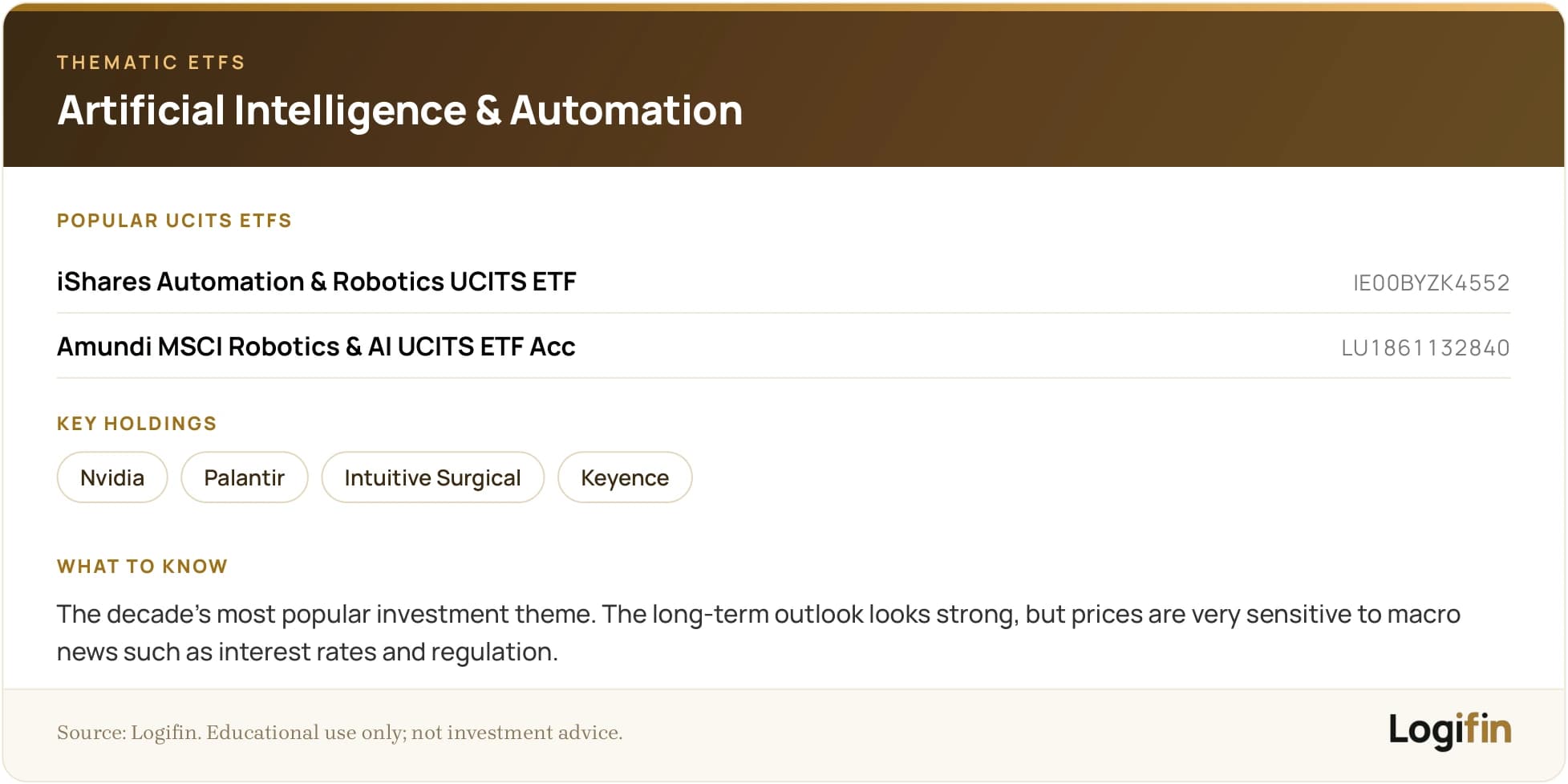
AI has emerged as the most popular investment theme of the decade. Companies such as Nvidia, Palantir, Intuitive Surgical and Keyence feature prominently in these ETFs.
Although the future outlook looks strong, prices are highly sensitive to macroeconomic news (e.g. interest rates, regulation).
🔶 Clean Energy & ESG
The main UCITS-compliant ETFs are:
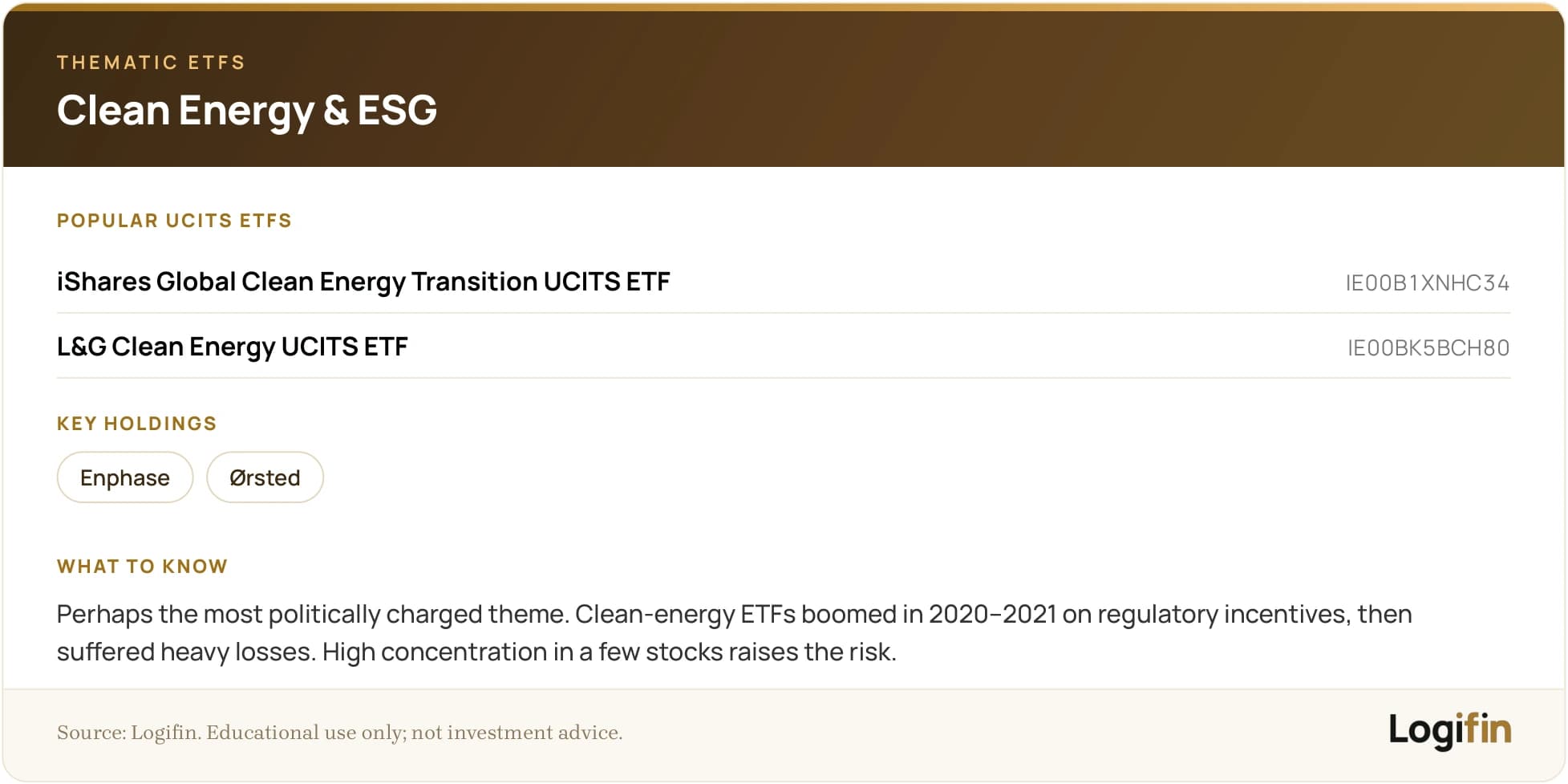
ESG is perhaps the most politically charged theme. Clean Energy ETFs surged in 2020–2021, driven by regulatory incentives, but suffered large losses thereafter.
However, the heavy concentration in a few stocks (e.g. Enphase, Ørsted) increases investment risk.
🔶 Cybersecurity
The main UCITS-compliant ETFs are:
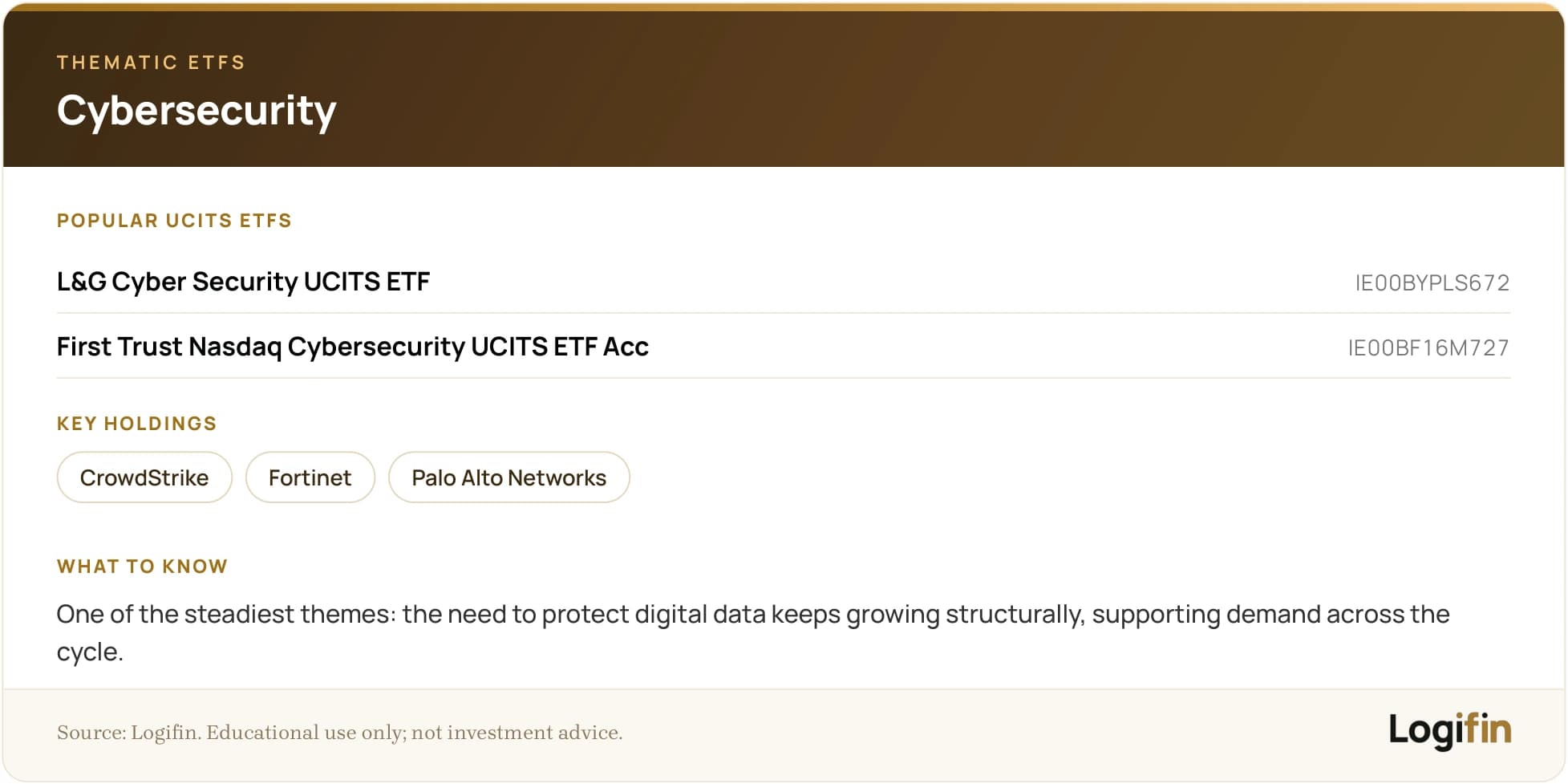
Cybersecurity is one of the most stable themes, as the need to protect digital data keeps growing.
It includes companies such as CrowdStrike, Fortinet and Palo Alto Networks.
🔶 Biotechnology & Health
The main UCITS-compliant ETFs are:
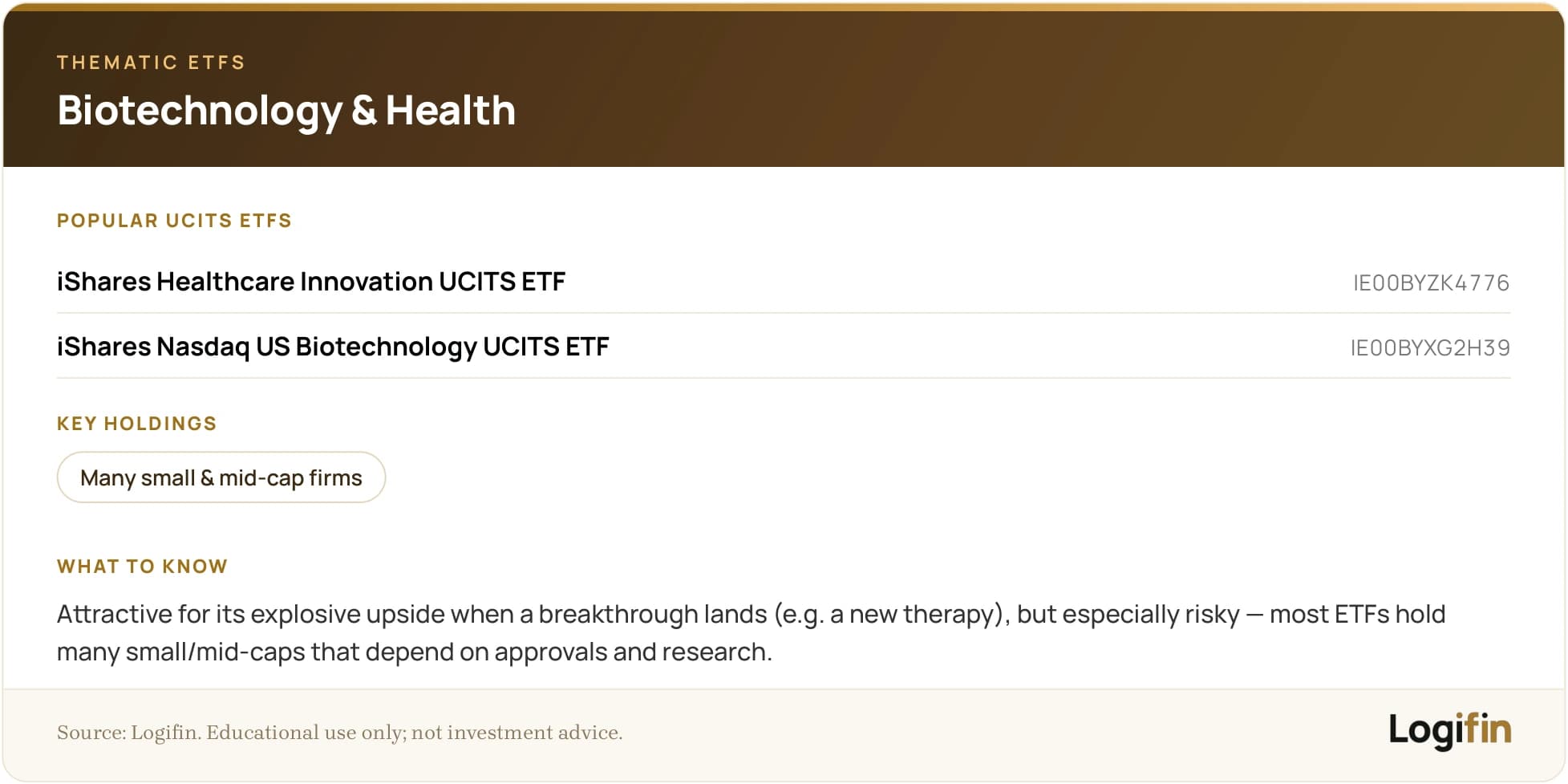
Biotechnology is appealing because of its “explosive” momentum when a breakthrough occurs (e.g. a new treatment), but it is also particularly risky.
Most of these ETFs hold many small/mid-cap companies that depend on approvals and research.
🔶 Fintech & Digital Payments
The main UCITS-compliant ETFs are:
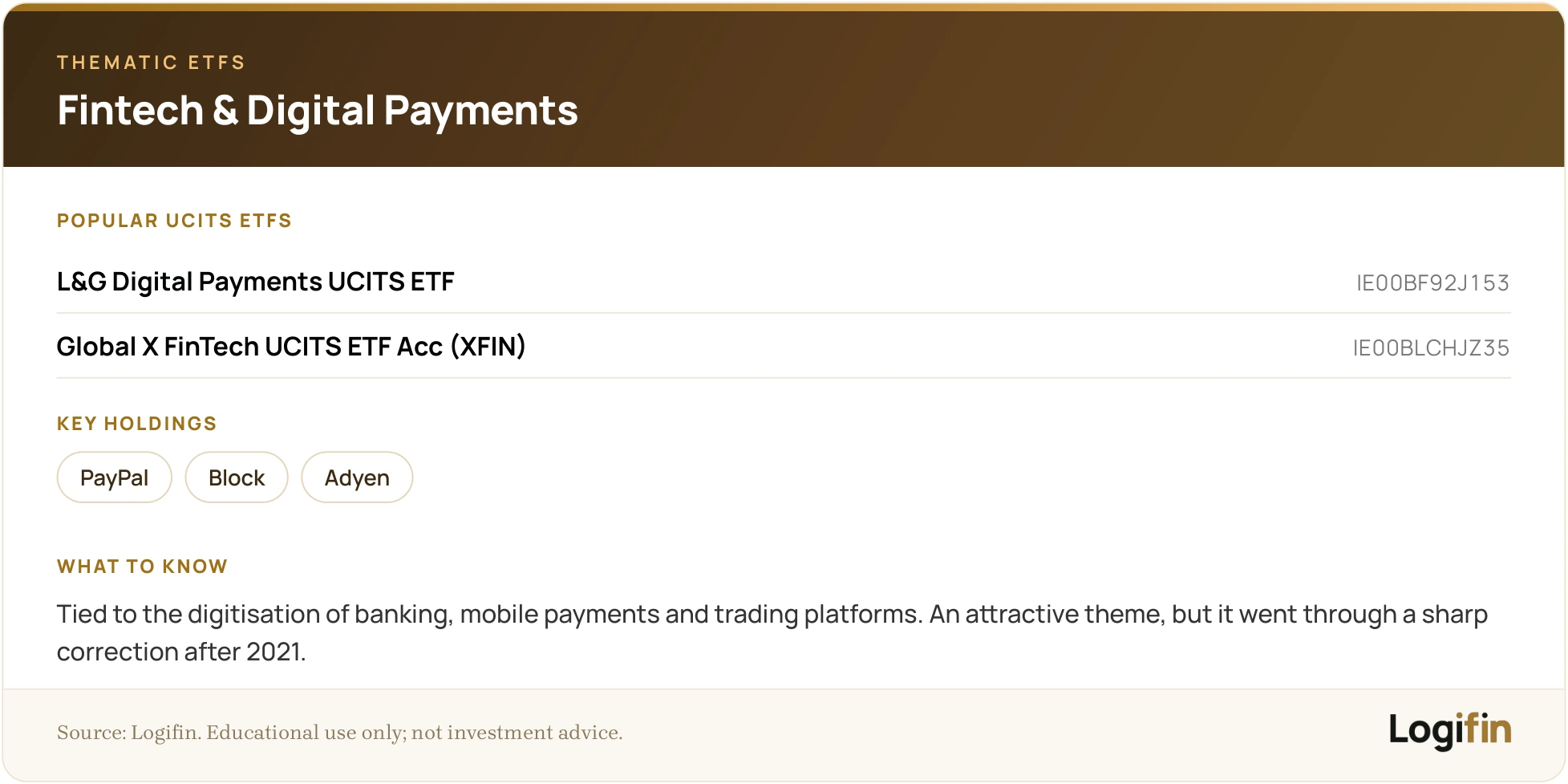
Fintech has become linked with the digitalisation of the banking system, mobile payments and trading platforms.
It includes companies such as PayPal, Block (formerly Square) and Adyen. Although the theme is attractive, it underwent a sharp correction after 2021.
🔶 Space, Satellite technology, New markets
The main UCITS-compliant ETFs are:
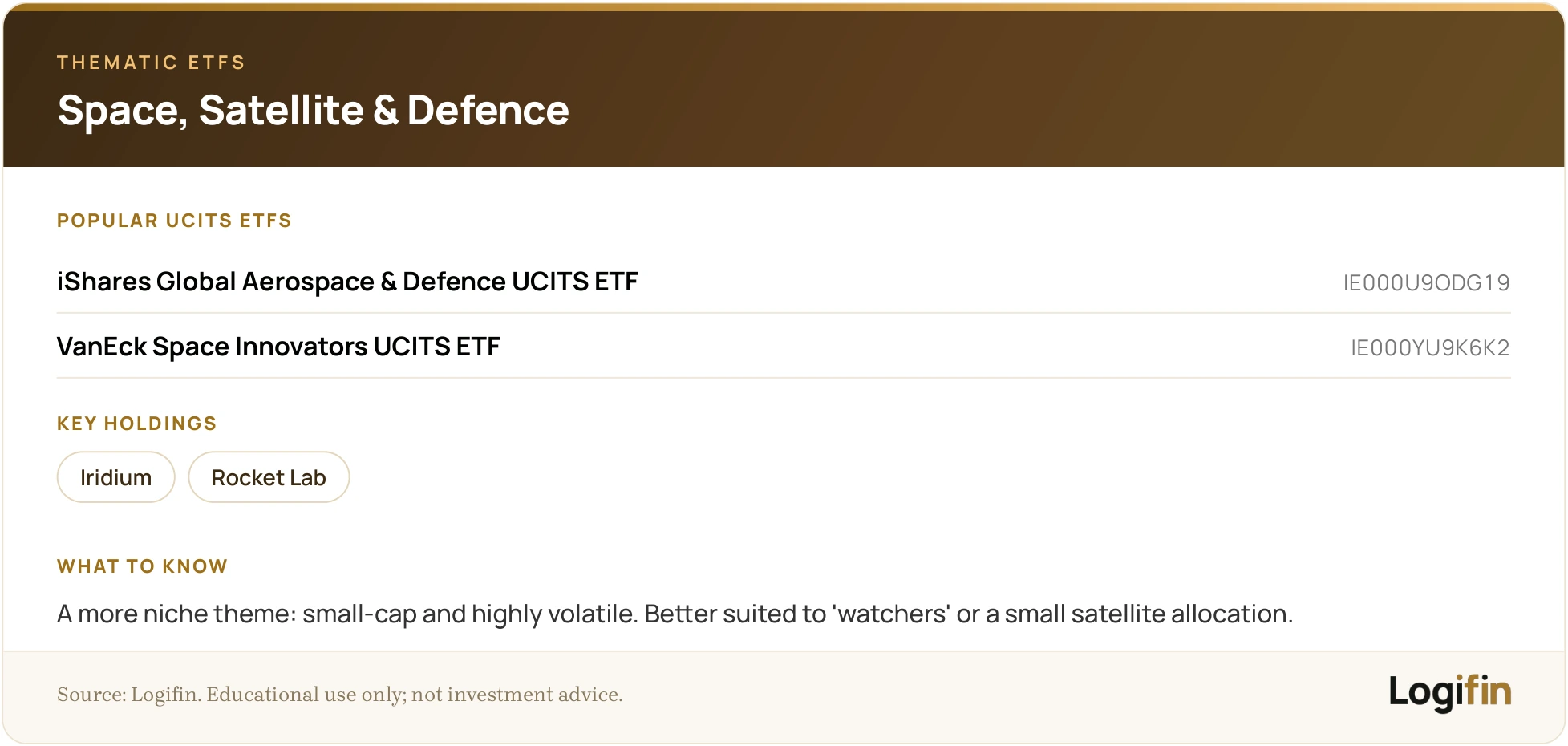
A more niche theme, with small capitalisation and high volatility. It invests in companies such as Iridium and Rocket Lab. More suitable for “observers” or a small satellite allocation.
The advantages of thematic ETFs
Although thematic ETFs are not a “core” of a portfolio, they have evolved into popular tools for diversification and strategic targeting.
It is no coincidence that providers such as BlackRock or Amundi keep expanding their thematic range.
The advantages are many, as long as you know what you are taking on.
🔶 Investing in trends you understand and believe in
- Most investors, especially from the younger generation, find it hard to feel a “connection” with an index like the MSCI World.
- By contrast, an ETF that invests in artificial intelligence, clean energy or biotechnology has a deeper sense of meaning.
- You feel you are backing something that expresses you, or that you believe will change the world.
- This also strengthens the investor’s psychological resilience: it is easier to stay invested when you understand what your ETF represents.
🔶 The potential to outperform if you “hit” the right trend
If a theme takes off (as happened with cloud computing, AI technology or electric vehicles), then a thematic ETF can outperform the broader market for a long period.
Example:
- The ARK Innovation ETF (ARKK) posted exceptionally high returns between 2017 and 2020, with a total annualised return (CAGR) of about 60%.
- That performance was mainly due to the ETF’s heavy exposure to companies such as Tesla, Roku and Block (formerly Square), at a time when they were still in the early stages of their rapid growth.
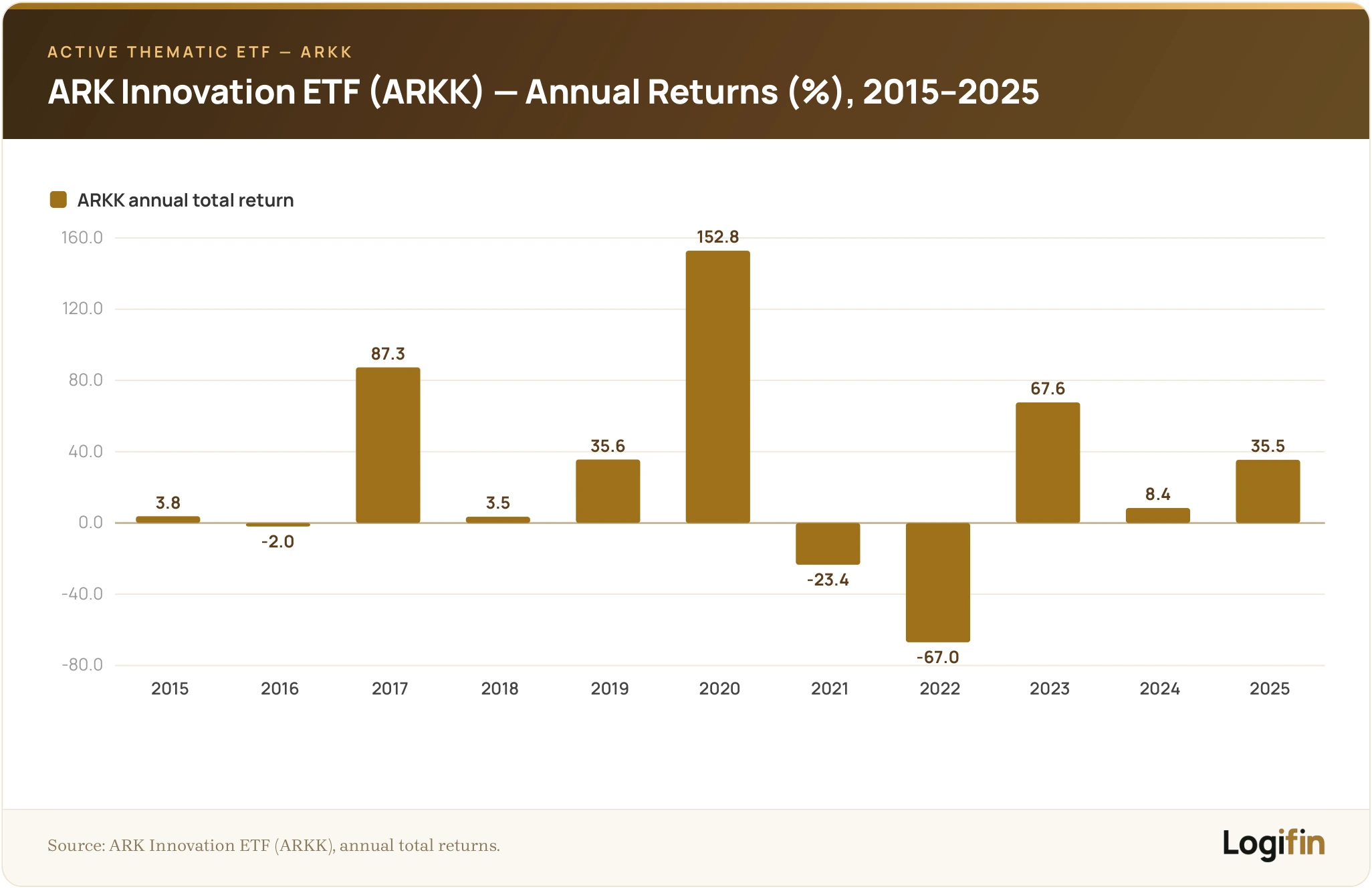
Caution: outperformance is possible, not guaranteed.
🔶 Focus without the need to pick individual stocks
- Investing in a theme through an ETF offers exposure to an entire sector or trend without having to pick which stock will succeed.
- Instead of choosing among 10 AI companies, you can invest in all of them through one ETF, reducing selection risk and increasing your chances of participating in the next breakout stock.
🔶 Smart geographic and sector diversification
- Although thematic ETFs are concentrated around a single concept, they also offer practical geographic diversification.
- For example, a clean energy ETF may include companies from the US, Denmark, China and Canada at the same time.
- This is useful when you want to diversify beyond the S&P 500 but without resorting to broad emerging-market indices.
🔶 Ideal for a “satellite” strategy
Thematic ETFs are extremely useful as “satellite” building blocks of a core portfolio.
They do not need to be the basis of your strategy. Instead, you can add them:
- To increase your exposure to a specific trend (e.g. AI)
- To give a “growth direction” to the portfolio
- To experiment with small amounts in new sectors
Example: An investor might hold 80% in core ETFs (MSCI World, S&P 500, Emerging Markets) and 20% in thematic choices such as clean energy or genomics, depending on their convictions and time horizon.
The disadvantages of thematic ETFs
Thematic ETFs can offer excitement, meaning and the potential for striking returns, but they also hide traps that many investors overlook.
Especially if used without a strategy, they can lead to wrong decisions or disappointment.
Let us look at the main risks you need to know.
🔶 They often chase trends after they have gone mainstream
Many thematic ETFs do not “predict” trends: they simply appear after those trends have already gained investor attention.
This means that:
- The ETF may include overbought stocks
- The investor enters at the end of the party, with high valuations and increased correction risk
- The ETF’s index is often created with a delay, not when the trend is still undervalued
🔶 High volatility and lack of stability
Unlike the large indices (S&P 500, MSCI World), thematic ETFs:
- Often include mid or small companies with more fragile financials
- Have concentration in a few stocks (sometimes >30% in 5 names)
- Are strongly affected by changes in interest rates, inflation or the regulatory environment
A thematic ETF can post +40% in one year and –35% the next, without anything essential having changed in its “story”.
🔶 Low liquidity and elevated spreads
Many thematic ETFs are relatively small (with AUM below €500 million) and trade on low daily volume. This creates:
- Wider bid/ask spreads (transaction cost)
- The risk of liquidity traps in periods of stress
- The possibility that the ETF closes if it does not gain enough traction
This risk is not theoretical: several thematic ETFs have been delisted or merged due to lack of interest.
🔶 Murky or vague stock-selection criteria
In some ETFs, the “theme” is not clear.
The ETF may claim it invests in artificial intelligence, but end up holding 20% Nvidia, 15% Alphabet and 10% Amazon, multi-theme companies that already sit in your portfolio through other broad market ETFs.
This creates:
- Overlap (double exposure without realising it)
- Loss of diversification
- A sense of “marketing hype” on the part of the ETF provider
If you invest in thematic ETFs, you must always check the list of holdings and the selection method.
🔶 They lack a long track record (and often do not even have a benchmark)
Many thematic ETFs are new. They were created after 2018–2020 and have not yet been through a full economic cycle.
This means that:
- You cannot easily assess their stability in bear markets
- You do not have 15–20 years of historical data to see how they perform over the long term
- Some do not even have a conventional benchmark, which makes evaluation even harder.
When and how to use thematic ETFs in your portfolio?
Although thematic ETFs offer a more focused and “lively” investing experience, they have no place as the main (core) structure of your portfolio.
However, they can be used cleverly and methodically as a satellite allocation, offering exposure to trends with high potential return.
Let us look at when it makes sense to use them and, above all, how to integrate them without disrupting your balance.
🔶 When it makes sense to invest in thematic ETFs
- When you want to increase your exposure to specific sectors or technologies not adequately covered by broad market indices (e.g. AI, biotech)
- When you have a long horizon and want to “bet” a small amount of capital on emerging megatrends
- When you know the field well (e.g. you work in a related industry and have information or understanding)
- When you use it as a diversification tool within an already stable core portfolio
🔶 When it is not a good idea
- When you try to cover basic geographic diversification through thematic ETFs
- When you buy simply because it was trending (without knowing what it contains)
- When you over-allocate (>20% of your portfolio) to thematic choices, aiming to “hit outperformance”
- When you have low tolerance for drawdowns: thematic indices correct faster and deeper than traditional ones
🔶 Core & Satellite strategy: how to add thematic ETFs
A tried-and-tested approach is to keep the base of your portfolio (core) in broadly diversified indices and add thematic ETFs as boosters of potential return.
For example:
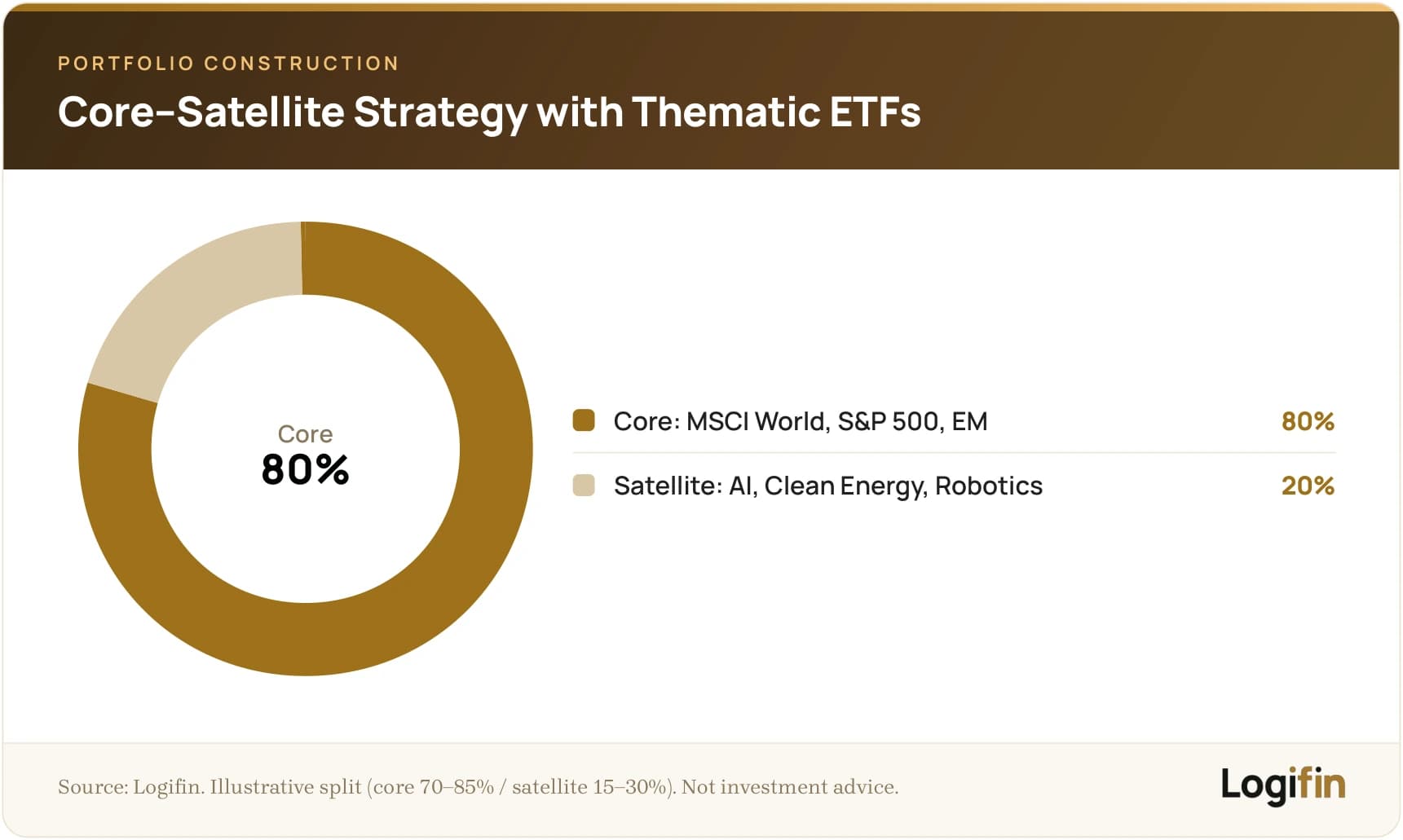
Tip: You can start with 5% in a single thematic ETF you know well and track its course relative to your core portfolio.
🔶 DCA or Lump Sum? Which strategy fits?
Because of the volatility, thematic investments are often favoured by DCA (Dollar-Cost Averaging).
Instead of placing a lump sum at the peak of a hype cycle, you can invest gradually to reduce timing risk.
Example:
If you want to invest a total of 1,000 € in an AI ETF, you can “split” it into 10 monthly instalments of 100 €, increasing the chance of buying at average prices.

🔶 Practical criteria for choosing a thematic ETF
Before you invest, check:
- What is the stock-selection methodology?
- What is the composition (top 10 holdings) and does it overlap with your other ETFs?
- What is the ETF’s AUM and liquidity?
- Is there a performance track record (or a benchmark for comparison)?
- Does it fit your tax planning?
Conclusion and practical takeaways
Thematic ETFs are exciting.
You are not simply investing in stocks. You are investing in ideas. In technologies that promise to change the world. In trends you see around you every day.
This makes them attractive. But it does not necessarily make them suitable for everyone, nor necessary components for every portfolio.
🔑 What to keep in mind:
They are worth considering seriously if:
- You want to diversify your portfolio beyond “traditional” indices
- You have a long-term horizon and accept higher volatility
- You strongly believe in a specific megatrend (e.g. AI, biotechnology, sustainability)
- You are willing to actively monitor and evaluate the evolution of the theme
Do not rely on thematic ETFs if:
- You are looking for stability or investing with a short/mid-term horizon
- You have not understood what is “inside” the ETF
- You hope to “hit the jackpot” because the theme is trending
- Your core portfolio is already unstable or you do not have investment discipline
Practical Tips if you want to invest in thematic ETFs:
1️⃣Choose a thematic ETF that fills a gap in your existing portfolio
2️⃣Combine it with core ETFs (S&P 500, MSCI World, EM, etc.)
3️⃣Monitor performance not only in bull markets, but also during corrections
4️⃣Do not forget: you do not need to follow every theme. Choose the ones you understand and believe in

The content of this article is provided exclusively for informational and educational purposes and does not constitute investment advice or a recommendation to buy or sell financial products. The information is based on publicly available sources considered reliable, without any guarantee of accuracy or completeness. Before making any financial or investment decision, it is recommended that you consult a certified professional advisor or accountant, taking into account your own financial situation and risk profile. The Logifin team bears no responsibility for any direct or indirect damages arising from the application of the information presented.
Related articles

What is an ETF? The complete beginner's guide
Learn how ETFs work, why they have become so popular and how you can use them to invest with strategy.
22 min read

Developed or emerging markets? Which ETFs suit you best in the end?
The geographical allocation that can make the difference in your portfolio
17 min read

How to build a resilient portfolio
A guide for investors who want to build something stable, simple and rewarding over the long term.
19 min read

What is a recession and how it affects investors?
How a recession is defined, what causes one, how the markets usually behave during it and what an investor can do to prepare in advance.
24 min read
EXPLORE LOGIFIN
Everything you need in order to learn, plan and track your investments.
Logifin Blog
Learn everything you need to get your finances in order and invest with confidence.
Logifin Insights
What moves the markets and what it means for a long term investor. Short and without the noise.
Logifin Tools
Free, inside the site, no signup. Everything you calculate stays on your device.
Logifin ETF Hub
Find the ETF that fits you: 550+ UCITS ETFs, smart filters and in-depth comparisons.
Logifin Guides
A series of guides that builds your investment plan step by step. The first guide is free for everyone.
Logifin Circle
The tools and the Hub are free for everyone. You become a member for the intelligence that never stops.