Logifin Insights
What does the Democratic win mean for the global economy?
Democrats won the Senate and the House in the US elections. What may change for the economy, tariffs and interest rates and what the result means for Europe, Russia and Iran.
· 9 min read
Democrats won both chambers of the US Congress in the elections of Tuesday 3 November. The Associated Press called the Senate for them on Tuesday night and the House of Representatives in the early hours of Wednesday, as TIME reported. Overnight, technology shares fell sharply in Asia, the dollar dropped to a one-month low and yields on US government bonds declined. Markets expect two years in which President Trump and Congress will struggle to agree on new laws.
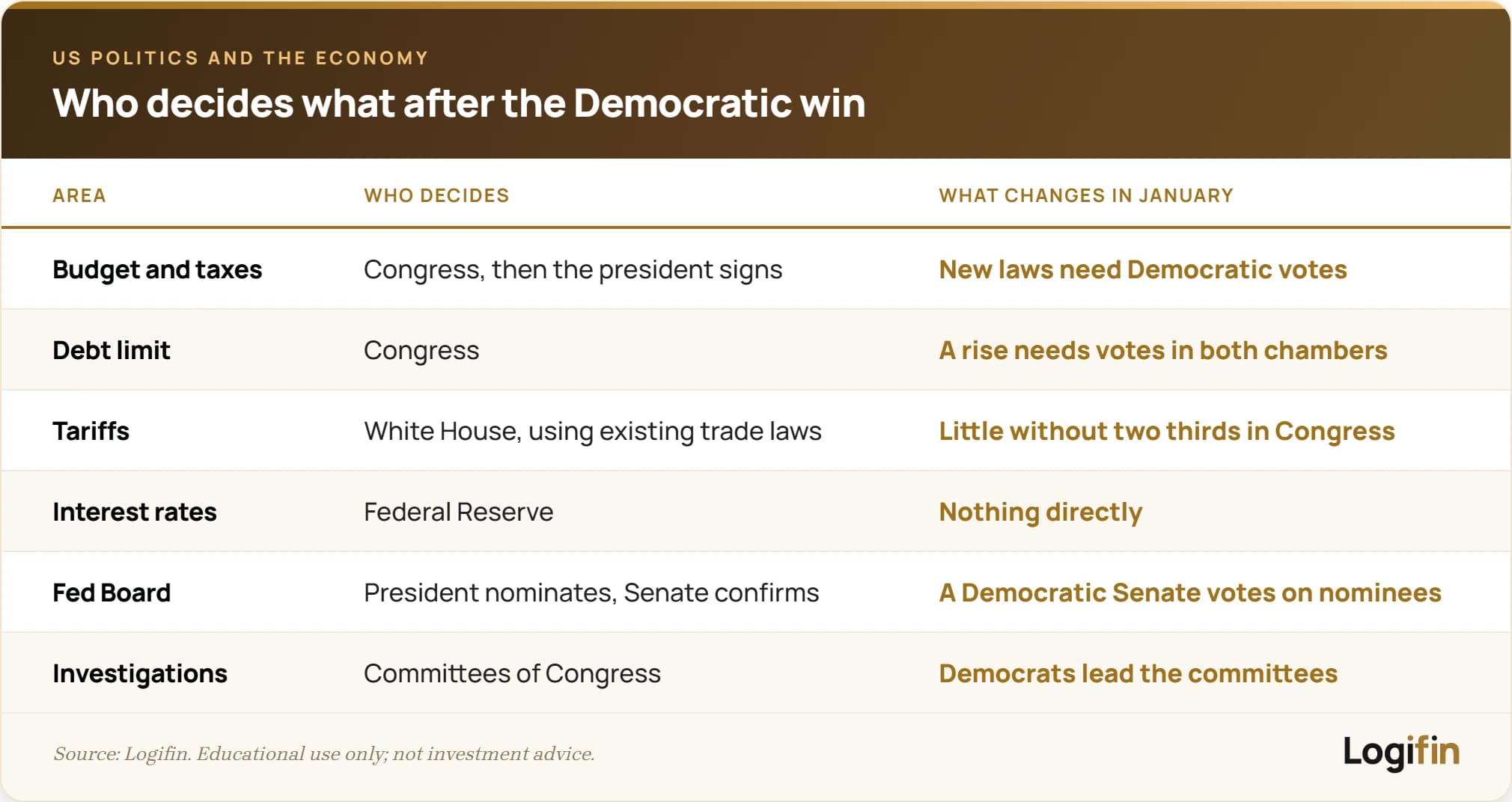
The new Congress takes over in January and will have a say on the budget and the debt limit. Its power over tariffs, interest rates and foreign policy is much smaller.
What happened at the polls and in the markets
Before the vote, Republicans held 53 of the 100 Senate seats and 218 of the 435 House seats. Democrats secured at least 51 Senate seats and the network MS NOW estimates they will hold at least 245 in the House. They took at least seven Senate seats from Republicans, including Texas and Kansas. Counting continues, so the numbers may change.
The win was expected, but its size was not. Before the vote, JPMorgan gave a 66% likelihood that Democrats would take both chambers. Chris Weston of Pepperstone said, according to Bloomberg, that the size of the victory is what caught markets off guard.
Nasdaq futures, which trade while Wall Street is closed, fell more than 2%, according to Reuters. The euro rose 0.5% to 1.1249 dollars. The yield on the 10-year US Treasury fell to about 4.91%, from 4.95% on Tuesday. By Wednesday morning in Europe, shares had erased the fall. S&P 500 and Nasdaq futures were up about 0.2% and the European STOXX 600 index gained 0.5% in early trading.
What the new Congress can change
Congress votes on the budget, on taxes and on the debt limit. From January, new tax cuts and large spending plans will need Democratic votes. That is why bonds rose on the same night that shares fell. Investors expect fewer new deficits and therefore less new debt. The yield on a bond falls when its price rises.
The US government ended fiscal year 2026 with a deficit of about 2 trillion dollars and its debt stood at 40.5 trillion on 2 November. David Chao of Invesco wrote that less fiscal stimulus could reduce upward pressure on growth, inflation and Treasury yields.
The debt limit, the maximum the government may borrow, is 41.1 trillion dollars and only Congress can raise it. Fiscal Lab projects that the debt will reach the limit in March 2027 and that the government will run out of borrowing room in the autumn of that year.
What stays in the hands of Trump
Trump can veto any law, and overriding a veto takes two thirds of both chambers. Tai Hui of J.P. Morgan Asset Management considers it unlikely that Democrats will reach that number, as Reuters reported. Trump told Fox News that he will work with them and that after a couple of months of vetoes they will call him to find a way forward, according to CBS.
Tariffs stay mainly with the White House. In February the Supreme Court struck down the tariffs imposed under the emergency economic powers law, but the administration relied on other laws. Since 24 July, tariffs of 10% or 12.5% have applied to imports from 60 economies, according to the Penn Wharton Budget Model. The EU was placed in the 10% group.
Neither Congress nor the president sets interest rates. On 28 October the Fed held its main rate at 3.75% to 4.00%, with two votes in favour of a rise. The Senate confirms the people the president nominates to the Fed Board, so from January any new member will need Democratic votes.
What it means for the US economy
The US economy enters this period with growth of 3.4% at an annual rate in the third quarter, according to the first estimate. Inflation was 3.7% in September, when gasoline was 34.2% more expensive than a year earlier. With growth and inflation at those levels, less new spending may reduce the pressure for rate rises.
The fall in technology shares has a different cause. Investors fear tighter rules on artificial intelligence and delays to data centres. Democrats won the Senate race and the governorship in both Texas and Georgia. The two states account for about a third of data centre spending, according to an estimate by Tapas Strickland of Moomoo ANZ, who thinks the result slows this investment without stopping it. Reuters reported before the vote that analysts see slim chances of a law that would seriously hurt their construction and expect investigations instead.
What it means for Europe and the rest of the world
Most experts do not expect a sharp turn in US foreign policy, because it stays mainly in the hands of the president. James Green of the Center for European Reform told The Parliament Magazine that Congress has "the ability to slow that car down, maybe make it put on a turn signal", but that changing "the overall route" over the next two years will be very difficult. Before the vote, Vessela Tcherneva of the European Council on Foreign Relations (ECFR) warned, according to the Kyiv Post, that a Trump constrained at home may become more erratic abroad.
Economy. Decisions in Washington affect the economy of the rest of the world in two ways:
- Dollar. A weaker dollar makes European and Japanese goods more expensive in the US market.
- Interest rates. The 10-year US Treasury is a reference point for borrowing costs around the world, so a lasting fall in its yield usually reaches rates in other countries too.
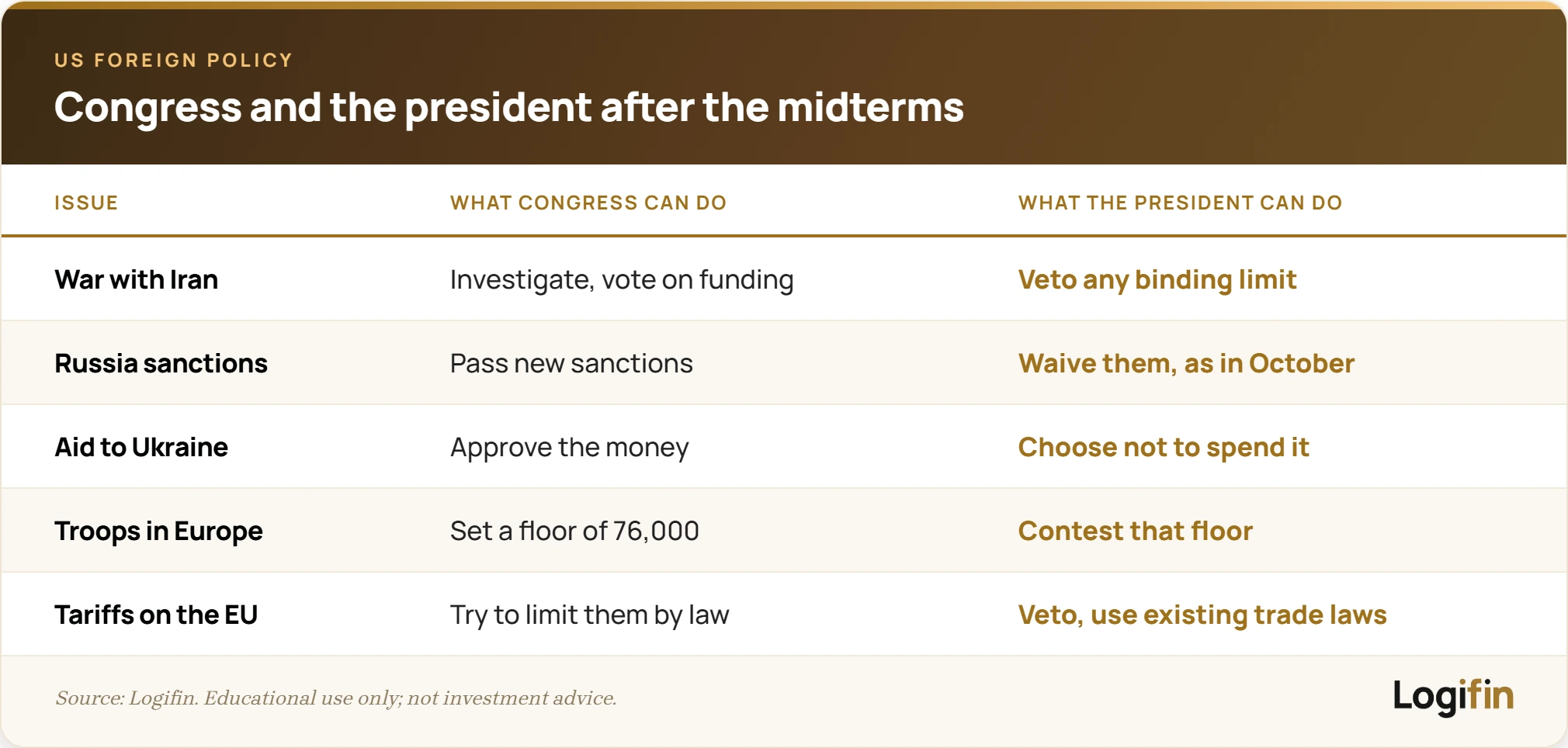
Relations with Europeans. Tariffs do not fall with the election result and German MEP Bernd Lange fears that Trump will turn more confrontational on trade. A "lame duck" is a president who has lost power, and Lange told The Parliament Magazine that "a lame duck could become an angry duck." The same magazine notes that the September law on Russia sanctions gave the White House new tariff powers. Nevada Joan Lee of the ECFR believes this exposes any EU country.
NATO. Congress has already set a floor. The defence law prohibits a reduction of US forces in Europe below 76,000 without certifying to Congress that NATO allies were consulted. According to the ECFR, the president contests the legality of this floor and a review of US forces is expected by December. The same institute believes that with a Democratic Congress it would be harder for Trump to pursue claims on European territory such as Greenland.
Russia and Ukraine. In September Congress passed new sanctions on Russia by a large majority. In October Trump waived many of them by executive order, a week after announcing a diesel deal with Russia. A Democratic majority can approve money for Ukraine, but Lee believes Trump may simply choose not to spend it. Juraj Majcin of the European Policy Centre considers it possible that the defeat will push Trump to restrict support for Ukraine even further.
Iran and oil. In June both chambers called on Trump to remove US forces from the war with Iran, in a symbolic resolution with no binding force. In September a new resolution failed in the Senate by 50 votes to 49. With the new majority such a resolution has a better chance of passing, but Trump can stop it with a veto. Democrats will also be able to investigate the handling of the war and challenge its funding, as Demócrata notes.
For Europeans the war shows up mainly in the price of oil. Brent cost about 71 dollars at the end of January and about 104 dollars on Wednesday morning. Talks in Qatar on reopening the Strait of Hormuz continue, but Euronews saw few signs of progress on Monday and Trump keeps the military option open. The election result guarantees neither cheaper oil nor an end to the war.
Asia and China. The reaction differed from market to market. The Nikkei closed 1.4% below its Monday level as the rise of the yen weighed on exporters, as Euronews noted. The Kospi fell as much as 4% and closed up 0.6%. The Shanghai Composite rose 2.2% and the Hang Seng 1.5%. Mark Cudmore of Bloomberg sees the result as positive for discounted markets in Asia, with China and South Korea standing out. Shan Weijian of PAG expects neither an improvement nor a significant deterioration in US relations with China, as he told Reuters.
If you hold a global ETF. On 30 October the MSCI World held 72.8% in US shares and 29.8% in technology companies, according to the MSCI factsheet. A European investor with an ETF on this index is affected twice, by US shares and by the dollar.
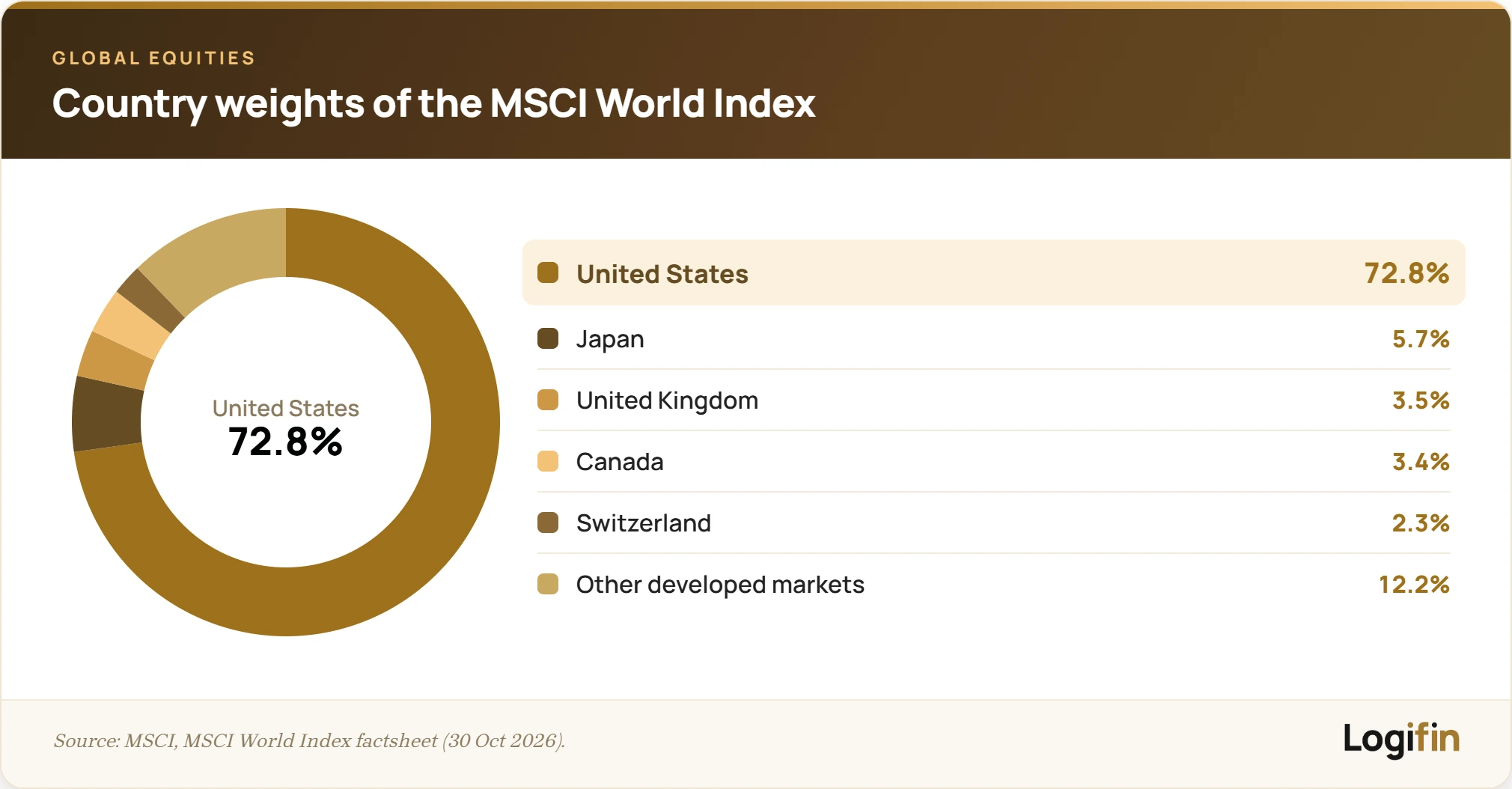
When the euro rises 1% against the dollar, the US part of such an ETF loses about 1% in euros, even if the shares stay where they are. Euro-hedged ETFs largely cancel out this move. European shares are less exposed to artificial intelligence, because technology companies make up only about 7% of the STOXX index, according to Reuters. Michael Arone of State Street told Reuters that the big risk for markets is not the Democratic win but investors overreacting to it.
What to watch
- After mid-November. Putin said he is ready to resume trilateral talks with the US and Ukraine, according to CNN.
- 9 December. The Fed announces its next decision on interest rates.
- 11 December. The temporary funding of the government expires. Until January the current Congress, with its Republican majority, still votes.
- December. The review of US forces in Europe is expected.
- Spring 2027. The debt approaches the limit of 41.1 trillion dollars, according to estimates.
What to take away
- Democrats won the Senate and the House. Markets expect less new spending and tighter scrutiny of technology, with a weaker dollar and shares quickly erasing the first fall.
- The new Congress will have a say on the budget and the debt limit, but tariffs stay mainly with the White House and interest rates with the Fed.
- For Europe, Russia and Iran, most experts do not expect a sharp turn, because Trump keeps the veto and the conduct of foreign policy.
Insights
Keep reading



EXPLORE LOGIFIN
Everything you need in order to learn, plan and track your investments.
Logifin Blog
Learn everything you need to get your finances in order and invest with confidence.
Logifin Insights
What moves the markets and what it means for a long term investor. Short and without the noise.
Logifin Tools
Free, inside the site, no signup. Everything you calculate stays on your device.
Logifin ETF Hub
Find the ETF that fits you: 500+ UCITS ETFs, smart filters and in-depth comparisons.
Logifin Guides
A series of guides that builds your investment plan step by step. The first guide is free for everyone.
Logifin Circle
The tools and the Hub are free for everyone. You become a member for the intelligence that never stops.