Logifin Insights
Why has gold fallen so far?
On Friday 30 October gold fell 3.3% to its lowest level in a year, at the end of its worst October since 2008. Behind the fall are forced selling, Fed interest rates and expensive oil.
3 November 2026 · 5 min read
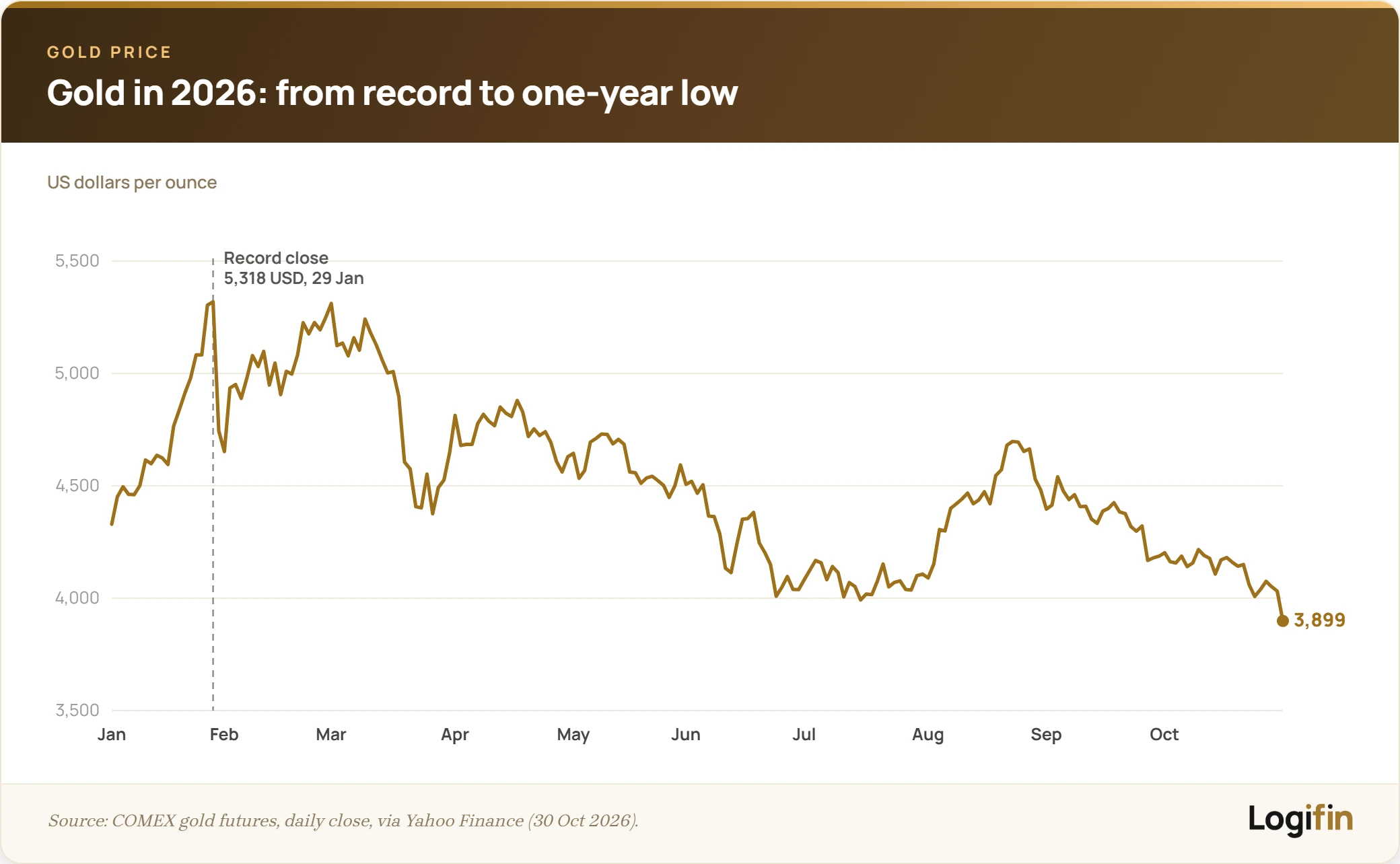
On Friday 30 October gold fell 3.3%. The December contract on the US commodities exchange Comex closed at 3,898.90 dollars an ounce, its lowest level in a year. It was gold's worst October since 2008, as Mining.com noted. From its highest close ever, on 29 January, the price has dropped by more than 25%.
On the same day the S&P 500 fell 1.8%. Gold, which many investors hold to protect them when stocks fall, fell further than the stocks themselves.
What happened on Friday
Friday's selling started in technology stocks. Intel shares fell 28.6% after a weak revenue outlook for the fourth quarter and the Philadelphia Semiconductor Index dropped 7.2%. Silver fell 5.9% to close at 49.10 dollars, below 50 for the first time since November 2025. Shares of gold and silver miners lost as much as 8%.
On the same day the dollar and US bond yields eased slightly, as Kitco pointed out. That usually supports gold. On Friday gold fell mainly because many investors suddenly needed cash.
Anyone who buys stocks with money borrowed from their broker must keep a minimum amount in the account as collateral, known as margin. When stocks fall sharply, the broker asks for the collateral to be topped up and the investor sells whatever can be sold quickly. Analysts at Commerzbank said the fall in technology stocks may have forced investors to sell gold to top up their collateral. They also described the decline in precious metals as exaggerated. Waleed Said of GivTrade explained it to Kitco: "Gold is liquid, so it is the first thing that gets sold when people need cash."
Why gold has been falling since January
Forced selling explains one day. The decline of the past nine months is mostly explained by interest rates.
In September the Fed raised its policy rate by 0.25 percentage points to 3.75% to 4.00%. On 28 October it held the rate, but with two votes against: Lisa Cook and Beth Hammack wanted another increase, according to the Fed statement. According to Mining.com, markets now put the chance of a hike in December at more than 70%.
Gold pays no interest and no dividend. Whoever holds it gives up the interest they would earn on a safe bond. That cost shows up in the real yield, the interest a bond pays above inflation. For the inflation-protected ten-year US government bond, the real yield rose from 1.89% on 29 January to 2.60% on 30 October, according to the US Treasury. The more a safe bond pays above inflation, the more expensive it becomes to hold a metal that earns nothing.
Philip Streible of Blue Line Futures told Kitco that gold does well when the central bank is forced to cut rates to support the economy. In his view, as long as the US economy keeps growing, the Fed has room to keep raising rates.
What role oil is playing
Brent cost about 71 dollars a barrel on 29 January and 117.64 dollars on 30 October. The rise is due to the US and Israeli war with Iran and the restrictions on shipping through the Strait of Hormuz, which carries about a fifth of the oil traded in the world.
Expensive oil pushes up inflation, inflation keeps central banks on a path of rate increases and those increases weigh on gold. Streible summed it up for Kitco: "Oil right now is the inflation."
The link was visible again on Monday 2 November. Iranian and Qatari officials held a third day of talks on ending the war, Brent fell and gold recovered.
How far gold has fallen in euros
The gold price is set in dollars. A European investor usually holds gold through an ETC, a product that trades on the stock exchange and follows the price of the metal. If the ETC is not currency hedged, the return the investor sees is the return of gold in euros.
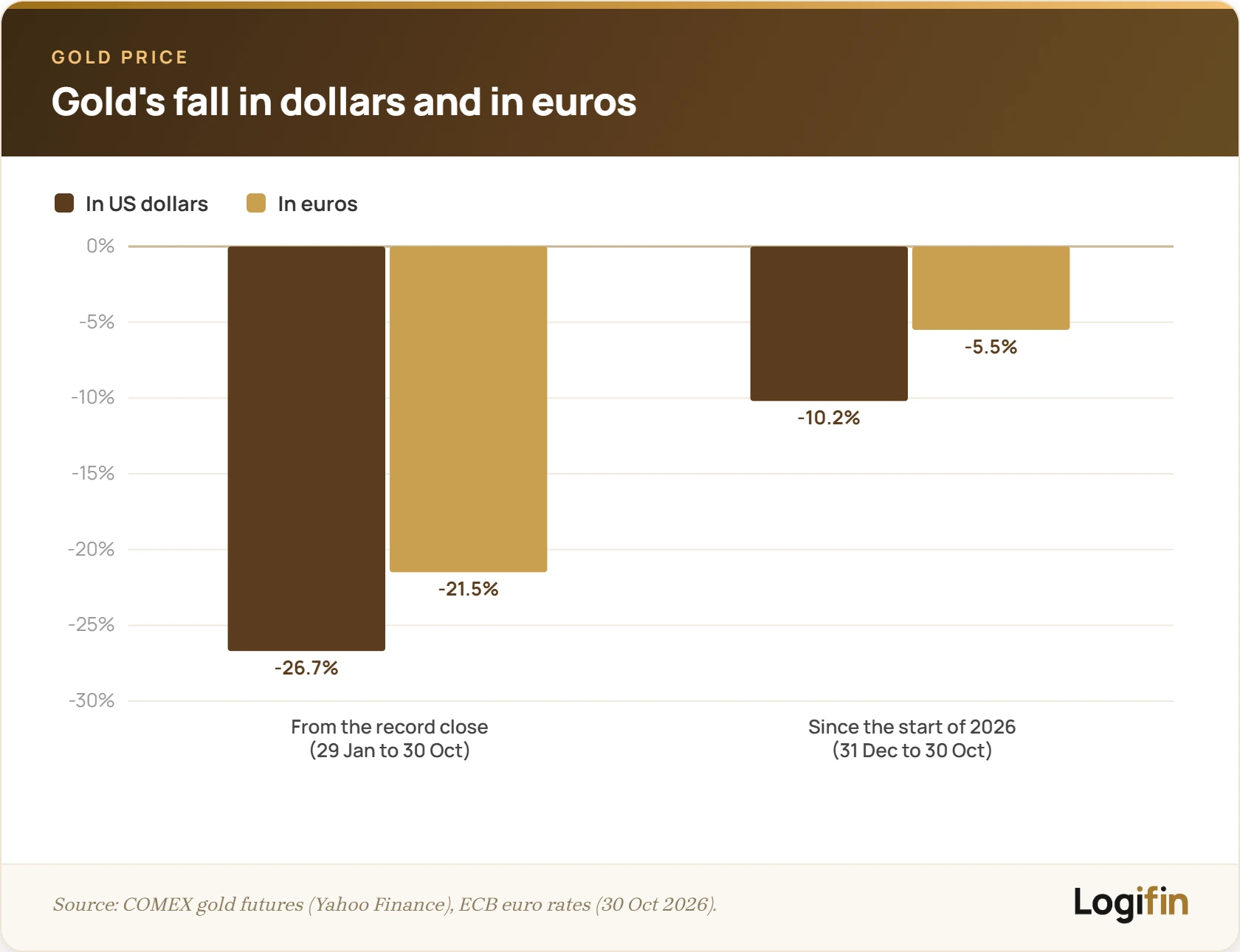
Since 29 January the ECB reference rate has moved from 1.1968 to 1.1172 dollars per euro, which means the dollar has gained about 7%. An ounce of gold cost about 4,444 euros at the January record and 3,490 euros on 30 October. In euros the fall from the record is 21.5% instead of 26.7%, because over the same period the dollar gained against the euro. Since the start of the year the fall is 5.5% in euros and 10.2% in dollars.
Euro hedged ETCs follow the dollar price of gold almost exactly, because hedging cancels out currency moves in both directions. This year, with the dollar gaining, their fall was close to the fall of gold in dollars.
Friday also showed that gold does not move against stocks in every session. On days of forced selling they fall together. To get back from 3,899 to 5,318 dollars, gold needs to rise 36%. The previous Insight on gold explains this arithmetic: a fall always needs a larger percentage rise to be recovered.
What is worth watching
On Friday 6 November the US jobs report for October is released. Simon-Peter Massabni of XS.com told Kitco that a clear slowdown in the labour market or in inflation would change expectations for interest rates and with them the outlook for gold.
The next Fed decision on interest rates is announced on 9 December, together with new economic projections. In the meantime, inflation expectations depend largely on oil and on the talks over the Strait of Hormuz.
What to take away
- On Friday gold fell together with stocks, because investors sold whatever was liquid to cover losses elsewhere.
- Since January the pressure has come from interest rates and oil. Gold pays no interest, while the real yield on the US ten-year bond rose from 1.89% to 2.60%.
- In euros the fall from the record is 21.5%, not 26.7%, because the dollar gained. Euro hedged ETCs follow the fall in dollars almost exactly.
Insights
Keep reading


EXPLORE LOGIFIN
Everything you need in order to learn, plan and track your investments.
Logifin Blog
Learn everything you need to get your finances in order and invest with confidence.
Logifin Insights
What moves the markets and what it means for a long term investor. Short and without the noise.
Logifin Tools
Free, inside the site, no signup. Everything you calculate stays on your device.
Logifin ETF Hub
Find the ETF that fits you: 500+ UCITS ETFs, smart filters and in-depth comparisons.
Logifin Guides
A series of guides that builds your investment plan step by step. The first guide is free for everyone.
Logifin Circle
The tools and the Hub are free for everyone. You become a member for the intelligence that never stops.