Logifin Insights
Why is Lagarde leaving the ECB early?
Christine Lagarde will step down as ECB President on 7 February 2027, almost nine months before her term ends. Her successor will be chosen before the French election, in a year when euro interest rates are rising again.
31 October 2026 · 7 min read

On Thursday 29 October Christine Lagarde informed the Governing Council of the European Central Bank and the President of the European Council, António Costa, that she is stepping down as ECB President. She will leave on 7 February 2027, while her term runs until 31 October 2027. At the press conference that afternoon she explained that she wants to speak freely on matters beyond monetary policy, something she cannot do as head of the ECB.
Her successor will be chosen by the governments of the 21 euro area countries, before the French presidential election of 2027 and in a year in which the ECB has already raised interest rates twice.
What the ECB announced on Thursday
The ECB announced the departure on Thursday morning in a short press release, which says her successor will be appointed by the European Council.
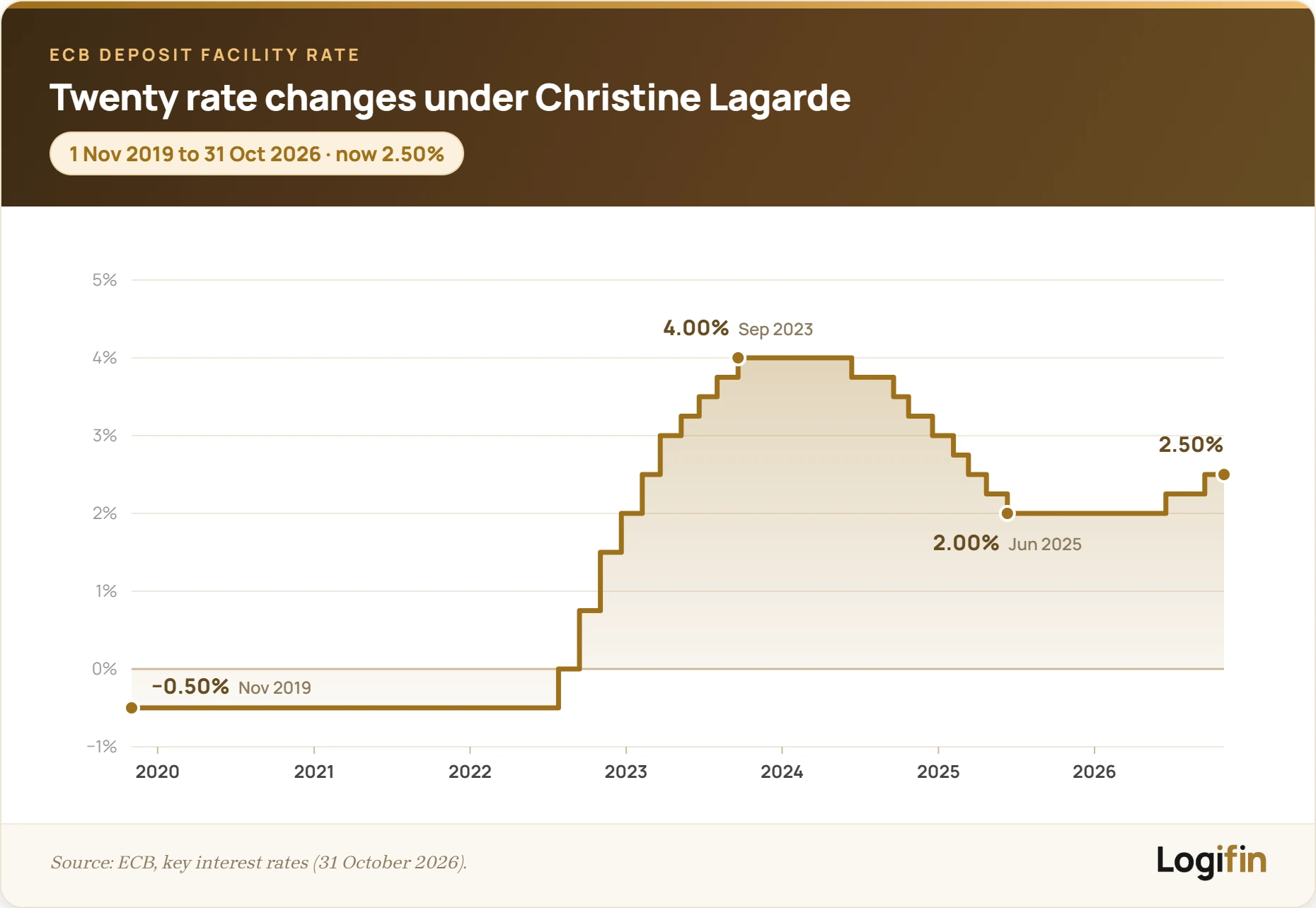
A few hours later the ECB left its deposit facility rate, the rate through which it steers monetary policy, unchanged at 2.50%. It had raised the rate from 2.00% in two steps, in June and in September. Euro area inflation, however, rose to 3.8% in September, driven mainly by energy, where prices were 18.9% higher than a year earlier.
According to Lagarde, the Governing Council discussed a hike but decided unanimously to wait. One reason was that bond yields had risen since the previous meeting, so borrowing became more expensive without a new ECB decision.
Why she is leaving early
Lagarde gave her reason at the press conference: "I want to have the freedom of speech, the freedom of expression and the freedom to engage on matters that are not monetary policy matters."
The ECB President, like the other members of the Governing Council, is under an obligation of neutrality. Public comments stay within the bank's mandate, which is price stability. Lagarde described this as "the price we pay for being independent". She said she did not think she could remain neutral, without revealing what she will do after 7 February.
Many questions were about France, her home country, where the first round of the presidential election takes place in April 2027. Holger Schmieding, chief economist at the German bank Berenberg, told the Associated Press that the early exit means her successor will be chosen while Emmanuel Macron is still President of France. In his view, the EU is protecting itself against the possibility that Marine Le Pen wins the election and influences the choice. Lagarde herself did not link her decision to the election.
How the next ECB President is chosen
The ECB President is appointed by the heads of state or government of the 21 euro area countries, meeting as the European Council. The procedure, as described by the Council of the EU, has four stages:
- Candidates. Euro area countries put forward names and the Eurogroup, made up of their finance ministers, agrees on one candidate.
- Recommendation. The Council of the EU adopts a recommendation to the European Council.
- Opinions. The European Parliament and the ECB Governing Council give their opinions.
- Appointment. The European Council decides by reinforced qualified majority: at least 16 of the 21 countries, representing at least 65% of the euro area population.
The term lasts eight years and cannot be renewed. In 2027, however, Lagarde's seat is not the only one to fill. Isabel Schnabel, who is responsible for the ECB's market operations, leaves on 3 January to join the International Monetary Fund. The term of chief economist Philip Lane ends on 31 May. Within five months, three of the six members of the Executive Board will change, the body that runs the ECB day to day.
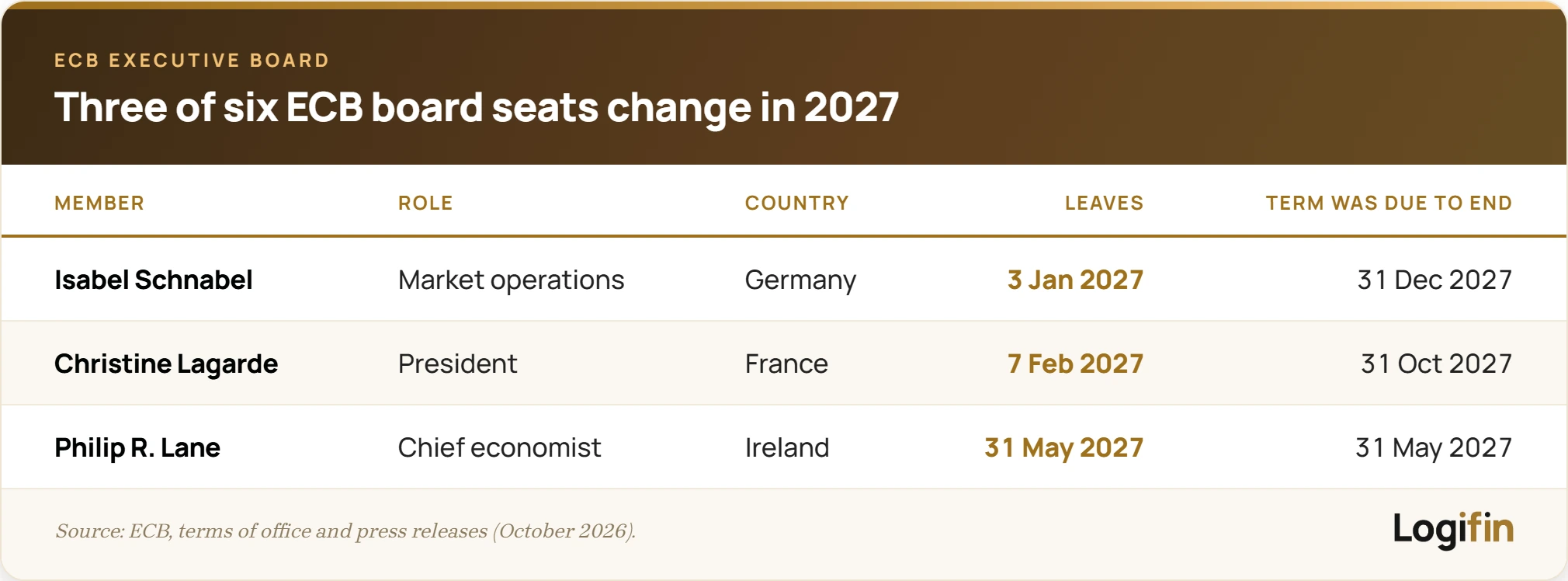
According to the AP, governments are expected to share out the three posts in a single package deal. For the presidency, analysts speaking to the AP and CNBC see two former national central bank governors as the leading contenders. Klaas Knot of the Netherlands headed the Dutch central bank from 2011 to 2025. Pablo Hernández de Cos of Spain headed the Bank of Spain and is now General Manager of the Bank for International Settlements. No official candidacies have been announced.
What it means for interest rates and bonds
Euro interest rates are not set by the President alone. They are set by the Governing Council, which brings together the six members of the Executive Board and the 21 governors of the national central banks. The President chairs the meetings and explains each decision in public.
That is why markets barely reacted. The ECB reference rate for the euro against the dollar was 1.1133 on Wednesday and 1.1130 on Thursday, after the announcement. The yield on the German 10-year bond moved from 3.43% to 3.42%, according to the Bundesbank. Reports of an early exit had been circulating since February.
Lagarde took office on 1 November 2019, with the deposit facility rate at minus 0.50%. During her term the rate changed 20 times: ten hikes up to 4.00% in September 2023, eight cuts down to 2.00% in June 2025 and two hikes this year.
Her successor will influence how much further rates rise and how the ECB responds if one country's bonds come under pressure. Analysts speaking to CNBC see Knot as the stricter of the two on inflation, meaning more willing to raise rates. They see Hernández de Cos as closer to continuity with current policy, with a focus on financial stability.
Pressure on bonds today mainly concerns France. According to CNBC, the gap between French and German bond yields is at its widest since the debt crisis of the early 2010s. For such cases the ECB has the Transmission Protection Instrument, a programme for buying a country's bonds when their yields rise sharply without justification in its economic data.
For anyone with savings, a loan or bonds in euros, the change of person matters through interest rates. The ECB deposit facility rate passes quickly into the returns of money market funds and money market ETFs. The prices of bonds already in circulation move the opposite way to rates: they fall when markets expect higher rates.
What to watch
The next ECB monetary policy meeting is on 17 December, with new projections and two more inflation readings published in the meantime. Lagarde said these data will show whether a hike is needed and that, unless there are major developments, "the direction of travel is quite clear for all of us".
Schmieding expects EU leaders to seek a deal on all three posts before the summit of 17 and 18 December. The last meeting with Lagarde as President is on 4 February 2027 and the first after her departure is on 18 March 2027.
What to take away
- Lagarde leaves the ECB on 7 February 2027, nine months early, because, as she put it, she can no longer remain neutral.
- Her successor is appointed by the 21 euro area countries by reinforced majority, together with two more Executive Board members and before the French election.
- Interest rates are set by the Governing Council, which is why markets barely reacted. The next President will still influence how far rates rise and how pressure on French bonds is handled.
Insights
Keep reading



EXPLORE LOGIFIN
Everything you need in order to learn, plan and track your investments.
Logifin Blog
Learn everything you need to get your finances in order and invest with confidence.
Logifin Insights
What moves the markets and what it means for a long term investor. Short and without the noise.
Logifin Tools
Free, inside the site, no signup. Everything you calculate stays on your device.
Logifin ETF Hub
Find the ETF that fits you: 500+ UCITS ETFs, smart filters and in-depth comparisons.
Logifin Guides
A series of guides that builds your investment plan step by step. The first guide is free for everyone.
Logifin Circle
The tools and the Hub are free for everyone. You become a member for the intelligence that never stops.