Logifin Insights
Why is France paying more to borrow?
France now pays more than Italy and Greece to borrow for ten years, even though its debt is lower. The explanation lies in its deficit and in political uncertainty.
10 October 2026 · 7 min read

On 2 October the yield on the French 10-year government bond rose to almost 4.9%, its highest level since 2002. The day before, the government had presented its budget for 2027. France now pays more to borrow for ten years than Italy and Greece, which both carry more debt. Markets do not only look at how much a country owes. They look at where its debt is heading and whether there is a government with the majority it needs to contain it.
How far France's borrowing cost has risen
The yield on a bond is the annual return earned by someone who buys it today and holds it to maturity. For the state that issues it, it is the cost of borrowing. In January the French 10-year yielded 3.53% on average according to the ECB, almost 1.4 percentage points less than in early October.
Part of the rise affects the whole euro area. The ECB raised rates in September because of energy-driven inflation and the German 10-year yield reached 3.69% on 28 September, its highest level since April 2011 according to the Bundesbank. The French yield rose much further. On 2 October the gap between French and German yields reached almost one and a half percentage points, up from 0.7 points in January.
This gap, the spread, is the extra interest investors demand to lend to France rather than to Germany. It is the widest since the euro area debt crisis of 2011 and 2012.
Why Italy and Greece borrow more cheaply
If markets judged on debt alone, the order would be reversed. At the end of 2025 public debt stood at 146.1% of GDP in Greece, 137.1% in Italy and 115.6% in France, according to Eurostat. Yet in August France paid an average of 4.00% to borrow for ten years, Italy 3.99% and Greece 3.87%. Since then the gap has widened: on 6 October the French 10-year yielded 4.85% and the Italian 4.61%.
The difference is explained mainly by the deficit, the amount by which a state spends more than it collects in a year. In 2025 Greece ran a surplus of 1.7% of GDP, Italy a deficit of 3.1% and France a deficit of 5.1%.
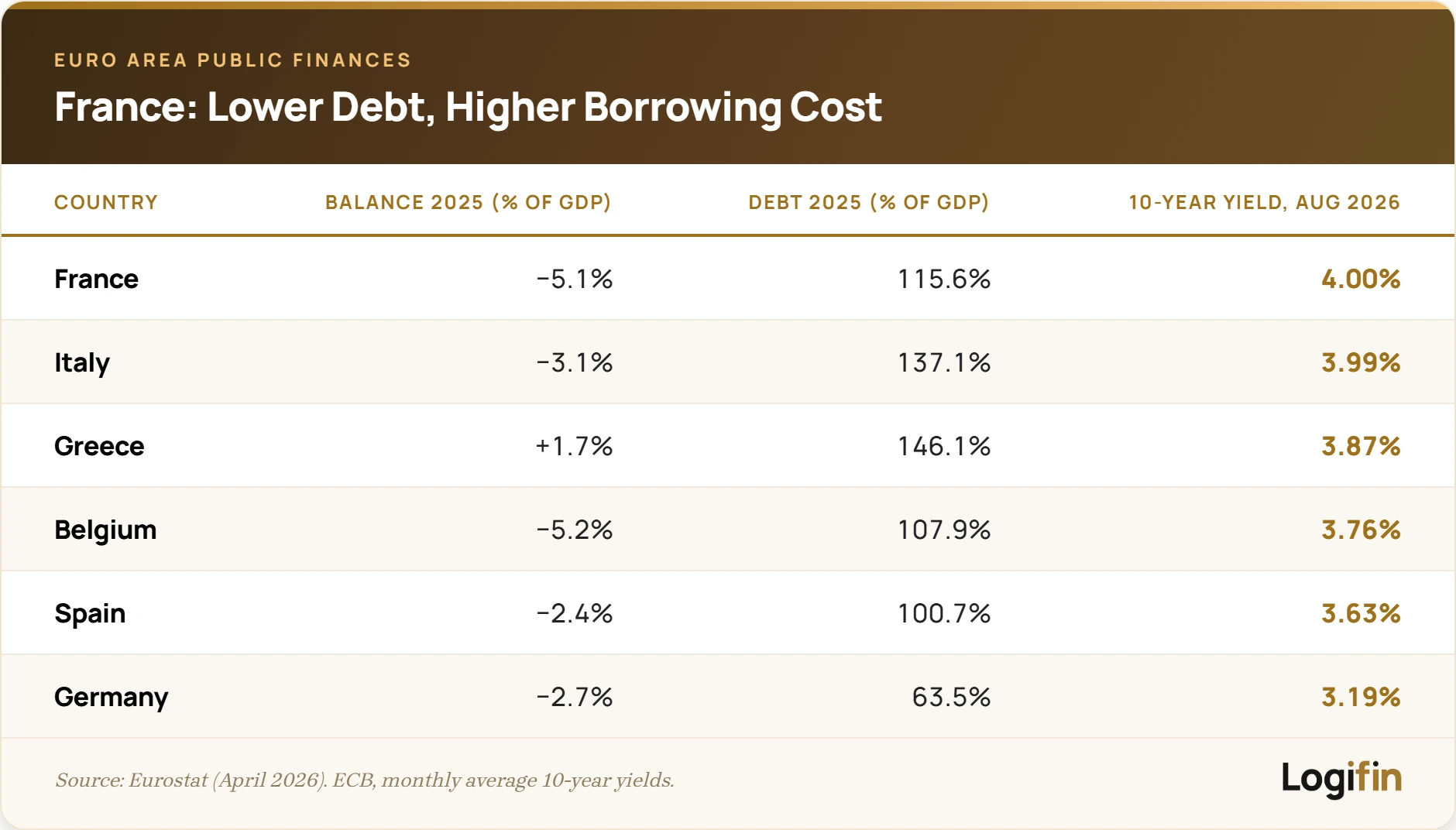
A country with a surplus reduces its debt as a share of GDP. In Greece debt fell from 154.2% to 146.1% in a single year. In France, with a deficit above 5%, debt reached 119.0% of GDP at the end of June according to INSEE, the French statistics office. The government's own budget projects 121.7% for 2027. Investors are pricing the direction of the debt more than its current level.
The deficit does not explain the borrowing cost on its own. Belgium ran a deficit of 5.2% in 2025, almost the same as France, but borrowed at 3.76% in August. In France there is also doubt about whether the political system can pass the measures that are needed.
The situation and the uncertainty in France
The government admits it will miss its target this year. The 2026 budget aimed for a deficit of 5.0% of GDP. The draft for 2027 revises that estimate to 5.4%, mainly because the conflict in the Middle East and the extreme weather of the summer reduced growth.
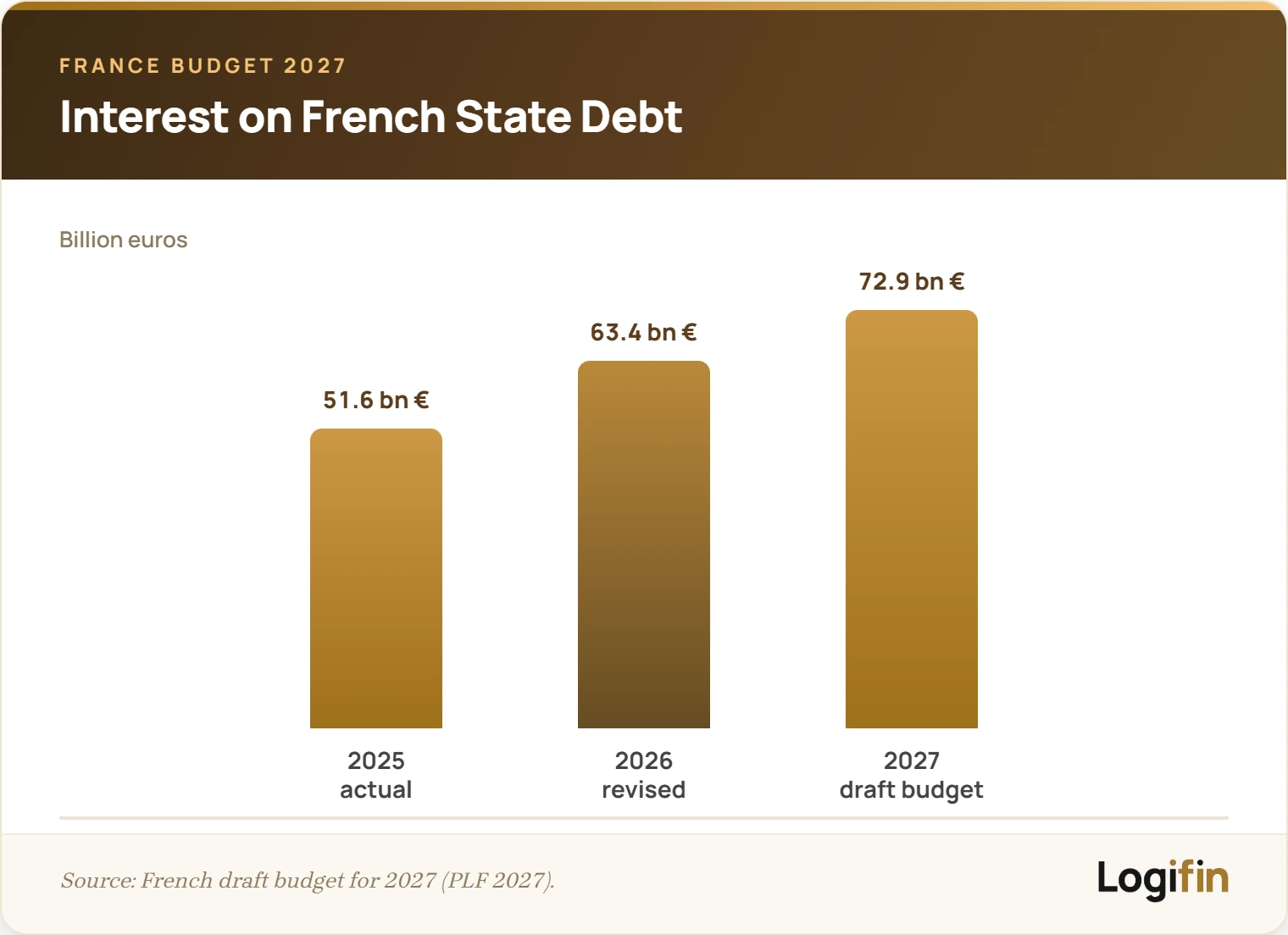
For 2027 the government of Sébastien Lecornu is targeting a deficit of 5.0%, with new measures worth 43 billion euros. Without them, according to the budget text itself, the deficit would rise by about one percentage point of GDP. Part of the pressure comes from interest, because bonds issued during the years of very low rates are maturing and being replaced with costlier ones.
The budget must first pass a National Assembly in which no party or coalition has a majority. On 2 October the Socialists, who supported the government last year after Lecornu suspended the pension reform, called the draft "not acceptable". Their leader Olivier Faure said that if nothing changes, a motion of censure is a given.
Bringing down the government takes 289 votes, an absolute majority of the Assembly. The left does not have them on its own, so the outcome also depends on Marine Le Pen's National Rally. Two governments have already fallen over the budget: that of Michel Barnier in December 2024 and that of François Bayrou in September 2025. The 2026 budget was finally passed without a vote, using Article 49.3 of the Constitution. If a motion of censure passes, the government resigns and the process effectively starts again.
Fitch, which kept France at A+ on 28 August, expects a deficit of 5.5% in 2027, above the government's target. All of this is happening six months before the presidential election of April 2027.
Why the problem does not stay in France
France is the second largest economy in the euro area. In the iShares Core € Govt Bond UCITS ETF, one of the largest euro government bond ETFs, French bonds made up 23.7% of the portfolio on 30 September, more than any other country. Whatever happens to French bonds therefore shows up in every euro area government bond portfolio.
A fiscal crisis begins when rising yields start to feed on themselves. Costlier borrowing raises interest payments, interest payments widen the deficit and a wider deficit worries investors even more. This is how the crisis of 2010 to 2012 spread from Greece to Ireland, Portugal, Spain and Italy.
Today there is a tool that did not exist then. Since July 2022 the ECB can buy a country's bonds through the Transmission Protection Instrument (TPI) when the rise in its yields is unwarranted and disorderly. The support comes with conditions: among other things, the country must comply with EU fiscal rules and have sustainable debt. France has been under an excessive deficit procedure since July 2024 and has committed to bring its deficit below 3% by 2029. The budget therefore matters for the ECB as well, since the TPI is meant for yield increases that are not justified by a country's public finances.
For a bond portfolio, rising yields mean falling prices, as explained in the insight on the ECB rate rise. The ETF mentioned above had a duration of 6.68 years on 30 September: a one percentage point rise in yields corresponds to a fall in its value of about 6.7%.
The dates that matter until the end of the year
- The debate in the National Assembly, which begins on 14 October. The Constitution gives Parliament 70 days; if it does not decide, the government can put the budget into force by its own act.
- The ECB meeting on 29 October. Every further rate rise increases the borrowing cost of every euro area state.
- The gap over German yields for France, Italy, Belgium and Greece. If it widens for all of them together, the pressure is no longer only about France.
What to take away
- France borrows at a higher rate than Italy and Greece even though its debt is lower, because its deficit is larger and its debt is rising.
- The 2027 budget has no secure majority, six months before the presidential election, while interest on state debt rises by 21 billion euros in two years.
- The ECB has a tool to contain a disorderly rise in yields, on condition that the country complies with EU fiscal rules.
EXPLORE LOGIFIN
Everything you need in order to learn, plan and track your investments.
Logifin Blog
Learn everything you need to get your finances in order and invest with confidence.
Logifin Insights
What moves the markets and what it means for a long term investor. Short and without the noise.
Logifin Tools
Free, inside the site, no signup. Everything you calculate stays on your device.
Logifin ETF Hub
Find the ETF that fits you: 500+ UCITS ETFs, smart filters and in-depth comparisons.
Logifin Guides
A series of guides that builds your investment plan step by step. The first guide is free for everyone.
Logifin Circle
The tools and the Hub are free for everyone. You become a member for the intelligence that never stops.