Logifin Insights
Stocks plunge, interest rates rise
In the week to 20 November the Nasdaq 100 lost 10.4% and Europe's STOXX 600 almost 6%. Inflation in the euro area, however, is 4.0% and markets still expect the ECB to raise interest rates on 17 December. A hike passes immediately to money market ETFs, has already largely passed into the Euribor rate behind variable loans and reaches bank deposits slowly. What the ECB had warned about and what it weighs before deciding.
· 6 min read

In the week to 20 November stocks had their worst run in years. The Nasdaq 100 lost 10.4%, its biggest weekly fall since March 2020. Europe's STOXX 600 index fell almost 6%. In the euro area, however, inflation rose to 4.0% in October, double the European Central Bank's target. Markets still expect the ECB to raise its deposit rate from 2.50% to 2.75% on 17 December. In a note on Tuesday 24 November, the Nordic bank Nordea wrote that the hike is almost fully priced in.
The worst week for stocks since 2020
The US S&P 500 fell in all five sessions of the week and lost 8.61% in total, according to TheStreet. On Friday it closed 10% below its record of 6 October, which means it was in a correction, the term used for a 10% fall from the peak. The biggest losses were in chip and artificial intelligence stocks. The PHLX semiconductor index lost 17.13%, more than in any single week since September 2001, after the attack on the Twin Towers.
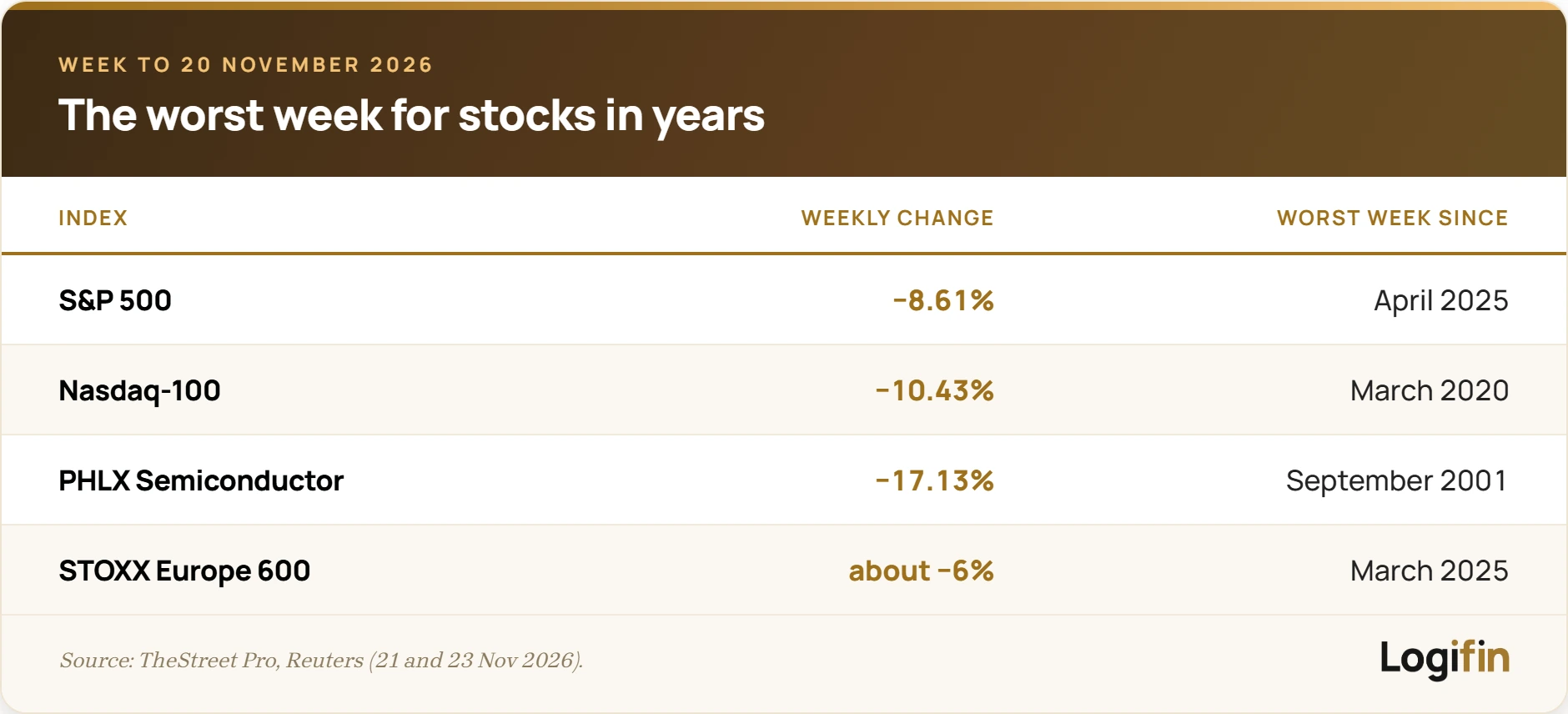
In Europe the fall in the STOXX 600 was the largest since March 2025. Reuters linked it to doubts about when investments in artificial intelligence will pay off and to the performance of Anthropic after its stock market listing. On Monday 23 November, when Nvidia announced the return of Jensen Huang, the S&P 500 rose 4.74% and left correction territory. On Tuesday chip stocks fell again.
What the ECB had warned about on 18 November
In the middle of that week, on Wednesday 18 November, the ECB published its Financial Stability Review, which comes out twice a year. The market data it uses stops on 10 November, so it was written before the fall. The ECB wrote that the valuations of artificial intelligence companies rely on ambitious earnings expectations and that this leaves markets exposed to abrupt corrections. According to the review, those expectations could be challenged if financing for the investments becomes harder or if cheaper AI models take share from more expensive ones.
The review makes two more points. Investment in AI infrastructure is increasingly funded with debt, so a change in sentiment could carry losses from stocks over to bonds. In addition, the very large stock market listings of AI companies may be a sign of excessive enthusiasm, of the kind that usually appears at the end of a long rise.
For European stocks the review paints a calmer picture. Their valuations, measured by the ratio of price to expected earnings for the next year, are close to their average since 2005. European indices also have a smaller weight in technology and AI companies than US indices.
Inflation at 4% came mostly from energy
On the same day, 18 November, Eurostat confirmed in its final data that inflation in the euro area rose to 4.0% in October, from 3.8% in September. Of the 4.0 percentage points, 1.89 came from energy, where prices were 21.0% higher than a year earlier. Services added another 1.55 points, with prices up 3.3%.
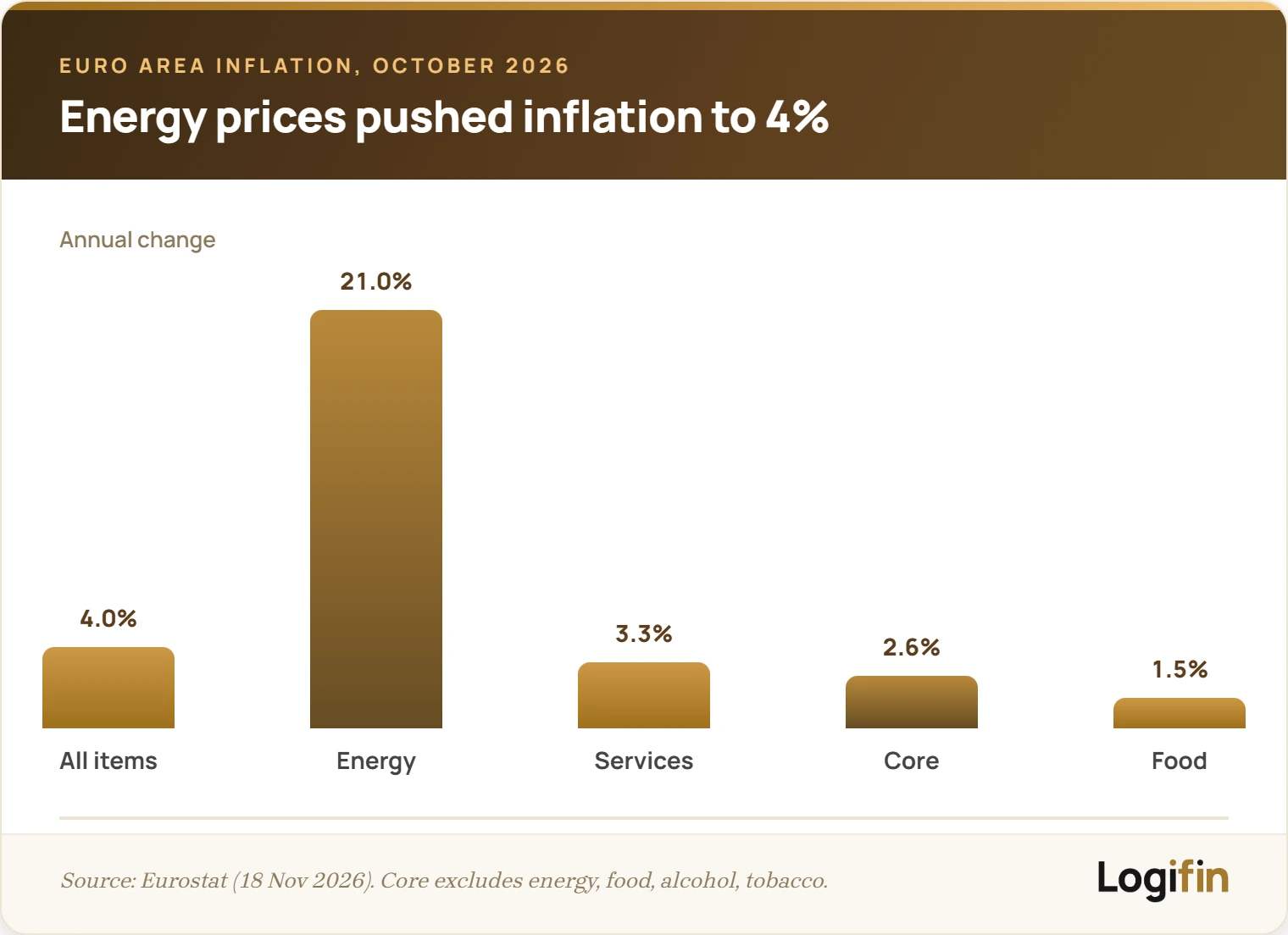
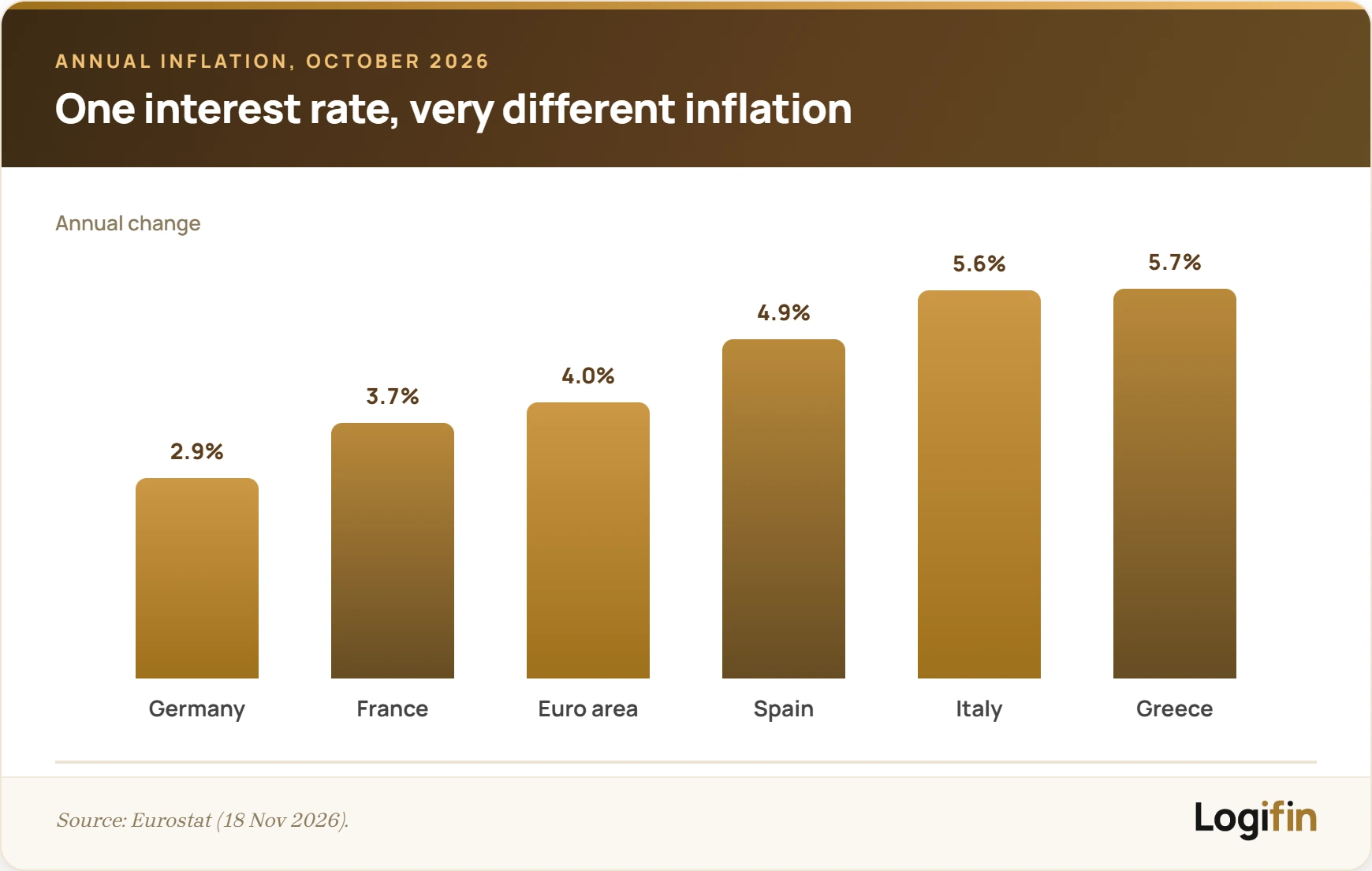
Core inflation, which excludes energy, food, alcohol and tobacco, rose to 2.6% from 2.5%. This measure shows whether higher prices are spreading from energy to other prices and to wages, which is what the ECB has been trying to prevent since June, when it started raising rates. The differences between euro countries are large: in October inflation was 2.9% in Germany, 3.7% in France, 4.9% in Spain, 5.6% in Italy and 5.7% in Greece.
What the ECB weighs before 17 December
The ECB has one main mandate, price stability, with a target of 2% inflation over the medium term. Interest rates are its tool for inflation. For the stability of the financial system it has other tools, such as banking supervision and a bond purchase programme for countries under pressure that their economic data do not justify. A fall in stocks affects the interest rate decision only if it changes the outlook for the economy and for inflation. That can happen if households spend less because their investments are worth less or if companies have to borrow at higher cost.
Before the fall, ECB policymakers were pointing towards a hike. On 10 November the ECB's chief economist Philip Lane told Bloomberg that, if the information the ECB has in December is the same as it had at that moment, it would be prudent to raise rates. On the same day the president of the German central bank, Joachim Nagel, spoke of a strong case for a hike. In a Reuters poll on 10 to 12 November, all 71 economists expected a hike to 2.75%. Forty six of them thought the hikes would stop there, while 25 expected one more, mostly in the first quarter of 2027.
Before the ECB meeting there are three dates to note:
- 1 December. Eurostat publishes its first estimate of November inflation, the last major data point before the decision.
- 16 and 17 December. The ECB Governing Council meets. On Thursday 17 December it announces its decision and the new Eurosystem staff projections for inflation and growth.
- 3 and 4 February 2027. The first meeting of 2027 is also the last for Christine Lagarde, who steps down on 7 February.
What it means for deposits, loans and bonds
A rise in the ECB deposit rate does not pass automatically and in full to savers or borrowers. The effect depends on the product:
- Deposits. Banks decide for themselves how much to raise the rates they pay and usually do so slowly. According to the Logifin Savings Monitor, in September a new term deposit of up to one year paid on average 1.28% in Greece and 2.33% in the euro area. Money market ETFs such as XEON track €STR, the rate at which euro area banks lend to each other overnight. €STR moves together with the ECB deposit rate.
- Loans. Variable rate loans follow Euribor, which is set on the basis of expectations for ECB rates. A hike that the market expects has largely passed into Euribor before it is announced.
- Bonds. When interest rates rise, the prices of bonds already in circulation fall. The fall is larger the longer their duration. According to the ECB review, yields on European government bonds are close to their highest level since the global financial crisis, especially at long maturities.
What to take away
- In the week to 20 November the Nasdaq 100 lost 10.4% and the STOXX 600 almost 6%. In the middle of that week the ECB had written that the valuations of AI companies leave markets exposed to abrupt corrections.
- Inflation in the euro area is 4.0%, mostly because of energy, while core inflation rose to 2.6%. Because the ECB sets interest rates on the basis of inflation, markets still expect a hike to 2.75% on 17 December.
- A hike passes immediately to money market ETFs, has largely passed into Euribor already and reaches bank deposits slowly. In bonds, rising rates lower the prices of those with long duration the most.
Insights
Keep reading



EXPLORE LOGIFIN
Everything you need in order to learn, plan and track your investments.
Logifin Blog
Learn everything you need to get your finances in order and invest with confidence.
Logifin Insights
What moves the markets and what it means for a long term investor.
Logifin Tools
Free, inside the site, no signup. Everything you calculate stays on your device.
Logifin ETF Hub
Find the ETF that fits you: 500+ UCITS ETFs, smart filters and in-depth comparisons.
Logifin Guides
A series of guides that builds your investment plan step by step. The first guide is free for everyone.
Logifin Circle
The tools and the Hub are free for everyone. You become a member for the intelligence that never stops.