Logifin Insights
Huang back at Nvidia after 11 days
Eleven days after his resignation, Jensen Huang returns as Nvidia's chief executive by unanimous decision of the board. The stock opened 33% higher and during the day the rise exceeded 36%. What the board decided, how it got here, which investigations remain open and what it means for anyone who holds an ETF.
· 8 min read
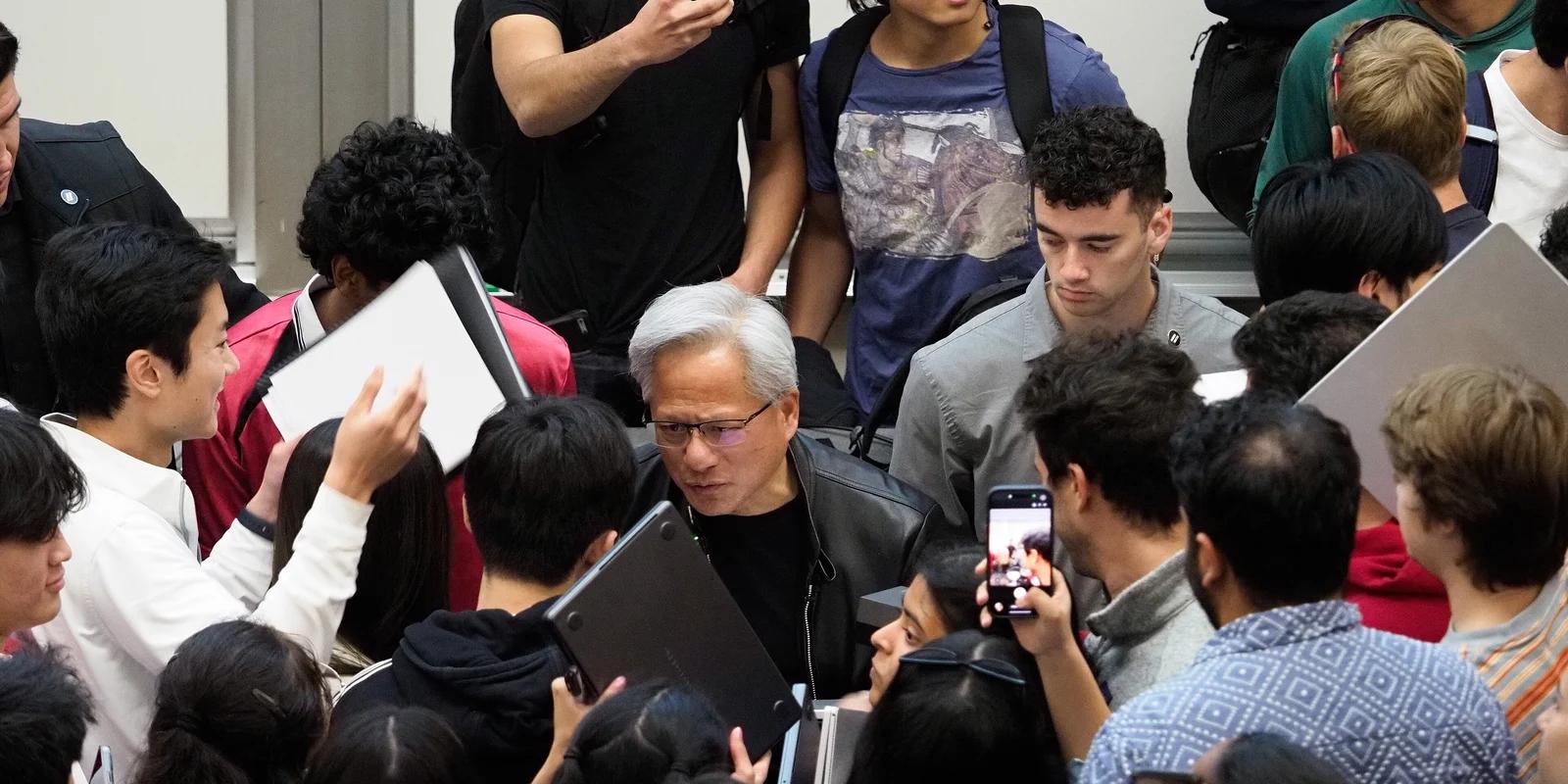
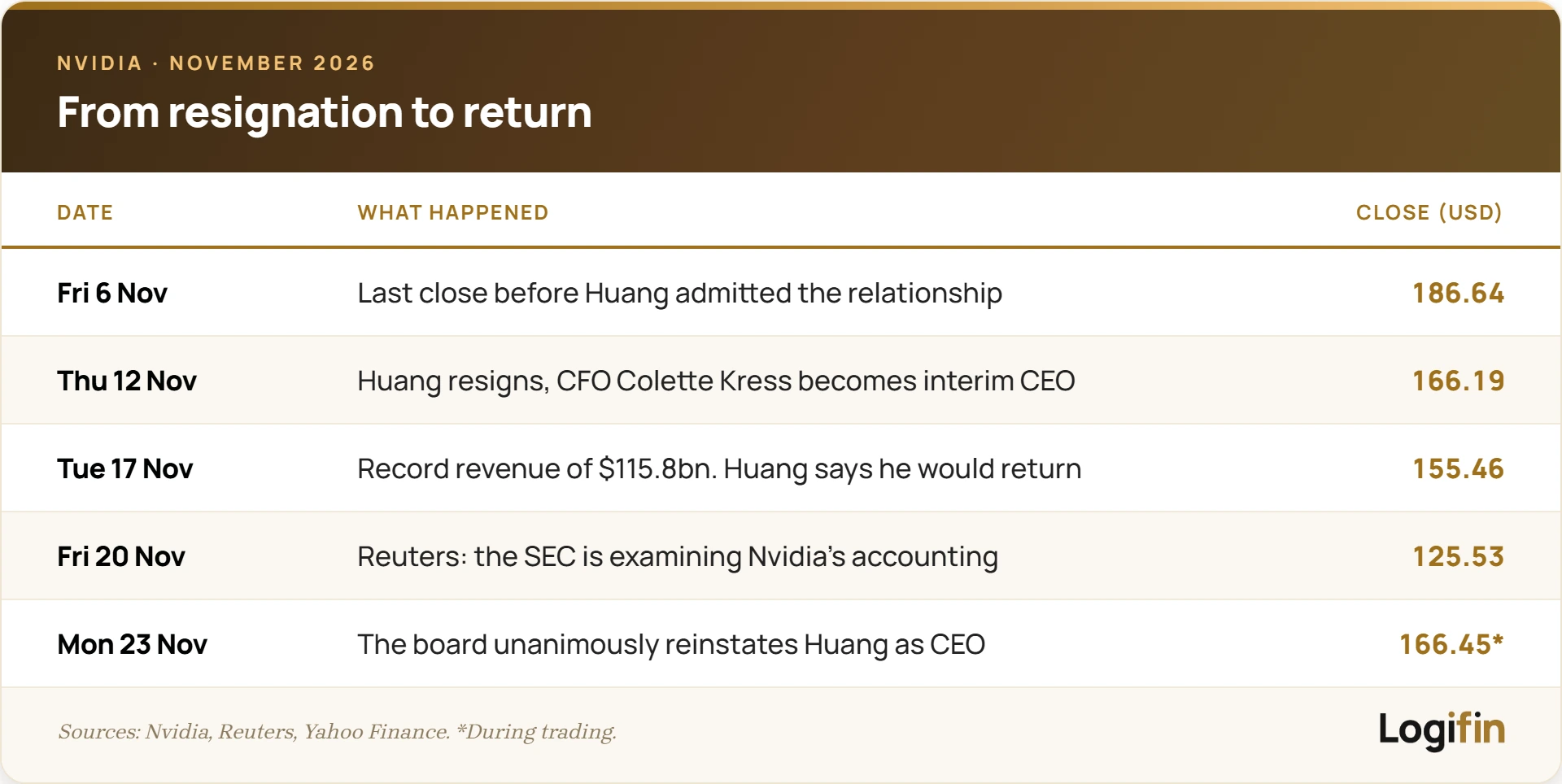
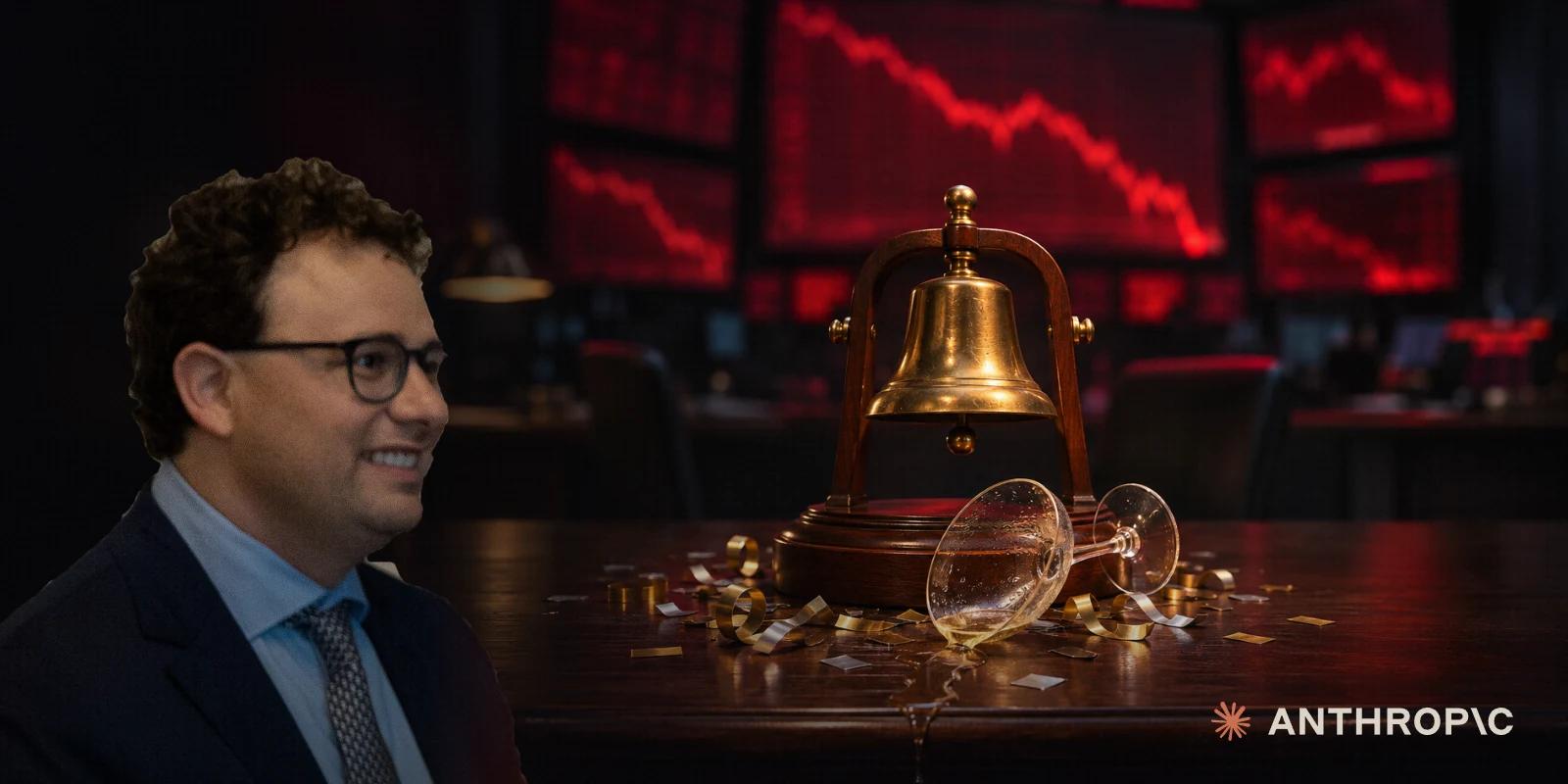
Jensen Huang is once again chief executive of Nvidia. On Monday 23 November, before Wall Street opened, the company announced that the board had unanimously reinstated him as president and chief executive and as a member of the board, effective immediately. Eleven days had passed since his resignation. The stock opened at 167.04 dollars, 33.1% above Friday's close, and during the day the rise exceeded 36%. The opening price is close to where the stock closed on the day of the resignation, 12 November.
What the Nvidia board decided
According to the announcement, which was also filed with the US Securities and Exchange Commission (SEC), the board decided after a series of discussions and meetings with Huang. The announcement has four parts:
- Return with immediate effect. Huang is again president and chief executive and rejoins the board. Harvey Jones remains chair of the board, a role he took after the resignation.
- Kress goes back to finance. Colette Kress, who was interim chief executive, continues as chief financial officer.
- The government's view. The board writes that it received input from senior levels of the US government and that, based on that input, it is confident Huang's return poses no national security risk.
- The investigation continues. The board's independent committee will complete its investigation into reports that Huang was the target of a foreign intelligence effort. The company is also looking for a chief compliance officer, who will report to a board committee.
The board says it is satisfied with Huang's candour and with his ability to lead the company. Huang said he returns with the greatest humility and renewed commitment. President Trump wrote on Truth Social that the decision was correct and that the government has no evidence that Huang did anything unlawful, as reported by CNBC. On 12 November he had suggested Apple's Tim Cook for the job.
The new committee for national security and export control, set up on 17 November, consists of three independent directors. It is chaired by Suzanne Nora Johnson, a former vice chair of Goldman Sachs, and its members are Stephen Neal, a former chief executive of the law firm Cooley, and John Dabiri, a professor at Caltech. Nvidia's national security team and its global trade compliance team now report to it, and it will meet at least once a quarter.
How it got here in eleven days
On 8 November Huang admitted to a relationship with a woman who, according to US intelligence agencies, is linked to Chinese intelligence. The woman was a senior executive and controlling shareholder of Megaspeed, a Singapore-based company under investigation over the possible diversion of Nvidia chips to China. On 22 November the New York Times reported that, for at least part of the time, she was in contact with an officer of China's Ministry of State Security. On 12 November Nvidia announced his resignation, as described in the Insight of that day. Three things happened in the days that followed that explain the decision.
On Tuesday 17 November Huang said he would be honoured to return if the board judged it to be in the interest of shareholders and employees, and that he owns his mistakes completely. On the same day the board set up a committee of independent directors for national security and export control, according to Reuters. Until that week the board had said it was not considering his return. Kress herself repeated this in an interview with CNBC the next day. By the close on Monday 16 November the affair had already wiped more than 400 billion dollars off Nvidia's market value.
That evening Nvidia reported its first results without Huang. Quarterly revenue was 115.8 billion dollars, 103% more than a year earlier, and the forecast for the next quarter is 130 billion. The figures beat analyst estimates, but the stock kept falling.
On Friday 20 November Reuters reported, citing two people briefed on the matter, that the SEC is examining potential accounting issues at Nvidia. The stock closed at 125.53 dollars, down 14% in one day. It was the lowest close since May 2025. It was also the stock's seventh losing week in a row, the longest such run since 2008, as CNBC noted.
How Nvidia's stock reacted
Before the open the stock was up about 27%. It opened at 167.04 dollars and shortly after 10:20 New York time reached 171.50, which is 36.6% above Friday. A rise of this size within a single day is Nvidia's largest since at least 2021. The previous largest was 24.4%, in May 2023, when the company gave a revenue forecast far above estimates.
Large investors had called for his return in public. Gavin Baker of Atreides Management and Brad Gerstner of Altimeter Capital had said since 14 November that Nvidia needs Huang. After the announcement Elon Musk wrote on X that the board's mistake had been corrected.
Even at the day's high, the stock was 8.1% below its close of 6 November, before Huang admitted the relationship, and 28.3% below the record of 239.24 dollars set on 6 October. The market has taken the stock back to roughly where it was on the day of the resignation. It has not taken it back to where it was before the affair began.
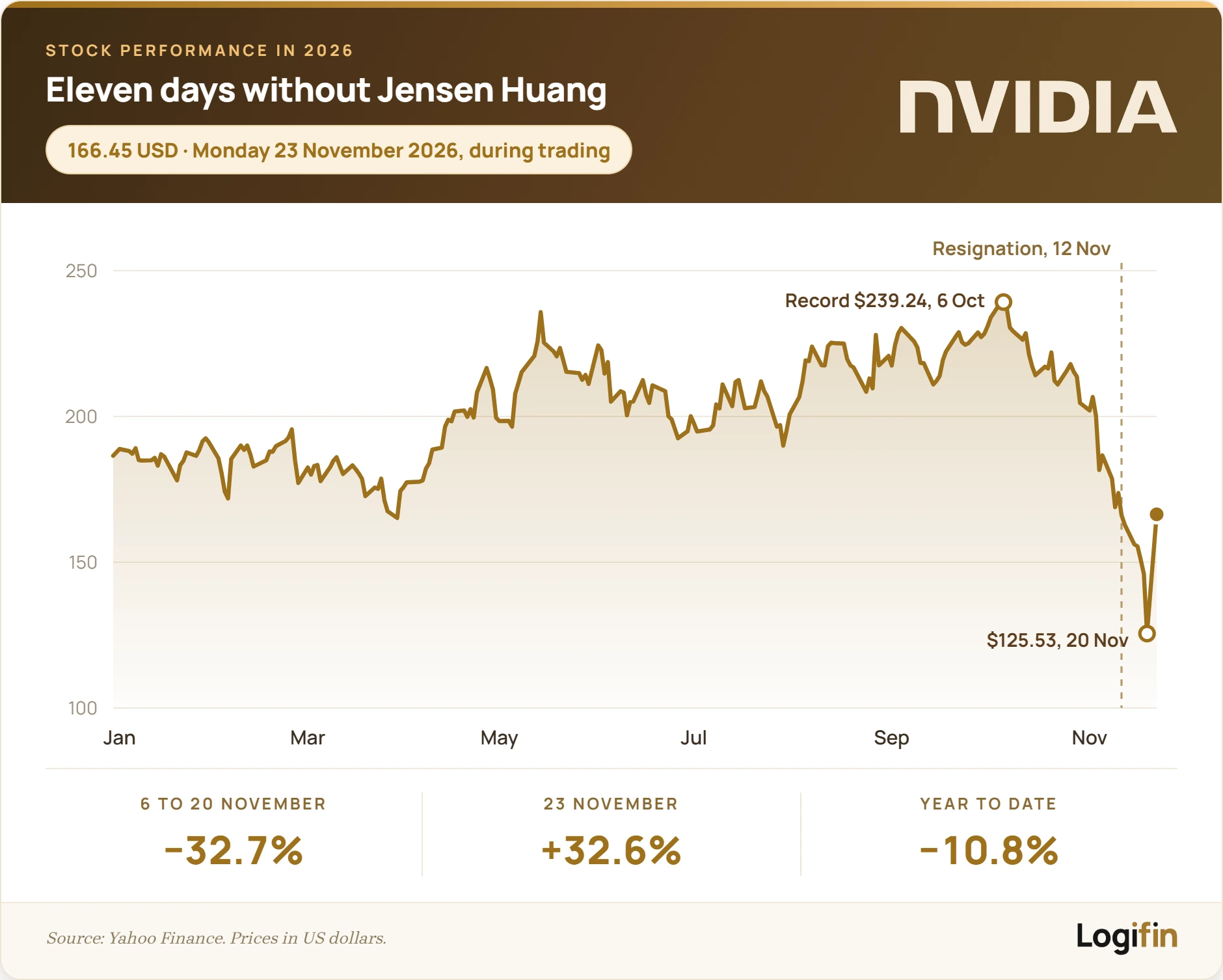
The gap has an explanation. Investors call it key man risk, the risk a company carries when it depends on one person, and Nvidia had depended on Huang since he founded it in 1993. His return removes that risk. It does not remove the investigations, which continue, or the tighter limits on chip sales to China that the US government signalled on 16 November.
Which investigations remain open
Huang's return closes none of the four matters that opened in November.
- The board's investigation. It is being run by the independent committee with the law firm Wachtell Lipton. The board repeated that it will be completed, without giving a date. Huang says he will cooperate.
- The SEC. The US Securities and Exchange Commission did not comment on the Reuters report and Nvidia did not respond. It is not known when the review began or which accounting issues it covers. According to press reports, the questions relate to the way Nvidia changed its presentation of revenue by country in 2025. The Financial Times had reported that the change came as sales billed in Singapore had reached almost half of the total.
- Congress, 1 December. Huang will sit for a closed-door interview with three committees of the House of Representatives, according to CBS. Nvidia's general counsel, Tim Teter, follows the next day. Huang has also agreed to testify at a public Senate hearing, for which no date has been set.
- Exports to China. The board's new committee will oversee the company's compliance with export rules, while the forecast for the next quarter includes no revenue from data center chips in China.
What it means for anyone who holds an ETF
Anyone who holds an S&P 500 ETF, such as VUAA, or a global equity ETF, such as VWCE or IWDA, also holds Nvidia. On 20 November, after the fall, Nvidia weighed 5.1% in the S&P 500 and ranked third, behind Apple and Microsoft. That was its weight in the holdings of SPY, the largest ETF on the index. On 10 November it was 6.3% and second.
With a weight of 5.1%, a 33% rise in Nvidia adds about 1.7 percentage points to an S&P 500 ETF on its own, if all other stocks stay flat. In a global ETF the effect is smaller, because there US stocks share the fund with stocks from other countries. Anyone who holds a thematic ETF on chips, such as SEMI or VVSM, holds more Nvidia, so moves in the stock pass through to the fund more strongly.
What to take away
- Jensen Huang returned to Nvidia eleven days after his resignation, by unanimous decision of the board and with the backing of the White House. Colette Kress goes back to the role of chief financial officer.
- The stock opened 33% higher and during the day the rise exceeded 36%, but it stayed below its level of early November. The market removed the risk of his departure, not the risk from the investigations.
- Next come Huang's interview with Congress on 1 December, the board's investigation and the SEC review. Nvidia weighs around 5% to 6% in an S&P 500 ETF, so each of these stories also reaches the fund.
Insights
Keep reading

EXPLORE LOGIFIN
Everything you need in order to learn, plan and track your investments.
Logifin Blog
Learn everything you need to get your finances in order and invest with confidence.
Logifin Insights
What moves the markets and what it means for a long term investor.
Logifin Tools
Free, inside the site, no signup. Everything you calculate stays on your device.
Logifin ETF Hub
Find the ETF that fits you: 500+ UCITS ETFs, smart filters and in-depth comparisons.
Logifin Guides
A series of guides that builds your investment plan step by step. The first guide is free for everyone.
Logifin Circle
The tools and the Hub are free for everyone. You become a member for the intelligence that never stops.