Logifin Insights
Nvidia without Jensen Huang
Jensen Huang has resigned from Nvidia after 33 years and chief financial officer Colette Kress has taken over on an interim basis. How the stock reacted, how much the company depended on its founder, who could succeed him and what it means for anyone who holds an ETF.
· 8 min read

Jensen Huang is no longer the chief executive of Nvidia. On Thursday 12 November the company announced that he has resigned as chief executive and as a member of the board of directors, effective immediately, after 33 years. Chief financial officer Colette Kress becomes interim chief executive until the board finds a permanent successor. The stock opened 13.1% lower on Wall Street and recovered more than half of that fall within the first hours of trading.
What Nvidia announced and what came before
The announcement came before Wall Street opened. According to the filing Nvidia made with the US Securities and Exchange Commission, the board had accepted the resignation on Wednesday 11 November. The announcement has three parts:
- Interim leadership. Colette Kress has been Nvidia's chief financial officer since 2013. She becomes interim chief executive and keeps her existing role.
- First chair of the board. The board of directors gets a chair for the first time, Harvey Jones, who has been a director since 1993.
- Search for a successor. For the permanent role the board will consider candidates from inside and outside the company. No timetable was given.
The announcement thanks Huang for his contribution and gives no reason for his departure. It also says nothing about the independent investigation the board had opened. Huang himself has not made a statement. Jones said the company's operations, customer commitments and product roadmap will continue without interruption.
The story began on 29 October. The New York Times reported then that, according to US intelligence agencies, a woman who is an executive at a company that buys from Nvidia has been recruited by Chinese intelligence. On 8 November Huang admitted in an email to employees that he had had a relationship with her. On the same day the board opened an investigation and said it had confidence in Huang, as the previous Insight describes.
On Wednesday 11 November the New York Times reported that Huang had also had a relationship with a senior Nvidia executive who reported directly to him. The newspaper cites five people who worked at the company and the report has been neither confirmed nor denied. Shortly afterwards the Wall Street Journal reported that the board was preparing to remove Huang.
How Nvidia's stock reacted
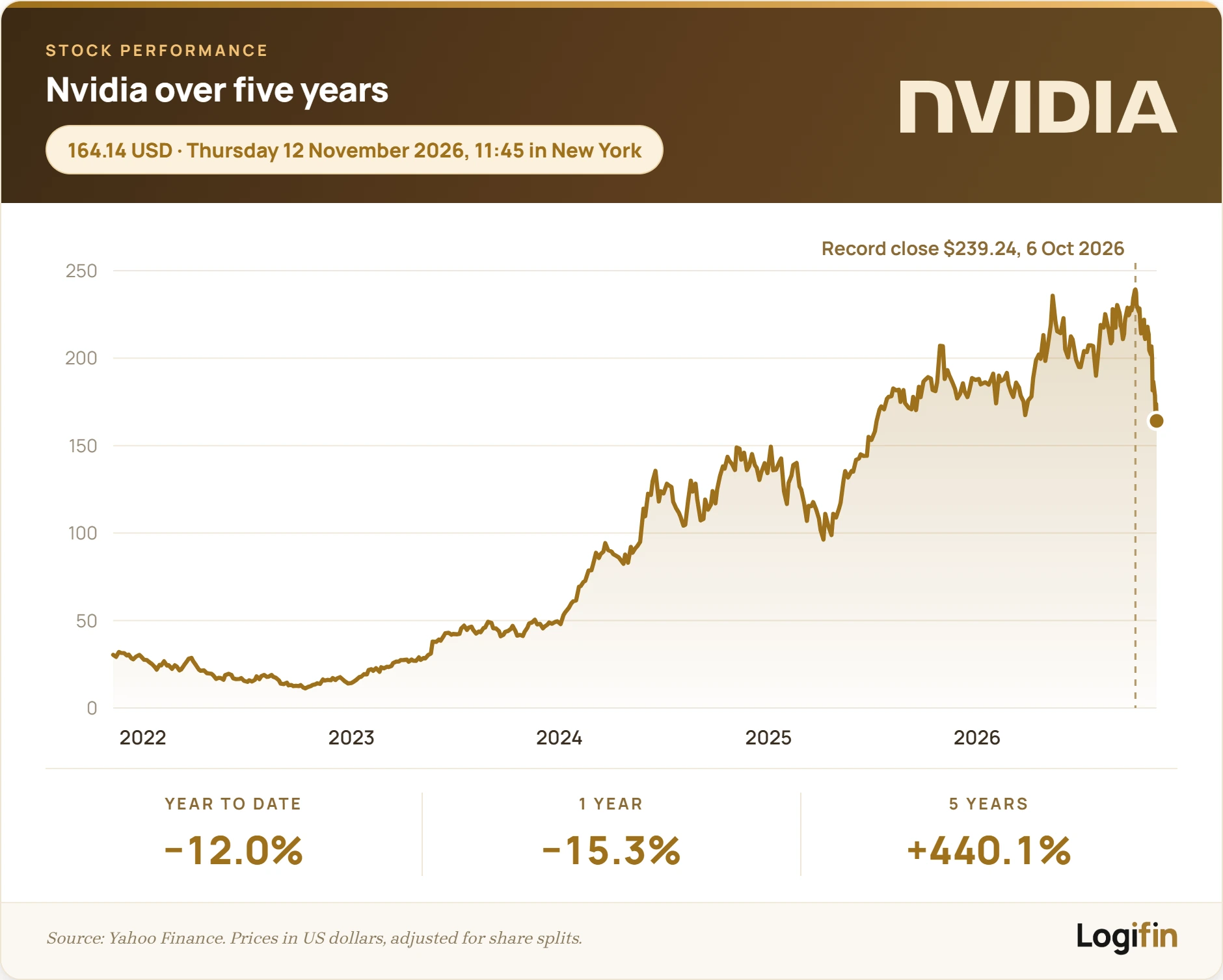
The stock had closed on Wednesday at 173.73 dollars. On Thursday it opened at 150.99 dollars, 13.1% lower. At that price Nvidia lost about 550 billion dollars of market value at the open. In the first minutes the stock fell as low as 148.80 dollars. By 11:45 in New York it had returned to 164.14 dollars and the fall for the day had narrowed to 5.5%.
Nvidia had reached its record of 239.24 dollars on 6 October, when it was worth almost 5.8 trillion dollars. At Thursday's open it stood 36.9% below that record. The last time the stock had closed below Thursday's opening price was in June 2025.
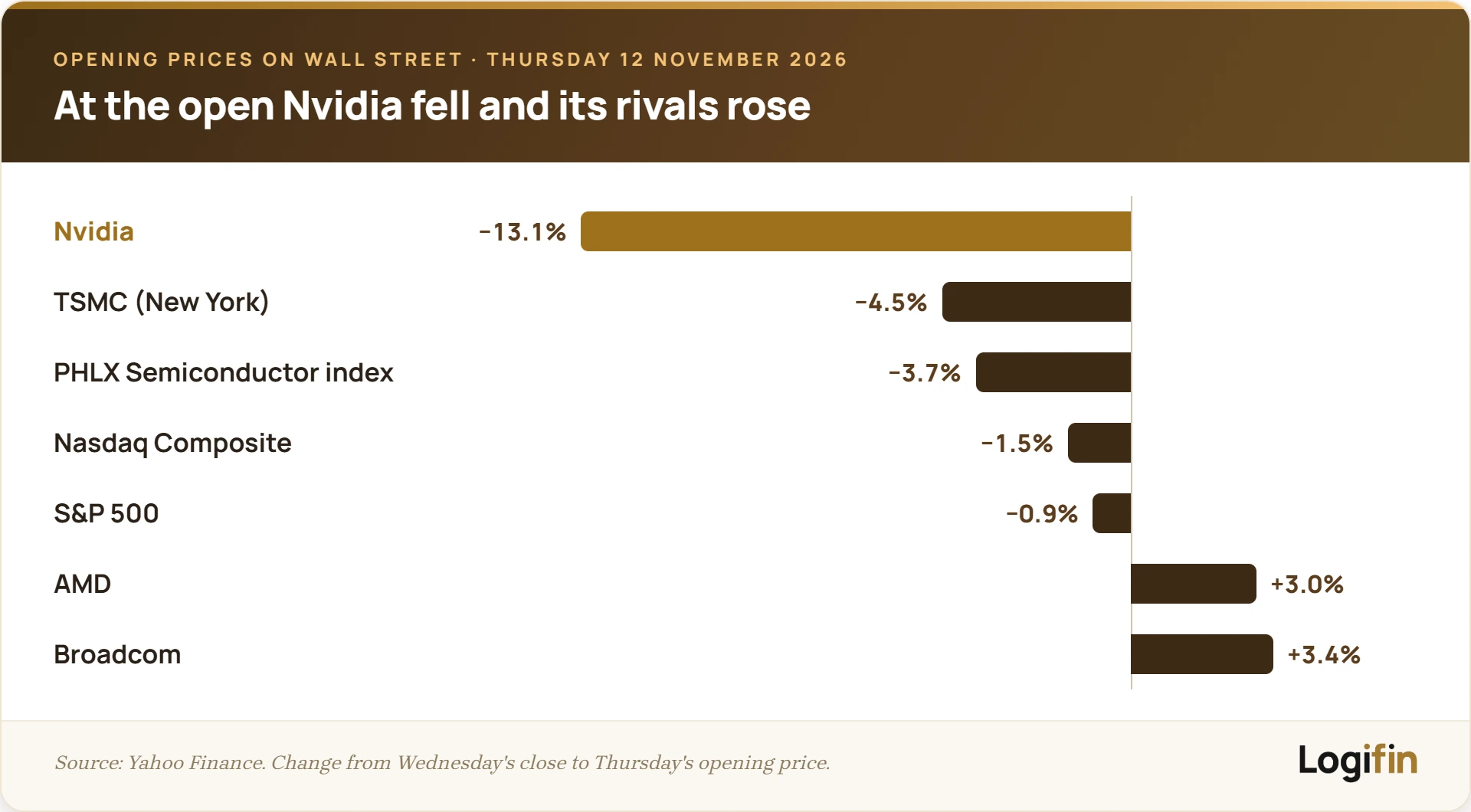
The fall did not spread to the market as a whole. The S&P 500 opened 0.9% lower and by 11:45 in New York it was back at Wednesday's level. AMD and Broadcom, two of Nvidia's competitors, opened 3.0% and 3.4% higher and were up more than 5% by 11:45. TSMC, which manufactures Nvidia's chips, opened 4.5% lower and later narrowed its fall to 1.5%. The market treated the resignation as the problem of one company. The picture was different on 5 November, when fears about spending on artificial intelligence had pulled all chip stocks down together.
Analysts read the resignation in two ways, as CNBC reports. John Vinh of KeyBanc wrote that Huang's departure is a material increase in strategic, organisational and execution risk. Jeremiah Buckley of Janus Henderson said the resignation could clear the air around Nvidia.
How much Nvidia depended on Huang
Huang founded Nvidia in 1993 with two other engineers and had run it since its first day. He had around sixty direct reports, no executive acted as his deputy and he had said publicly in March that he does not believe in succession planning. Investors call this dependence key man risk, the risk a company carries when it relies on one person. Stacy Rasgon of Bernstein had put it in one sentence on 9 November: Jensen is not an ordinary chief executive, he is Nvidia.
The company's financial results did not change with the resignation. In the quarter to 26 July Nvidia had revenue of 96.2 billion dollars, more than double the figure of a year earlier, and net income of 59.7 billion. It has about 42,000 employees and, according to research firm IDC, it takes 81% of the revenue from data centre chips. Until now, however, the decisions about the next products and the largest customers were made by Huang. It is not known who will make them from here on.
Who could succeed Huang
Kress now holds two roles and, as Bloomberg notes, a chief financial officer is usually seen as a temporary choice and not a permanent one. The board has not named any candidate for the permanent role. Analyst Ben Bajarin of Creative Strategies told CNBC that the most logical internal candidate is Ian Buck, the Nvidia vice president in charge of the data centre business. President Trump wrote on Truth Social that the job should go to Tim Cook of Apple. Huang remains a shareholder with about 3.5% of the company. His shares do not carry extra voting rights.
Whether a successor is ready has mattered in earlier departures. When Steve Jobs stepped down at Apple in August 2011, Tim Cook took over on the same day and the stock was 76% higher a year later. When HP suddenly lost its chief executive in August 2010, the stock was 32% lower a year later. Two examples do not make a rule and over a year a stock is moved by many other things.
What it means for anyone who holds an ETF
Anyone who holds an S&P 500 ETF, such as VUAA, or a global equity ETF, such as VWCE, also holds Nvidia. In the S&P 500 Nvidia is the second largest company after Apple, with a weight of 6.3%. That was its weight in the holdings of SPY, the largest ETF on the index, on 10 November. In a global ETF its weight is around 4%. On the same day it was 4.3% in the MSCI World, the index of IWDA, and 3.9% in the MSCI ACWI.
With these weights, a 13% fall in Nvidia takes about 0.8 of a percentage point off an S&P 500 ETF and between 0.5 and 0.6 off a global ETF, if all other stocks stay unchanged. The S&P 500 did open 0.9% lower, almost exactly what Nvidia explains on its own.
Anyone who holds a thematic ETF for chips holds more Nvidia. Its weight was 6.8% in the iShares MSCI Global Semiconductors UCITS ETF (SEMI) on 10 November and 8.9% in the VanEck Semiconductor UCITS ETF (VVSM) on 11 November. These ETFs also hold its competitors, however, which rose on Thursday.
The next dates for Nvidia
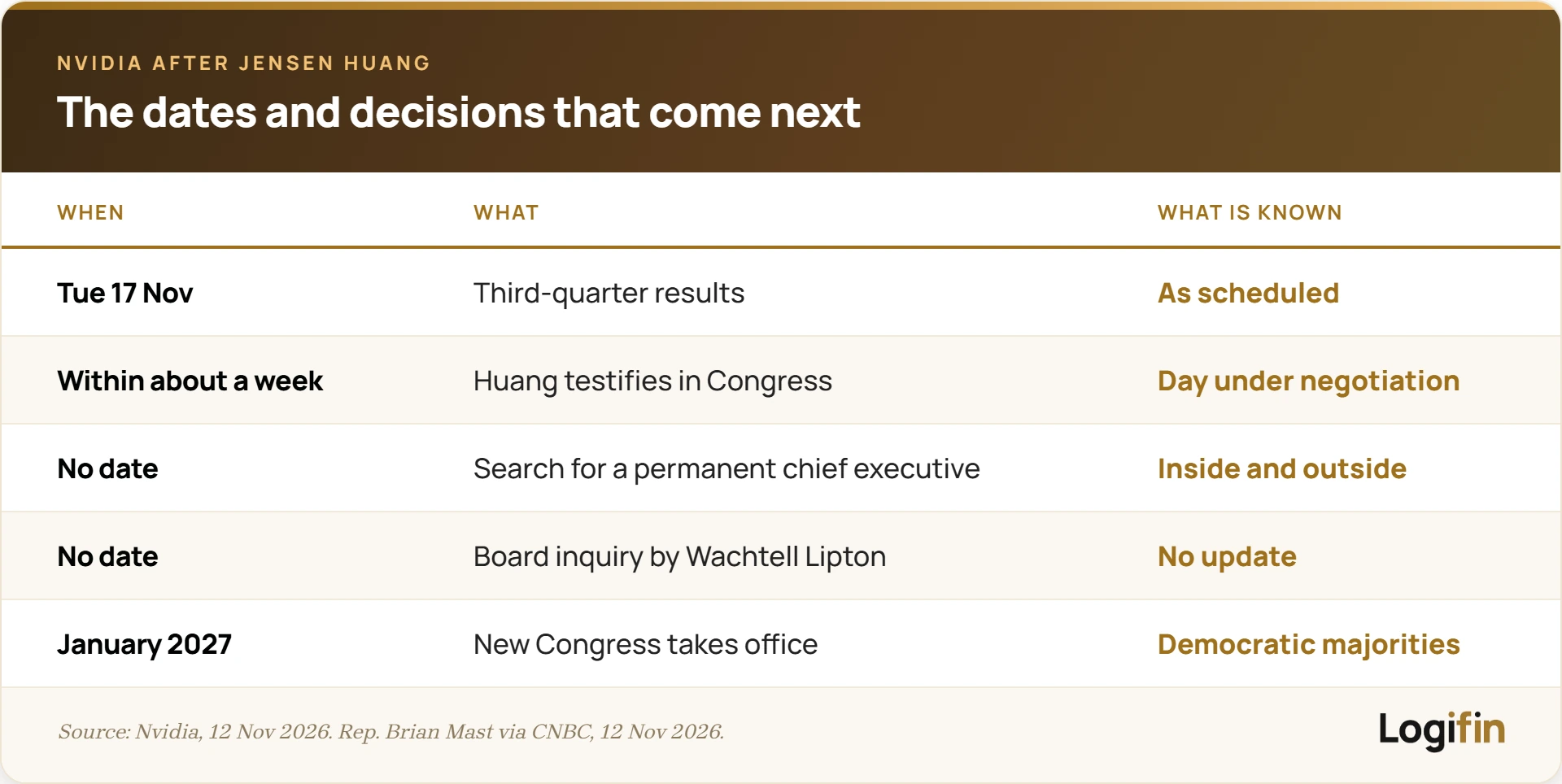
The first date is the results on Tuesday 17 November, which will be presented without Huang for the first time.
- Results, Tuesday 17 November. Nvidia reports its third-quarter results as scheduled, after the Wall Street close. Its forecast for the quarter is revenue of 108 billion dollars, plus or minus 2%.
- Testimony in Congress. Brian Mast, chair of the House Foreign Affairs Committee, said on Thursday that Huang has agreed to testify and that the day is under negotiation. Mast wants the testimony to take place within about a week. Senator Elizabeth Warren said the resignation does not absolve Huang or the company of responsibility.
- The board's investigation. It is being handled by the law firm Wachtell Lipton. Thursday's announcement does not say whether the investigation continues or whether its findings will be published.
- Permanent chief executive. The board has not given a date for the appointment.
- New Congress, January. The Democrats won both chambers in the elections of 3 November and take office in January.
What to take away
- Jensen Huang has resigned from Nvidia after 33 years and the company has given no reason. Chief financial officer Colette Kress has taken over on an interim basis and the board is looking for a permanent successor inside and outside the company.
- The stock opened 13.1% lower and by 11:45 in New York it had narrowed the fall to 5.5%. AMD and Broadcom rose, so the market saw the resignation as a problem for Nvidia and not for the whole sector.
- An S&P 500 ETF holds 6.3% Nvidia and a global ETF around 4%. A 13% fall in the stock moves these ETFs by less than one percentage point. Next come the results of 17 November and Huang's testimony in Congress.
Insights
Keep reading



EXPLORE LOGIFIN
Everything you need in order to learn, plan and track your investments.
Logifin Blog
Learn everything you need to get your finances in order and invest with confidence.
Logifin Insights
What moves the markets and what it means for a long term investor.
Logifin Tools
Free, inside the site, no signup. Everything you calculate stays on your device.
Logifin ETF Hub
Find the ETF that fits you: 500+ UCITS ETFs, smart filters and in-depth comparisons.
Logifin Guides
A series of guides that builds your investment plan step by step. The first guide is free for everyone.
Logifin Circle
The tools and the Hub are free for everyone. You become a member for the intelligence that never stops.