Logifin Insights
What Nvidia does with 235 billion dollars
On 28 September Nvidia raised the amount available for share buybacks to 235 billion dollars. What changes for those who hold the stock and for those who own it through an S&P 500 ETF.
5 October 2026 · 6 min read
On Monday 28 September Nvidia announced that its board had added 150 billion dollars to its share repurchase programme, meaning the amount it can use to buy its own shares in the market. The amount still available rises to 235 billion. The company intends to use it up by the end of fiscal year 2028, which means by late January 2028. According to Nvidia, it is the largest increase to a buyback programme in history.
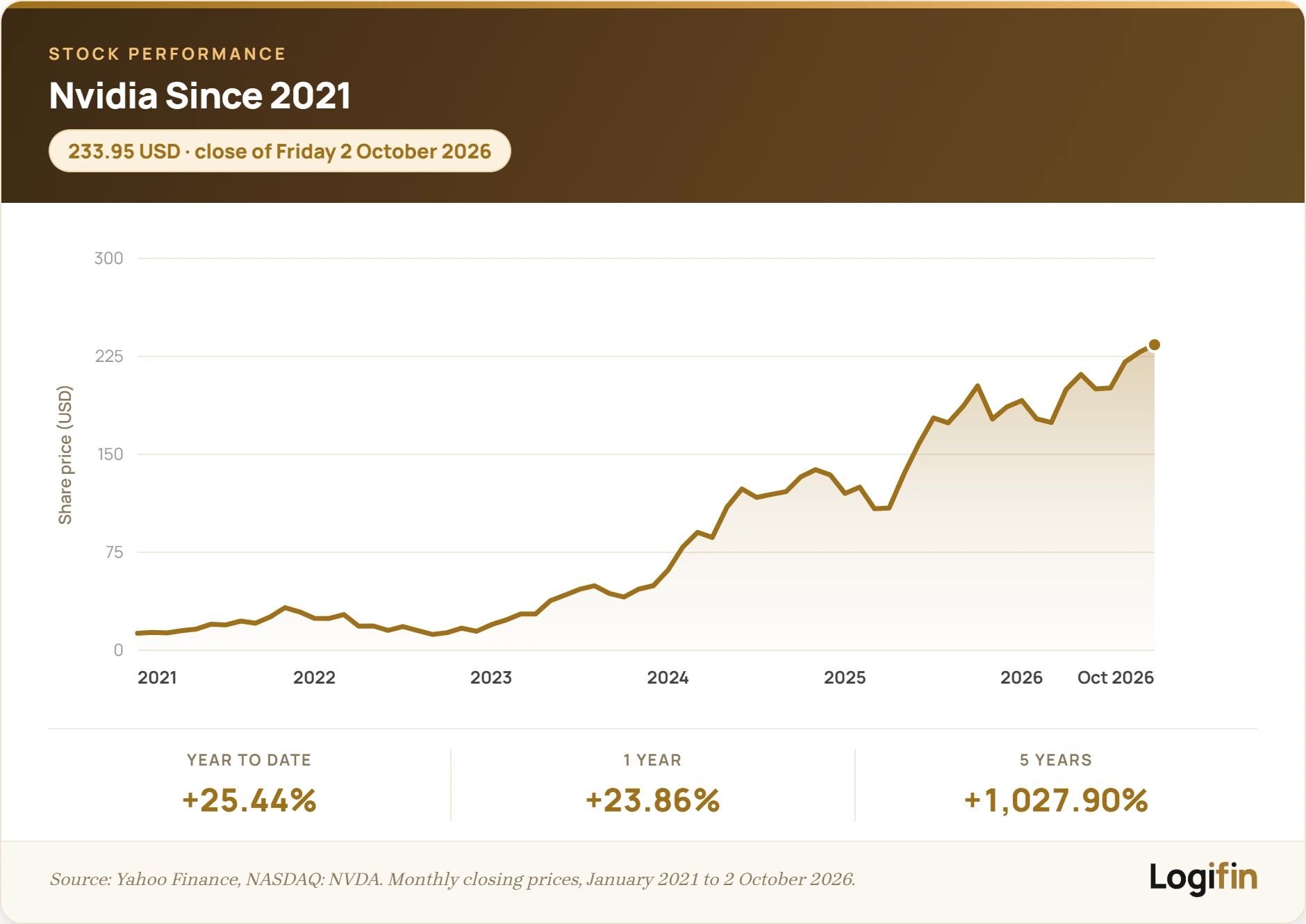
The stock rose 1.7% that day. On Friday 2 October it reached 237.88 dollars during the session, the highest level in its history. The market value of the company came close to 5.7 trillion dollars. The whole US market rose that day, after jobs figures reduced expectations of an interest rate increase by the Fed. The stock closed at 233.95 dollars, just below the record close of 235.74 set on 14 May.
Over a longer period, the stock has gained 25.44% since the start of the year and 23.86% over one year. Over five years its price has multiplied roughly elevenfold, a rise of 1,027.90%.
What the board approved
A buyback authorisation allows a company to buy its own shares in the market without obliging it to do so. This time Nvidia also gave a time frame. It is the second increase in 2026. The first, on 18 May, was 80 billion.
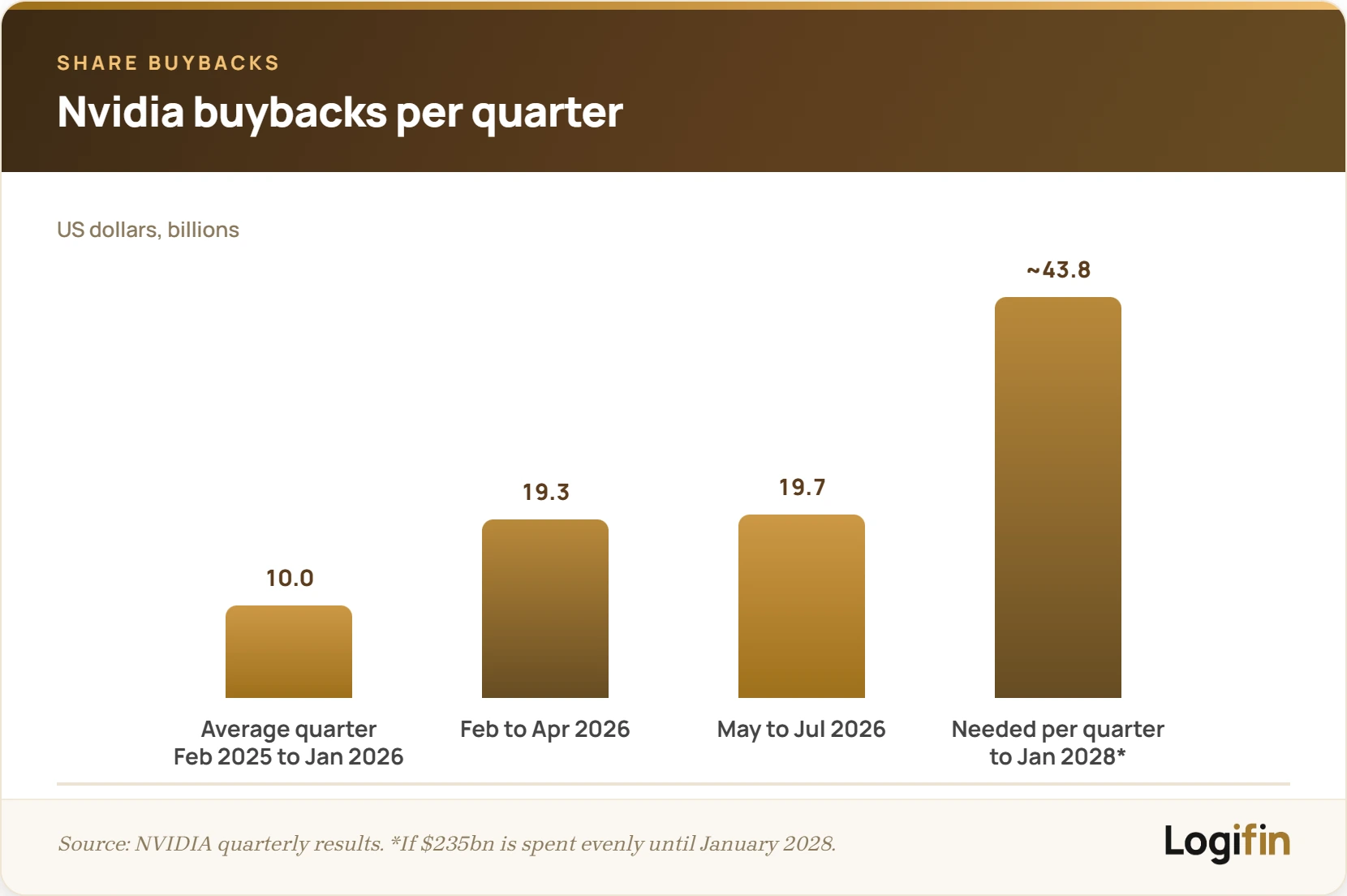
There are roughly sixteen months left until late January 2028. To use up 235 billion in that time, Nvidia needs to buy around 44 billion dollars of shares a quarter. In the quarter that ended on 26 July it bought 19.7 billion, less than half of that. In the previous fiscal year, from February 2025 to January 2026, the average was 10 billion a quarter.
Where the money comes from
The money comes from free cash flow, meaning the cash left over from running the business after the company pays for its investments. In the previous fiscal year it reached 96.6 billion dollars. In the first half of the current fiscal year, from February to July, free cash flow was 69.9 billion and Nvidia returned 45.3 billion of it to shareholders. Buybacks took 39 billion and dividends 6.3 billion. Jensen Huang, founder and chief executive, said in the announcement that cash generation allows the company to keep investing while returning capital to shareholders.
The dividend rose in May from 1 cent to 25 cents per share a quarter. Even so, buybacks remain the main way the company returns cash. The buybacks come while the company keeps growing fast. In the quarter to 26 July revenue rose 106% from a year earlier to 96.2 billion dollars.
Measured against the size of the company, 235 billion is about 4% of its market value. At the closing price of 2 October, that amount buys roughly one billion shares.
What a buyback does for those who keep the stock
The shares a company buys back stop counting as shares outstanding. If a company has 100 shares and buys 4, each of the remaining 96 represents a little more than 1% of the profits instead of exactly 1%. A buyback gives cash to those who sell and enlarges the stake of those who keep their shares.
The value of the company does not rise because of the buyback itself, since the cash leaves the company and goes to the shareholders who sell. Unlike a dividend, which is paid to everyone, a buyback gives cash only to those who choose to sell.
At Nvidia the effect stays small in percentage terms because the company is so large. From February 2025 to July 2026 it spent 79 billion dollars on buybacks. The share count it uses for earnings per share fell from 24.71 billion in the quarter to January 2025 to 24.29 billion in the quarter to July 2026, a decline of 1.7%.
What it means for those who own Nvidia through an ETF
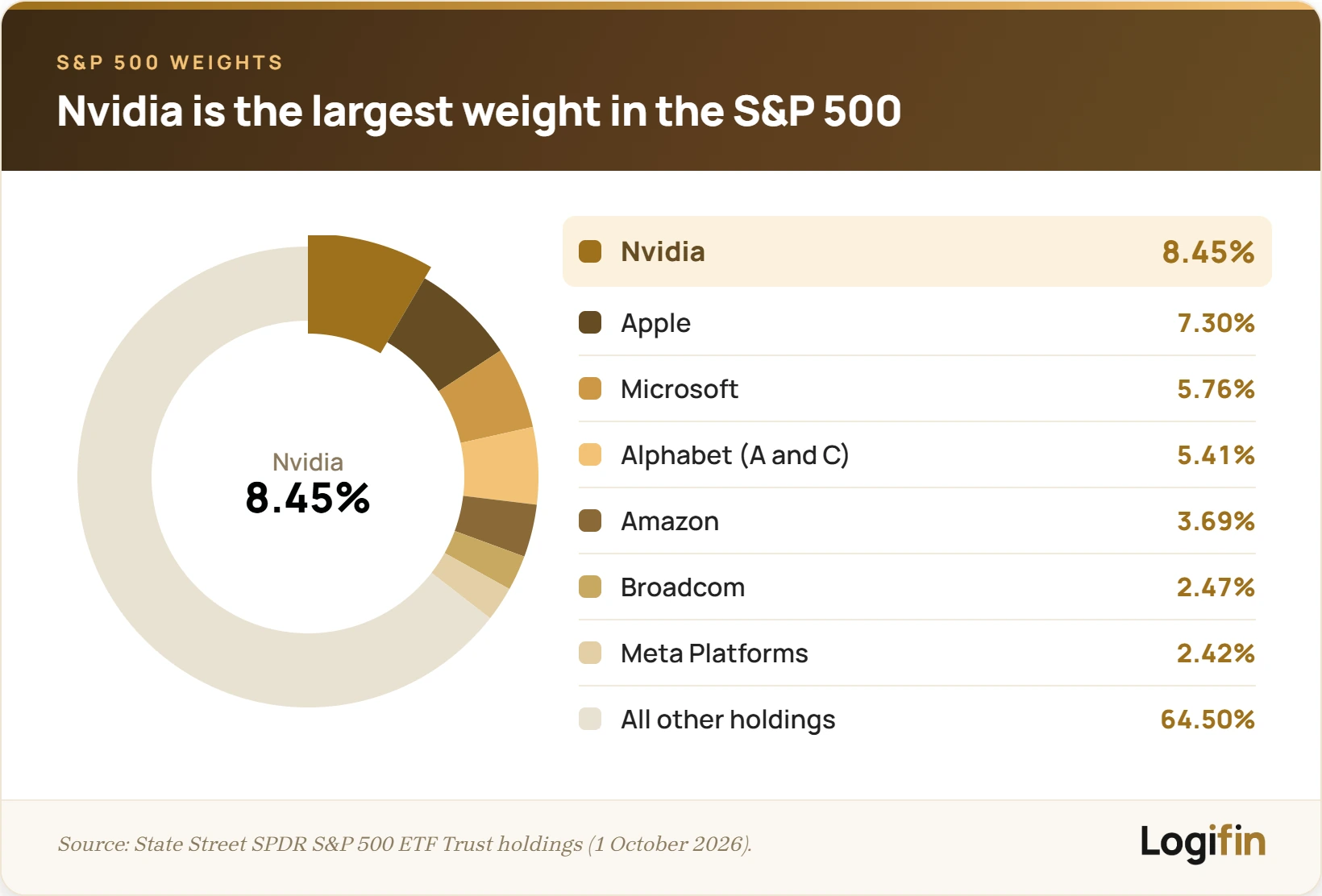
On 1 October Nvidia was the largest company in the S&P 500, with a weight of 8.45% in the SPDR S&P 500 ETF Trust. Many European ETFs track the same index, such as VUAA and SXR8.
The weight of a company in the index is set by its market value, meaning the share price multiplied by the number of shares. The S&P 500 updates the share count of each company at its quarterly rebalancing, on the third Friday of March, June, September and December. When the number of Nvidia shares falls, ETFs hold correspondingly fewer of them and the difference goes to the other companies in the index.
A buyback on its own does not increase the weight of Nvidia in the index. If the weight rises, it will be because the share price rose. The ATLAS guide explains how weighting rules shape the position of each company in an index.
What to watch
Third quarter results in November will show whether the pace of buying picked up. They will cover the period from August to late October, including the first weeks after the announcement.
The same results will show free cash flow. In the quarter that ended on 26 July it was 21.3 billion dollars, down from 48.6 billion in the previous quarter. The 44 billion a quarter that the programme needs is more than double that amount. At the end of July the company held 56.6 billion in cash and bonds.
The price matters as well. With the stock close to its record high, each buyback dollar buys fewer shares.
What to take away
- Nvidia can spend 235 billion dollars buying its own shares and intends to do so by late January 2028. That works out to around 44 billion a quarter, more than double the pace of the summer.
- A buyback gives cash to those who sell and enlarges the stake of those who keep their shares. It does not make the company more valuable on its own.
- In the S&P 500 Nvidia weighs 8.45%. Its weight is set by the share price, not by the buyback.
EXPLORE LOGIFIN
Everything you need in order to learn, plan and track your investments.
Logifin Blog
Learn everything you need to get your finances in order and invest with confidence.
Logifin Insights
What moves the markets and what it means for a long term investor. Short and without the noise.
Logifin Tools
Free, inside the site, no signup. Everything you calculate stays on your device.
Logifin ETF Hub
Find the ETF that fits you: 500+ UCITS ETFs, smart filters and in-depth comparisons.
Logifin Guides
A series of guides that builds your investment plan step by step. The first guide is free for everyone.
Logifin Circle
The tools and the Hub are free for everyone. You become a member for the intelligence that never stops.