Logifin Insights
Microsoft: servers down for 30 hours. The stock +8%
Outlook and Teams went down for about 30 hours, yet Microsoft stock rose on both days and remains 8.3% above its level at the start of the year. What the results showed, how much the company spends on artificial intelligence, what it earns from OpenAI and how much it weighs in ETFs.
· 8 min read

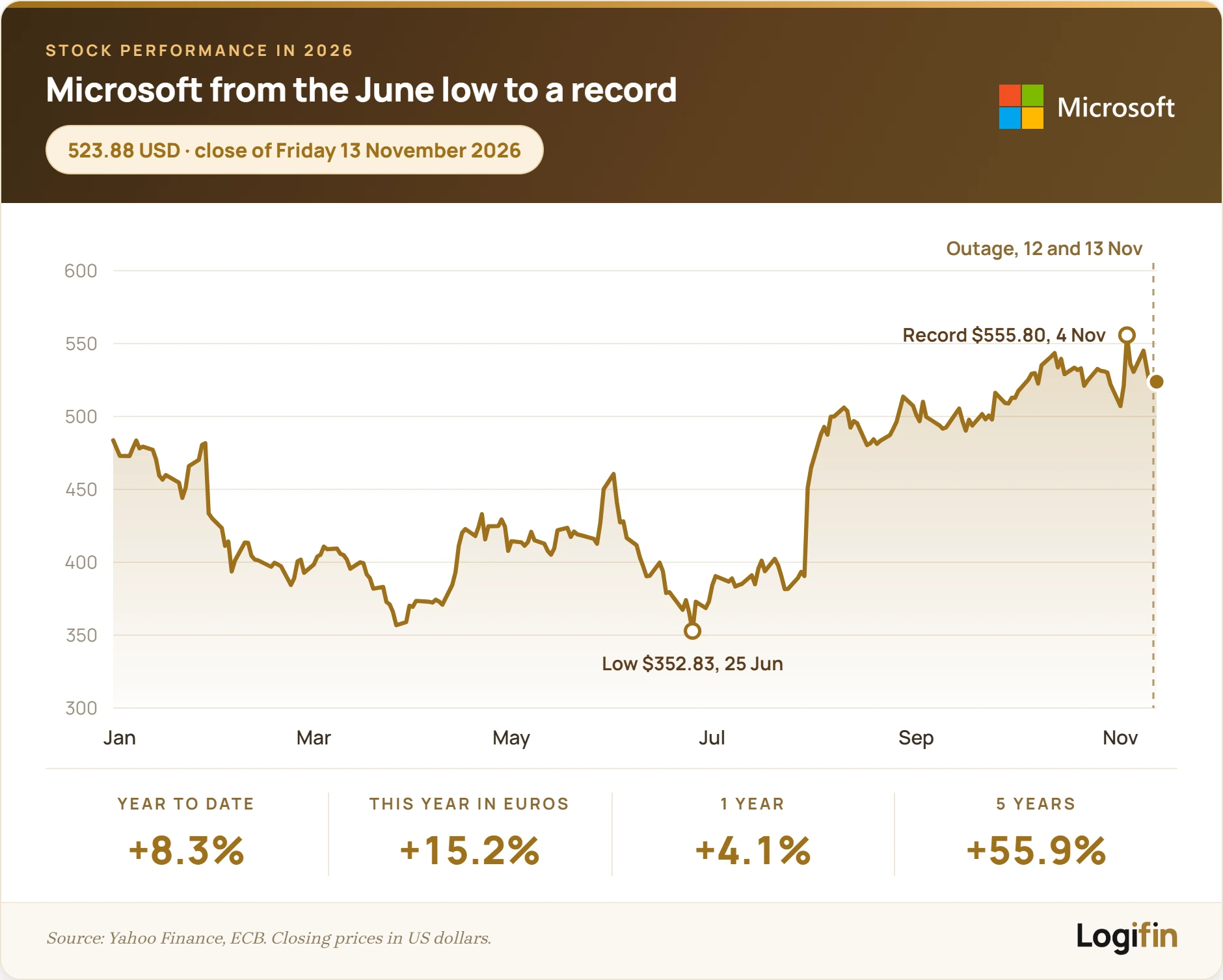
On Thursday 12 November Outlook, the Teams calendar and Copilot stopped working for users around the world. According to Microsoft's own record, the outage lasted from 10:05 on Thursday to 16:10 on Friday, UTC, about 30 hours. Reports about Outlook on Downdetector reached 130,000. Microsoft stock, however, closed 0.4% higher on Thursday and 0.2% higher on Friday, while the S&P 500 fell on both days. Since the start of the year it is up 8.3% in dollars. In euros the gain reaches 15.2%, because over the same period the euro fell against the dollar, from $1.175 to $1.105.
What happened to Microsoft 365
The outage began in Exchange Online, the service that holds company mailboxes. Everything that relies on it stopped too, such as the Teams calendar and meeting invitations, part of SharePoint and Copilot. Microsoft said that a number of its servers became unexpectedly unavailable, so their load passed to the remaining servers, which could not cope. As a preliminary cause it pointed to a fault from an earlier upgrade of its network capacity, which surfaced after a recent network change. It also said there was no sign of a cyberattack.
Recovery was slow because, according to Euronews, servers that were brought back failed again as soon as traffic returned. Anderson Economic Group estimated the cost of lost productivity at almost $7 billion, but this is an estimate and not an official figure. Microsoft has committed to publish a preliminary report on the incident within two business days and the final one within five.
Why the outage did not touch the stock
Companies pay for Microsoft 365 by subscription, usually for one year or more, and many pay in advance. On 30 September Microsoft had $69.6 billion on its balance sheet for services that customers had paid for but it had not yet delivered. Signed contracts with businesses that have not yet turned into revenue reach $677 billion. A 30-hour outage does not cancel these contracts, so the market had no reason to expect lower revenue.
For such cases Microsoft's terms provide only a credit on the bill. The company guarantees that Exchange Online, Teams and SharePoint work 99.9% of the month. If availability falls below that level, the customer is entitled to a credit of 25% of the monthly cost of the service. Below 99% the credit rises to 50% and below 95% it covers the whole amount. The credit is not automatic, because the customer has to claim it.
How the stock moved in 2026
Microsoft started the year badly. On 29 January, after the results for the quarter to December, the stock fell 10% in one day, because investment in data centres was growing faster than revenue. By the end of March it had lost 23.5%. According to CNBC, it was its worst quarter since 2008. Investors were worried about the cost of artificial intelligence and about how many customers pay for Copilot. The low of the year came on 25 June, at $352.83, 27% below the start of the year.
The picture changed on 30 July. The results for the quarter to June showed that revenue from Azure, the company's cloud service, was growing 43%, and the stock rose 15.5% in one day. On 4 November, after the Democrats won the US midterm elections, it rose another 6.7% and closed at a record $555.80. According to Benzinga, investors expected stricter rules for new data centres to favour companies that have already built their own. From the June low to Friday's close the stock rose 48.5%, although it remains 5.7% below the record of 4 November.
What the October results showed
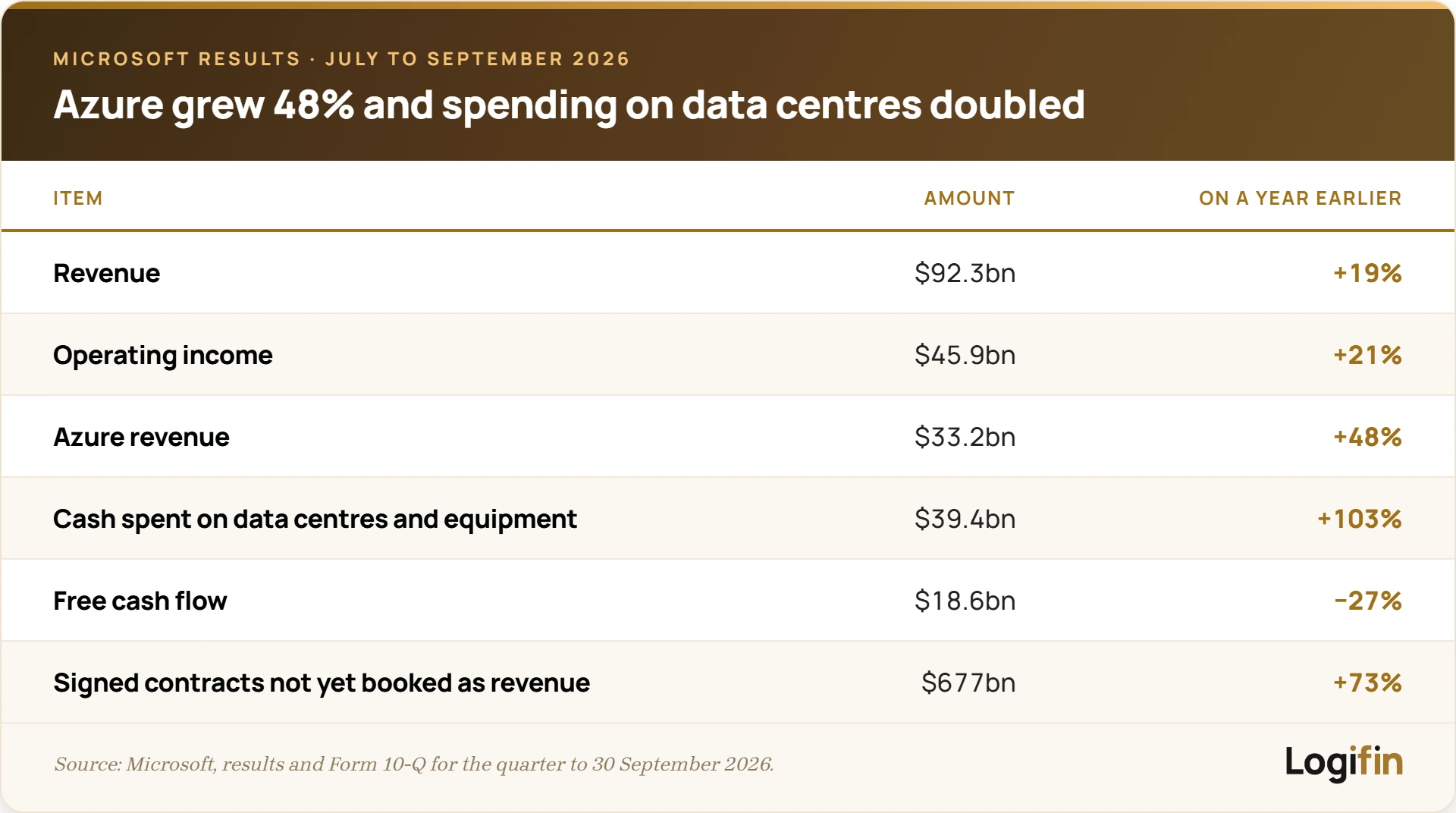
On 28 October Microsoft reported results for the quarter from July to September, the first of its 2027 fiscal year. Revenue rose 19% to $92.3 billion and operating income rose 21% to $45.9 billion. Azure revenue grew 48% and reached $33.2 billion. It was the first time the company reported the amount in dollars and not only the growth rate. For the quarter to December it expects Azure to grow 49% to 50%.
The next day the stock barely moved, while Alphabet, which reported results on the same evening, fell 12%. The difference between the two companies is explained in the Insight on Google and Microsoft.
How much it spends on artificial intelligence
In the same quarter Microsoft's capital expenditure reached $45.2 billion. Of this, $7.4 billion relates to data centre leases, while the cash it paid for data centres and equipment was $39.4 billion, twice as much as a year earlier. About three quarters of the spending went on processors and graphics chips, which age within a few years, and the rest on buildings and long-lived equipment. During the quarter the company brought 24 new data centres into operation on five continents. For the whole of 2026 it estimates capital expenditure of about $170 billion, of which more than $50 billion in the quarter to December. The other large technology companies spend similar amounts.
Free cash flow, the money left from the company's operations after its investment has been paid, was $18.6 billion. Two days before the results, on 26 October, Microsoft offered voluntary buyouts to about 60,000 employees in the US, Canada, the United Kingdom and India. According to the Associated Press, that is about 27% of its workforce.
What Microsoft earns from OpenAI
Microsoft owns about 24% of OpenAI, according to its quarterly report to the SEC. Since 2019 it has committed to invest $13 billion and has already paid $12 billion. In the quarter to September OpenAI brought it $10 billion in revenue, about 11% of the total and more than Xbox or Bing advertising. The amount includes the share OpenAI pays from its own sales and what it pays to train and run its models on Azure.
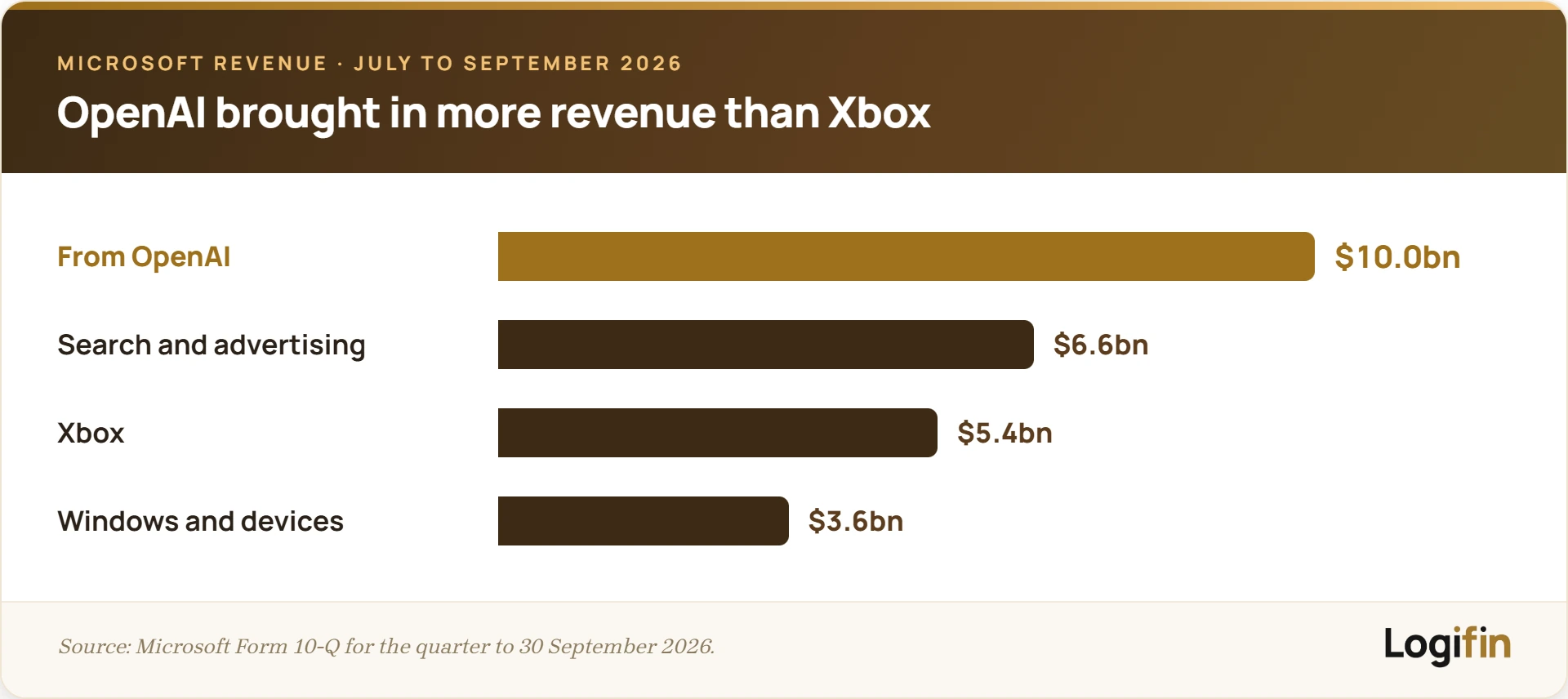
The ties between the two companies have loosened, however. In October 2025 OpenAI committed to buy $250 billion of Azure services. Under the new agreement of April 2026, as described by CNBC, OpenAI can now sell its products through any cloud. It will pay a revenue share to Microsoft until 2030, subject to a total cap, while Microsoft has stopped paying a share to OpenAI. Microsoft's licence to use OpenAI models runs until 2032, but it is no longer exclusive.
How it is valued and how much it weighs in ETFs
With 7.43 billion shares and a price of $523.88, Microsoft is valued at about $3.9 trillion. Earnings per share over the last four quarters were $19.15. The share price is therefore about 27 times annual earnings, a ratio known as P/E. In March, according to CNBC, this ratio had fallen to its lowest level since the end of 2022.
Most European investors hold Microsoft through ETFs. In the holdings of SPY on 12 November it weighed 5.93% of the S&P 500 and ranked third, after Apple and Nvidia. In the MSCI World it weighed 4.11% on 30 October, according to the MSCI factsheet. In an MSCI World ETF such as IWDA, a 10% move in Microsoft changes the value of the ETF by about 0.4%.
What to watch
Three things will show whether the outage remains an isolated incident.
- The final report on the outage. Microsoft has committed to publish it within five business days. It will show exactly what failed and what the company is fixing so that it does not happen again.
- The January results. The company expects Azure growth of 49% to 50% and spending above $50 billion in the quarter to December. Last January the stock fell 10% when spending grew faster than revenue.
- The relationship with OpenAI. The $10 billion of the quarter is 11% of revenue, so any change in the partnership shows up immediately in Microsoft's results.
What to take away
- The outage did not change revenue. Microsoft's signed contracts reach $677 billion and its only obligation after an outage is a credit on the bill, if the customer claims it.
- This year the stock was driven by investment in artificial intelligence. It fell 27% until June, when spending worried the market, and from there rose 48.5%, when Azure showed that the spending brings revenue.
- For a European investor Microsoft is 4.1% of the MSCI World. In euros the stock is up 15.2% this year, more than the 8.3% in dollars, because this year the euro fell against the dollar.
Insights
Keep reading



EXPLORE LOGIFIN
Everything you need in order to learn, plan and track your investments.
Logifin Blog
Learn everything you need to get your finances in order and invest with confidence.
Logifin Insights
What moves the markets and what it means for a long term investor.
Logifin Tools
Free, inside the site, no signup. Everything you calculate stays on your device.
Logifin ETF Hub
Find the ETF that fits you: 500+ UCITS ETFs, smart filters and in-depth comparisons.
Logifin Guides
A series of guides that builds your investment plan step by step. The first guide is free for everyone.
Logifin Circle
The tools and the Hub are free for everyone. You become a member for the intelligence that never stops.