Logifin Insights
Europe has overtaken Wall Street
After Black Thursday the STOXX Europe 600 is up 9.4% this year and the S&P 500 is up 7.8%. For anyone investing in euros, however, the order is reversed, because the dollar has risen. What the ETFs of the two indices show.
· 6 min read
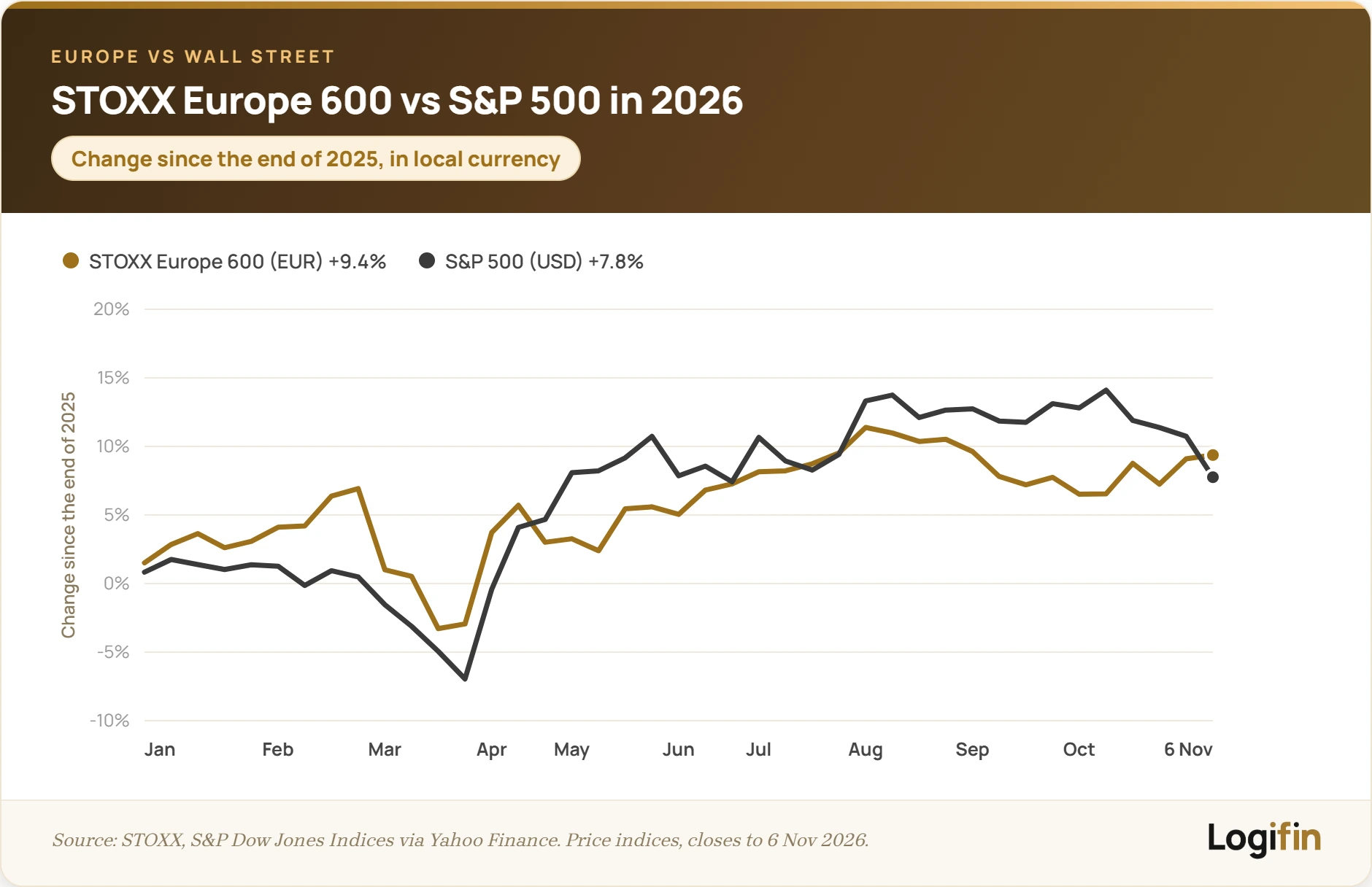
European shares have now gained more than American shares in 2026. On Friday 6 November the STOXX Europe 600, which holds the 600 largest listed companies in Europe, closed at 648.33 points, 9.4% above its 2025 close. The S&P 500 closed at 7,376.86 points, 7.8% above the 6,845.50 points of 31 December. Europe moved ahead on Thursday 5 November, the day the S&P 500 lost 4.4%. For a European investor, however, the picture is different, because the S&P 500 is measured in dollars and the dollar has risen against the euro this year.
How the order changed in a single day
Up to Wednesday 4 November the S&P 500 was up 12.3% for the year and the STOXX Europe 600 was up 10.9%. On Thursday, Black Thursday on Wall Street, the S&P 500 lost 4.36%, while the European index lost only 0.4%. In one session a gap of 1.4 points in favour of Wall Street became a gap of 3 points in favour of Europe. On Friday the S&P 500 recovered 0.3% and the STOXX Europe 600 lost 1.0%, so the gap narrowed to 1.6 points. Reuters reported the change on the same day.
Europe had also started the year in front. On 2 March the STOXX Europe 600 was up 5.2% and the S&P 500 only 0.5%. On 22 April the S&P 500 moved ahead and stayed there on most days until November. In early October the gap was more than six points.
What makes the difference between the two indices
The two indices are built very differently. The so called Magnificent Seven, that is Apple, Nvidia, Microsoft, Amazon, Alphabet, Meta and Tesla, made up 33.5% of the S&P 500 on 4 November, according to the holdings of the State Street SPY ETF. Technology companies make up about 7% of the STOXX Europe 600.
When artificial intelligence stocks fall, the S&P 500 loses much more than the European index. The distance from their highs shows this. On 6 November the Nasdaq Composite was 10.9% below its record of 6 October and the S&P 500 was 5.7% below its own record of the same day. The STOXX Europe 600 was only 1.8% below its high of 660.51 points on 11 August.
The same make up explains the months when Wall Street was in front. On 6 October, the day of the record, the Nasdaq was up 18.7% for the year and the S&P 500 was up 14.2%, while the STOXX Europe 600 was up only 7.4%. As long as technology stocks were rising, the European index stayed behind.
What changes when you measure in euros
The S&P 500 is calculated in dollars. A European who buys an S&P 500 ETF in euros also gains or loses from the exchange rate. According to the ECB reference rates, one euro was worth 1.1750 dollars on 31 December 2025 and 1.1165 dollars on 6 November 2026. In other words the euro fell by 5%. Each dollar is now worth about 5% more in euros than at the start of the year.
Measured in euros, the S&P 500 is up about 13% this year, well ahead of the 9.4% of the European index. Thursday's overtaking holds only when each index is measured in its own currency.
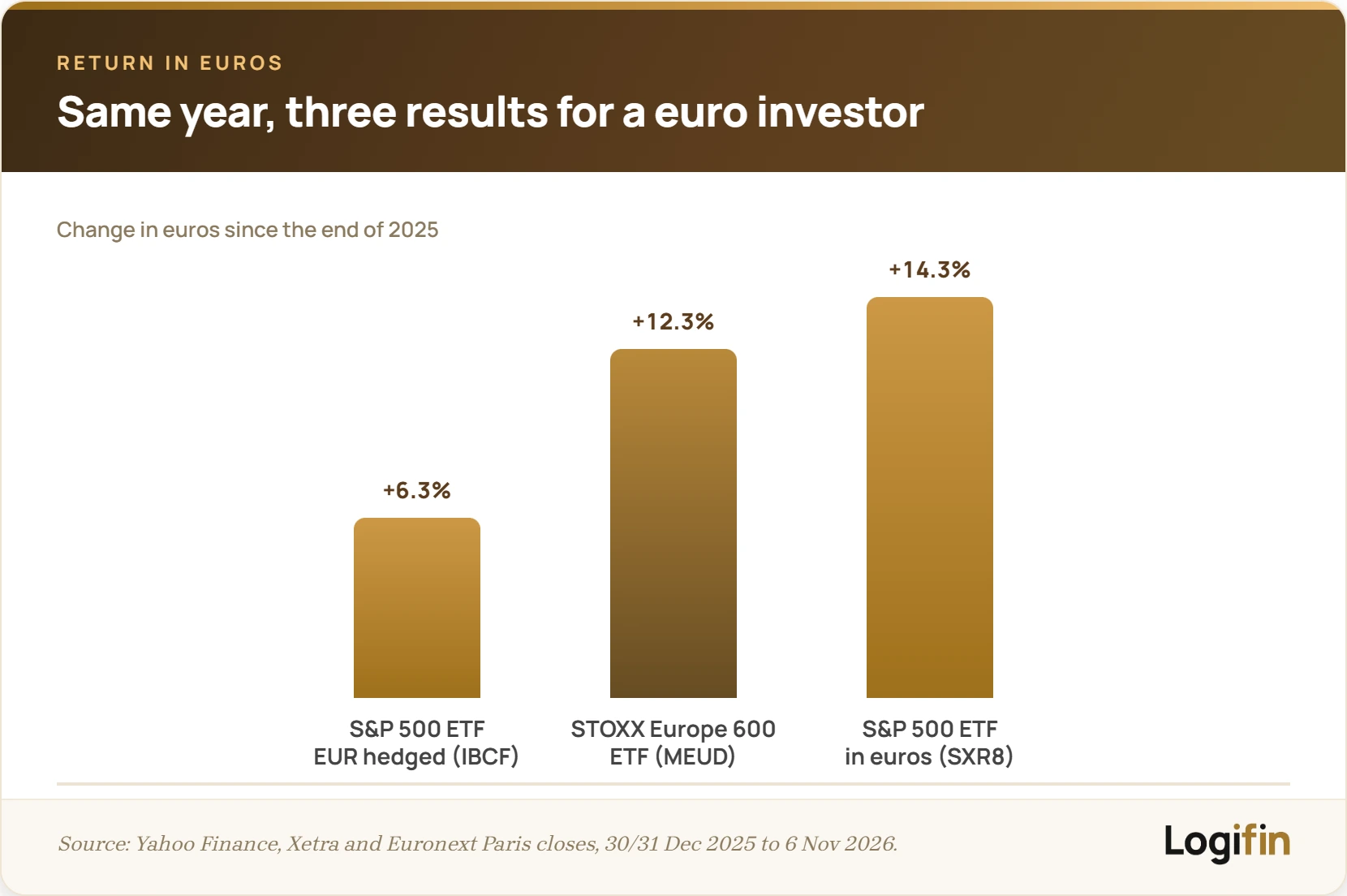
The prices of the ETFs on European exchanges show the same thing. The iShares SXR8, which tracks the S&P 500 and trades in euros on Xetra, gained 14.3% from the end of 2025 to 6 November. The Amundi MEUD, which tracks the STOXX Europe 600, gained 12.3% on Euronext Paris. Both are accumulating, which means they reinvest dividends. That is why they gained more than the indices themselves. European companies usually pay higher dividends than American ones, so the gap between MEUD and its index is wider.
The currency hedged ETF gained the least
There are also S&P 500 ETFs with currency hedging, that is with contracts that largely cancel out the effect of the exchange rate. One of them is the iShares IBCF, which carries "EUR Hedged" in its name. This year IBCF gained only 6.3% on Xetra, less than the European ETF and less than half the return of SXR8. The reason is that the hedge removed the gain from the rise of the dollar. Hedging also has a cost, which depends mainly on the gap between short term dollar and euro interest rates. That is why IBCF ended up even below the S&P 500 in dollars.
Last year the opposite happened. On 31 December 2024 one euro was worth 1.0389 dollars, so during 2025 the euro rose 13% against the dollar. Back then the hedge protected investors from the fall of the dollar. The exchange rate moves in both directions. In 2026 the euro reached 1.1974 dollars on 28 January and fell to 1.1130 on 29 October.
What it means for ETF investors
Comparing two indices only makes sense for an investor in the currency the investor actually uses. The headlines about the overtaking compare the STOXX Europe 600 in euros with the S&P 500 in dollars, but a European investor does not hold dollars. For anyone with an unhedged S&P 500 ETF, the rise of the dollar added about five points to the return this year.
The same applies to global ETFs, such as those that track the MSCI World, where American companies weighed 72.8% on 30 October, according to the MSCI factsheet. Anyone who wants to see how their money is split between Europe and the United States will find more in the guide to the geographic allocation of a portfolio.
What to watch
- US inflation. The consumer price index for October is published on Tuesday 10 November. It affects expectations for Fed interest rates and therefore the euro dollar exchange rate.
- Artificial intelligence stocks. The Nasdaq is in correction territory. These stocks have decided the order between the two indices this year.
- The euro dollar exchange rate. For a European investor a 5% move in the exchange rate has the same effect as a 5% move in American shares.
What to take away
- Since the start of 2026 the STOXX Europe 600 is up 9.4% and the S&P 500 is up 7.8%, each in its own currency. Europe moved ahead on Black Thursday because it has much less weight in technology.
- In euros the order is reversed. The euro fell 5% against the dollar and the S&P 500 ETF SXR8 gained 14.3%, against 12.3% for the STOXX Europe 600 ETF MEUD.
- The currency hedged S&P 500 ETF gained only 6.3%. Hedging protects when the dollar falls, as in 2025, and costs when it rises, as this year.
Insights
Keep reading


EXPLORE LOGIFIN
Everything you need in order to learn, plan and track your investments.
Logifin Blog
Learn everything you need to get your finances in order and invest with confidence.
Logifin Insights
What moves the markets and what it means for a long term investor. Short and without the noise.
Logifin Tools
Free, inside the site, no signup. Everything you calculate stays on your device.
Logifin ETF Hub
Find the ETF that fits you: 500+ UCITS ETFs, smart filters and in-depth comparisons.
Logifin Guides
A series of guides that builds your investment plan step by step. The first guide is free for everyone.
Logifin Circle
The tools and the Hub are free for everyone. You become a member for the intelligence that never stops.