Logifin Insights
Deutsche Bank: old secrets, a new fall
More than 200 journalists published an investigation based on over 15 million internal Deutsche Bank files, covering Epstein, Trump and Russian oligarchs. The stock fell 6% and is now 6.6% lower than at the start of the year. What the files contain, what the bank says and what it means for anyone who holds ETFs.
· 7 min read
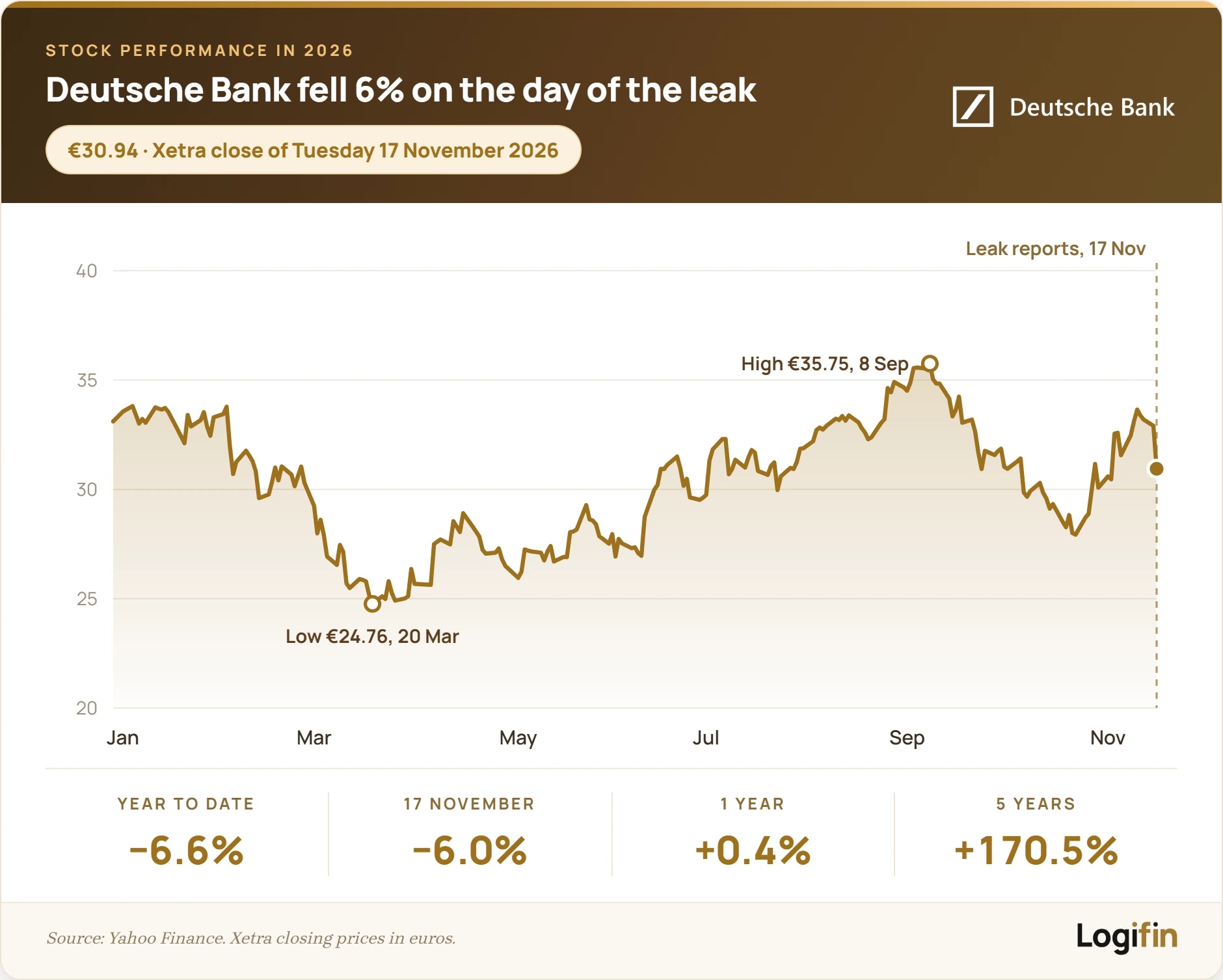
On Tuesday 17 November more than 200 journalists from 56 media outlets, among them the Financial Times, Le Monde, Der Spiegel and The New York Times, published the "Inside Deutsche Bank" investigation at the same time. It is based on more than 15 million internal files from Germany's largest bank and covers payments linked to Jeffrey Epstein, tax records of Donald Trump and clients from Russia. Deutsche Bank shares closed at €30.94 on Xetra, down 6%, and are now 6.6% lower than at the start of the year. The bank says the matters are old, some of them up to twenty years old, and that it does not expect a meaningful financial impact.
What the 15 million files contain
The material comes from two whistleblowers whose identities are being protected. They gave it to the Indian journalist Josy Joseph and the South African journalist Khadija Sharife, and the work of the media outlets was coordinated by Barracuda Media, a non-profit organisation in South Africa. It includes emails from executives, client files, risk assessments and suspicious transaction reports. What the reports have in common is a bank that identified risks in powerful clients but was slow to act on them. The main points, as the media published them:
- Epstein. According to The Wire, the bank filed 21 suspicious activity reports covering about 3,000 payments linked to Epstein, worth $581.9 million in total, between October 2013 and May 2019. The amount known until now was a little over $250 million, from a report by the US senator Ron Wyden.
- Trump. In 2017 a tax document belonging to Trump was sent by mistake to another client's accountant. According to CNBC, chief executive Christian Sewing called it "an awful mistake". Trump called the leak illegal.
- Russia. According to Follow the Money, more than €1.7 billion passed through the bank's systems between 2017 and 2020 via companies linked to Oleg Deripaska, who was placed under US sanctions in 2018. None of the bank's suspicious activity reports named him.
- Clients who stayed. According to CNBC, about 28,000 investment bank clients who had been flagged as problematic had still not been removed by early 2018, even though the bank had decided to end those relationships.
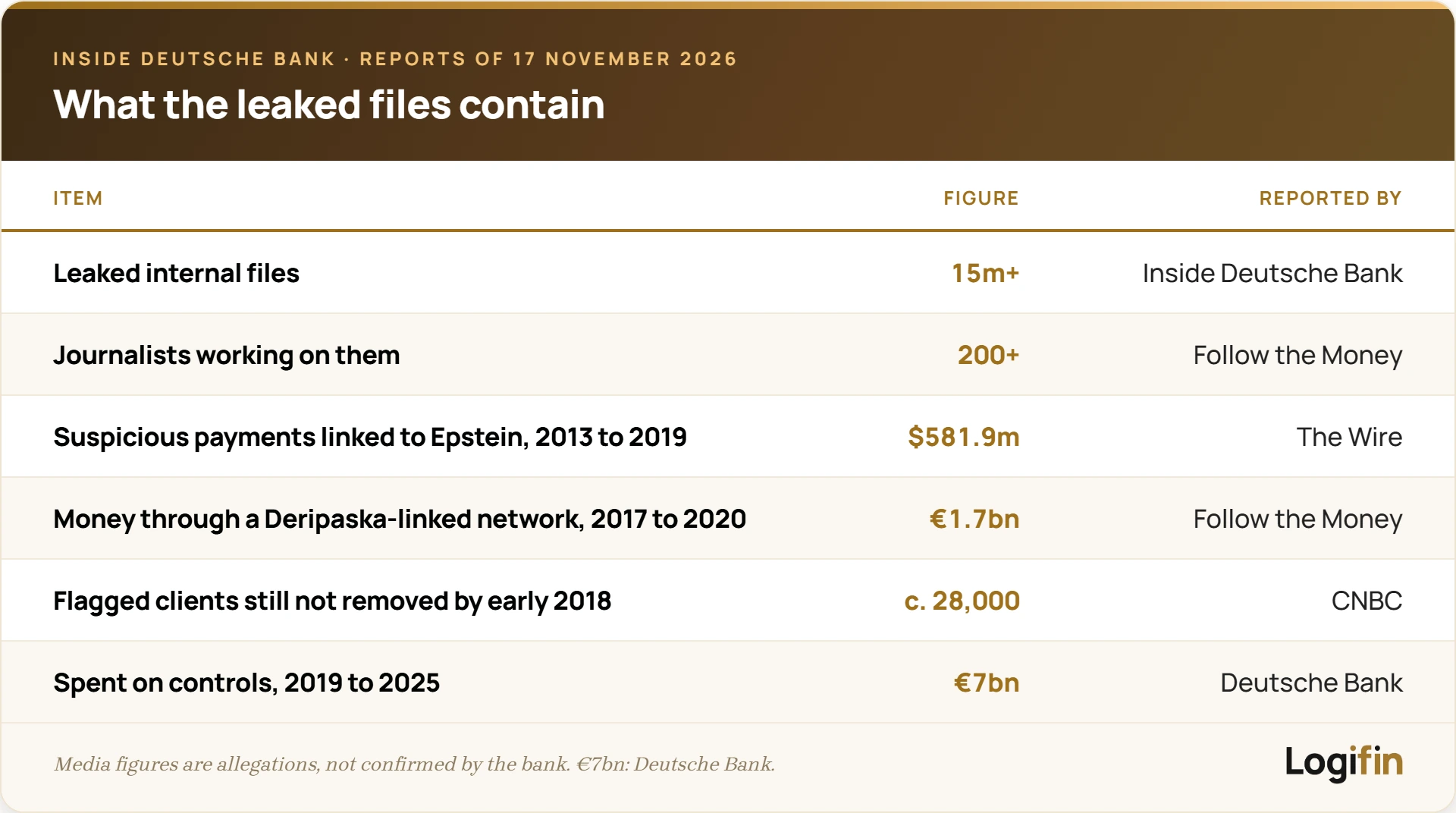
These figures are claims made by the media, based on documents that the bank describes as "purported" internal documents. The reports published on Tuesday mention no new investigation or fine by any supervisor.
What Deutsche Bank says
In a statement on the same day, the bank wrote that the matters in the reports date back many years, in some cases as much as two decades. Its position is that these are old cases, which it had already reviewed at the time in close cooperation with its supervisors. It says it invested €7 billion in its control environment between 2019 and 2025. After testing with a security firm, it says there is no sign that its current systems have been compromised or that anyone has accessed account information, login details or payment data. It has also informed the relevant authorities, including the data protection authority.
According to Reuters, the bank believes that because the matters are old, any financial impact is not expected to be meaningful. Chairman Alexander Wynaendts backed Sewing in a statement to Reuters. The German finance minister Lars Klingbeil called on the authorities to examine the revelations and take the necessary action, and a member of the European Parliament asked Sewing to appear before it. The ECB, which directly supervises the large banks of the euro area, declined to comment.
Why the stock fell if the cases are old
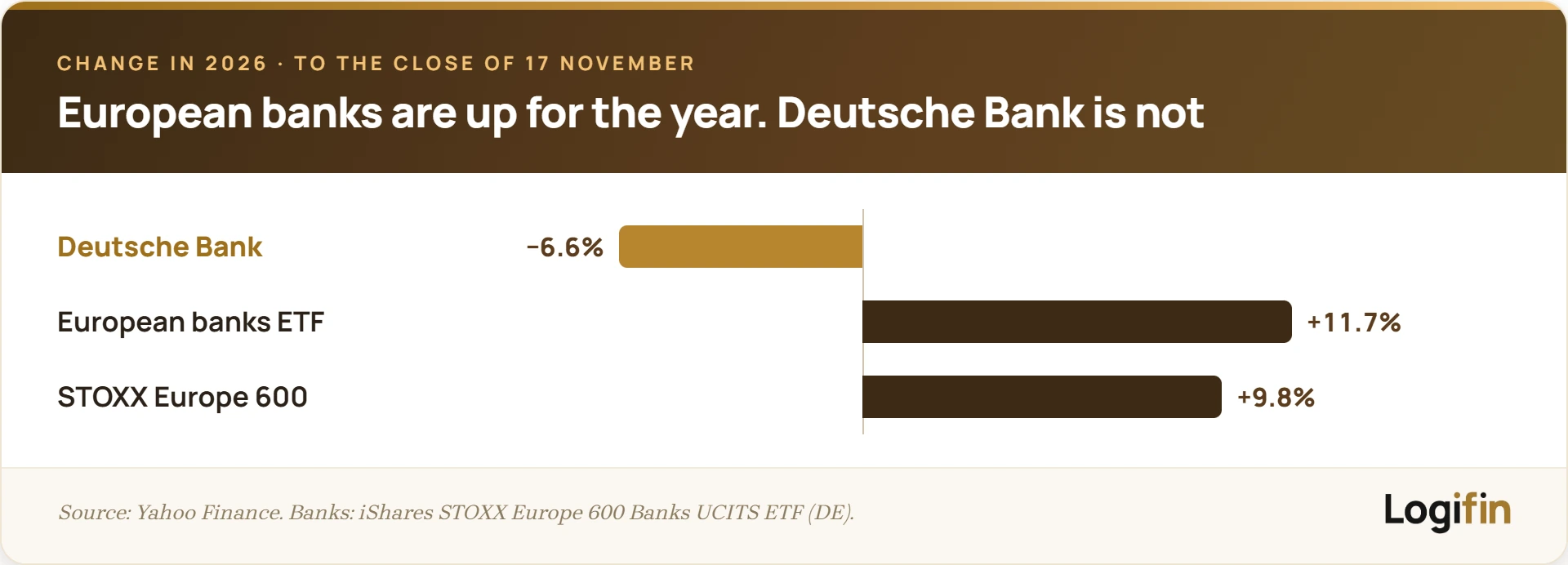
Tuesday was a bad day across Europe. The STOXX Europe 600 fell 1.75%, its biggest fall since 20 March, mainly on the fears about artificial intelligence that also hit Wall Street. The iShares ETF for European banks lost 1.9%. Deutsche Bank fell 6%, about three times as much as its sector, and Reuters attributed the fall to the revelations. By early afternoon the loss had narrowed to 3.8%, but by the close it was back at 6%.
When a bank is at the centre of revelations like these, the market is not pricing the old events. It is pricing what may follow: new investigations, fines, restrictions from supervisors, clients who leave and changes in management. Deutsche Bank has a history here. According to Financial Times figures reported by CNBC, it has paid about €18.6 billion in settlements and fines since 2012. In 2020, for example, the New York financial regulator fined it $150 million for failures in its controls, which included the Epstein relationship. The market does not yet know whether the new revelations will lead to investigations or fines, and that uncertainty shows up as a lower share price. As Jochen Stanzl, an analyst at Consorsbank, told Reuters, in the short term the revelations are not helping the stock.
How the stock has done in 2026
In 2025 Deutsche Bank shares almost doubled, rising 99%. 2026 started differently. On 20 March the stock fell to €24.76, 25% below where it began the year, and then rose to €35.75 on 8 September. After Tuesday's fall it is 13.5% below that high.
After Tuesday's fall Deutsche Bank has dropped behind the rest of the European banks. Since the start of the year it is down 6.6%, while the European banks ETF is up 11.7% and the STOXX Europe 600 is up 9.8%.
What it means for anyone who holds ETFs
Deutsche Bank is a member of the DAX, the index of the 40 largest German companies, and of the STOXX Europe 600, which includes 600 companies from 17 European countries. A private investor usually does not buy it directly. They hold it through an ETF that tracks one of these indices or a global index. In an ETF the bank is one of dozens or hundreds of companies, so a scandal at that bank has far less effect on the whole. Tuesday showed this: the stock lost 6% and the European banks ETF 1.9%. In a global ETF with more than a thousand companies its weight is smaller still.
This is the main difference between buying individual shares and ETFs. Someone who had bought only Deutsche Bank at the start of 2026 would be showing a loss today, while someone who had bought a European banks ETF would be showing a gain. ETFs of European shares, with the cost and size of each, are in the Logifin ETF Hub.
What to watch
- New reports. Follow the Money has announced a more detailed report on the Deripaska network for 18 November.
- The supervisors. Germany's BaFin and the ECB have not taken a position. According to Follow the Money, the whistleblowers also gave material to the US Department of Justice and to FinCEN, the US Treasury unit that deals with money laundering.
- The management. Whether Sewing agrees to appear before the European Parliament and whether the board continues to back him.
What to take away
- The "Inside Deutsche Bank" investigation is based on more than 15 million internal files and mostly concerns cases from the previous decade. The bank says they are old and that it does not expect a meaningful financial impact.
- The stock fell 6%, about three times as much as European banks, and is now down 6.6% for the year. What the market is pricing is the risk of new investigations and fines.
- Inside an ETF the risk of a single company is spread across many. On Tuesday the European banks ETF lost 1.9%, and it is still up 11.7% for the year.
Insights
Keep reading



EXPLORE LOGIFIN
Everything you need in order to learn, plan and track your investments.
Logifin Blog
Learn everything you need to get your finances in order and invest with confidence.
Logifin Insights
What moves the markets and what it means for a long term investor.
Logifin Tools
Free, inside the site, no signup. Everything you calculate stays on your device.
Logifin ETF Hub
Find the ETF that fits you: 500+ UCITS ETFs, smart filters and in-depth comparisons.
Logifin Guides
A series of guides that builds your investment plan step by step. The first guide is free for everyone.
Logifin Circle
The tools and the Hub are free for everyone. You become a member for the intelligence that never stops.