Logifin Insights
CoreWeave: a $710m loss but the stock +25%
CoreWeave reported a $709 million loss for the third quarter and its stock rose 24.7% the next day. Where the loss comes from, what the $132.5 billion in contracts means and how much the company weighs in Nasdaq-100 ETFs.
· 6 min read

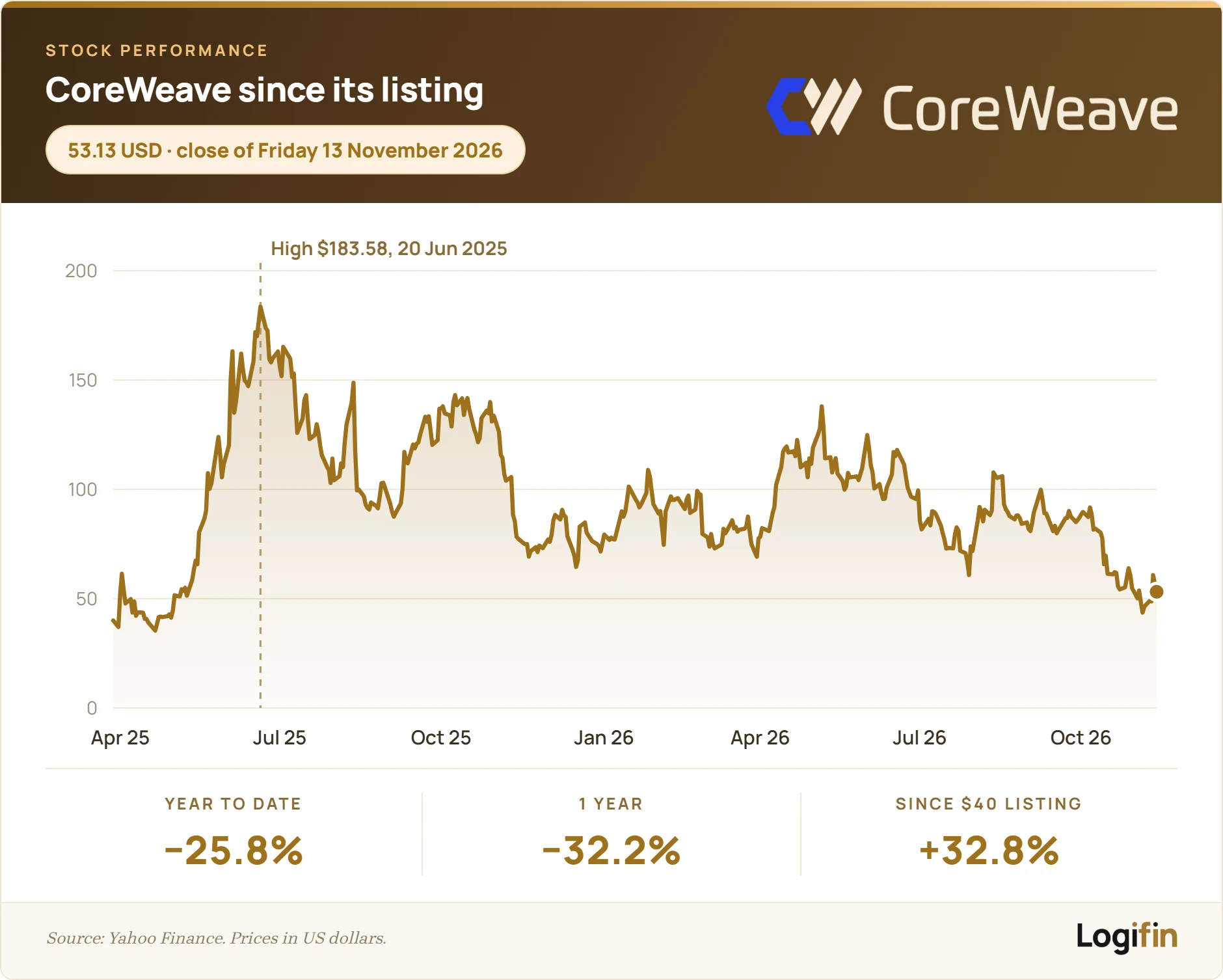
CoreWeave, which rents computing power to artificial intelligence companies, reported on 10 November a $709 million loss for the third quarter, compared with $110 million a year earlier. In the same results revenue reached $3.66 billion, almost three times last year. The revenue it has already secured through contracts for the coming years now stands at about $132.5 billion. The next day the stock rose 24.7%, from $48.73 to $60.77. On Thursday and Friday it gave back part of the gain and closed the week at $53.13.
What CoreWeave reported for the third quarter
CoreWeave builds data centres filled with Nvidia chips and rents their computing power to those who train and run artificial intelligence models. The customers named in the announcement include OpenAI, Perplexity, Cohere and Jane Street. Quarterly revenue rose 168% and the company raised its target for the whole of 2026 to $13.0 to $13.3 billion.
The power of the data centres already in operation passed 1.7 gigawatts, double the level at the start of the year. The company expects to exceed 1.85 gigawatts by the end of the year. To build the new data centres, it estimates that it will spend $37 to $39 billion this year on investment, mostly in computers and data centres. The large technology companies spend in the same way, but they pay with the profits of other businesses. CoreWeave has no other profitable business.
Where the $709 million loss comes from
The loss did not come from the operations of the company. Before interest CoreWeave made a profit of $207 million, but the interest on its loans reached $846 million and turned the result into a loss. After other income of $13 million and taxes of $83 million, the net loss reached $709 million. A year earlier interest was $310 million, almost three times lower.
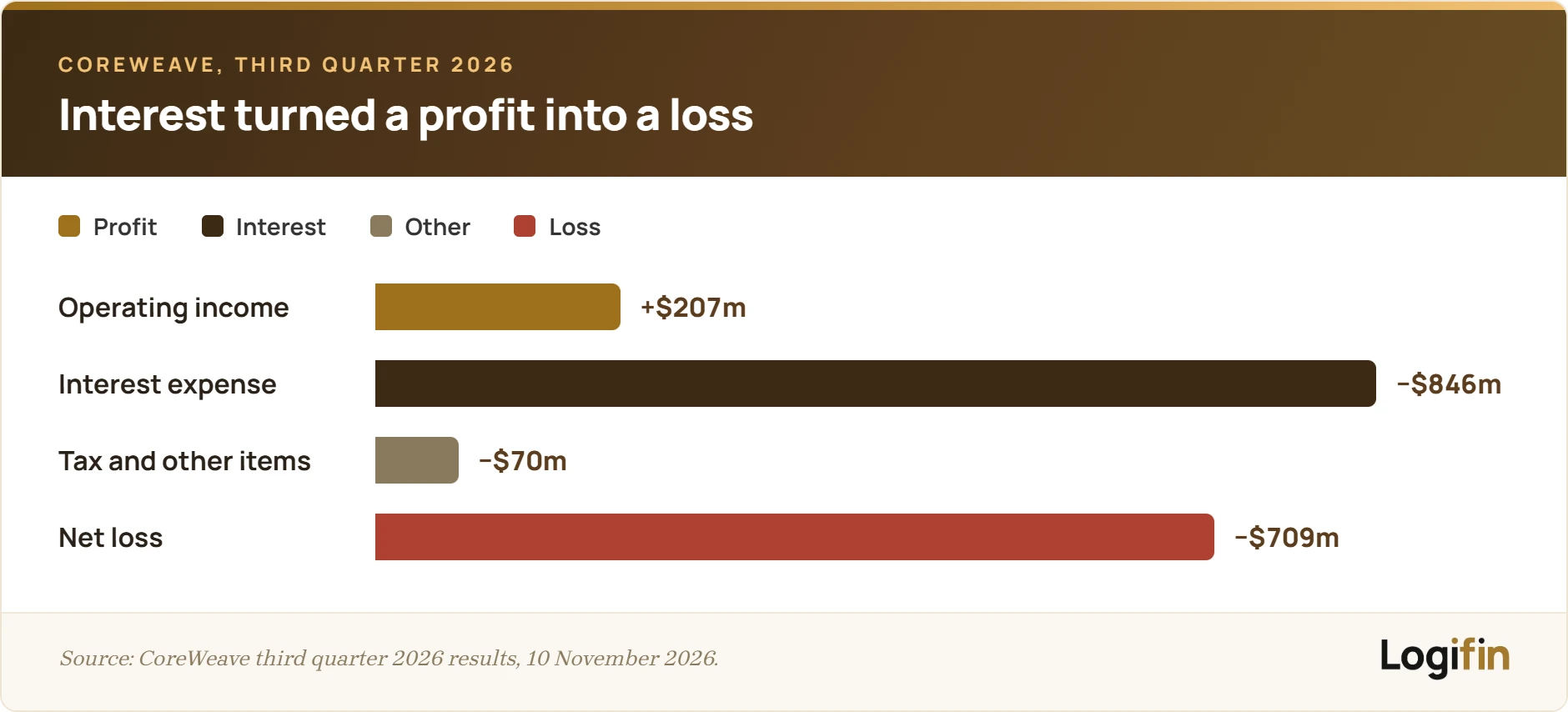
Interest grows because CoreWeave buys the chips and builds the data centres before the customer starts paying. It borrows the money and part of its debt is secured by the customer contracts themselves. In the third quarter alone it raised about $4.2 billion through convertible notes, that is loans that can later turn into shares. It also closed a new $2.6 billion loan. For the fourth quarter the company itself expects interest expense of $1.05 to $1.15 billion.
There is a second reason why the accounting result stays low. The computers the company buys lose their value within a few years. This wear, called depreciation, is recorded as an expense in every quarter. For this reason CoreWeave also reports adjusted earnings before interest, taxes, depreciation and amortisation (adjusted EBITDA), which were $2.26 billion in the quarter.
What the $132.5 billion in contracts is
The figure investors looked at most is the revenue backlog. According to the company definition, it is the revenue it expects to record in the coming years from contracts that are already signed, provided it delivers the computing power it promised. The $132.5 billion is about ten times the revenue the company expects for the whole of 2026.
The backlog is not yet money in the bank. To turn it into revenue, CoreWeave must first build the data centres and secure the electricity they need, which means spending and borrowing even more. The loss and the contracts are therefore two sides of the same strategy, since every new contract needs new data centres and new loans.
Why the stock rose and what happened next
Before the results the market was worried that artificial intelligence spending would slow down. The growth in revenue, the new contracts and the higher target for 2026 pointed the other way. On Wednesday 11 November the stock rose 24.7% and, according to Reuters, the results also supported the S&P 500 and the Nasdaq that day.
On Thursday, the day Jensen Huang resigned from Nvidia, CoreWeave lost 6.9%. On Friday it lost another 6.1%, so it closed the week up 14.5%. Even after the gain on Wednesday, the stock is 26% below the start of the year and 71% below its June 2025 high. CoreWeave listed on the stock exchange in March 2025 at a price of $40.
How much CoreWeave weighs in ETFs
CoreWeave joined the Nasdaq-100 on 22 June 2026, according to its announcement. On 12 November it weighed 0.12% in the holdings of QQQ, the largest ETF on the index, while Nvidia weighed 6.53%. The European ETFs that track the same index, such as EQQQ, hold it with roughly the same weight. For someone who owns such an ETF, even a 25% rise in CoreWeave lifts its value by only about 0.03%.
CoreWeave is not in the S&P 500. It does not appear in the holdings of SPY on 12 November, because the index requires positive GAAP earnings, that is under US accounting standards, both in the latest quarter and in total over the last four. As long as interest turns the result into a loss, CoreWeave stays out of the S&P 500, however large it becomes. The Nasdaq-100 does not require profits, so it admits earlier the young companies that invest heavily and still make losses.
What to watch
Three figures will show whether the gap between the loss and the contracts is closing.
- Interest in the fourth quarter. The company expects $1.05 to $1.15 billion. If operating income does not grow faster than interest, the losses will continue.
- The power that comes into operation. The target for the end of the year is more than 1.85 gigawatts. It determines how quickly the contracts turn into revenue.
- Nvidia results on Tuesday 17 November. CoreWeave runs on Nvidia chips, so the first results after the departure of Huang will also show whether demand for computing power is holding.
What to take away
- The CoreWeave loss came from interest. Its operations made a profit of $207 million, but it paid $846 million in interest on the loans it uses to buy chips and build data centres.
- Investors looked at the contracts. The $132.5 billion is about ten times the revenue of 2026, but it turns into revenue only once the data centres are built, which means even more borrowing.
- In ETFs CoreWeave counts for little. It weighs 0.12% in the Nasdaq-100 and is absent from the S&P 500, which requires profits before it admits a company.
Insights
Keep reading


EXPLORE LOGIFIN
Everything you need in order to learn, plan and track your investments.
Logifin Blog
Learn everything you need to get your finances in order and invest with confidence.
Logifin Insights
What moves the markets and what it means for a long term investor.
Logifin Tools
Free, inside the site, no signup. Everything you calculate stays on your device.
Logifin ETF Hub
Find the ETF that fits you: 500+ UCITS ETFs, smart filters and in-depth comparisons.
Logifin Guides
A series of guides that builds your investment plan step by step. The first guide is free for everyone.
Logifin Circle
The tools and the Hub are free for everyone. You become a member for the intelligence that never stops.