Logifin Insights
The biggest merger of 2026
Marvell is buying Lumentum with shares, in a deal that values Lumentum at $115 billion. Since then Marvell stock has lost 44% and the offer is worth far less. How an all-stock takeover works and what it means for ETFs.
· 6 min read
Marvell Technology announced on 2 November that it is buying Lumentum and paying entirely with its own shares. According to the joint announcement of the two companies, the deal values Lumentum at $115 billion including its debt. According to Bloomberg, it is the largest takeover announced anywhere in the world this year. For each Lumentum share Marvell is offering 4.5 of its own shares, which were worth about $1,132 on 28 October. Since then Marvell stock has lost 44%, so at the close on Friday 6 November the same offer was worth $635.
What Marvell and Lumentum agreed
Lumentum shareholders will receive 4.5 Marvell shares for each share they own and will hold about 33% of the combined company. The remaining 67% stays with existing Marvell shareholders. Matt Murphy, Chairman and CEO of Marvell, keeps both roles in the combined company, while three Lumentum directors, including CEO Michael Hurlston, join the Marvell board. The two companies expect more than $1 billion a year in cost savings. Completion is expected in the first half of 2028 and requires approval from the shareholders of both companies and from regulators.
The two companies make different parts of a data center. Marvell designs custom chips for large cloud customers, as well as the circuits that move data from chip to chip. Lumentum makes lasers and optical transceivers, the components that turn electrical signals into light and back again. In new AI data centers more and more data travels between computers as light through optical fiber, and every one of those connections needs a laser. Nvidia has invested $2 billion in Lumentum since March and, according to TechCrunch, another $2 billion in Marvell the same spring.
How Marvell stock reacted
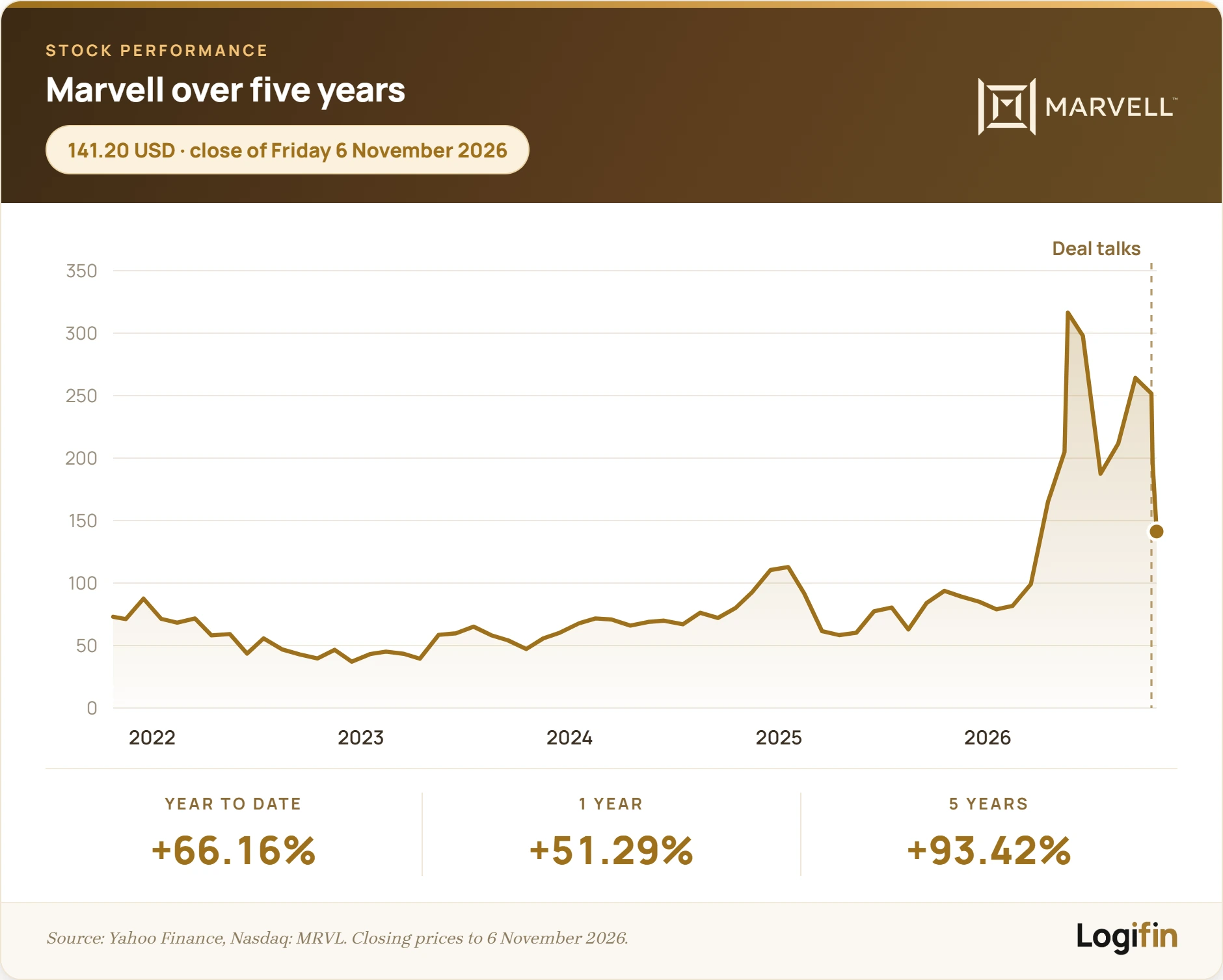
Bloomberg reported on the evening of 28 October that Marvell was in advanced talks to buy Lumentum. The next day Marvell stock fell 13.2%, on 30 October it fell another 10.1% and on 2 November, the day of the announcement, another 12.7%. Investors reacted to the size of the deal. On the day of the report Lumentum had a stock market value of about $83 billion, a third of Marvell, which was worth about $221 billion. To pay in shares, Marvell will issue a large number of new shares, so each existing shareholder will own a smaller part of the company. From 28 October to 2 November Marvell lost 31.9%, while the index of US chip companies (PHLX Semiconductor) lost 11.6%.
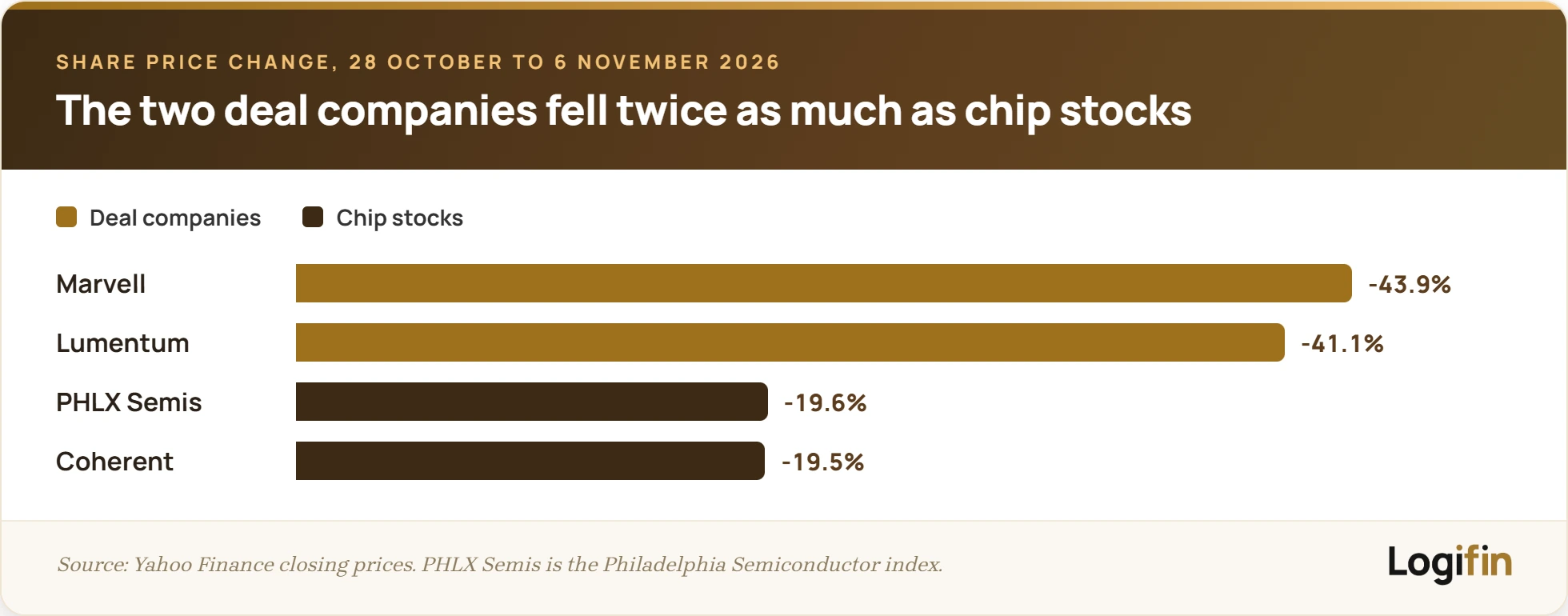
On 5 November Marvell lost another 16.4%, this time together with the whole sector, on Black Thursday on Wall Street. By the close on Friday 6 November Marvell had lost 43.9% in total and Lumentum 41.1%. Over the same period the chip index lost 19.6% and Coherent, the largest competitor of Lumentum, lost 19.5%.
Why the offer is now worth less
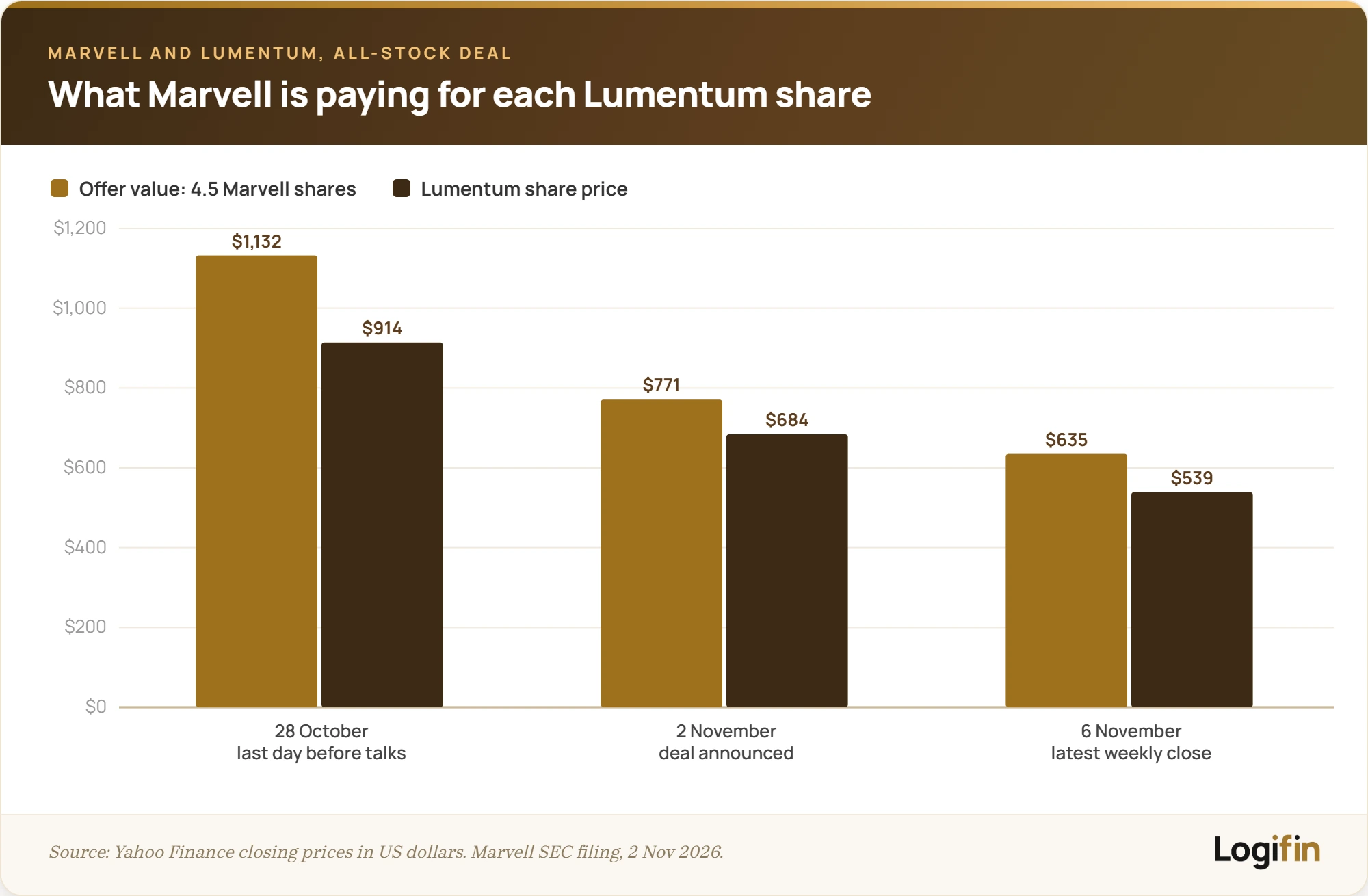
When a takeover is paid in shares, the value of the offer rises and falls with the share price of the buyer. The agreement fixes a number of shares, 4.5 Marvell shares for each Lumentum share, not an amount in dollars. The $1,132 was the value of 4.5 shares at the Marvell price on 28 October, which was 23.9% above the Lumentum price that day. At the price of 2 November the same offer was worth $771 and at the price of 6 November $635.
The $115 billion figure was therefore calculated with the prices of 28 October, before the talks became public. It is not an amount that will be paid in cash. If the takeover were paid in cash, Lumentum shareholders would know from the start how much they will receive and only Marvell shareholders would carry the fall in Marvell stock. With shares, the shareholders of both companies share it.
Why Lumentum costs less than the offer
At the close on 6 November Lumentum stock stood at $538.59, while the 4.5 Marvell shares that each shareholder will receive were worth $635.40. Lumentum was trading 15.2% below the value of the offer, while on the day of the announcement the gap was 11.3%.
This gap exists in almost every takeover that has not yet closed, because anyone who buys the target company today takes on two risks. The first is time, since completion is expected in 2028 and the money stays tied up until then. The second is that the deal may not close, if shareholders or regulators do not approve it, in which case Lumentum stock would be judged on its own again. Some investment funds systematically buy such shares to earn that difference. The strategy is called merger arbitrage. The wider the gap, the more doubt the market is pricing about whether the deal will close.
What it means for S&P 500 ETF investors
Both companies are in the S&P 500. On 6 November Marvell weighed 0.19% and Lumentum 0.07% in the holdings of SPY, the largest ETF on the index, so less than 0.3% together. For comparison, Nvidia weighed 7.10% on the same day. For anyone holding an S&P 500 ETF such as VUAA, the fall in Marvell and Lumentum counts for far less than a move in Nvidia.
Anyone holding a thematic ETF on chips or on AI infrastructure has much larger exposure. In those funds the companies of the sector are the whole portfolio, so Marvell and Lumentum carry a much larger weight.
When the deal closes, Lumentum will leave the S&P 500 and Marvell will remain as one larger company in place of the two. An ETF that tracks the index will receive new Marvell shares in place of the Lumentum shares it holds, without the investor having to do anything.
What to watch
Until completion in 2028 there are three signals that will show whether the deal is on track.
- The disclosure document. The two companies will file with the US Securities and Exchange Commission (SEC) the document that asks shareholders for their vote. It describes the meetings that led to the deal, including any involving Nvidia.
- The shareholder votes. Shareholders of both companies must approve the deal. Marvell shareholders have already paid part of the cost through the fall in the stock, while Lumentum shareholders will receive less than they expected on 2 November.
- The gap between Lumentum and the offer. If the 15% gap narrows, the market sees completion as more likely. If it widens, the market sees a failed deal as more likely.
What to take away
- The biggest merger of 2026 is paid in shares. Marvell gives 4.5 shares for each Lumentum share and the value of the offer fell from $1,132 to $635 between 28 October and 6 November, because the share price of the buyer fell.
- The market punished the buyer. Before the sector-wide fall on 5 November, Marvell had already lost 31.9%, almost three times the chip index. Lumentum trades 15% below the offer, a sign of doubt about completion.
- For an S&P 500 ETF the two companies weigh less than 0.3%. Exposure is much larger in thematic chip ETFs, where the companies of the sector are the whole portfolio.
Insights
Keep reading



EXPLORE LOGIFIN
Everything you need in order to learn, plan and track your investments.
Logifin Blog
Learn everything you need to get your finances in order and invest with confidence.
Logifin Insights
What moves the markets and what it means for a long term investor.
Logifin Tools
Free, inside the site, no signup. Everything you calculate stays on your device.
Logifin ETF Hub
Find the ETF that fits you: 500+ UCITS ETFs, smart filters and in-depth comparisons.
Logifin Guides
A series of guides that builds your investment plan step by step. The first guide is free for everyone.
Logifin Circle
The tools and the Hub are free for everyone. You become a member for the intelligence that never stops.