Logifin Insights
Why is Meta issuing non-voting shares?
Meta will give every shareholder one new non-voting share for each share they own. What this changes for control of the company, for the share price and for stock indices.
23 October 2026 · 7 min read

On Wednesday 21 October, together with its third-quarter results, Meta announced a new class of shares with no voting rights, called Class C. Every shareholder will receive one Class C share free of charge for each share they hold, once the change takes effect in January 2027. The company says it will use the new shares to raise capital, to pay employees and to fund acquisitions, without changing how votes are distributed. In the same quarter Meta's investment spending exceeded the cash generated by its operations, for the first time since 2012.
The results and the share price reaction
Revenue for the quarter reached 64.6 billion dollars, 26% more than a year earlier. Operating income, however, fell 37% to 13.0 billion, mainly because of a 9.89 billion charge for the August settlement with US states concerning the safety of minors. For the whole of 2026 Meta now expects capital expenditure of 135 to 145 billion dollars. Until now the lower end of the range was 130 billion.
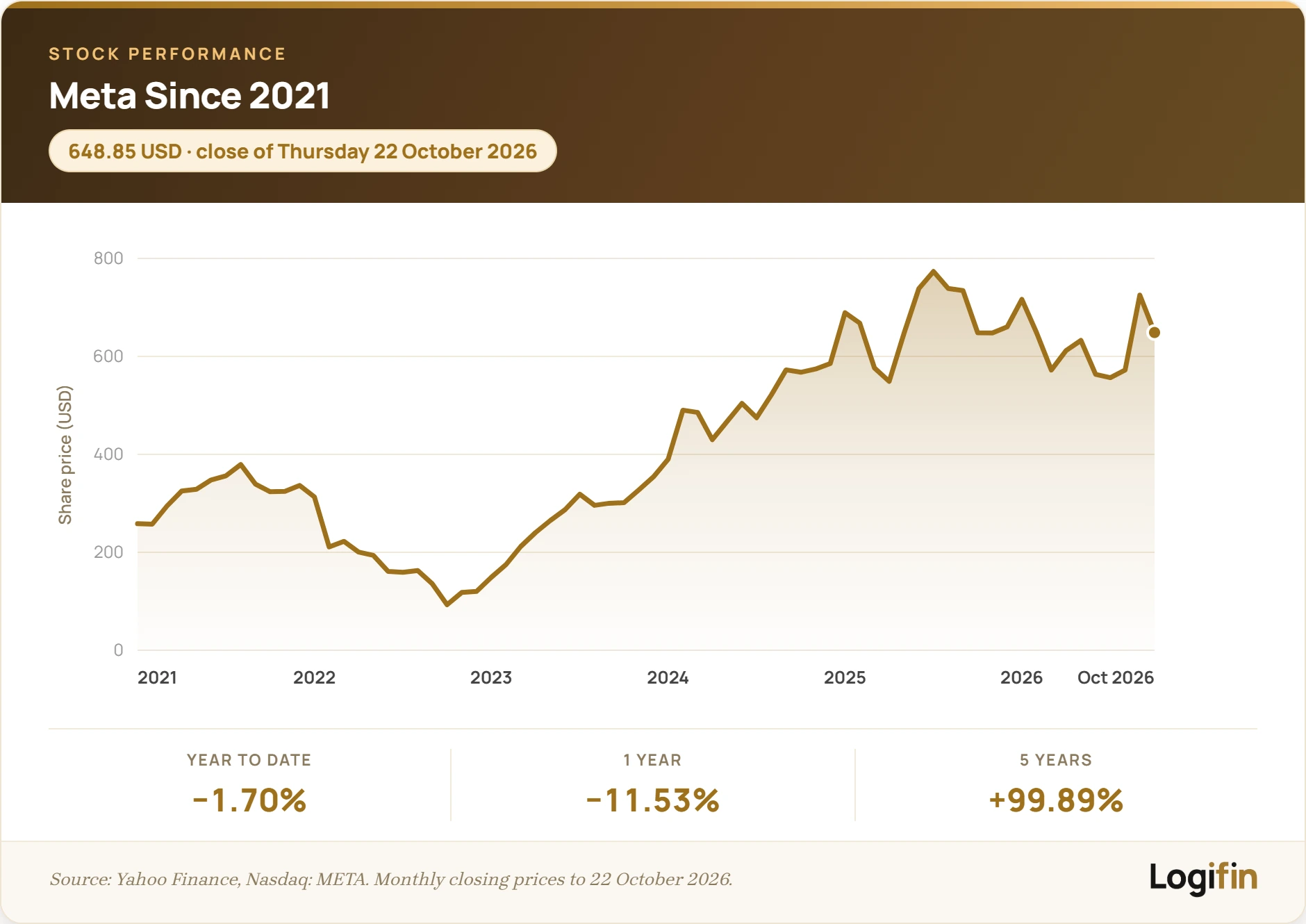
In trading after Wednesday's close the shares rose. On Thursday, however, they closed 6.98% lower, at 648.85 dollars. The company's market value fell by about 124 billion dollars. Reports on the day linked the fall to the higher spending and to the quarter's cash, which was not enough to cover it. On the same day the Nasdaq lost 2.6%, with the largest losses in chipmaker shares.
Why cash flow turned negative
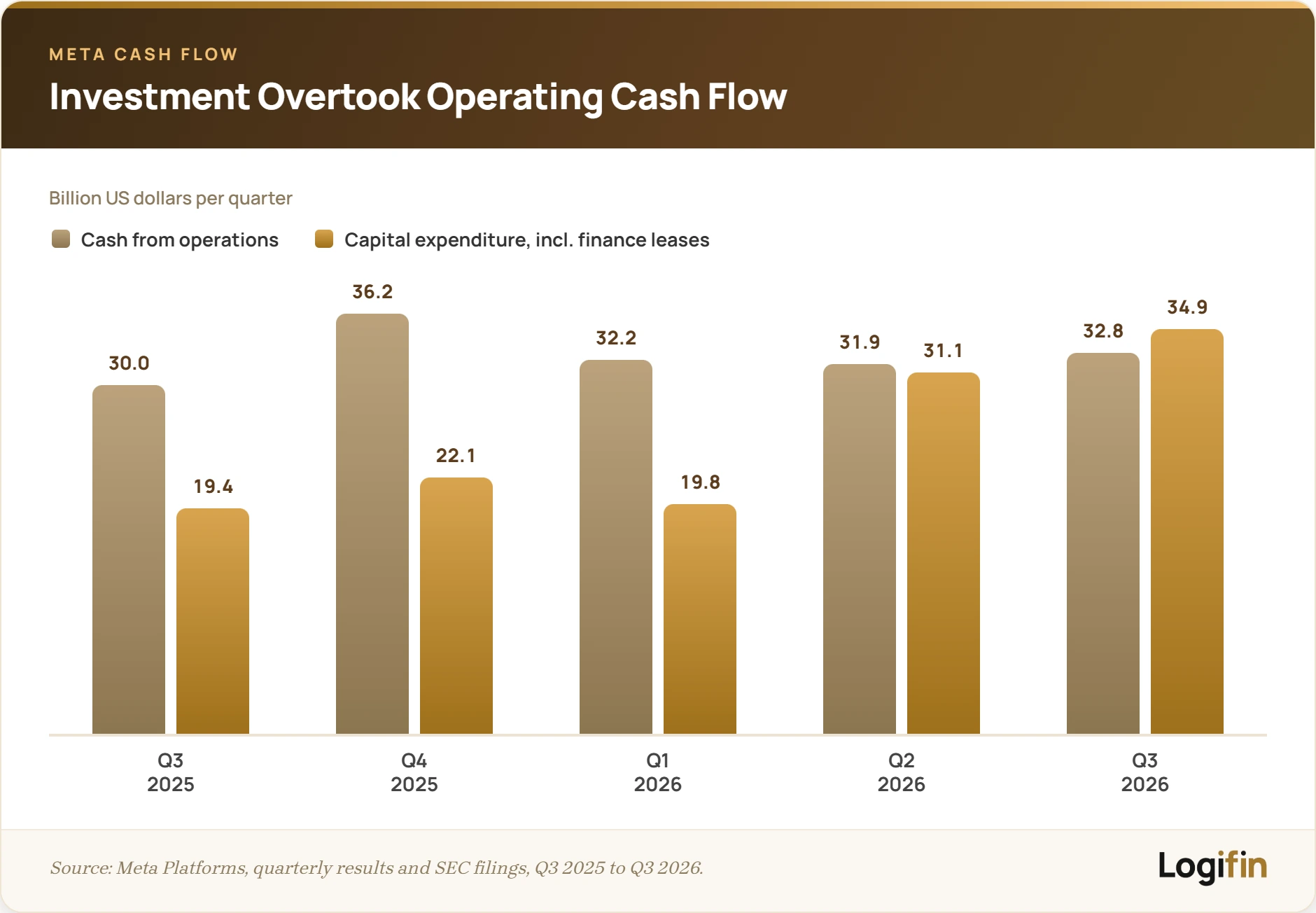
Free cash flow is the cash a company has left from its operations after paying for its investments. In the third quarter Meta's operations brought in 32.8 billion dollars, while its capital expenditure reached 34.9 billion. Free cash flow was therefore negative, at minus 2.1 billion. A year earlier it was positive, at 10.6 billion. Meta's capital expenditure goes mainly into infrastructure for artificial intelligence.
In the three quarters to March 2026 capital expenditure was around 60% to 65% of operating cash flow. In the second quarter it almost matched it and in the third quarter it went above it. This year Meta has not bought back any of its own shares. At the end of September it held cash and marketable securities of 82.4 billion dollars, against long-term debt of 80.9 billion.
How Meta's share classes work
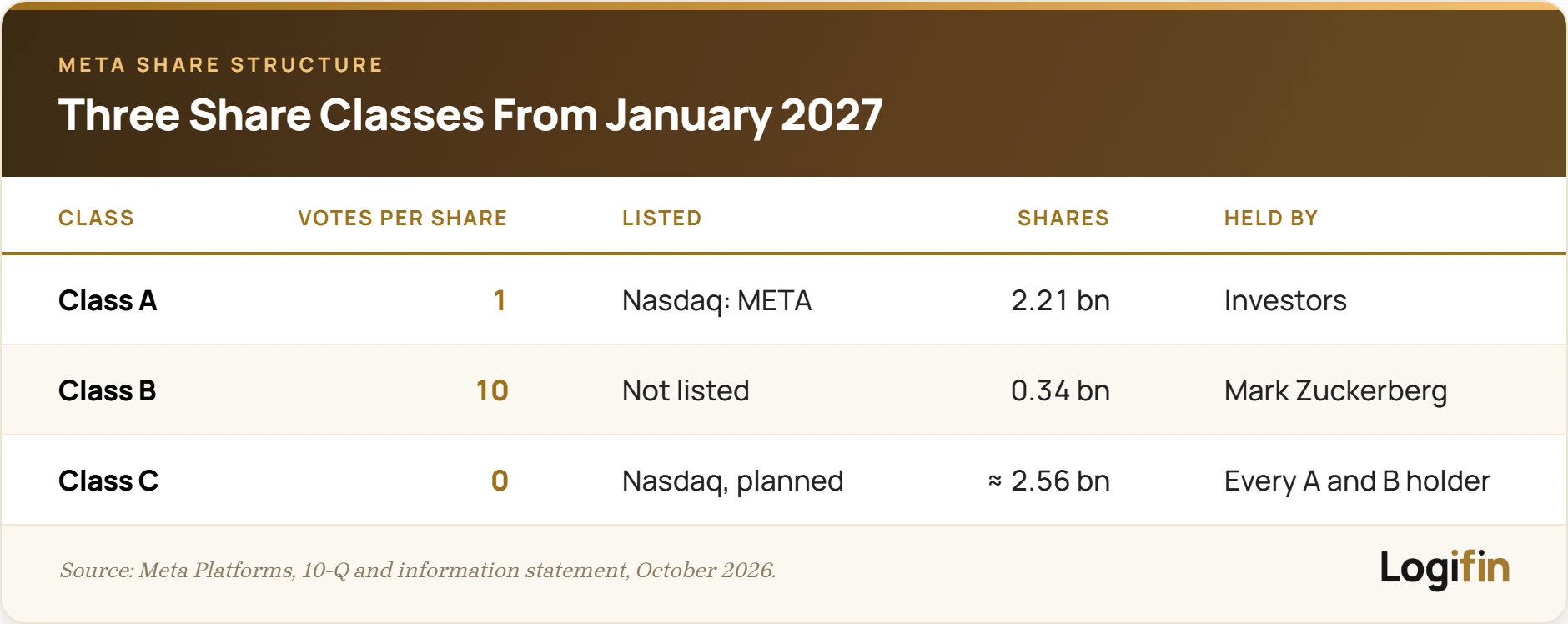
Meta currently has two classes of shares. Class A shares trade on the Nasdaq under the symbol META and carry one vote each. Class B shares do not trade, carry ten votes each and almost all of them belong to the founder and chief executive, Mark Zuckerberg. As a result Zuckerberg owns about 13.4% of the value of the company but controls 60.6% of the votes.
The new Class C shares will have the same rights as the other two classes to profits and dividends, but no vote. Meta will distribute them as a stock dividend: every shareholder will receive one Class C share for each Class A or Class B share they hold. The company expects that after the distribution the Class A price will adjust as in a two-for-one split, that is, to roughly half. Anyone who holds one share today will hold two, with roughly the same total value. One of the two, however, will carry no vote.
The change was approved without a general meeting. Following a recommendation from a committee of independent board members, the written consent of Zuckerberg's holding companies, with 56.1% of the votes, was enough.
Why Meta wants shares without votes
When a company raises capital by selling new shares, the stake of existing shareholders shrinks. If Meta sold new Class A shares, Zuckerberg's share of the votes would shrink too. With Class C shares the company can raise money without changing who controls the votes. In the information statement it filed with the US Securities and Exchange Commission (SEC), Meta says it expects to sell Class C shares from time to time, depending on market conditions. It has not announced a specific offering and notes that it currently has enough capital for its present needs.
According to the same document, Zuckerberg had told the committee he was considering moving his main residence out of California because of Proposition 40. This is a tax on large fortunes, on which the state's voters decide on 3 November. The committee wanted Zuckerberg to keep running the company from its headquarters in California. Of the Class C shares he will receive, he can freely sell 20%, which is about 10% of his total stake. He could use them to pay the tax, if the proposition is approved. Every sale of the rest has to be matched by a sale or conversion of Class A or Class B shares, which also reduces his votes.
Google did the same in 2014. It distributed one non-voting Class C share for each Class A and Class B share, so that its founders Larry Page and Sergey Brin would keep control. In the first year Class C traded slightly below Class A. For that gap Google paid 522 million dollars to Class C holders, as required by a court settlement with shareholders. Meta writes that its own Class C shares will also likely trade at some discount to Class A.
What the change means for stock indices
Major stock indices such as the S&P 500 currently include only Meta's Class A shares, because they are the only ones that trade. On 22 October Meta weighed 2.17% in the S&P 500, according to the holdings of the SPDR S&P 500 ETF, which replicates the index. Alphabet, the parent company of Google, appears in the same ETF twice: its Class A shares at 2.88% and its Class C shares at 2.31%.
Meta writes that it chose one new share for every existing share to increase the likelihood that Class C shares will be included in stock indices. It also mentions the possibility that some indices may keep only Class A. If an index includes both classes, as the S&P 500 does with Alphabet, Meta's total weight stays roughly the same. If it keeps only Class A, Meta's weight in the index will be about half of what it is today. ETFs that track such an index would then have to sell the Class C shares they receive.
What to watch
- The date of the distribution. Meta's new charter takes effect on 19 January 2027 and the Class C shares must be distributed within five business days.
- The index decisions. The companies that calculate stock indices, such as S&P Dow Jones Indices and MSCI, will decide whether Class C shares join Class A in their indices.
- The first sale of Class C shares. If Meta raises capital with new shares, the amount will show how much money it needs beyond what its operations bring in. It has not yet given a forecast for capital expenditure in 2027.
What to take away
- Every Meta shareholder will receive one non-voting Class C share for each share they hold. Meta expects the Class A price to adjust as in a two-for-one split, so the total value of a holding stays roughly the same.
- The new shares let Meta raise capital without reducing Zuckerberg's control, as he owns 13.4% of the value and 60.6% of the votes.
- For ETFs that track the major indices, what matters is whether Class C shares are included. Alphabet already appears twice in the S&P 500, once for each of its share classes.
EXPLORE LOGIFIN
Everything you need in order to learn, plan and track your investments.
Logifin Blog
Learn everything you need to get your finances in order and invest with confidence.
Logifin Insights
What moves the markets and what it means for a long term investor. Short and without the noise.
Logifin Tools
Free, inside the site, no signup. Everything you calculate stays on your device.
Logifin ETF Hub
Find the ETF that fits you: 500+ UCITS ETFs, smart filters and in-depth comparisons.
Logifin Guides
A series of guides that builds your investment plan step by step. The first guide is free for everyone.
Logifin Circle
The tools and the Hub are free for everyone. You become a member for the intelligence that never stops.