Logifin Insights
$192bn of Meta's market value. In one day.
Early demand for Muse lifted expectations for Meta. The download figures show interest. Revenue is the part that remains unknown.
23 September 2026 · 8 min read

On Monday 21 September Meta shares closed more than 11% higher and the market value of the company rose by roughly 192 billion dollars. Reports that day linked the rally to early demand for Muse, the new artificial intelligence app from Meta, which had reached the top of the US Apple App Store. On the same day Wells Fargo raised its price target for the share from 640 to 796 dollars.
Meta had published no revenue figures for Muse by that point. The app had been available for only thirteen days.
What Muse does
Muse launched on 8 September in the United States, through an iOS and Android app, on the web and inside WhatsApp. It is an artificial intelligence assistant that can carry out tasks for the user, such as sending email or arranging travel. Reuters also cites selling a car on a user's behalf as an example of a more complex task.
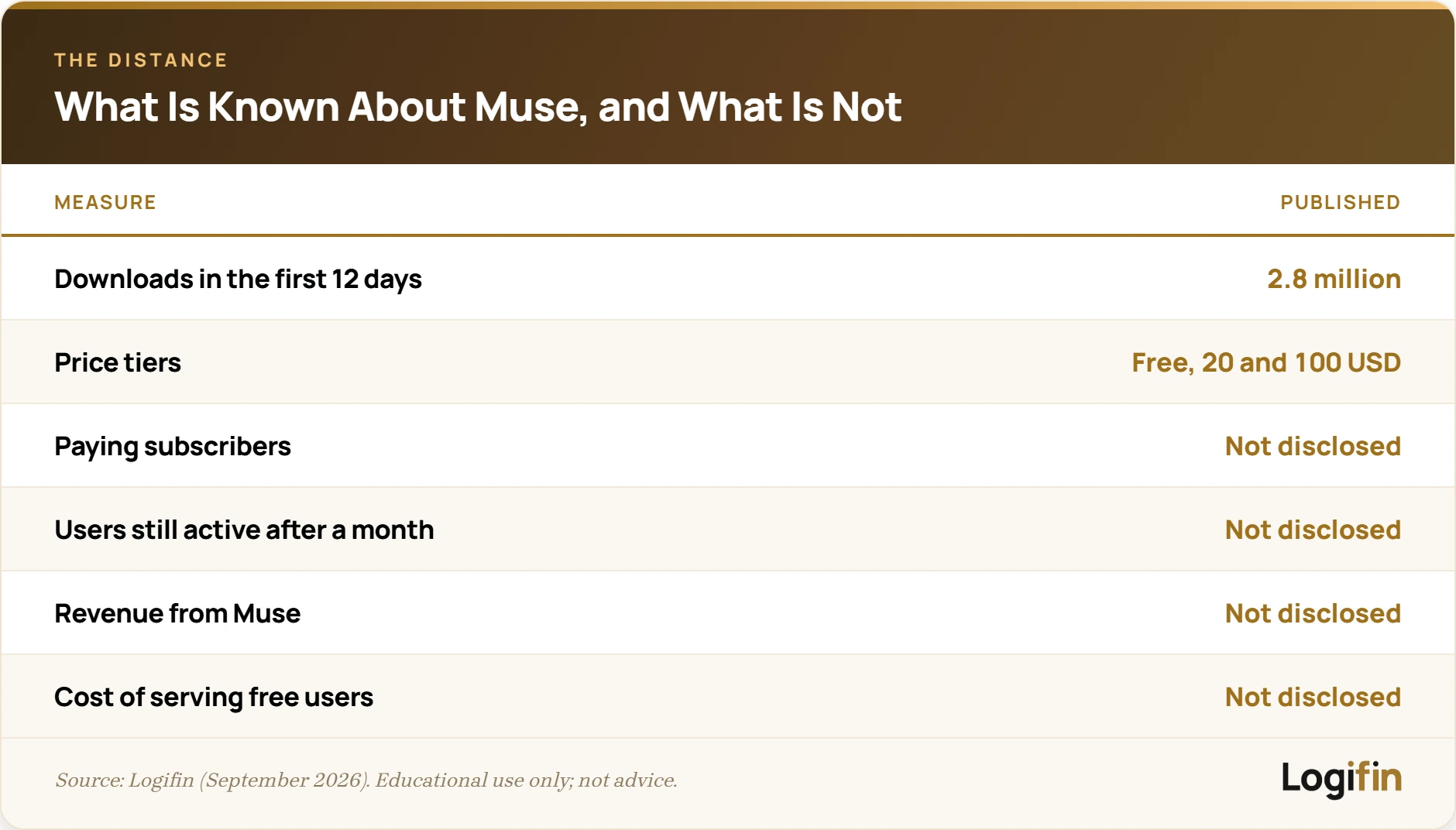
Taking actions on the user's behalf is the defining feature of this category of app. Muse is available free with a usage limit, alongside subscriptions of 20 and 100 dollars a month.
Access through WhatsApp may make it easier to try for people who already use that app. What is not known is how much this contributed to the first downloads, or how many of those who tried it will keep using it.
Early demand and the share price
On 19 September Muse recorded 264,000 downloads in a single day in the United States. Across its first twelve days it gathered roughly 2.8 million downloads in the United States and Canada, according to an Apptopia estimate cited by Reuters.
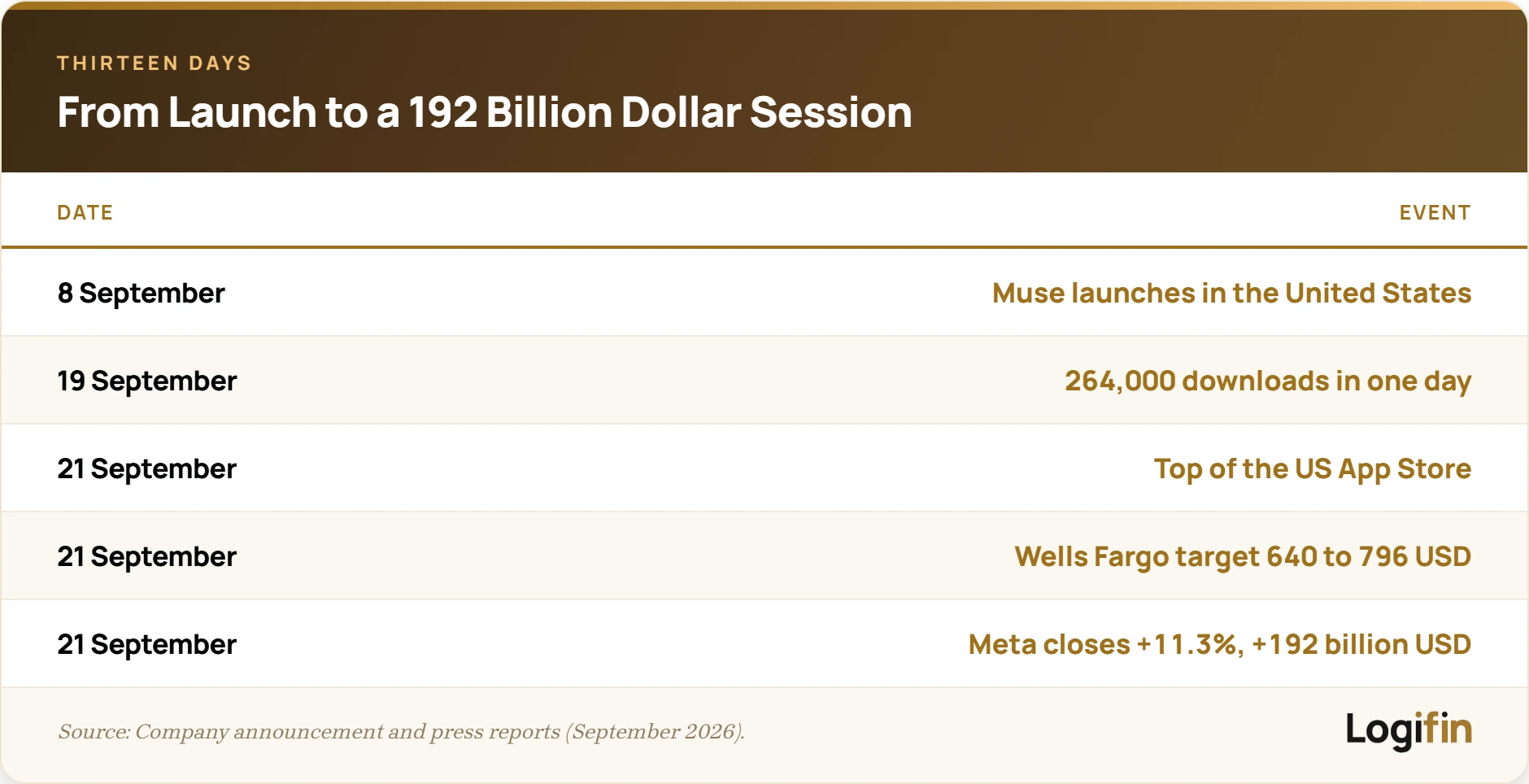
The rally had started earlier. From the launch of Muse on 8 September to the close on the 21st, the share had gained more than 20%.
Monday's rise came in a strong session for the US market. The Nasdaq Composite gained 2.26% to a record close and the S&P 500 added 1.49%. Communication services and technology were the strongest sectors in the index. Intel also gained, by 12.17%, as did AMD, by 9.95%.
Reports connected the mood of the session with optimism around artificial intelligence, falling oil prices and expectations for the diplomatic meetings of the week.
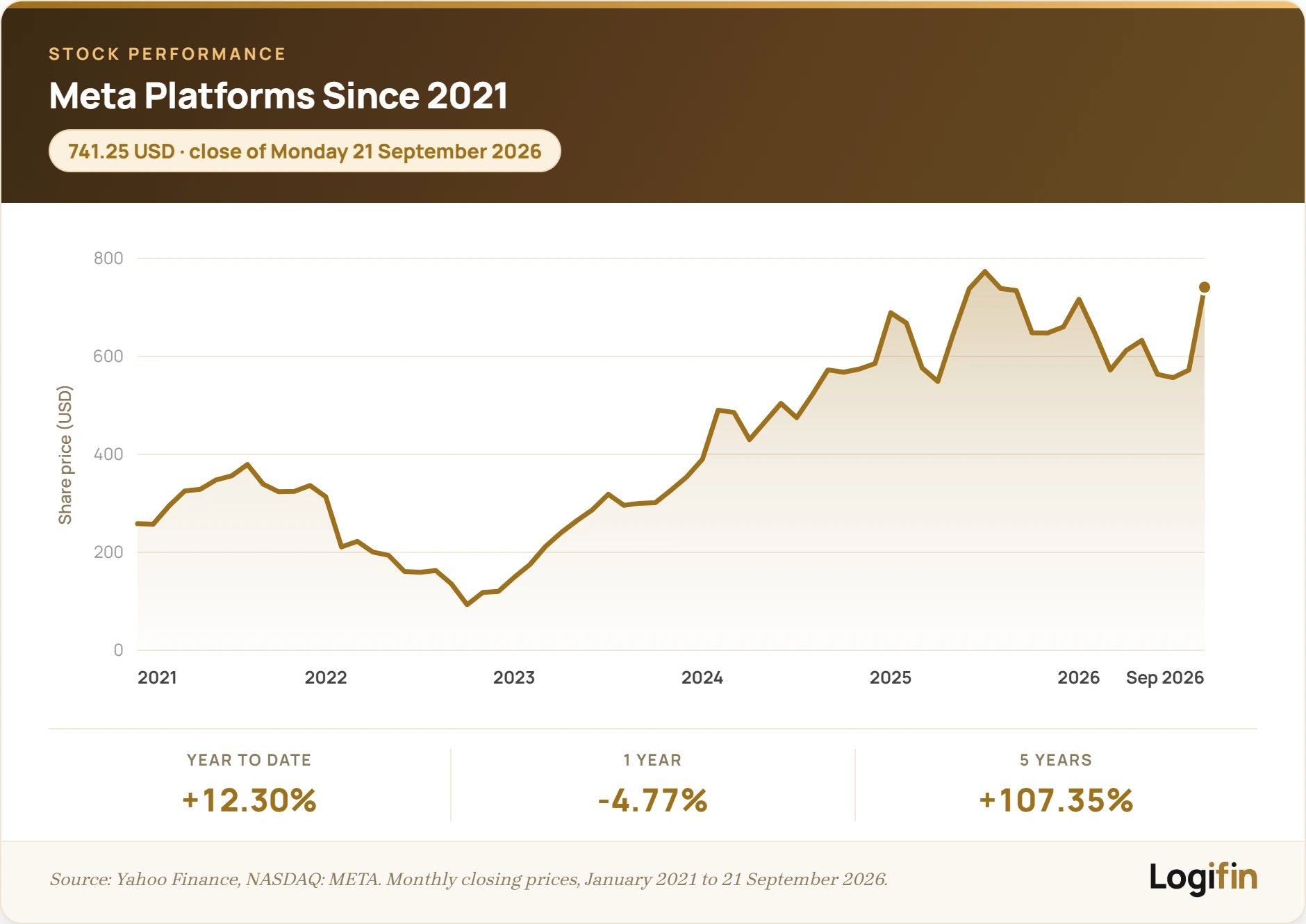
Over a longer period the picture is different. Despite Monday's jump, the share remained lower than it had been a year earlier. Across five years it has more than doubled, having passed through the steep fall of 2022, when it traded below 100 dollars.
Downloads are not revenue
Downloads are a first sign of interest, not a measure of revenue. They count how many times an app was installed, according to each data provider's methodology, not how many people pay for it.
Assessing the commercial prospects of Muse requires answers to three questions: how many users will keep using it, how many will subscribe and how much it will cost to serve them. The computing power needed to carry out tasks affects the cost of free and paid use alike. Early download figures are not enough to answer these questions.
On 22 September, Reuters reported a Jefferies scenario for potential revenue from Muse. If Muse reaches one billion users by the end of 2027 and at least 3% move to a paid version, annualised revenue would come to 10.8 billion dollars.
That figure needs two clarifications. The first is that annualised revenue expresses a revenue rate over a full year. It does not mean that this amount would already have been earned during 2027. It also describes revenue rather than profit.
The second is that the two conditions do not produce the number on their own. At exactly 3% conversion, one billion users would mean 30 million paying subscribers. Subscription revenue of 10.8 billion dollars a year would then require average revenue of 30 dollars per subscriber per month.
The cost of the artificial intelligence build-out
Muse is not a standalone product. It is the visible part of an investment that has already changed the shape of the company's accounts. In the second quarter results, published on 29 July, revenue reached 60.8 billion dollars, up 28% on the year.
Revenue rose 28%, but costs rose 55%. The operating margin fell from 43% to 31% and net income declined 14%, to 15.85 billion dollars. Capital expenditure reached 31.08 billion dollars within the quarter and free cash flow came to 784 million dollars.
For the whole of 2026 the company guides to capital expenditure of 130 to 145 billion dollars. The share fell after the results were published. The question investors raised at the time was when that spending would begin to produce revenue. Muse is one of the possible answers.
The 17 billion dollar settlement
Two weeks before Muse launched, the company closed a major legal matter. On 26 August Meta agreed to pay up to 17.1 billion dollars over a decade, settling claims by 47 states, the District of Columbia and several US territories over the safety of minors on Facebook and Instagram. Judge Yvonne Gonzalez Rogers approved the settlement.
The states argued that the platforms were designed to be addictive to young users. Beyond the payment, the agreement requires changes to the apps themselves: a daily time limit, automatic pauses and a block on access between midnight and six in the morning for minors. Most of these have to stay in place for at least a decade.
How expectations affect the share price
The price of a share reflects expectations about the future financial performance of the company as well as the risks investors see. A new product can therefore affect a company's market value before any revenue figure for it is published.
LSEG data cited by Reuters on 22 September showed that 57 of the 64 brokerages covering Meta rated it a buy or higher, with a median price target of 760 dollars. Jefferies raised its own target to 875 dollars.
The next official measurement has a date. The third quarter results are expected on 28 October. The company guides to revenue of 61 to 64 billion dollars for the quarter, an amount that comes mainly from advertising.
Muse, however, launched on 8 September, three weeks before the quarter closed. Whatever revenue it has produced covers only a handful of days in the period. What will show more clearly is the cost, along with whatever management says about the scale of investment in 2027.
What this means for a UCITS ETF
If a UCITS ETF tracks an index that includes Meta, changes in the Meta share price contribute to the performance of the ETF in proportion to its index weight. That exposure applies to falls as well as rises, without the investor buying the share separately.
Take the S&P 500, the index tracked by many European ETFs holding US shares. On 22 September Meta was the seventh largest company in the index, at a weight of 2.42%. Ahead of it stood Nvidia at 8.26%, Apple at 7.40%, Alphabet at 5.54%, Microsoft at 5.52%, Amazon at 3.73% and Broadcom at 2.59%.
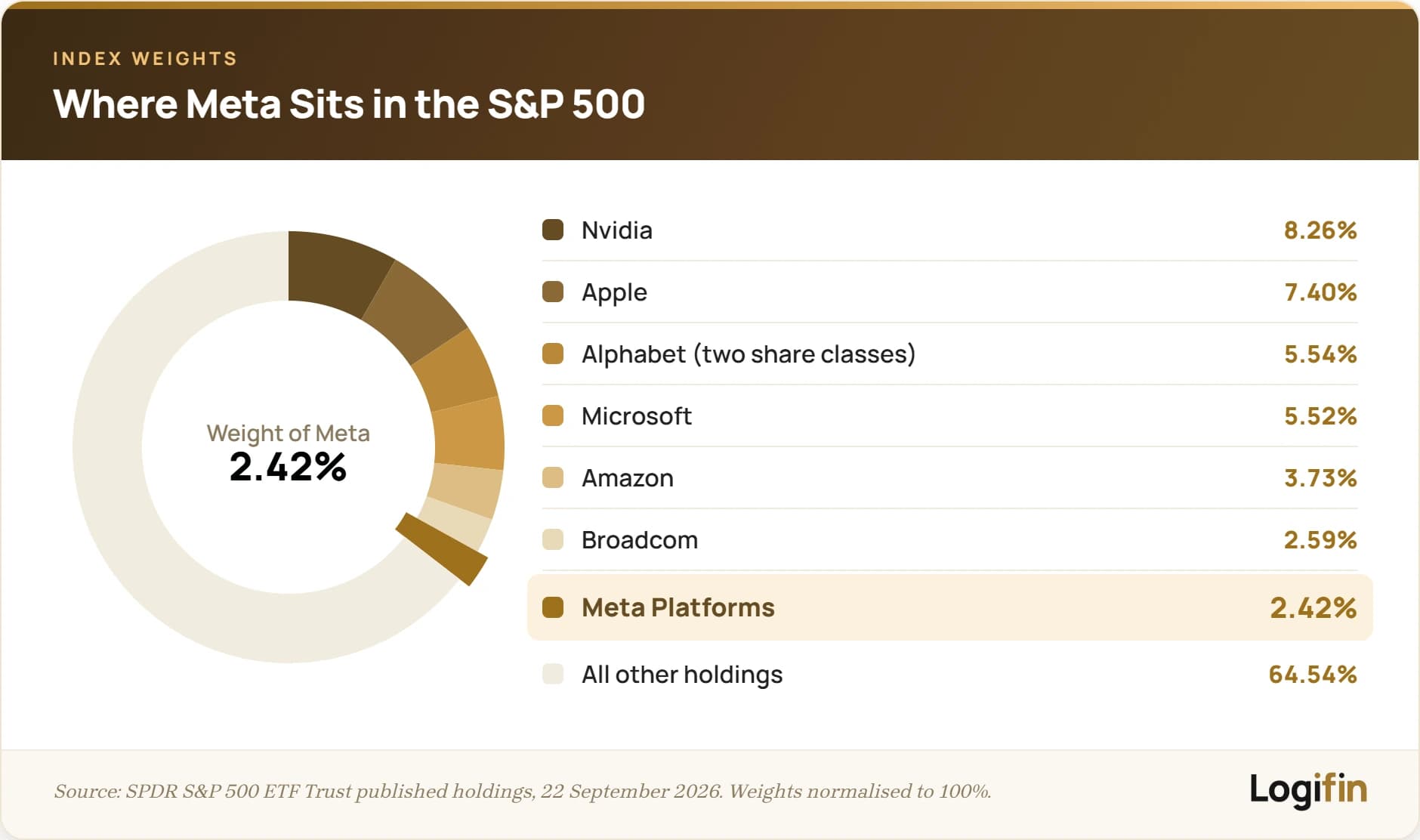
Here is the arithmetic. Before Monday's rise the weight of Meta in the index was a little above 2%. In a position of that size, a gain of 11.3% adds around a quarter of a percentage point. The S&P 500 closed that day up 1.49%. The rest of the rise came from the other companies in the index.
The ATLAS guide explains how weighting rules shape the part each company plays in an index. The Logifin ETF Hub shows which index each ETF tracks.
What to take away
- Early demand for Muse lifted expectations of new revenue at Meta. Downloads on their own do not show how profitable the service can become.
- Over the same period costs are rising faster than revenue, while the August settlement commits up to 17.1 billion dollars over a decade.
- The next real evidence arrives on 28 October with the third quarter results. What matters there is user retention, paid subscriptions and the cost of running the service.
- The performance of a UCITS ETF is affected by Meta when the index it tracks includes the share. In the S&P 500 its weight was 2.42% on 22 September.
EXPLORE LOGIFIN
Everything you need in order to learn, plan and track your investments.
Logifin Blog
Learn everything you need to get your finances in order and invest with confidence.
Logifin Insights
What moves the markets and what it means for a long term investor. Short and without the noise.
Logifin Tools
Free, inside the site, no signup. Everything you calculate stays on your device.
Logifin ETF Hub
Find the ETF that fits you: 500+ UCITS ETFs, smart filters and in-depth comparisons.
Logifin Guides
A series of guides that builds your investment plan step by step. The first guide is free for everyone.
Logifin Circle
The tools and the Hub are free for everyone. You become a member for the intelligence that never stops.