Logifin Insights
Why the SpaceX index weight doubles
The SpaceX weighting in the Nasdaq-100 more than doubles on Monday 21 September and estimates published before the rebalance pointed to buying of up to 22 billion dollars, with no change in the company itself.
19 September 2026 · 5 min read
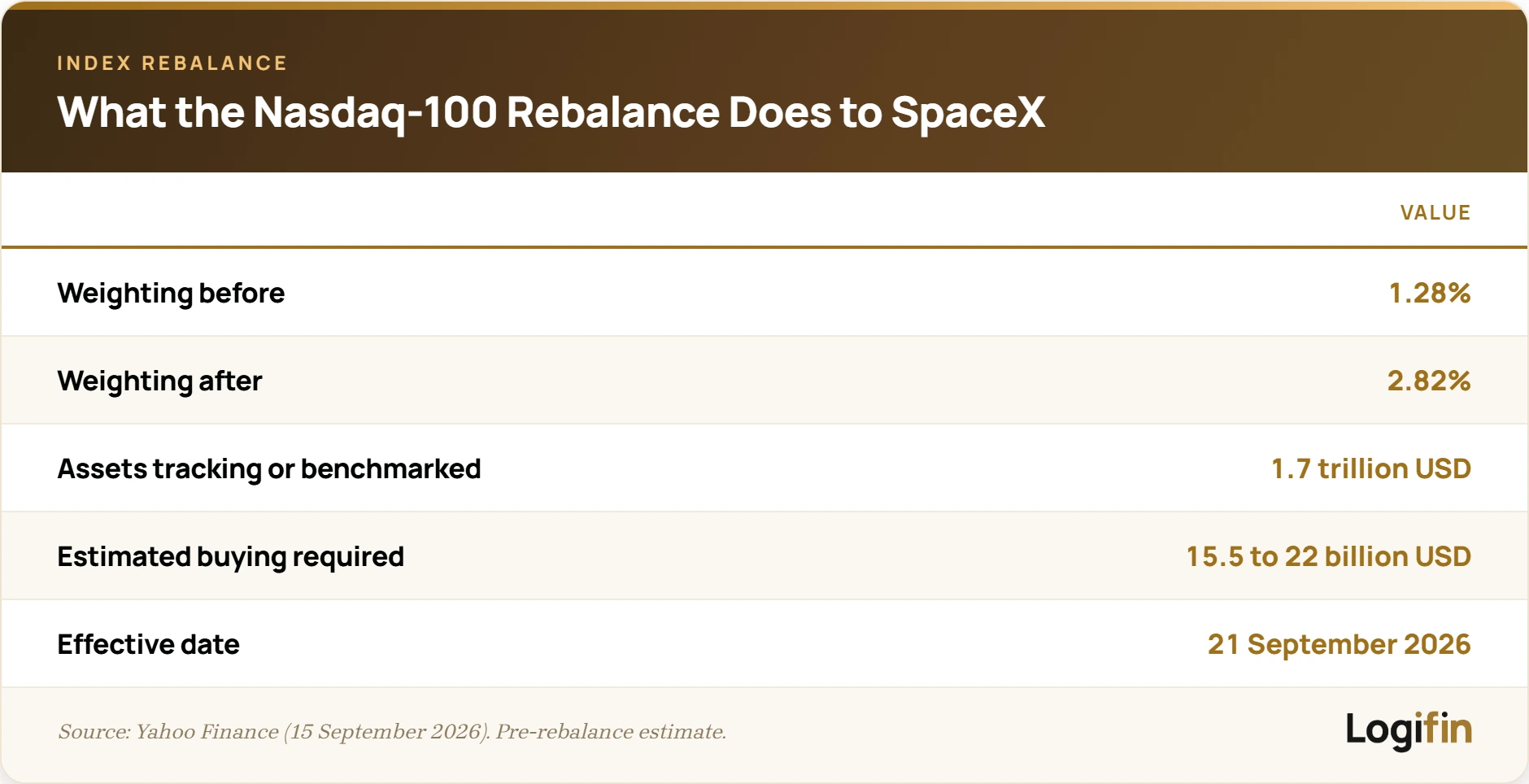
On Monday 21 September the SpaceX weighting in the Nasdaq-100 more than doubles, from roughly 1.28% to 2.82%. Funds that replicate the index make the adjustment in Friday's session. Estimates published before the rebalance pointed to buying of between 15.5 and 22 billion dollars.
SpaceX did not suddenly become a different company. Its free float increased, meaning that more of its shares became available for public trading.
What changes on Monday
Around 1.7 trillion dollars sits in funds that track the Nasdaq-100 or use it as their benchmark. Funds that aim to replicate its performance adjust their exposure when the composition or the weighting changes. Otherwise they stop following the index faithfully.
The buying estimate reflects the adjustment required for funds to track the new index weight. The figure on its own does not demonstrate increased investor appetite for SpaceX.
The rule behind it
The Nasdaq-100 weights its constituents by market capitalisation. For those with a very closely held share base, a further limit has applied since May 2026.
For low-float securities, the index uses the lower of the eligible listed share class's total shares outstanding or three times its free-floating shares. It multiplies that number by the share price to calculate the market capitalisation used for weighting.
As the lockups expired, the free float the index recognises grew. The SpaceX weighting grew with it. The ATLAS guide explains how different weighting rules change the composition and the behaviour of an index.
Only 5% of the shares were offered
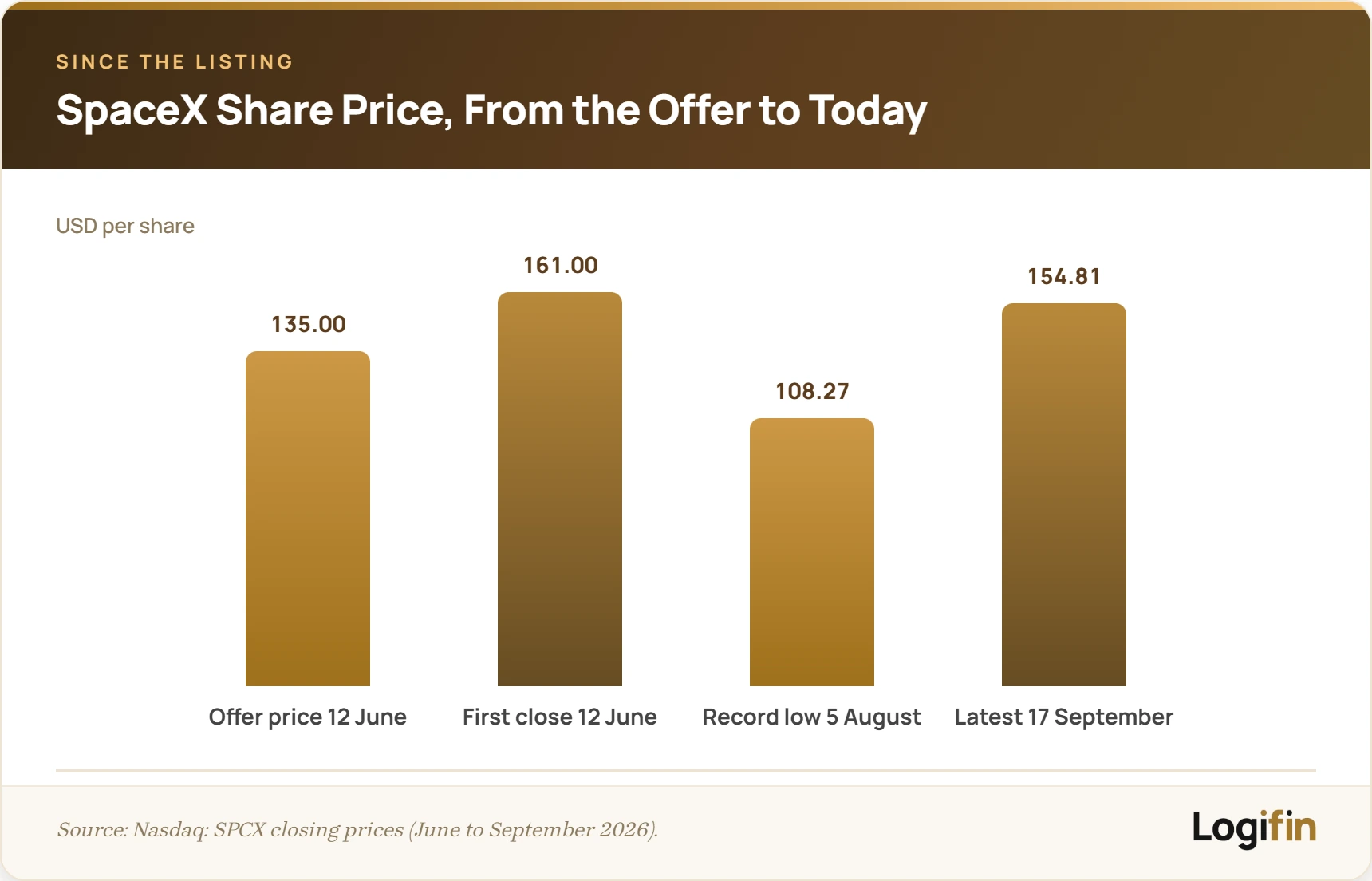
SpaceX went public on 12 June 2026 at 135 dollars a share, at a valuation of 1.77 trillion, raising 75 billion. It was the largest IPO in history. On the first day it closed at 161 dollars, 19% higher, which pushed the valuation past 2.1 trillion.
About 5% of the total shares were offered at the IPO, far below normal practice, which required a waiver from the US Securities and Exchange Commission. Two share classes run alongside each other: the Class A shares the public bought carry one vote, the Class B shares held by insiders carry ten. Elon Musk owns 42% of the shares and controls between 82% and 85% of the votes.
The lockup periods began to expire in August. On 6 August roughly 911.5 million insider shares were unlocked and by the end of the month more than 1.2 billion had been released. In October and November more than 2.3 billion further shares come out of lockup.
What the share price did meanwhile
The first results as a listed company arrived on 4 August. Second quarter revenue reached 7.8 billion dollars, up 92% in a year. Despite the growth in revenue and in operating profit, the company reported a loss of 541 million dollars.
The next day the shares fell almost 14%, closing at 108.27 dollars, their lowest close since the listing. On 6 August, the day the 911.5 million shares were unlocked, they rose more than 6%.
On 17 September they traded at 154.81 dollars. From the listing until then they had moved between 104.83 and 225.64 dollars.
Results were announced in the same period and lockups expired. The scheduled change in weighting relates to the way the index accounts for the free float.
Why it is missing from the S&P 500
SpaceX entered the Nasdaq-100 fifteen trading sessions after it listed. It does not yet meet the S&P 500 criteria. Those criteria require positive GAAP earnings in the most recent quarter and across the most recent four quarters combined, while SpaceX reported a loss of 541 million dollars in the second quarter of 2026. The criteria also require twelve months of trading. SpaceX reaches that milestone in June 2027, but this does not guarantee inclusion.
In June 2026 S&P Dow Jones Indices rejected a proposal to fast track very large new listings into the index, on the reasoning that exceptions are not granted on the basis of size alone.
Different inclusion criteria can therefore leave a company in the Nasdaq-100 and outside the S&P 500. The same pattern appeared when The Trade Desk left the S&P 500. Index membership follows from the rules of the index, not from an assessment of the quality of a company.
The change in weighting also affects the exposure of the UCITS ETFs that track the Nasdaq-100. From Monday their exposure to SpaceX roughly doubles, without the investor having to make a single trade. The Logifin ETF Hub shows which index each fund tracks.
What to take away
- The 15.5 to 22 billion of buying, as estimated before the rebalance, follows from the rulebook of the index rather than from any assessment of the share.
- The Nasdaq-100 weighting takes the free float into account. As more shares become freely tradable, the weight of a company in the index can rise.
- The Nasdaq-100 and the S&P 500 apply different rules. That is why the same company can carry a significant weight in one and still fail to meet the criteria of the other.
EXPLORE LOGIFIN
Everything you need in order to learn, plan and track your investments.
Logifin Blog
Learn everything you need to get your finances in order and invest with confidence.
Logifin Insights
What moves the markets and what it means for a long term investor. Short and without the noise.
Logifin Tools
Free, inside the site, no signup. Everything you calculate stays on your device.
Logifin ETF Hub
Find the ETF that fits you: 500+ UCITS ETFs, smart filters and in-depth comparisons.
Logifin Guides
A series of guides that builds your investment plan step by step. The first guide is free for everyone.
Logifin Circle
The tools and the Hub are free for everyone. You become a member for the intelligence that never stops.