Logifin Insights
It joined the index at 80 dollars and leaves at 14. What does the S&P 500 measure?
On September 4 S&P announced three arrivals and three departures. One company had joined fourteen months earlier. The reason it is leaving explains what an index actually measures.
7 September 2026 · 5 min read

On September 4 S&P Dow Jones Indices announced which companies join and which leave the S&P 500 on September 21. Among those leaving is The Trade Desk. It entered the index on July 18, 2025, when the shares closed at 80.21 dollars. On the day its departure was announced they closed at 14.43. Fourteen months, a fall of 82%.
The conclusion most people reach is that the index picked the wrong company. The index picked nothing at all. That is where the useful part of the story sits.
The seat had opened because of an acquisition
The Trade Desk did not enter the S&P 500 because somebody judged that it deserved a place. It entered because a seat fell vacant. In July 2025 Synopsys was completing its acquisition of ANSYS, so ANSYS was about to stop existing as a separate listed company and had to go. S&P announced on July 14 that The Trade Desk would take the seat, effective July 18.
An index has a fixed number of places. When a company is acquired, merges or leaves the stock market, its seat has to be filled by another one that fits the size bracket. Joining an index is not a prize, it is a bookkeeping entry.
The index measures size, it does not grade quality
In the same announcement S&P gives the reason in a single sentence: the changes ensure that each index is more representative of its market capitalisation range. It says nothing about prospects, about the quality of management or about whether a share is attractive. It says the numbers no longer fit the shelf.
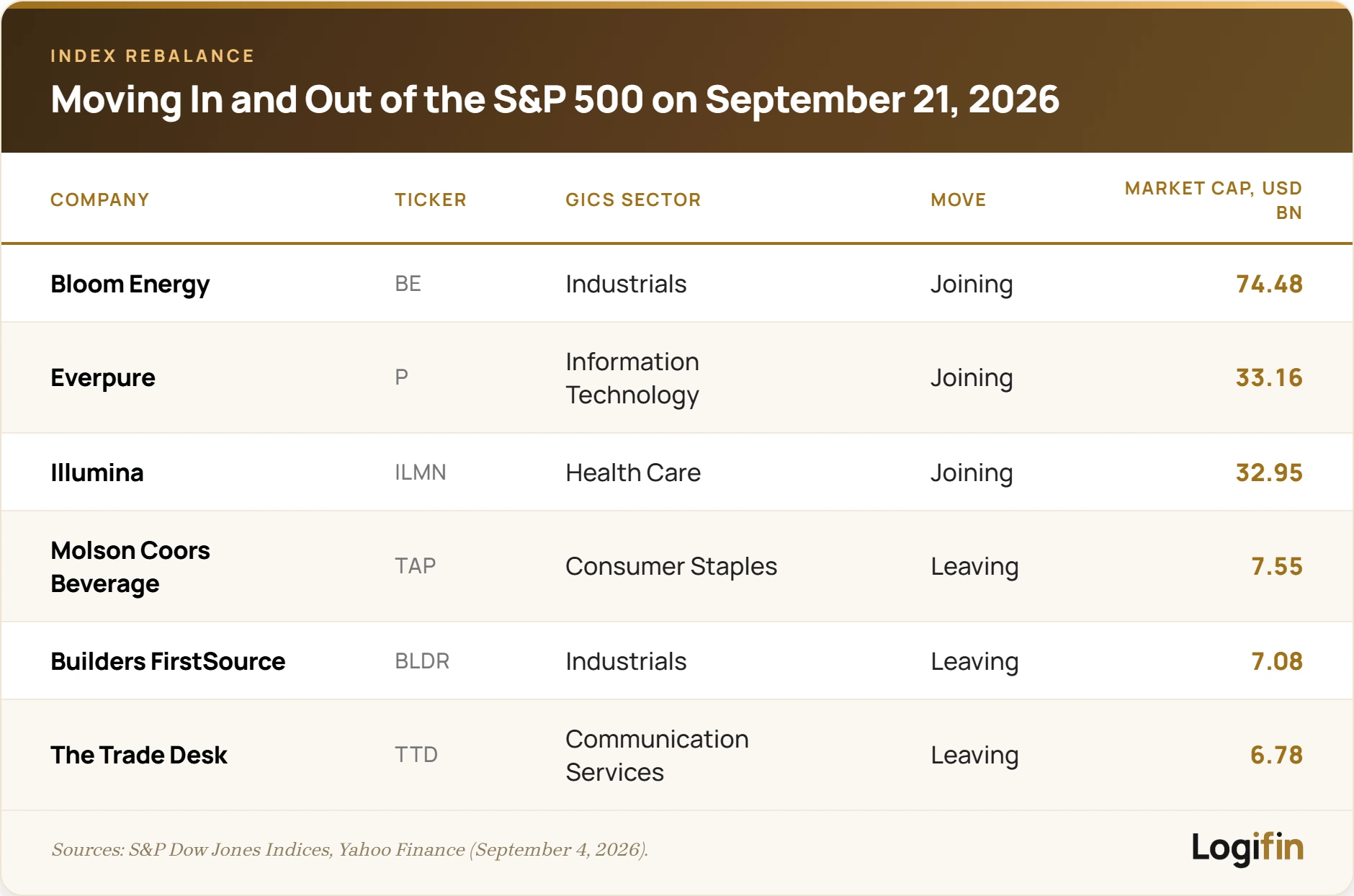
The figures show it plainly. The three joining are worth about 140 billion dollars together, the three leaving about 21. Bloom Energy alone is worth more than three times all three departures combined. Illumina and Everpure do not appear from nowhere, they move up from the S&P MidCap 400, while the three that leave drop into the S&P SmallCap 600, the small company index.
The S&P 500 is therefore not a list of the best American companies. It is a list of the largest, and what separates it from the other big indices starts with the rule used to compile it.
Why an index buys high and sells low
To enter a large company index a business must have already grown. To leave it, the business must have already shrunk. The rule is obliged to look backwards, because only the past can be measured.
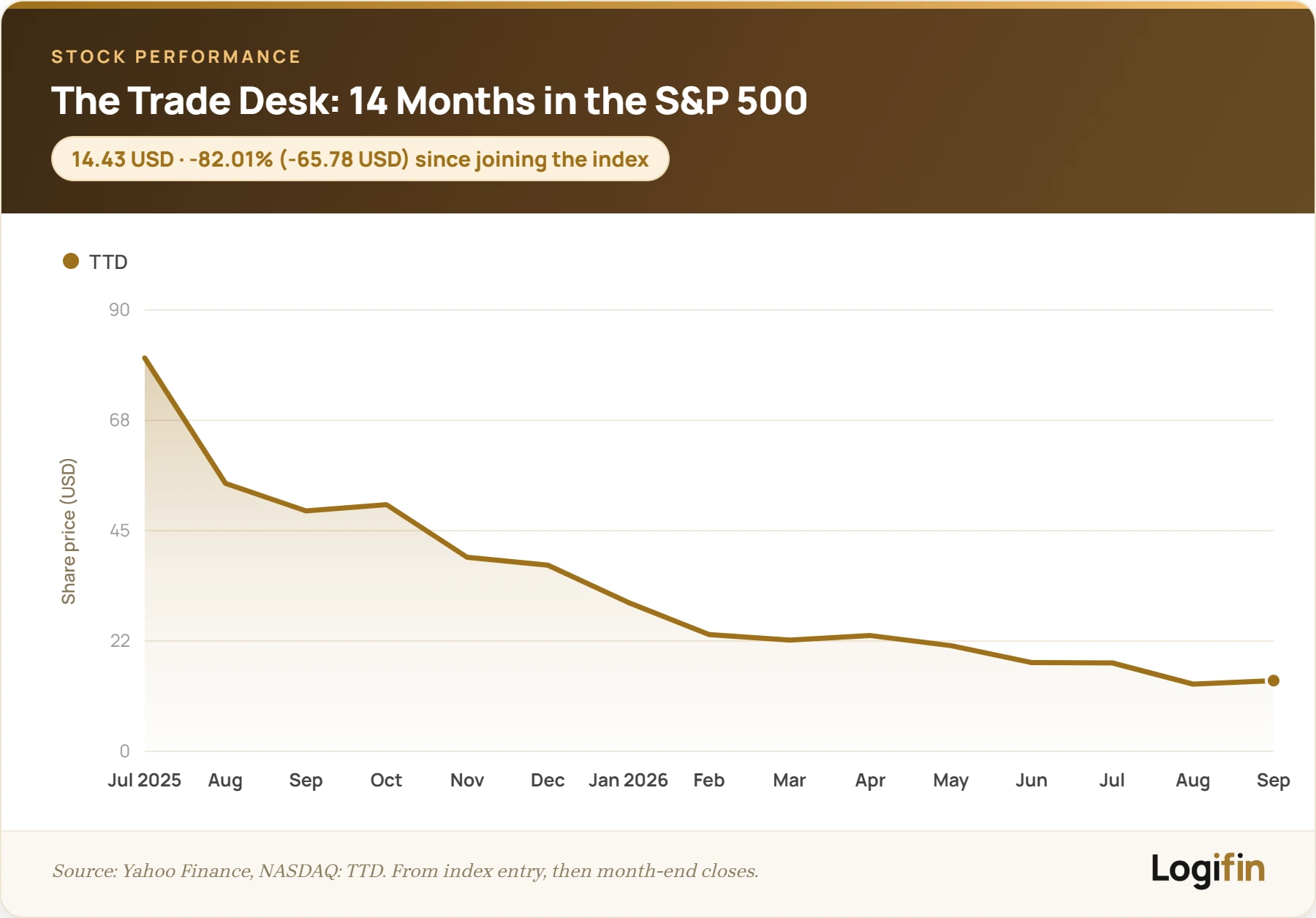
The result looks like a paradox and is not one. A fund that copies the index bought this share at around 80 and will sell it at around 14, without taking a single decision along the way. This is not a failure by the manager. It is the product itself: whoever buys an index buys its rule.
The same effect appears in the other direction. On July 14, 2025, the day of the announcement, the shares closed at 75.43 dollars. In the next session they closed at 80.40, which is 6.6% higher before the company had even entered the index. Nothing had been announced about the business. What had been announced was that within days a large number of funds would be obliged to buy.
Where this lands inside an ETF
In Europe, exposure to the S&P 500 rarely means holding these shares one by one. They usually sit inside a UCITS ETF on the S&P 500. Three things are true at the same time.
- The change happens on its own. On September 21, before the market opens, the fund will have sold the three and bought the other three. No action is required from the investor and there is no button that stops it.
- Their weight is small. All six sit at the bottom edge of a five hundred company index weighted by market capitalisation. The largest positions drive the return, not swaps at the margin.
- The cost is not zero. When thousands of funds have to make the same trade at the same moment, the price they achieve is worse than the price they saw beforehand. That gap is handled by market makers, and part of it stays with the fund as friction.
The practical conclusion is not about one share. It is about what an index actually contains: a size rule applied mechanically, four times a year, without asking anybody. To see which rule a particular fund follows, the Logifin ETF Hub shows what each ETF tracks.
What to take away
- Joining or leaving an index is not a verdict on value. S&P says so itself: the changes concern the market capitalisation range and nothing else.
- The rule looks backwards. A company enters after it has grown and leaves after it has shrunk, so buying high and selling low is a feature of the design rather than a mistake.
- Inside an index fund the change happens by itself and weighs little. What matters is not which three names leave, but that the fund will always do what the rule says.
EXPLORE LOGIFIN
Everything you need in order to learn, plan and track your investments.
Logifin Blog
Learn everything you need to get your finances in order and invest with confidence.
Logifin Insights
What moves the markets and what it means for a long term investor. Short and without the noise.
Logifin Tools
Free, inside the site, no signup. Everything you calculate stays on your device.
Logifin ETF Hub
Find the ETF that fits you: 550+ UCITS ETFs, smart filters and in-depth comparisons.
Logifin Guides
A series of guides that builds your investment plan step by step. The first guide is free for everyone.
Logifin Circle
The tools and the Hub are free for everyone. You become a member for the intelligence that never stops.