Logifin Insights
The economy lost 23,000 jobs and unemployment fell. How?
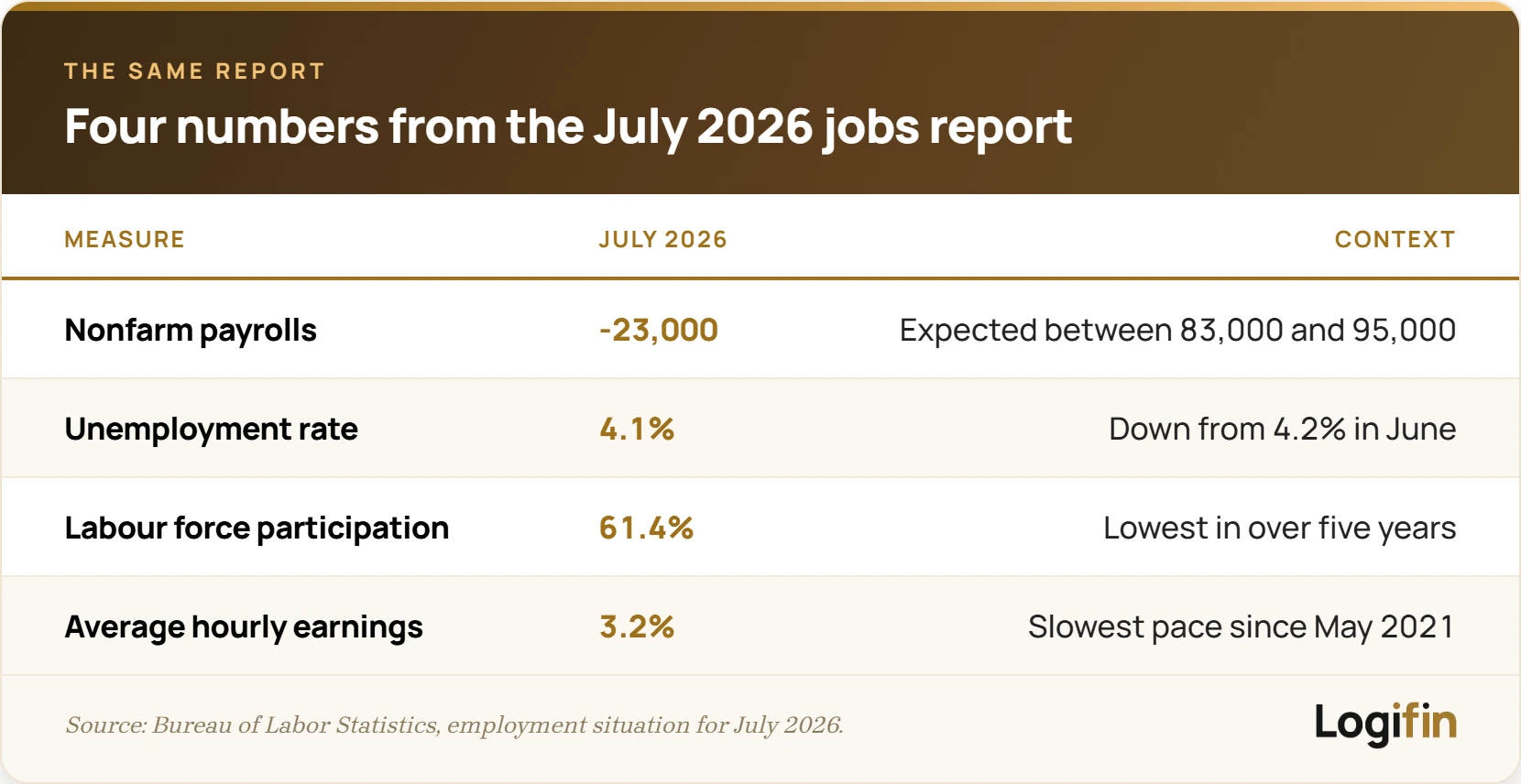
The US economy shed 23,000 jobs in July and the unemployment rate dropped to 4.1%. That is not an error in the data, it is how unemployment is measured.
8 August 2026 · 3 min read

The employment report of 7 August showed two numbers that appear to disagree. The US economy lost 23,000 jobs in July. At the same time, the unemployment rate fell from 4.2% to 4.1%.
There is no error in the data. There is a misunderstanding about what the unemployment rate measures.
Two surveys, two different things
Jobs are counted by asking businesses how many salaries they paid. Unemployment is measured by asking households whether they work and, if not, whether they are actively looking. They are two separate surveys, with different samples and different questions, that happen to be published on the same morning.
The unemployment rate is a fraction. The numerator holds those looking and not finding. The denominator holds the labour force, meaning those working plus those looking. Anyone who stops looking leaves both. The fraction shrinks and the rate falls without a single person finding work.
That is exactly what the third number in the report shows, the one that rarely makes a headline. The labour force participation rate fell to 61.4%, a level not seen in over five years. Unemployment did not fall because more people found work. It fell because fewer people are looking.
Where jobs were lost and where they were created
Private payrolls added 30,000. Government lost 53,000, with the largest loss in local government education at 50,000 positions. Retail trade lost 19,000.
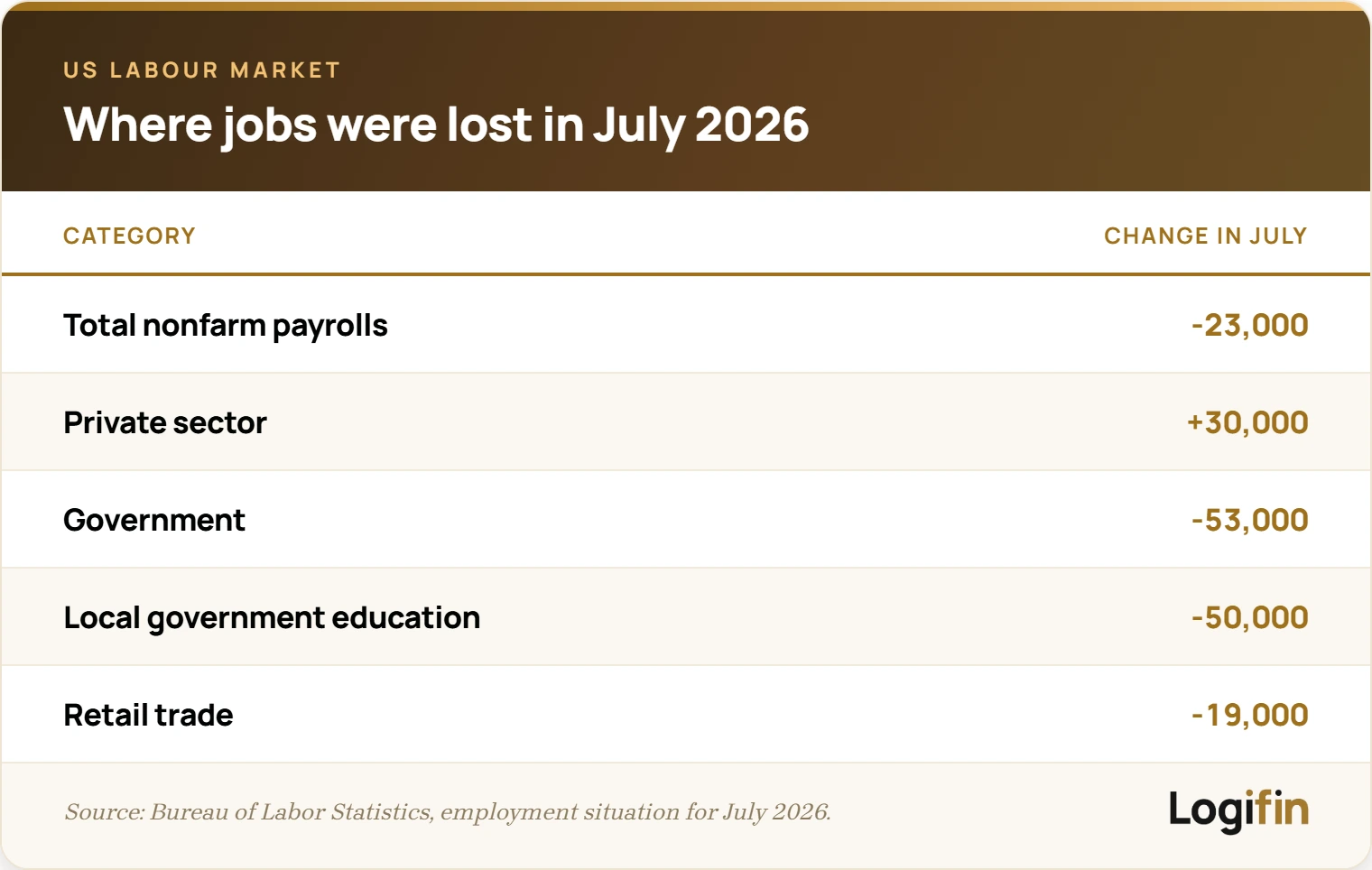
Composition changes the interpretation. A decline driven by public sector cuts does not say the same thing as a decline driven by factory layoffs. The first is a budget decision, the second is a message about demand.
Economists had expected between 83,000 and 95,000 new jobs, so the miss was large. The average of the preceding twelve months was 34,000 a month, which was already low for this economy. Wages rose 3.2% over the year, the slowest pace since May 2021.
Why markets did not read it the usual way
In a normal year a weak jobs report reads as a reason for easier monetary policy, which is to say good news for shares. Not this year, because inflation remains above target and three Fed officials wanted a rate increase just nine days earlier.
When the labour market cools and prices do not fall, the two mandates of the central bank pull in opposite directions. One monthly release does not settle that. How economic indicators affect the stock market explains why identical news changes meaning depending on what the market fears at the time.
How to read a jobs report properly
Three practical rules help:
- Participation next to unemployment. Read alone, one number hides the other.
- Composition, not just the total. Private and public payrolls say entirely different things.
- Never a single month. The data gets revised, and the revision is often larger than the original change.
One month is not a trend, and a weak labour market does not by itself mean a recession. It means one of many thermometers came back lower.
What to take away
- Unemployment can fall because fewer people are looking. Always read it alongside the participation rate.
- Payrolls and unemployment come from different surveys. They are not contradictory, they measure different things.
- The slowest wage growth since 2021 counts twice, because when pay runs behind inflation purchasing power falls.
EXPLORE LOGIFIN
Everything you need in order to learn, plan and track your investments.
Logifin Blog
Learn everything you need to get your finances in order and invest with confidence.
Logifin Insights
What moves the markets and what it means for a long term investor. Short and without the noise.
Logifin Tools
Free, inside the site, no signup. Everything you calculate stays on your device.
Logifin ETF Hub
Find the ETF that fits you: 550+ UCITS ETFs, smart filters and in-depth comparisons.
Logifin Guides
A series of guides that builds your investment plan step by step. The first guide is free for everyone.
Logifin Circle
The tools and the Hub are free for everyone. You become a member for the intelligence that never stops.